

These delays become costly when the follow-up is inconsistent. Some accounts receive repeated reminders, others remain untouched, and valid disputes surface only after balances have aged. According to PYMNTS’ 2026 Money Mobility Tracker, SMB owners estimate average annual losses of $39,406 from delayed payments.
A structured payment collection process gives each account a clear path from billing to resolution. It defines when to send pre-due reminders, how first-party dunning should progress, and when unresolved balances should move to third-party collections or charge-off review.
This blog explains the six-step lifecycle, along with the compliance controls and performance metrics needed to manage it.
How does the payment collection process work?
The payment collection process covers the full invoice-to-cash lifecycle, from invoicing and predelinquency reminders through dunning, disputes, payment plans, escalation, and write-off decisions. Its purpose is to give every unpaid balance a clear status, owner, and next action.
First-party collections are handled by the business or a branded partner and can include pre-due reminders and overdue dunning. First-party therefore describes who communicates with the customer, not a stage that follows dunning.
On the other hand, third-party collections occur after placement with an outside agency operating under its own name. Debt collection focuses specifically on recovering balances that are already due.
The payment collection process at a glance
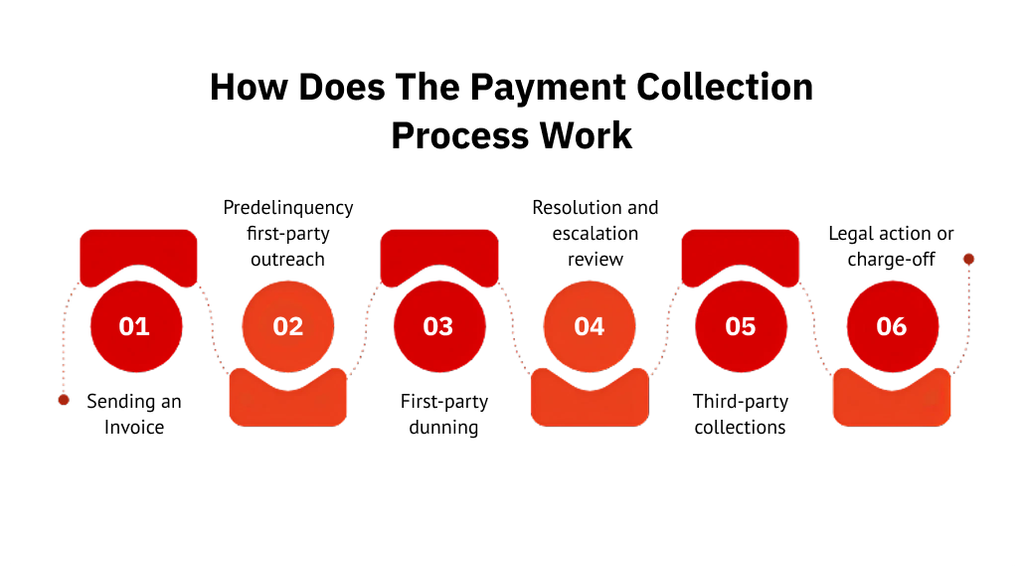
Each stage has a different purpose.
- Invoice: Send an accurate invoice with clear terms and accessible payment options.
- Predelinquency first-party outreach: Confirm receipt and address payment barriers before the due date.
- First-party dunning: Follow a structured reminder and resolution process after the account becomes overdue.
- Resolution and escalation review: Decide whether to continue first-party outreach or prepare the account for placement.
- Third-party collections: Place qualifying accounts with an agency operating under its own name.
- Legal action or charge-off: Determine whether continued recovery is practical.
| Account status | Recommended action | Primary goal |
| Before the due date | Initiate proactive customer outreach | Confirm receipt and prevent avoidable delays |
| 1 to 7 days past due | Start first-party dunning | Prompt payment or identify an issue |
| 8 to 30 days past due | Continue structured first-party follow-up | Resolve disputes or payment barriers |
| 31 to 60 days past due | Intensify first-party recovery | Secure payment or an approved arrangement |
| 61 to 90 days past due | Review account risk and engagement | Determine the appropriate recovery path |
| At the placement threshold | Consider third-party collections | Recover balances first-party efforts have not resolved |
| After external recovery efforts | Review legal or charge-off options | Choose the most practical final action |
These windows are planning guides, not automatic cutoffs. Account value, engagement, disputes, and placement policies should also influence the next action.
The payment collection process, step by step
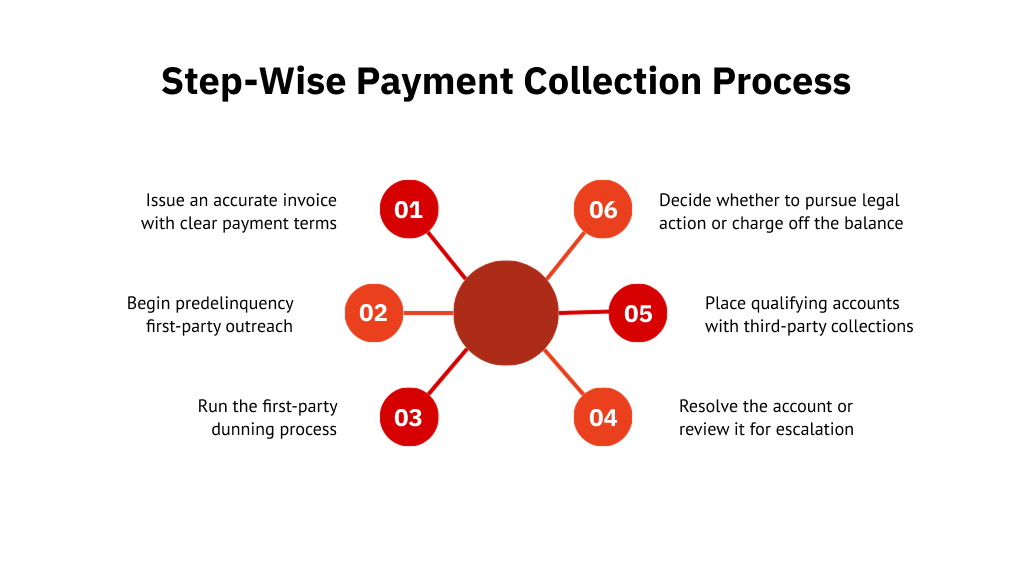
Each stage of payment collection has an objective. Early steps remove billing friction and prevent avoidable delays, while later steps focus on resolution, external placement, and the cost of continued recovery.
Step 1: Issue an accurate invoice with clear payment terms
An accurate invoice removes preventable reasons for delay. Every invoice should:
- Identify the customer and invoice clearly.
- State the issue date, due date, and payment terms.
- Itemize the charges so the customer can verify the balance.
- List accepted payment methods and provide a direct payment link.
- Explain any applicable late-fee terms.
- Provide a contact for billing questions or corrections.
Before sending the invoice, confirm that the customer can verify the amount, understand the terms, report an error, and pay without unnecessary steps. A confusing invoice or difficult payment experience can create collection problems before the balance is overdue.
Step 2: Begin predelinquency first-party outreach
Predelinquency first-party outreach occurs before the due date. The business or a partner communicating under its brand confirms that the invoice was received and identifies issues that could delay payment.
A reminder should restate the invoice number, balance, due date, payment options, and contact path. It also allows the customer to report an incorrect charge, missing purchase order, approval delay, or payment-method problem.
The channel should reflect customer consent, preference, and account value. Digital collections can give customers ways to review the balance, pay, ask questions, chat, or request a callback. Larger balances and accounts with previous delays may require agent outreach before the due date. If payment does not arrive, the same first-party process can move into a structured dunning sequence.
Step 3: Run the first-party dunning process
Dunning is generally part of first-party collections. It uses scheduled reminders and follow-up actions after an invoice becomes overdue, with the tone becoming firmer as the account ages.
| Timing | Message focus | Tone |
| Day 1 past due | Notify the customer that the invoice appears overdue | Polite and helpful |
| Day 7 | Request payment or a response | Clear and direct |
| Day 15 | Ask the customer to resolve the balance or explain the delay | Firmer, with support options |
| Day 30 | State that the account requires immediate attention | Urgent but professional |
| Day 45 | Warn that the account may enter escalation review | Formal and direct |
| Day 60 | Send a final first-party notice before possible placement | Documented and firm |
The exact schedule should reflect the payment terms, customer relationship, account value, and placement policy. High-risk accounts may require earlier agent outreach, while customers resolving valid disputes may remain in first-party collections longer.
First-party collections can combine automated reminders with calls, email, SMS, payment links, approved plans, and agent follow-up under the business’s brand. Any late fees must follow the contract or payment terms.
The dunning process also needs a dispute path. When a customer challenges an invoice, document the issue, route it for review, and adjust outreach based on the dispute status. As the sequence progresses, review each account individually because the schedule alone should not determine placement.
Step 4: Resolve the account or review it for escalation
At the review point, assign each account one of five outcomes:
- The customer pays the balance in full.
- The customer enters an approved payment arrangement.
- The account moves into dispute investigation and resolution.
- The account remains in first-party follow-up.
- The account is placed with a third-party collection agency.
This review is a decision point, not an automatic escalation. Consider the account’s age and balance, payment history, customer value, dispute status, engagement, broken commitments, and recovery probability. Engaged customers with active disputes or payment plans may remain first-party. Continued non-response, broken commitments, or an aging balance may support external placement.
Before placement, verify the balance, resolve or document any dispute, and confirm that the account file is complete. A clear placement decision reduces conflicting outreach and gives the outside agency a reliable record to work from.
Step 5: Place qualifying accounts with third-party collections
After placement, an outside agency contacts the customer under its own name. A complete file preserves earlier work and should include:
- Customer details
- Invoices
- Contracts
- Payment history
- Outreach records
- Disputes
- Payment commitments
- Fees
- Account notes
Complete records allow third-party collections to continue recovery without rebuilding the account history.
Continue monitoring recoveries, payment arrangements, disputes, complaints, and account status after placement. This visibility helps the business evaluate agency performance and determine the next action for unresolved accounts.
Step 6: Decide whether to pursue legal action or charge off the balance
For accounts that remain unresolved, the organization may continue collection activity, consider legal action, or charge off the balance according to its policies.
Review the following factors:
- Compare the outstanding balance with the expected recovery.
- Confirm that the supporting documentation is complete.
- Evaluate the customer’s location and collectability.
- Review previous recovery efforts and any dispute history.
- Estimate the legal and administrative costs of continuing.
- Check the applicable compliance, contractual, and accounting requirements.
Legal action may be practical when the expected recovery justifies the cost and the supporting records are complete. A charge-off or write-off is an accounting decision and does not automatically determine whether recovery must stop. Follow applicable policies, contracts, laws, and qualified legal or tax guidance.
First-party vs third-party collections: when to escalate
Escalation is the point at which customer-facing recovery moves from the business or its branded partner to an outside agency. It is generally appropriate when the defined first-party treatment has been completed, and another internal cycle is unlikely to justify the added time and cost.
A placement matrix can make this decision consistent by combining treatment status, approved exceptions, recovery economics, and handoff readiness.
| Escalation test | Continue first-party collections when | Consider third-party placement when |
| Treatment status | Scheduled contacts or response windows are still open. | The approved first-party cycle is complete. |
| Placement policy | The account has not met the segment-specific placement rules. | The account satisfies the documented criteria for its portfolio segment. |
| Recovery economics | Additional internal effort has a reasonable expected return. | The likely benefit of another cycle is too low to warrant the delay or cost. |
| Exception status | The account requires further review under relationship, contractual, or portfolio rules. | No approved hold or extension remains. |
| Operating readiness | Agency authority, approval limits, or reporting workflows are still undefined. | Communication, approval, reporting, and exception procedures are established. |
Document these criteria by portfolio or account segment and specify who can authorize placement or approve an exception. This prevents teams from extending first-party treatment inconsistently and gives the agency a clear mandate once the account is transferred.
| Pro tip: Review placement performance by segment before changing escalation thresholds. Compare net recovery, time to payment, disputes, complaints, and first-party effort to determine whether earlier or later placement improves results for that account group. |
Staying compliant with the FDCPA, Regulation F, and TCPA
Requirements vary by debt type, collector, communication channel, and state. Review the applicable debt collection compliance and regulations before setting outreach rules.
- Fair Debt Collection Practices Act (FDCPA) and Regulation F: These federal rules apply to FDCPA-covered debt collectors collecting consumer debts. Their requirements address validation information, communications, call frequency, and digital opt-outs.
- Telephone Consumer Protection Act (TCPA): This law governs certain automated or prerecorded calls and texts based on the technology used, number called, and recipient consent.
- State collection laws: State requirements may regulate first-party and third-party activity through licensing, disclosures, contact hours, fees, and communication rules.
- Industry and contractual rules: Sector-specific requirements and agreed payment terms may determine late fees and permitted account actions.
Maintain scripts, consent records, opt-outs, communication histories, dispute statuses, and account documents throughout the process.
How to measure and improve your collection process
Measure more than total dollars collected. Track the following indicators:
- Days Sales Outstanding: This metric measures how long collection takes after a sale.
- Collection Effectiveness Index: This metric shows how much of the available receivables the business collects.
- AR aging: This report displays balances across current, 30-, 60-, 90-, and 120-plus-day buckets.
- Percentage over 90 days: This metric shows how much of the portfolio has entered higher-risk territory.
- Promise-to-pay completion: This metric measures how often customers keep payment commitments.
- Dispute resolution time: This metric measures how quickly invoice issues are cleared.
- Recovery by channel: This metric identifies channels producing payments, responses, or disputes.
Use these metrics to identify process failures. Repeated disputes may indicate unclear billing, abandoned payment links can reveal portal friction, and growth in older aging buckets may signal that escalation occurs too late. Review results by account stage, customer segment, and channel before changing the outreach strategy.
When should you outsource the payment collection process?
Outsource where internal coverage is breaking down. A partner may manage predelinquency communication and dunning under the business’s brand or handle accounts placed for external recovery.
The risk extends beyond delayed cash. Creditsafe’s 2025 report found that nearly one-third of businesses lost between 5% and 30% of annual revenue to bad debt.
Consider outsourcing when:
- Teams cannot maintain a consistent outreach cadence.
- DSO and overdue receivables continue to rise.
- Accounts repeatedly cross placement thresholds.
- Customers ignore existing contact methods.
- Disputes, payment plans, and handoffs are difficult to track.
- Compliance and reporting needs exceed internal capacity.
The right model should address the specific operational gap. FCS can align first-party support, third-party recovery, or a staged combination with the portfolio’s account mix and internal capacity. This approach adds coverage where the process is under strain while keeping escalation and handoffs clearly defined.
Turn earlier action into stronger recovery
A strong payment collection process combines accurate invoicing, timely first-party outreach, clear resolution paths, and defined placement criteria. It gives customers an accessible path to payment while helping internal teams act before balances move into harder recovery stages. When each account has a status, owner, and next action, fewer balances remain unattended as they age.
If internal capacity is limiting recovery, contact FCS to build a more consistent payment collection process.
FAQs
1. Can different customers follow different collection timelines?
Yes. Businesses can segment timelines by payment terms, balance size, customer history, dispute status, and risk. Document the criteria and apply them consistently to comparable accounts.
2. Can an account go to collections before it is charged off?
Yes. Third-party placement and charge-off are separate decisions. A business may place an account before or after charge-off based on its policies, contracts, account status, and applicable requirements.
3. How should partial payments affect the collection process?
Apply the payment promptly, confirm the remaining balance, and reassess the account’s next step. An active arrangement may pause escalation, while an unexplained partial payment may still require follow-up.
4. What happens if a customer disputes an account after third-party placement?
Document the dispute and share it with the business for review. Both parties should update the account status, preserve supporting records, and coordinate further communication under the applicable dispute process.
5. How often should a payment collection process be reviewed?
Review it periodically and whenever payment terms, channels, regulations, or portfolio behavior change. Rising DSO, slower dispute resolution, and growth in older aging buckets can also trigger a review.