


Patient payment collections now affect a larger share of the revenue cycle as patients take on a larger share of healthcare costs. The process covers recovering copays, deductibles, coinsurance, and self-pay balances that patients owe out of pocket.
Patient responsibility remains substantial. The average single-coverage deductible reached $1,886 in 2025 for covered workers with a deductible. That figure was 17% higher than five years earlier, according to the 2025 Employer Health Benefits Survey.
Those balances create a different collection challenge than contracted payer receivables. Patients may receive bills they did not expect or fully understand. That can delay payment, increase billing contacts, and add avoidable work across already stretched revenue cycle teams at scale.
For revenue cycle leaders, the goal is to recover patient-responsibility balances efficiently while protecting the patient financial experience. This guide explains how to strengthen that process, evaluate the right operating model, and decide when internal resources need additional support.
Why patient payment collections got harder, and why it matters now
Patient payment collections become harder as patient responsibility, billing confusion, and staff constraints converge. That combination can delay payment and increase repeated follow-up.
- Rising patient responsibility: Higher deductibles can leave patients responsible for larger portions of covered care. Revenue cycle teams therefore manage more balances that depend on individual payment behavior.
- Billing confusion: Patients may delay payment when they cannot tell what insurance paid, why a balance remains, or what payment options are available. That uncertainty can extend resolution time and generate additional billing contacts.
- Staffing strain: Patient balance follow-up is repetitive and volume-sensitive. When staffing falls behind demand, older accounts may receive less consistent attention.
| Pro Tip: You cannot solve a confusion problem with more notices alone. Make the balance, insurance adjustment, due amount, and payment options easy to understand. |
How to collect patient payments in 6 steps
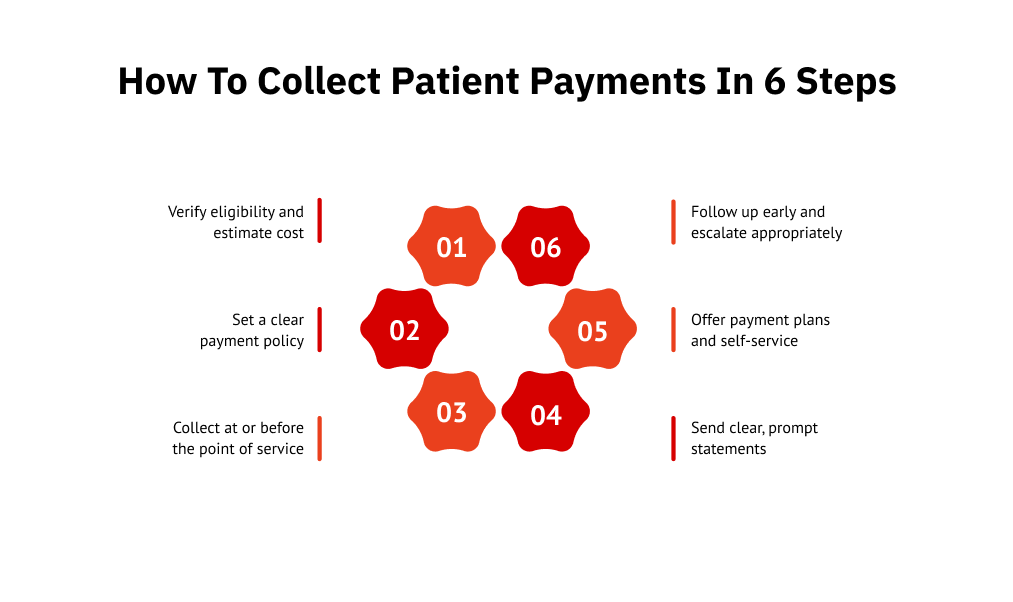
Effective patient payment collection strategies act early, reduce billing ambiguity, and give patients practical ways to pay. These six steps create a repeatable workflow.
Step 1: Verify eligibility and estimate cost before the visit
Verify active coverage before the appointment and identify known patient-responsibility amounts. Provide a clear estimate when reliable information is available.
For uninsured or self-pay patients, providers should also account for applicable Good Faith Estimate requirements when scheduling qualifying services. Building that check into the pre-visit workflow helps align cost communication, billing expectations, and downstream patient payment recovery.
Step 2: Set and communicate a clear payment policy
Put payment expectations in writing. Explain when payment is due, which methods are accepted, and when payment plans or financial assistance may apply.
Use the same policy across registration, digital communications, and staff conversations. Consistency reduces conflicting messages and gives front-desk teams a clear process to follow.
Step 3: Collect at or before the point of service
Collect known patient responsibility before or at the point of service when appropriate. Pre-visit payment links, card-on-file options, and clear check-in requests can reduce downstream follow-up.
Staff should use direct, respectful language. They should also distinguish confirmed amounts from estimates that may change after claim adjudication.
Step 4: Send clear, prompt digital statements
When a balance remains, send a statement soon after the amount is established. Use plain language that shows charges, insurance activity, patient responsibility, and available payment options.
Digital delivery can shorten the path from statement to action. Embedded payment links also remove steps between reviewing a balance and paying it.
Step 5: Offer flexible payment plans and self-service
Larger or harder-to-resolve balances may require more than a single payment request. Offer eligible payment plans, self-service options, and clear ways to request help.
A 24/7 portal can let patients review balances and make payments outside office hours. That reduces dependence on live staff for routine transactions.
Step 6: Follow up early and escalate appropriately
Use a defined follow-up cadence so patient balances do not age because outreach stopped. Sequence digital and phone contact according to account status, patient preference, and applicable rules.
Escalation should reflect the provider’s policies, account stage, and legal requirements. If an account moves from first-party recovery to third-party collections, the operating model and patient-facing experience also change.
Segment balances: not every patient collection is the same
Patient balances should be segmented by factors that affect the most appropriate recovery path. Useful inputs include balance size, account age, prior engagement, financial assistance status, and need for human support.
A simple framework can help teams assign effort without imposing arbitrary balance thresholds:
| Segment | Typical characteristics | Primary approach |
| Routine | Lower complexity, clear balance, no hardship signal | Digital reminders and self-service payment |
| Assisted | Larger or less responsive balance, plan may help | Digital outreach plus payment-plan options |
| High-touch | Hardship, dispute, complex balance, or repeated nonresponse | Trained representative and individualized review |
Financial assistance and charity-care screening should occur before inappropriate escalation. That protects eligible patients from entering a recovery workflow that does not fit their circumstances.
Segmentation also improves the patient financial experience because it matches the level of contact to the account’s actual needs.
Building a patient-centered collection process
Build a patient-centered collection process around clear communication, practical payment options, timely outreach, and trained support for complex situations. How a healthcare organization communicates about a balance can shape the patient’s entire billing experience. Unclear or inconsistent messaging can create frustration even when the underlying balance is accurate.
Tone, timing, and channel choice all matter. Prompt outreach with a clear balance and direct payment path feels different from delayed messages that lack context.
Empathy at scale comes from process design. Use understandable statements, practical payment options, accessible self-service, and trained staff for hardship or dispute conversations.
Those controls support revenue recovery and establish standards for compliant communication.
| Pro Tip: Treat clarity as part of recovery operations. A patient who understands the balance can make a decision faster than one who must first decode the bill. |
Compliance requirements for patient payment collections
Compliance requirements depend on the organization, account stage, communication activity, and parties involved. Healthcare providers should design patient payment recovery around privacy, payment security, and applicable collection rules.
Health Insurance Portability and Accountability Act (HIPAA) and Protected Health Information (PHI)
A vendor that handles protected health information for a covered entity may qualify as a business associate. In that case, HIPAA generally requires a written Business Associate Agreement and appropriate safeguards.
The U.S. Department of Health and Human Services explains that covered entities must establish written arrangements with business associates handling protected health information. The agreement should define permitted uses, disclosures, and safeguards.
For payment data, evaluate Payment Card Industry Data Security Standard (PCI DSS) controls. System and Organization Controls (SOC) 2 Type II reporting can also inform security reviews.
Fair Debt Collection Practices Act (FDCPA) and Regulation F for patient outreach
The Fair Debt Collection Practices Act applies to covered debt collectors under federal law. Regulation F implements that statute and does not apply universally to provider-side billing.
For covered debt collection activity, Regulation F addresses communications, prohibited practices, validation information, disputes, and other requirements. The Consumer Financial Protection Bureau’s Regulation F resource provides the current rule and official interpretations.
Healthcare organizations should map which rules apply to each account stage and operating model. State requirements may add further obligations.
Medical debt credit reporting: what providers should monitor in 2026
Healthcare organizations should treat medical debt credit reporting as a policy and compliance issue that requires ongoing review. Federal and state requirements can change reporting practices.
The Consumer Financial Protection Bureau finalized a medical-debt reporting rule in January 2025. However, that policy did not remain in effect. A federal court vacated the rule on July 11, 2025, and the CFPB’s current Regulation V guidance reflects that change.
Separate voluntary credit-bureau policies still affect medical collection reporting. According to TransUnion’s current medical debt guidance, paid medical collections and medical collections initially under $500 do not appear on credit reports. Unpaid medical collections generally wait one year from the original delinquency date before appearing.
Because state laws may impose additional restrictions, healthcare organizations should keep credit-reporting policies current and obtain legal guidance where needed.
Technology that moves the needle
Technology improves patient payment recovery when it removes manual work, shortens payment paths, and supports consistent execution across channels.
- Digital access: Pre-visit estimates, digital registration, online statements, and payment links can bring payment opportunities closer to the point where patients review their responsibility.
- Workflow automation: Automated statement delivery and reminder sequencing can keep routine balances moving without requiring staff to initiate every contact.
- Self-service: Portals can let patients review balances and make payments on their schedule. Payment-plan access can also reduce avoidable calls when plans are available.
- Data and routing: Effective programs need reliable data movement, clear account status, and defined routing for questions, disputes, hardship, or live-agent support.
Technology should support the operating model. Buyers should assess data exchange, outreach coordination, and exception routing.
The KPIs that tell you it’s working
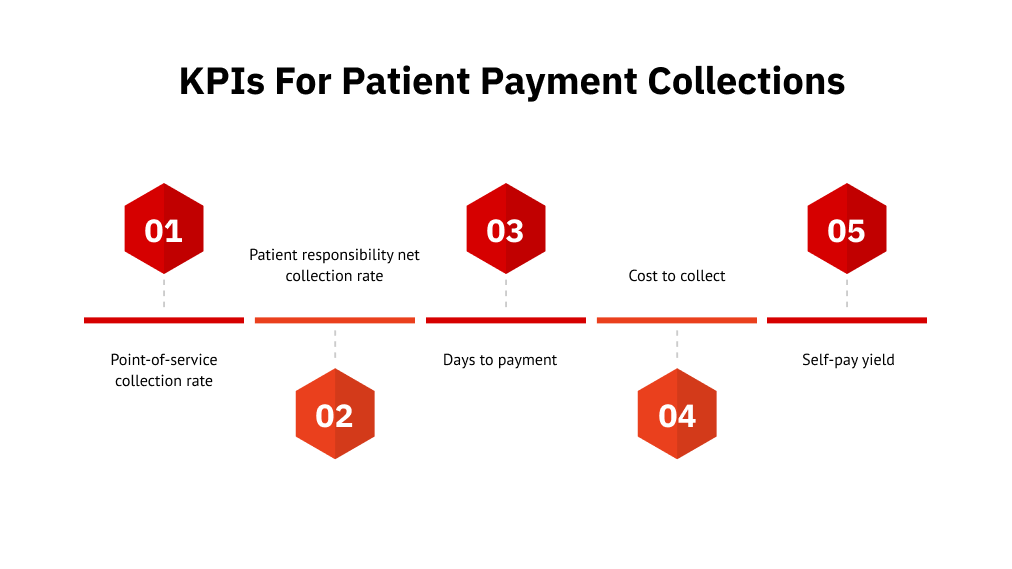
A small set of metrics can show whether patient payment collections are improving. The most useful targets come from your own baseline, payer mix, specialty, balance distribution, and operating model.
| Metric | What it measures | What to monitor |
| Point-of-service collection rate | Known patient responsibility collected at check-in or check-out | Whether capture improves over time |
| Patient responsibility net collection rate | Patient dollars collected compared with collectible patient responsibility | Trend by specialty, location, and balance segment |
| Days to payment | Time from established balance or statement to payment | Whether balances resolve faster |
| Cost to collect | Operating cost relative to patient dollars recovered | Whether automation lowers avoidable manual effort |
| Self-pay yield | Share of collectible self-pay dollars recovered before write-off | Whether earlier intervention improves recovery |
Use a consistent reporting period and segment data to identify performance differences. Then focus on the metric with the clearest operational cause.
| Pro Tip: Track point-of-service collection separately from downstream recovery. That distinction shows whether improvement comes from earlier capture or stronger follow-up. |
Common patient collections mistakes to avoid
The most common patient collection mistakes happen when providers delay cost conversations, make balances hard to understand, limit payment options, or follow up inconsistently. These gaps increase avoidable friction and make patient balances harder to resolve. Watch for these five breakdowns across the patient payment workflow:
- Waiting too long to discuss cost: Share reliable estimates and known responsibility early enough for patients to prepare and ask questions.
- Using unclear statements: Show what was charged, what insurance addressed, what remains, and which payment options are available.
- Offering limited payment access: Give patients reasonable ways to pay across digital and assisted channels.
- Failing to surface payment or assistance options: Make eligible plans and financial assistance visible before accounts require higher-touch follow-up.
- Using inconsistent follow-up: Establish a documented cadence with clear ownership, escalation rules, and compliance review.
Fixing these gaps creates a more predictable process without adding unnecessary contact. It also helps teams distinguish workflow problems from genuine capacity constraints.
In-house vs. early-out partner: when to get help
An early-out partner makes sense when patient balances are aging faster than your in-house team can work them consistently. Volume growth, staffing gaps, limited outreach capacity, or weak follow-up coverage can signal that internal resources have reached their practical limit.
When in-house is enough
An internal team may be sufficient when volume is manageable and staffing is stable. Technology should also support reliable outreach and payment access.
Consistency matters more than a universal benchmark. If balances receive timely follow-up and aging remains controlled, internal operations may cover the need.
When an early-out partner makes sense
An early-out partner can help when patient balances grow faster than internal teams can work them. Staffing gaps, inconsistent follow-up, and limited channel coverage can also justify external support.
An Extended Business Office (EBO) partner can support pre-write-off recovery within an agreed provider-branded model.
| Factor | In-house | Early-out / EBO partner |
| Capacity | Limited by internal staffing and operating hours | Adds managed capacity for defined account segments |
| Technology | Depends on internal systems and implementation resources | May add managed outreach and payment infrastructure |
| Governance | Direct internal control | Shared governance, reporting, and defined responsibilities |
| Patient experience | Provider controls every touchpoint | Can remain provider-branded in a first-party model |
| Implementation | Internal workflow changes and training | Requires onboarding, data exchange, workflow design, and training |
The decision should reflect service scope, patient experience, compliance, data requirements, and implementation effort.
How First Credit Services handles patient balance recovery
At First Credit Services, we support provider-branded, pre-write-off patient balance recovery through managed first-party collections and patient engagement programs. We operate as a revenue recovery and customer engagement partner.
We bring more than 30 years of collections and receivables-management experience to these programs.
We operate UCEP (Unified Consumer Engagement Platform) on the client’s behalf. It supports coordinated SMS, email, chat, phone engagement, and self-service payment experiences within our managed programs.
Our model best fits medium-to-large healthcare organizations that need managed recovery capacity, coordinated digital engagement, and provider-sensitive patient interactions.
Recover more patient payment collections without losing the relationship
Strong patient payment collections depend on a consistent process that makes balances clear, gives patients practical ways to pay, and keeps follow-up moving before accounts age further. For revenue cycle leaders, the key decision is whether internal teams can sustain that process as patient responsibility and workload grow.
When capacity becomes the constraint, the right support model should extend recovery efforts without weakening the patient financial experience or provider brand.
Ready to improve patient payment collections without adding more pressure to your internal team? Discuss your patient balance recovery needs with our team to evaluate whether managed early-out support fits your self-pay and patient-responsibility workload.
FAQs
1. What data should providers prepare for patient payment collections integration?
Providers should identify the account, balance, insurance, contact, payment, and status data needed to support the program. They should also confirm how data will move between systems, how often it updates, and who owns exception handling.
2. What reporting should patient payment collection services provide?
Reporting should show recovery activity, account status, aging, payment outcomes, outreach performance, and program-relevant exceptions. Providers should also confirm reporting frequency, available segmentation, and how unresolved issues are surfaced.
3. How are patient payment collection services typically priced?
Pricing depends on the service scope and operating model. Providers should compare what the fee covers, how digital and live-agent work are priced, and whether additional implementation or operational costs apply.
4. What happens when a patient disputes a balance during collections?
The account should follow the provider’s defined dispute and escalation process. Recovery activity may require review while billing records, insurance adjustments, or other supporting information are checked before further action.
5. How should providers decide when to move an account from first-party to third-party collections?
The handoff should follow defined account-stage, aging, and recovery policies rather than an arbitrary universal deadline. Providers should document when first-party efforts end and how the patient-facing experience changes after placement.
6. What should healthcare providers evaluate during patient payment collections onboarding?
Providers should evaluate data exchange, account eligibility, outreach rules, branding, payment options, reporting, exception handling, and staff responsibilities. The implementation plan should also define how changes are approved after the program launches.