

A collector reaches a number that hasn’t belonged to the account holder in two years. Nobody catches it before the call connects, and a routine contact turns into a complaint on file with the Consumer Financial Protection Bureau.
Debt collection risk management closes that gap: catching exposure in the data, the contact, or the payment before it becomes a complaint, a fine, or a lawsuit. As per the CFPB FDCPA Annual Report 2025, complaints about debt collection to the CFPB nearly doubled in a single year, climbing from roughly 109,900 in 2023 to approximately 207,800 in 2024. Nearly half involved a debt the consumer said wasn’t even theirs to owe.
This guide walks through the five risk categories hiding inside a collections program, a five-step framework to manage them, and how to measure whether your controls are actually working.
What is debt collection risk management?
Debt collection risk management is the structured practice of identifying, assessing, and controlling risk across the recovery lifecycle.
It covers five categories: regulatory, reputational, data security, operational, and financial, using documented policies, risk scoring, and monitoring to keep exposure low without slowing recovery.
The surge in CFPB complaints and tighter Regulation F enforcement have also raised the cost of compliance risk in collections. Strong debt collection compliance helps prevent a wrong-party call or missing validation notice from escalating into regulatory, financial, and reputational fallout.
The 5 categories of risk in debt collection
Collections risk management spans five interconnected categories: regulatory, financial, reputational, operational, and technological risk.
1. Regulatory and compliance risk
The most visible category draws lawsuits and fines. The Fair Debt Collection Practices Act (FDCPA) sets the baseline for collector conduct. Regulation F adds enforceable specifics, including a seven-call-in-seven-days frequency cap and a required validation notice before collecting.
Several other regulations expand the compliance surface:
- Telephone Consumer Protection Act (TCPA): governs consent for automated calls and texts.
- Fair Credit Reporting Act (FCRA) covers accurate credit reporting and dispute handling.
- Unfair, Deceptive, or Abusive Acts or Practices (UDAAP) adds another enforcement layer.
Each carries its own violation pathway, and together they touch nearly every collector action.
2. Reputational risk
Compliance risk rarely stays contained. Consumer complaints, negative reviews, and public enforcement actions damage credibility, and that damage flows to the creditor as much as the agency.
A single viral complaint can undo years of brand investment, an exposure especially acute in healthcare and financial services, where trust anchors the relationship.
3. Data security and privacy risk
Reputational risk leads directly into data security, since a breach creates both at once. Collections operations handle sensitive financial and personal data at high volume, and a breach here also triggers regulatory reporting requirements.
Payment Card Industry Data Security Standard (PCI DSS) compliance protects payment data, while System and Organization Controls 2 (SOC 2) Type II standards govern process integrity. Without both, a data incident becomes a compliance event and a reputational event at once.
4. Operational risk
Even with regulations mapped and data secured, process failures create their own exposure, usually driven by bad data: outdated addresses, wrong-party contacts, skip-trace errors, and duplicate records that waste effort and cause compliance violations.
An agent working from stale information may contact the wrong person, try to collect a discharged debt, or violate a cease-and-desist order. Human error is the most common root cause, compounding with every step downstream.
5. Financial and third-party risk
The final category ties back to the bottom line: unrecoverable debt, rising cost-to-collect, and vendor liability round out the taxonomy.
Creditors often assume outsourcing transfers the risk, yet the Office of the Comptroller of the Currency (OCC) makes clear that creditors retain responsibility for the agencies they hire, per OCC Bulletin 2023-17, and a violation exposes both parties.
| Pro tip: These five categories overlap. A single bad data record can trigger operational risk (wrong-party contact), compliance risk (FDCPA violation), and reputational risk (consumer complaint) simultaneously. Manage them as a connected system. |
A debt collection risk management framework (5 steps)
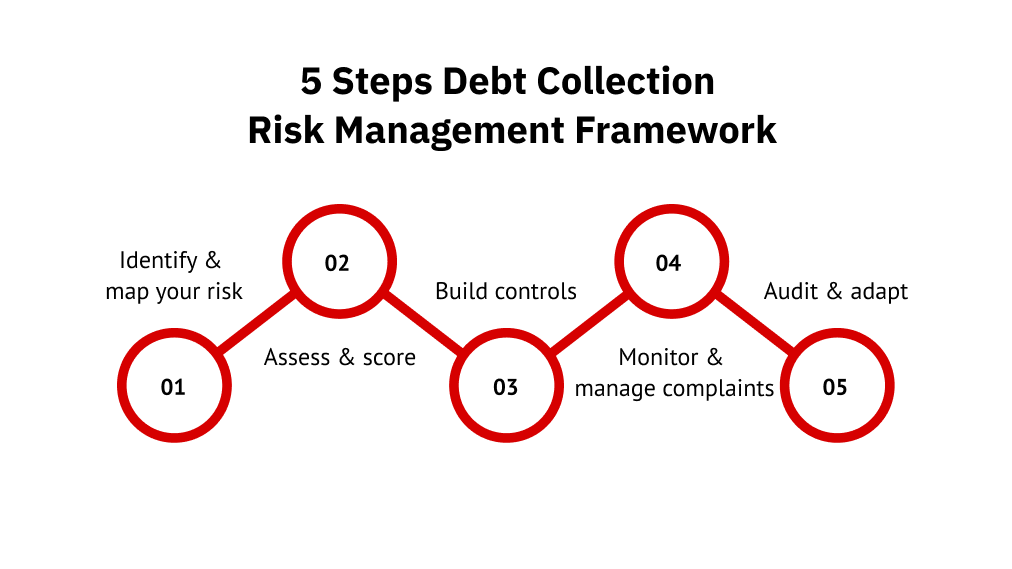
Understanding the risk categories is the starting point. Building a repeatable framework is what turns that awareness into actual protection. The following five steps create a loop that adapts as regulations, volumes, and consumer behavior change.
Step 1: Identify and map your risk
Walk through each stage of the recovery lifecycle: data intake, contact, payment, dispute, and closure. At each stage, ask where regulatory, reputational, data, operational, and financial risks could surface. The output is a risk map that shows exactly where your controls need to sit.
Step 2: Assess and score
Once you know where risk lives, rank it. Risk scoring at the account level matches effort to exposure. High-risk accounts, such as those with disputed balances or bankruptcy flags, need different handling than routine past-due balances.
Data scrub cadence, bankruptcy screening, and deceased-consumer checks all belong in this step. They prevent contacts that should never happen in the first place.
Step 3: Build controls
With risk scored, the next step is building policies that map each regulation to a specific control. As per Regulation F, the call cap requires automated frequency tracking. Per TCPA rules, consent must be documented before contact. Under PCI DSS, payment processing must be encrypted, and SOC 2 Type II controls govern how that data is accessed and logged.
Agent scripting, call monitoring, and dispute workflows serve as controls too. This step turns regulatory requirements into operational guardrails.
Step 4: Monitor and manage complaints
Controls only work if you can verify they are holding. Complaint tracking is the earliest warning system in collections risk management. Track complaint volume, type, and resolution time. Monitor calls through quality assurance (QA) reviews.
A spike in complaints about a specific account type, channel, or agent team signals a control gap before regulators find it. Treat complaints as a leading indicator rather than a backward-looking report.
Step 5: Audit and adapt
The framework is a loop, and this step closes it. Regular audits verify that controls work as designed. Documented audit trails prove compliance to regulators when they ask.
Regulatory-change tracking ensures new rules are built into controls before enforcement begins. A risk program that runs without regular audits is one you are hoping works.
First Credit Services runs this exact loop as a managed, compliance-first operating model, built into its debt collection outsourcing services, so creditors inherit the controls instead of building them from scratch.
Mapping regulations to controls: A compliance risk checklist
The framework’s third step, building controls, gets easier once each regulation maps to a specific control. The table below connects the major rules to their operational counterparts.
| Regulation | Core Requirement | Control |
| FDCPA | Collector conduct, timing, disclosure | Agent scripting, call-time rules, validation procedures |
| Regulation F | 7-in-7 call cap, validation notice | Automated dialer limits, templated notices, logged delivery |
| TCPA | Documented consent for calls and texts | Consent management system, opt-in records |
| FCRA | Accurate reporting, dispute handling | Dispute workflows, furnishing accuracy checks |
| PCI DSS | Secure payment processing | Encrypted systems, access controls, annual assessments |
| SOC 2 Type II | Data-handling process integrity | Documented controls, continuous monitoring, third-party audits |
Skip any, and the gap left behind is exactly where a regulator or a lawsuit gets in.
Why compliance cannot be an afterthought
The scale of compliance risk in collections is clearly in the data. As per the CFPB FDCPA Annual Report 2025, the CFPB logged roughly 207,800 debt collection complaints in 2024, about 7% of all complaints it received, and 45% involved a debt consumers said they didn’t owe.
Most of those complaints trace to the same root causes: inaccurate data, missing validation, and weak process controls, the kind of gaps that documented, audit-ready processes close before they ever reach a regulator.
First Credit Services builds RMAI membership and SOC-aligned controls into every portfolio recovery services engagement, so documented audit trails exist by default rather than by exception.
Data security and vendor risk: The categories everyone underrates
The regulation-to-control table above covers the compliance categories that most teams already fold into debt recovery risk mitigation. However, two risk categories consistently receive less attention than they deserve. Data security and vendor oversight are among the costliest exposures when they fail.
Protecting consumer data
Collections operations process account numbers, Social Security numbers, and payment information at high volume daily. A breach in this environment is expensive.
As per the IBM Cost of a Data Breach Report 2026, the global average cost of a data breach reached a record $4.99 million, up 12% year over year, with financial services among the costliest sectors.
Three controls cap this exposure:
- PCI DSS Level 1 compliance protects payment data at the highest certification tier.
- SOC 2 Type II certification verifies that data-handling processes meet defined standards.
- A tested breach-response plan limits the operational and reputational fallout when an incident occurs.
Third-party and vendor oversight
Data security risk extends beyond your own walls. Creditors retain liability for the agencies they use, per OCC Bulletin 2023-17, regardless of who signs the contract.
Before signing with a leading third-party debt collection agency, verify their certifications, audit history, data security posture, and complaint record. Ask for SOC 2 reports, PCI DSS attestation, and documented FDCPA and TCPA compliance procedures.
| Common Mistakes to Avoid: Treating data security as “IT’s problem,” skipping vendor due diligence, or assuming an outsourced agency’s violation isn’t your exposure. |
How to operationalize risk management without killing recovery
Reading through five risk categories and a checklist of controls might make it seem like managing risk in debt recovery slows things down. In a well-designed program, controls and recovery move together.
The recovery-versus-risk balance
Controls should route effort toward the right accounts, not freeze effort altogether. Risk scoring directs agents toward accounts with the highest recovery probability and the greatest compliance exposure.
Low-risk, low-balance accounts can flow into digital debt collection instead, where consumers resolve balances on their own timeline. The result is more efficient agent deployment and fewer risky contacts overall.
Technology as a control layer
This balance is hard to sustain manually, which is where technology earns its place. Automated data scrubs catch deceased and bankrupt accounts before outreach begins. Consent-tracking systems log opt-in status for every channel.
Call-frequency enforcement prevents Regulation F violations without requiring agents to count dials manually. QA analytics flag patterns across agent teams and channels so control gaps surface early. Technology makes compliance repeatable at the scale most collection operations require.
First Credit Services runs on exactly this model, compliance-first and tech-enabled, built to lift recovery and lower exposure at the same time, from lending to the fintech industry to debt collection for medical bills.
How to measure a debt collection risk program
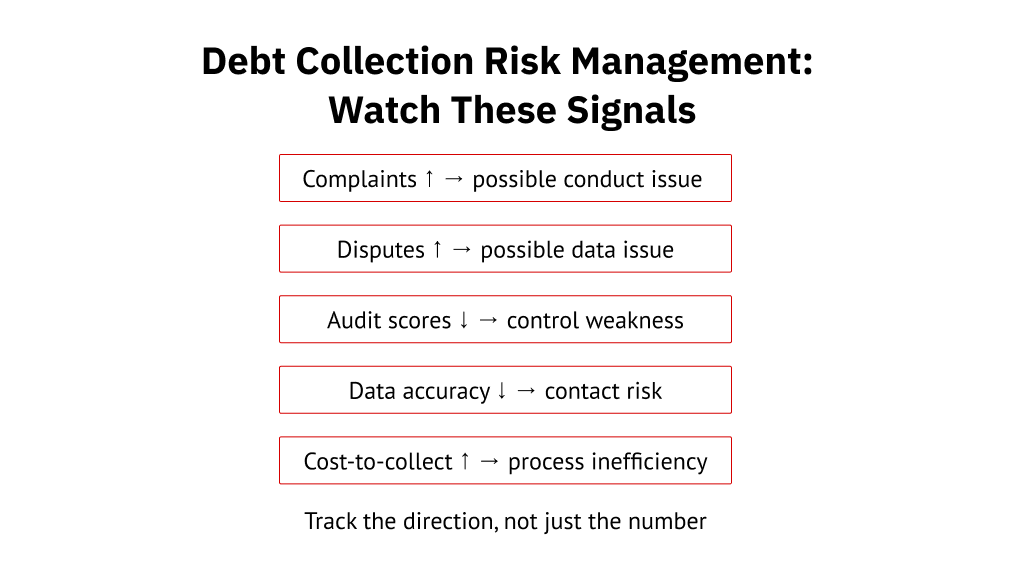
You measure a debt collection risk program by tracking six KPIs every month: complaint rate, dispute rate, compliance-audit pass rate, data-accuracy rate, right-party-contact rate, and cost-to-collect.
The risk KPIs that matter
Six metrics, tracked consistently every month, cover most of what a risk program needs to catch drift early:
- Complaint rate
- Dispute rate
- Compliance-audit pass rate
- Data accuracy or scrub rate
- Right-party-contact rate
- Cost-to-collect
Complaint and dispute rates move first when something is wrong. A slipping audit-pass or scrub rate usually confirms it a few weeks later.
The best programs report these numbers through a live client portal rather than a quarterly recap, so drift shows up before it becomes a violation.
A quick risk-maturity self-check
Tracking the right numbers only helps once you know where your program actually stands. Score it honestly against three stages.
- Reactive: Complaints and exam findings drive the response, with no standing controls in between.
- Managed: Controls exist and map to specific regulations, and someone owns tracking them every month.
- Optimized: KPIs are reviewed on a set cadence, and findings feed back into policy before they turn into complaints.
| Pro tip: If you can’t measure your complaint and audit-pass rates monthly, you don’t have a risk program yet. You have hope, and hope is not a control. |
Conclusion
Risk in collections rarely looks dramatic. It’s a call that connects to the wrong number, a validation notice that goes out a day late, a payment plan nobody logged, small things, until one of them becomes a complaint, a lawsuit, or a fine.
Debt collection risk management is what catches those small things before they compound. The operators who sleep at night aren’t taking fewer shots at recovery; they’re the ones whose every contact is clean, logged, and defensible.
That’s the standard First Credit Services has held for over 30+ years: compliance-first recovery that protects your brand while it protects your bottom line.
See where your program’s exposure really sits. Talk to us at First Credit Services for a candid read on your risk and the gaps worth closing first.
FAQs
1. What is the biggest compliance risk in debt collection?
Contacting the wrong person or collecting on invalid debt, both caused by bad data, so accurate account information and FDCPA and Regulation F guardrails are your best controls.
2. How did Regulation F change debt collection risk?
Regulation F turned informal etiquette into enforceable rules, including a 7-in-7 call cap and a required validation notice, raising the bar on documentation and audit readiness.
3. What is a debt collection risk assessment?
A structured review of where risk sits across your recovery process, from data intake to disputes, scored by likelihood and impact so controls land where they matter.
4. How do you measure debt collection risk?
Track leading indicators like complaint rate, dispute rate, right-party-contact rate, data-accuracy rate, and compliance-audit pass rate, since rising complaints or a slipping audit-pass rate signal drift early.
5. What happens if a debt collector violates the FDCPA?
Violations can bring lawsuits, statutory damages, CFPB enforcement, and reputational harm, and liability often reaches the creditor too, which is why vetting a partner’s compliance record matters.
6. Does outsourcing collections increase or reduce risk?
It depends on the partner: a compliance-weak vendor adds exposure you’re liable for, while a strong, audited one brings mature controls, so due diligence before signing is what matters.