


What happens to a member’s balance the moment they stop showing up but don’t cancel?
Debt collection for gym membership is how fitness operators recover unpaid dues, cancellation fees, and contract balances after a payment fails or a member stops paying. It typically starts with internal follow-up, calls, emails, and texts, before escalating to a third-party agency if the balance stays unresolved.
Chasing that revenue takes more than just persistence. It takes processes, compliance controls, and follow-up that’s consistent enough to actually work. That’s a lot to run alongside coaching classes and keeping the equipment in one piece.
This guide covers what debt collection for gym membership involves and the legal rules a partner must follow. It also looks at how to evaluate a partner, what the process typically costs, and how it unfolds once accounts are placed.
Why gym membership accounts go unpaid, and when to escalate
Unpaid gym membership balances generally come from one of two situations, and telling them apart shapes how fast you should act. Some of your members still want to pay, but their payment method fails. Others have quietly stopped coming, yet their contract keeps billing them.
Here’s how to tell the two apart.
Involuntary non-payment
Involuntary non-payment happens when a card expires, a bank account changes, or an automated draft simply fails. The member has not decided to leave. They just have not noticed the failed charge yet.
These accounts respond well to early, low-friction contact from you. A short reminder or a one-click update link often resolves the balance before it ages into a complex collections problem.
Voluntary non-payment looks different, and it needs a different response from you.
| Did you know? Most fitness operators collect only 85-90% of what members owe. A 97% collection rate is achievable once payment operations are optimized, according to a 2025 ABC Fitness analysis of payment and operational data from 40 million members across 30,000 fitness locations. |
Voluntary non-payment
Voluntary non-payment happens when a member stops using the gym but never submits a formal cancellation. Under most membership agreements, the obligation to pay continues until the contract is properly terminated. This holds regardless of whether the member still shows up.
This is where disputes usually start. A member who assumed month-to-month billing would stop automatically is more likely to push back once you escalate the account. Your documentation from signup matters as much as the outreach itself.
Once you know which type of account you are dealing with, the next question is timing. Timing is where most unpaid gym membership collections actually go wrong.
Escalation framework
Your internal follow-up should always come first, but it needs a defined endpoint. Without one, your staff tends to keep trying the same channel long after it has stopped working.
| Timeframe | Recommended Action |
| Day 0-7 | Automated payment retry plus a soft reminder |
| Day 8-30 | Dunning sequence across email, SMS, and in-app messaging, with card-update prompts |
| Day 30-60 | Direct outreach and a payment-plan offer |
| Day 60-90 | Pre-collection notice under the gym’s own name |
| Day 90+ | Placement with a third-party collection agency |
| Pro tip: Recovery potential drops sharply as an account ages. Set your escalation timeline in writing while accounts are still current, so the trigger points are already decided before a balance feels unrecoverable. |
Following that timeline consistently is harder than it sounds, which is why most gyms lean on automation for the early stages.
Technology-enabled recovery
Automated payment retries, failed-payment workflows, and omnichannel reminders catch a large share of involuntary non-payment before it needs a human at all. A failed draft can trigger a text with a payment link within minutes. Your staff would likely not notice that fast on their own.
Automation has limits, though. Disputes and payment plan negotiations still need a person on your team. Accounts with a genuine complaint about the contract also need someone who can review the full history and make a judgment call.
What a compliant gym membership collection program must (and must not) include
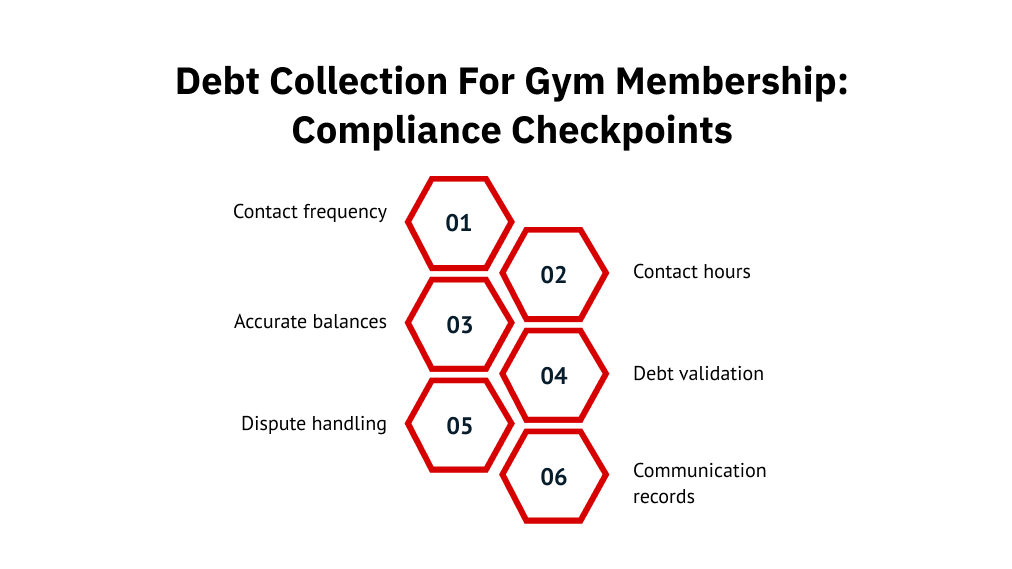
The Fair Debt Collection Practices Act (FDCPA) governs third-party collectors directly. Your own internal team sits outside that legal definition, though most compliant programs hold internal follow-up to the same standard anyway. A member rarely tells the difference between a call from your front desk and a call from an agency, so the practical bar stays the same either way.
Building a compliant gym membership debt collection program starts with knowing exactly where that line sits.
- You can generally contact a member by phone, mail, email, text, and through a self-service payment portal, as per the Regulation F final rule.
- Excessive contact is not permitted. As per 12 CFR § 1006.14, Regulation F presumes a violation after seven calls about one debt within seven days.
- It also presumes a violation for any call placed within seven days of a conversation about that same debt.
- False or misleading statements are off the table too. As per 15 U.S.C. § 1692e, you cannot misstate the amount a member owes or the consequences of nonpayment.
Once an outside agency takes over, debt validation requirements apply as well. As per 15 U.S.C. § 1692g, the collector must provide specific information about the debt. If the member disputes it, a defined validation process governs the response.
Here’s how it breaks down in practice, side by side:
| Permitted | Prohibited |
| Contact by phone, mail, email, text, and a self-service payment portal | Calling more than seven times about one debt within seven days |
| A brief callback message that identifies the caller | A voicemail that discloses the debt to someone other than the member |
| Contact between 8 a.m. and 9 p.m. in the member’s time zone | Contact outside that window |
| Offering payment plans and settlement options | Threatening consequences the gym cannot legally carry out |
| Reporting accurate balances and, where applicable, to credit bureaus | Misstating the amount owed or implying legal action that is not planned |
| Responding to a dispute with the required validation information | Continuing active collection while a valid dispute sits unresolved |
Frequency, honesty, and process are what separate a defensible program from a risky one, whether you run outreach in-house or hand it to a partner.
This is the operational standard a compliant fitness-industry recovery partner should already have built into its systems: documented controls you can verify, not a sales-call assurance.
Even gyms that know these rules well still trip on a handful of avoidable mistakes long before compliance becomes the real issue.
Common mistakes gyms make when chasing unpaid dues
Even gyms with a clear escalation policy lose recoverable fitness club debt recovery revenue to a handful of repeatable mistakes.
Here are the common points that trip up otherwise solid recovery programs:
- Waiting too long to escalate: Staff quietly extend the timeline for loyal members. The longer an account ages past that point, the harder it becomes to recover.
- Using front-desk staff for collections calls: They’re rarely trained on call-frequency limits or dispute handling. It also strains the member relationship and pulls staff off the job you hired them to do.
- Treating every account the same: Involuntary non-payers just need a quick prompt. Voluntary non-payers need context on why the balance exists before they’ll engage at all.
- Skipping clear documentation at signup: Weak records of contract terms and cancellation policy turn a routine balance into a drawn-out dispute. Your position weakens fast if a member claims they never understood the terms.
- Placing accounts with bad contact data: An old phone number, a stale email, or the wrong communication preference wastes the highest-value early window. Recovery odds drop fast the longer an account sits unresolved.
| Pro tip: A respectful, compliant recovery approach protects the member relationship while you pursue the balance, and it often makes future reactivation easier. |
How to evaluate a gym debt collection partner
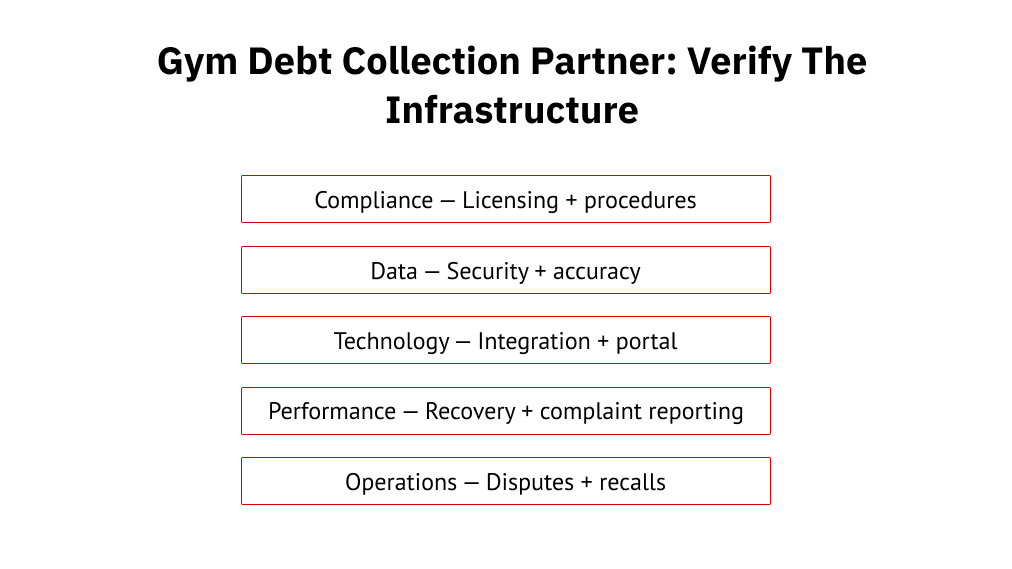
Gym experience varies widely among partners who claim to have it. Before you sign anything, run any gym billing recovery services partner through these questions and expect real specifics, not a generic pitch. Here’s what to check before you commit to one:
- State licensing: Confirm the partner holds a license in every state where your members live. Licensing requirements follow the member’s location, not your gym’s headquarters.
- First-party versus third-party capability: Ask whether the partner offers early-stage, branded first-party recovery in addition to standard third-party collections. Some fitness-industry partners work third-party accounts only, so confirm which model applies to your volume.
- Fitness-industry experience: General collections experience outside the fitness industry does not automatically translate to gym accounts. Membership contracts, cancellation disputes, and seasonal enrollment patterns behave differently than a typical retail or medical balance.
- Recovery-rate and complaint-rate reporting: A headline recovery percentage means little without context. Ask for the breakdown by account age and by involuntary versus voluntary non-payment.
- How disputes are handled on your behalf: Confirm whether the partner manages disputes and documentation for you directly, or whether that work lands back on your team. Ask how quickly documentation reaches you once a member disputes a balance.
- Documented procedures for escalations: Confirm the partner has a defined process for validation requests, cease-communication requests, and account recalls. These should be written procedures, not case-by-case judgment calls.
- Technology and integration: Ask whether the partner connects to your gym management platform through a native integration or a custom API, SFTP, or file-upload setup. Also ask about their client portal and how often reporting updates in real time.
- Credit bureau reporting: Ask whether the partner reports delinquent balances to major credit bureaus. Confirm whether it also manages Fair Credit Reporting Act (FCRA) disputes once a report is filed.
- Data security: Confirm the partner holds Payment Card Industry Data Security Standard (PCI DSS) Level 1 certification, the most rigorous compliance level, requiring annual on-site validation. That level matters most for any partner handling card numbers, stored payment data, and member PII directly.
This is the same standard First Credit Services builds into its own operations. It should be checkable and built into daily processes, not something asserted during a sales pitch. Meeting that standard on paper is one thing, though. Seeing how the process actually runs once accounts are placed is what tells you whether a partner delivers on it.
What the collection process looks like after you place accounts
Placing an account with a partner does not end your visibility into it. A well-run process moves through a few predictable stages, and knowing them ahead of time sets clear expectations on both sides for your gym membership debt collection program.
Here’s what typically happens once an account changes hands:
- Account handoff: You provide member contact information, a copy of the membership agreement, a balance breakdown, payment history, and any prior dispute documentation. The file format varies by partner, whether that means an API (application programming interface) integration, an SFTP (secure file transfer protocol) upload, or a spreadsheet.
- Member communication flow: The partner contacts the member through compliant channels: calls, mail, email, and text. Depending on the model, that outreach runs under the partner’s own name or your gym’s brand. Either way, you set the tone and boundaries before outreach begins.
- Dispute and validation handling: If a member disputes the balance, the partner follows the required validation process covered earlier. You may need to supply supporting documentation when this happens. A good partner runs this through a defined workflow, not an ad hoc request every time.
- Reporting cadence: Expect regular updates on recovery amounts, contact attempts, dispute status, and accounts recommended for closure. Many partners offer a real-time client portal instead of a monthly summary.
- Typical recovery timeline: Most recovery activity happens in the first 60 to 90 days after placement. Balances remaining after 120 days grow harder to recover and may move toward credit reporting or legal review depending on the amount and the contract terms involved.
FCS provides a client portal with account status, documented dispute workflows, and defined reporting intervals, so you see exactly where every placed account stands. Behind that portal sits UCEP (Unified Consumer Engagement Platform), FCS’ in-house platform that sequences outreach across SMS, email, chat, and phone based on how an account has responded so far.
How gym membership debt collection is typically priced
Pricing for gym membership debt collection varies more than most operators expect.
Here’s what actually drives the cost:
- Variable pricing: Cost depends on account age, volume, and whether the work is early-stage first-party recovery or harder third-party collections.
- Account age: Contingency fees run lower on fresher accounts, typically 30 to 60 days past due, and higher on aged accounts, typically 120 days or more. Older balances take more effort to recover, so the fee reflects that.
- Contingency fee structure: Under this common model, you pay a percentage of whatever the partner actually recovers, rather than a flat upfront cost.
- General range: No published industry-wide standard exists. Contingency fees for member accounts commonly fall between 25 and 50 percent, depending on account age, volume, and the type of work involved. Ask any partner for a disclosed fee schedule before you place accounts.
- What “no recovery, no fee” means: Under a pure contingency model, you pay nothing if the partner does not collect. That structure shifts the financial risk to the partner, which is part of why contingency percentages run higher than flat-fee equivalents.
- Flat fee per account: Some partners offer this instead, particularly for defined account-processing work or early-stage recovery programs where the outreach is more standardized.
- Volume and contract terms: Larger account volumes or longer placement terms sometimes qualify for lower rates. Ask about minimum volume requirements, contract length, and any other conditions tied to pricing.
Cost matters, but it should never be the only factor in your decision.
Putting your recovery strategy to work
Unpaid gym membership balances are a timing, compliance, and relationship problem for your gym, not just a money problem. They test how well your compliance program holds up, how clean your documentation is, and whether your escalation timing protects the member relationship.
Getting debt collection for gym membership right comes down to timing and choosing a partner who understands the fitness industry, both of which matter more than the size of any single unpaid balance.
Considering how a partner would handle your delinquent member accounts? Connect with the FCS health and fitness team about how compliance and recovery are built into every placement.
FAQs
1. Can gyms legally send a delinquent membership account to a collection agency?
Ye. Gyms can generally place delinquent membership accounts with a collection agency, subject to the membership contract, federal requirements, and state law. When an outside agency collects on your behalf, the FDCPA and Regulation F apply, along with any state-specific licensing and collection rules.
2. How soon should we place a delinquent gym membership account with a collection agency?
There is no single fixed timeline. You should set a defined escalation point rather than letting balances age indefinitely. The right timing depends on your billing cycle, internal outreach process, account characteristics, and overall recovery strategy, with most gyms escalating somewhere between day 60 and day 90.
3. Will sending a member to collections hurt our gym’s reputation or member relationships?
Nol. A well-run collection program can protect your gym’s brand while giving the member a clear, respectful path to resolve the balance. Aggressive or non-compliant outreach is what damages relationships, not the act of escalating an unpaid account itself.
4. What legal rules must a collection partner follow when recovering gym membership debt?
Your partner should have documented processes for complying with the FDCPA, CFPB Regulation F, and applicable state laws, including validation requirements and dispute handling. This covers contact frequency limits, accurate balance reporting, and defined procedures for cease-communication requests, account recalls, and credit bureau disputes under the FCRA.
5. Should we handle gym membership collections in-house or outsource to an agency?
It depends on your account volume, staff capacity, internal expertise, and existing recovery process. Outsourcing tends to make sense once you lack the staff, systems, or specialized compliance infrastructure to manage delinquent accounts at scale, especially as your gym grows past a few dozen unresolved accounts monthly.
6. What should we look for before hiring a gym debt collection company?
Look for state licensing, documented fitness-industry experience, both first-party and third-party capability, and transparent recovery and complaint-rate reporting. You also want a member-centric approach that protects your brand while recovering revenue, along with clear technology integration and defined data security certifications like PCI DSS.