


Every collection program carries risk at the point of contact. One wrong call, text, or consent record can turn routine follow-up into statutory damages. Under the Telephone Consumer Protection Act, non-compliant calls or texts can cost $500 each. Courts can raise that to $1,500 per violation if the conduct is willful.
At scale, that exposure adds up fast. A stale consent list, an unchecked dialer rule, or repeated outreach to the wrong number can cost more than the balance being collected.
That is why compliant debt collection best practices matter. They give creditors a structured way to recover overdue balances through better timing, segmentation, payment access, documentation, and compliance control.
This guide covers the compliant practices that improve recovery, reduce risk, and show when an outside partner should step in.
What are debt collection best practices?
Debt collection best practices are the compliant, repeatable methods creditors use to recover overdue balances while protecting customer relationships. They cover timing, segmentation, channel mix, payment flexibility, measurement, documentation, and regulatory control.
The key is not to treat collection activity as one broad workflow. Two stages sit behind it, and each stage needs a different approach.
- Pre-write-off: The balance is still an active receivable. Your business owns the account, expects payment, and has a customer relationship worth preserving.
- Post-write-off: The balance has been charged off or placed with an agency. Recovery becomes later-stage, the economics change, and compliance expectations become more complex.
The 8 debt collection best practices for creditors in 2026
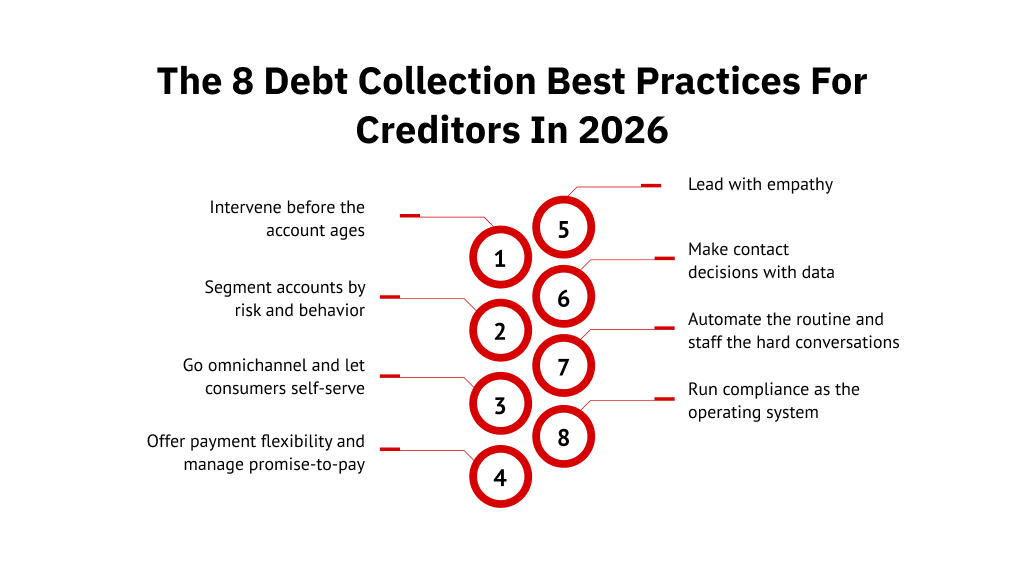
These eight practices carry most of the lift in a recovery program. They compound, so partial adoption returns partial results.
1. Intervene before the account ages
Recovery odds fall at every roll forward. An account that moves from 30 days past due to 60, then 90, loses value at each stage.
Credit card balances flowed into serious delinquency at 6.97% in mid-2026, according to the New York Fed Household Debt Report 2026. Auto loans ran at 3.00%. These transitions show how quickly portfolio value can disappear as accounts age.
Two forces drive the decline.
- Contact data gets stale, and consumer urgency fades.
- A balance that felt urgent in week two may compete with newer obligations by month four.
| Pro tip: Build your outreach calendar around days past due, not month-end batches. A pre-due reminder and a day-three follow-up can resolve accounts that would otherwise need repeated touches at day 90. Once timing is under control, the next step is deciding which accounts deserve which type of effort. |
2. Segment accounts by risk and behavior
One cadence for every account creates two problems. It overspends on consumers who would have paid with a simple reminder, and it under-serves accounts that need more structured follow-up.
Useful segmentation should combine three inputs:
- Balance tier: How much agent time the account can justify.
- Risk score: Payment history, delinquency depth, and credit or portfolio data.
- Behavior: Channel engagement, response speed, prior promise-to-pay performance, and last successful contact.
Behavior is often the missing layer. A modest balance from a consumer who opens every message may be more recoverable than a larger balance attached to someone you cannot reach.
The failure pattern is segmenting by balance alone. That sends agents toward high-value accounts with poor contactability, while easier-to-resolve accounts sit in the queue.
Segmentation then shapes the channel strategy.
3. Go omnichannel and let consumers self-serve
Omnichannel collections means the channels work together as one sequence. It is not the same as sending a text, email, and phone call independently.
A practical sequence may start with a text that includes a secure payment link. An email can follow with more detail. A call can then be reserved for accounts that ignored both, where agent time is more likely to create value.
Self-service removes another barrier. Consumers who can view a balance, choose a payment option, and pay after hours do not need to wait for an agent. That lowers cost per resolution and reduces friction.
However, digital outreach still needs discipline. Among electronic communication complaints in the FDCPA Annual Report 2025, 58% cited frequent or repeated messages.
That means cadence control must be built into every omnichannel debt collection program from the start. Without it, digital outreach can quickly shift from convenient to overwhelming, especially when the same consumer receives repeated messages across multiple channels.
4. Offer payment flexibility and manage promise-to-pay
Many past-due balances reflect limited capacity, not unwillingness to pay. The Federal Reserve Report on the Economic Well-Being of U.S. Households in 2025 found that 16% of adults did not pay all their bills in the prior month.
Payment flexibility helps convert that group. Offer realistic plans, multiple payment methods, and settlement options where policy allows.
The weak point is promise-to-pay management. A promise recorded and forgotten can stop outreach without producing payment. Hence, every commitment should trigger a reminder before the due date and a follow-up within 48 hours if the payment is missed.
The second installment deserves special attention. Plans often break in month two, once urgency fades, and no reminder arrives.
Payment flexibility works best when it is paired with the right tone.
5. Lead with empathy
Empathy is not just a nicer script. It is an operating choice. It shows up in what agents are allowed to offer, how hardship is handled, and how quickly disputes or cease requests are honored.
A more empathetic process includes:
- Agents who can acknowledge hardship and move to a payment option without unnecessary escalation.
- Scripts that open with a path to resolution, not the consequence of non-payment.
- Dispute, cease, and hardship requests that are logged and actioned on the first ask.
The business case is direct. Complaints, regulator attention, and public reviews are all shaped by how the interaction feels. A recovered balance that damages the customer relationship can still be a poor trade.
Empathy also becomes stronger when decisions are backed by data.
6. Make contact decisions with data
Test contact strategy, do not assume it. Many programs still rely on fixed cadence rules without checking whether they actually improve contact or recovery.
Start by measuring right-party-contact rate by channel and time of day. Patterns vary by portfolio, so borrowed benchmarks can mislead. When you change cadence, hold out a control group so seasonality does not get credit for the strategy.
Prioritization matters as much as timing. Rank accounts by expected recovery value, not balance alone. A stronger score combines balance size, propensity to pay, and contactability.
| Did you know? Attempts to collect a debt the consumer says is not owed remain one of the most common debt collection complaints reported to the Consumer Financial Protection Bureau. Placement data quality can drive that issue as much as agent conduct, according to the CFPB’s Consumer Response Annual Report. Once the strategy is clear, automation can help keep it consistent. |
7. Automate the routine and staff the hard conversations
Automation should handle predictable, repetitive tasks like reminders, notices, plan confirmations, receipts, and account routing
Agents should handle the moments that need judgment. Hardship, disputes, settlement discussions, vulnerable consumers, and complex account histories all require context that automation can miss.
The risk is automating the wrong step. A dispute is not just another message. It can trigger validation timelines and legal obligations. If the first response is mishandled, the recovery gain can quickly become a compliance problem.
That is why automation should support the workflow, while compliance controls guide every step.
8. Run compliance as the operating system
Compliance built into the process costs less than compliance added after something goes wrong. When consent status, call caps, validation timing, and dispute handling are configured inside the workflow, agents are less likely to breach them by accident.
Treat compliance as system design, not only training. A debt collection compliance program that relies on agents remembering every rule will struggle at scale.
The next step is understanding which guardrails to build into the recovery process.
Compliance-led recovery: guardrails that protect recovery and reputation
Federal enforcement has gone quiet. The Consumer Financial Protection Bureau brought no public FDCPA enforcement action in 2024, per the FDCPA Annual Report 2025. Thus, exposure shifted to private suits and per-violation damages, which scale with your contact volume.
Complaints tell the same story. The Consumer Response Annual Report 2026 logged roughly 387,400 debt collection complaints in 2025, up from about 207,800.
What the creditor still owns
The FDCPA definition of debt collector excludes employees collecting in the creditor’s own name. That exclusion narrows fast. A creditor using a name implying a third party is collecting falls inside the definition.
The Telephone Consumer Protection Act and unfair, deceptive, or abusive acts or practices (UDAAP) standards apply regardless of who dials. Vendor oversight is the control that matters. Therefore, your agency’s conduct lands on your brand, your complaint file, and your recovery rate.
How to measure debt collection success
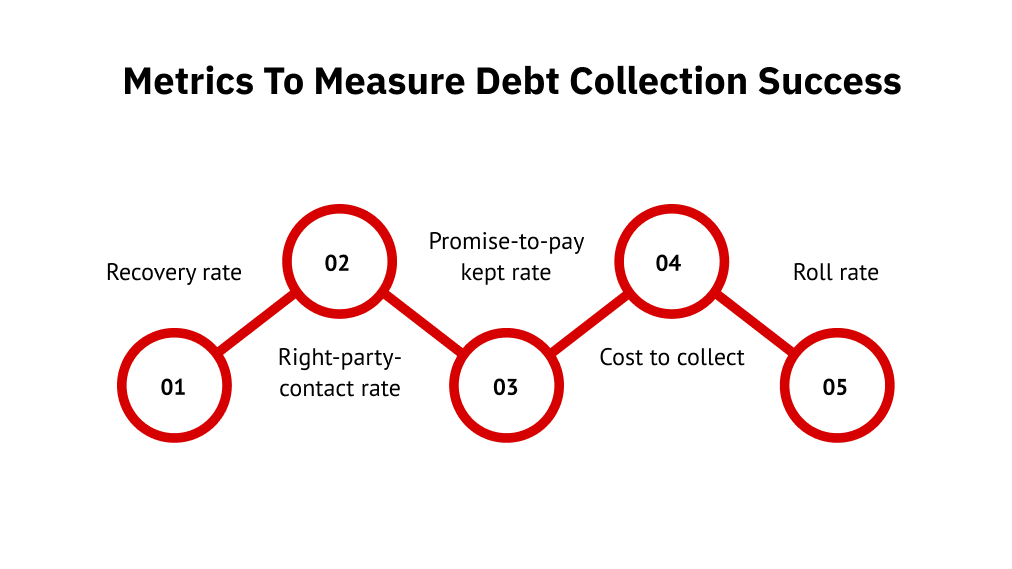
These five metrics show where a recovery program is working.
| Metric | What it measures | Why it matters |
| Recovery rate | Dollars collected against dollars placed | The headline number, always read by placement cohort |
| Right-party-contact rate | Contacts reaching the correct consumer | The leading indicator; recovery cannot beat contact |
| Promise-to-pay kept rate | Share of commitments honored | Exposes whether plans are realistic or optimistic |
| Cost to collect | Program cost per dollar recovered | Where channel mix and automation prove their value |
| Roll rate | Accounts moving to the next delinquency bucket | Early warning, visible months before recovery drops |
What good recovery looks like
Recovery rates vary by industry, account age, and placement quality, so a number that signals success in one portfolio signals failure in another.
Read the trend instead. Measure by placement cohort rather than calendar month, since calendar reporting hides both.
| Pro tip: Track right-party-contact rate weekly and recovery rate monthly. Contact moves first, so a contact rate falling in week two predicts next month’s recovery number. |
First-party vs third-party collections: when to bring in a partner
First-party and third-party collections solve different problems. The mistake is treating them as interchangeable.
| Aspects | First-party | Third-party |
| Stage | Early, pre-write-off | Late-stage, charged-off, or placed |
| Brand shown | Your brand, white-labeled | The agency’s own brand |
| Consumer experience | Reads as customer service | Reads as collections |
| Compliance profile | Narrower where the creditor collects its own debt | Full FDCPA and Regulation F exposure |
| Best used for | Failed payments, lapsed subscriptions, early balances | Aged inventory and exhausted internal effort |
The right sequence usually starts inside the business, then moves outward.
A simple decision framework
Work through the sequence in order. Skipping steps can mean paying an agency to fix a process problem that could have been solved earlier.
- Improve the in-house process first: Fix timing, segmentation, cadence, and documentation.
- Add technology next: Use digital channels and self-service payment to increase capacity without adding headcount.
- Bring in a partner when a trigger fires: Watch for volume outpacing staff, recovery flattening across two cohorts, or accounts aging past your ideal window.
First-party collections suits early-stage balances where the relationship still holds value. On the other hand, third-party collections fits accounts that your team has already worked on but can no longer recover efficiently.
5 common debt collection mistakes to avoid
Even well-run teams lose recovery when small process gaps repeat at scale. These are the mistakes to address first:
- Waiting for the 90-day bucket: Recovery odds have already fallen by then.
Fix: Start pre-due and treat day 30 as late. - Running a single channel: Phone-only programs miss consumers who do not answer unknown numbers.
Fix: Sequence text, email, portal links, and calls. - Skipping segmentation: One cadence for every account overspends on easy wins and under-serves complex cases.
Fix: Route by risk, balance, and behavior. - Documenting loosely: A contact you cannot evidence is a contact you cannot defend.
Fix: Log every attempt, disposition, consent change, and consumer statement. - Treating compliance as training: Rules that live only in a handbook get broken.
Fix: Build call caps, consent rules, and validation timing into the workflow.
Fixing these issues usually improves performance before major structural changes are needed.
How First Credit Services applies these practices
Omnichannel sequencing and self-service payment are the capabilities most creditors struggle to build internally. That is because both need infrastructure rather than headcount.
FCS runs that infrastructure as a managed service, across more than 125 million customer interactions annually. The team handles strategy, sequencing, delivery, and reporting on the client’s behalf.
That work runs on Unified Consumer Engagement Platform (UCEP), a proprietary engagement and payment system. It scores each account, picks the message, channel, and timing, then routes consumers to a self-service portal.
This model fits mid-market and enterprise creditors placing multi-million dollar volumes annually. Smaller portfolios are usually better served by tightening the in-house process first.
Build a recovery process that improves before accounts age
Debt collection best practices work best when they are applied early, measured consistently, and built around compliance from the start. The most effective programs do not wait for accounts to become hard to recover. They intervene sooner, segment smarter, and give consumers more ways to resolve the balance.
The sequence matters as well. Fix the internal process first and add digital capacity where manual follow-up is slowing the team down. Then place accounts before they age beyond efficient recovery.
To pressure-test that sequence against your portfolio, talk to FCS about early-stage and late-stage recovery at your placement volume.
FAQs
1. How long should a creditor work an account in-house before placing it?
Most creditors work accounts internally for 90 to 180 days, but the right window depends on portfolio performance. Track recovery by cohort age. When recovery flattens across two cohorts, the account may need escalation.
2. How do collection agencies charge for their services?
Agencies often charge on contingency, taking an agreed percentage of what they recover. Creditors usually pay nothing on uncollected balances. Rates vary by account age, balance size, industry, and placement volume.
3. How long does it take to onboard a collections partner?
Late-stage placement programs can often launch within one to two weeks. Early-stage, brand-facing programs usually take longer because they require integration, custom messaging, and agent training on the creditor’s tone and policies.
4. What data does an agency need to start working accounts?
At minimum, an agency needs consumer identifiers, contact details, balance, itemization date, delinquency status, payment history, and consent records by channel. Missing consent documentation can delay launch and limit outreach.
5. Does placing an account with an agency affect credit reporting?
It can, but practices vary. Some agencies furnish tradelines after a defined waiting period, while others do not furnish at all. Confirm the credit reporting policy during partner selection because it affects the consumer experience.
6. How should a creditor handle a consumer dispute?
Stop collection activity on the disputed balance immediately. Verify the debt against original account records, then send written verification before resuming contact. Log the dispute, evidence, and outcome for audit readiness.