


Is the AI collecting from your customers treating them fairly, and could you prove it?
AI ethics in debt collection is a real business risk today. One biased scoring model or one misleading automated message can reach thousands of accounts before anyone catches the error. Every one of those messages carries your company’s name.
A Pew Research Center September 2025 survey found that 50 percent of Americans are more concerned than excited about AI in daily life. Meanwhile, 57 percent rate AI’s societal risks as high. Your customers are already paying attention, and regulators are close behind.
The path forward starts with setting clear rules for what AI decides, what data it touches, and when a person steps in. Your collections partner should meet that same standard.
This guide covers six principles with measurable safeguards and a worked example of one real decision. It also lists the evidence to request from any recovery partner.
What does AI ethics in debt collection actually mean?
AI ethics in debt collection means making sure automated decisions about your customers are fair across groups and explainable on request. It also requires using only necessary data and assigning clear human accountability for those decisions.
These principles cover every step where software acts on a customer’s account: who gets contacted, when, through which channel, and with what offer.
Staying legal vs. doing right: where the two split
Regulations set the minimum. An ethical program adds a second test: would your customers and your brand be comfortable if the decision logic were public? For the statutory rules, explore debt compliance and regulations first.
Here’s how an ethical program builds on regulatory requirements across key collection decisions.
| Decision area | What the rule requires | What an ethical program adds |
| How often your customers are contacted | Reg F call caps and permitted hours | Fewer, better-timed touches with automatic pauses when a customer signals distress |
| What your customers are told | Collector identity and validation details | A clear note when the customer is dealing with AI |
| Which customer data is used | Lawful sourcing and adequate security | Only the fields a model genuinely needs, deleted on a schedule |
| How models decide | No unfair, deceptive, or abusive acts | A plain-language reason behind every score or offer |
The gap between these two columns is where most AI-related brand risk lives. Compliance keeps you out of enforcement actions. However, ethical safeguards keep your customers’ trust intact.
Why collections is a high-stakes arena for AI
AI decisions can affect customers already under financial pressure. When historical disparities feed into automated workflows, your team can unintentionally repeat those patterns across an entire portfolio.
Historical collections data carries existing disparities
Debt in collections is unevenly distributed across communities. The Urban Institute’s Debt in America map uses credit data from August 2025. It compares debt burdens between majority-white communities and communities of color at national, state, and county levels.
Models trained on historical collections data may carry existing patterns into how your customers are treated. For example, an account-prioritization algorithm could deprioritize ZIP codes with historically lower recovery rates. In turn, fewer contacts may mean fewer opportunities to resolve accounts, reinforcing existing disparities.
One flawed rule, thousands of accounts
Scale compounds that risk. A single flawed scoring rule or misleading message template can affect thousands of accounts before anyone reviews the output. In phone-based collections, a supervisor may catch a poor script during monitored calls.
However, automated outreach can spread that mistake across your portfolio before anyone intervenes, with every message carrying your company’s name.
6 principles every responsible AI collections program needs
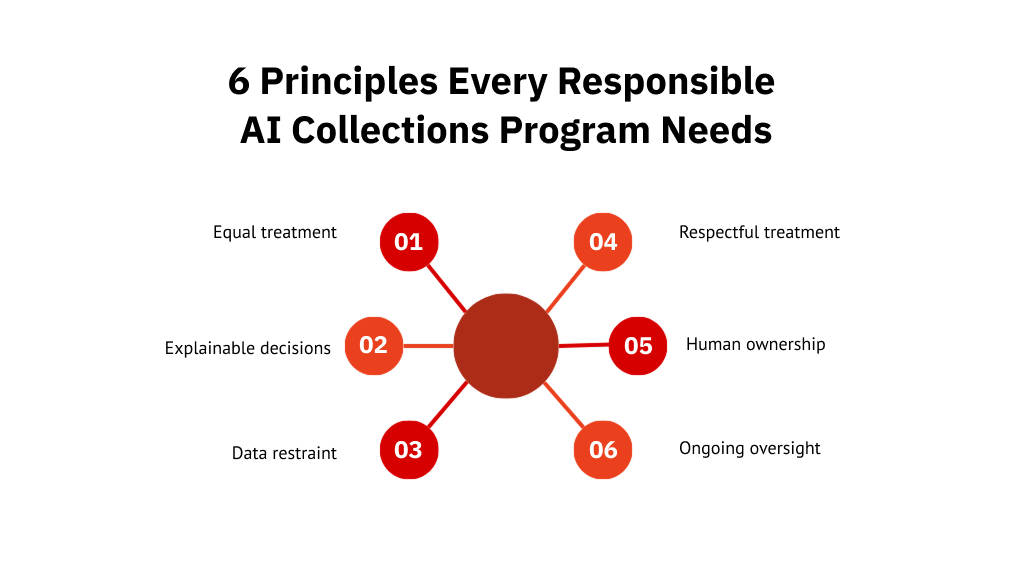
These principles match the themes regulators, researchers, and industry bodies raise most often. Each comes with a safeguard and a metric that tells your business whether to approve, keep monitoring, or pause a deployment.
| Principle | What can go wrong | Safeguard | Decision metric |
| Equal treatment | Comparable customers get different offers or contact levels | Compare outcomes across comparable segments before launch and quarterly | Gap in hardship-plan offer rates between comparable segments (pause if it exceeds an agreed threshold) |
| Explainable decisions | No one can justify a decision to a customer or examiner | Stored reason codes for each automated decision | Share of decisions with a documented reason (target: all) |
| Data restraint | Excess customer data raises breach and privacy exposure | Field-by-field data review, documented exclusions, and deletion schedules | Fields per model vs. approved list; overdue deletions |
| Respectful treatment | Pressure tactics damage your brand | Rules on tone, urgency, and send times with hardship routes | Complaints per 1,000 accounts against a pre-launch baseline |
| Human ownership | Customers get stuck in automated loops | Defined hand-off triggers and a person reachable in every channel | Rate of unresolved hand-offs; time to reach a person |
| Ongoing oversight | Models drift or change unnoticed | Model register, change, sign-off, and scheduled reviews | Time since last review; drift alerts actioned |
1. Equal treatment across customer groups
Unfairness can enter a model through stand-ins for sensitive traits. For example, postal code, preferred language, phone type, and usual payment method may act as proxies for characteristics you never intended the model to consider.
For that reason, excluding sensitive fields alone does not demonstrate fairness. Instead, compare outcomes across customer groups with similar balances and payment histories. Run that comparison before launch, then repeat it quarterly. If hardship-plan offer rates diverge beyond your agreed threshold, pause the model and investigate before resuming.
2. Decisions you can explain
Customers should also be able to understand why they received a particular offer or contact schedule. Your internal team and any collections partner acting on your behalf should be able to explain the decision in one or two plain sentences.
This means storing a reason code with every automated decision. That code should support a clear explanation of which inputs mattered most and how they shaped the outcome, without exposing the full algorithm.
3. Collect less, protect more: privacy by default
To put privacy into practice, start with the model’s job and work back to the data it needs. For example, consider a model that only chooses when and how to contact your customers. The table below shows which data points that task requires.
| Data point | Needed for contact timing? | Reason |
| Past contact attempts and response times | Yes | Shows when the customer actually engages |
| Customer’s time zone | Yes | Needed to stay within permitted hours |
| Channel consent and opt-out status | Yes | Determines which channels may be used at all |
| Full credit report | No | Exposes far more financial detail than timing requires |
| Employer details | No | Raises the risk of workplace contact and disclosure errors |
| Medical codes (healthcare accounts) | No | Sensitive health data with no bearing on timing |
| Social media or location history | No | Intrusive and hard to defend if challenged |
Record every exclusion and the reason behind it, so the decision can be shown to an auditor. After removing fields, re-test outcomes by segment. Remaining fields can still act as stand-ins for the ones you took out.
| Pro tip: Require your collections partner to operate under audited security standards such as SOC 2 Type II and Payment Card Industry Data Security Standard (PCI DSS). These certifications verify that the data behind every AI-driven outreach stays in a controlled environment. |
4. Respectful treatment at every touchpoint
Start by setting clear rules on wording, urgency, and send times. In particular, avoid artificial deadlines or added pressure when a customer appears distressed, as these tactics can damage trust in your brand. Instead, pause automated outreach when signs of hardship emerge and route the account to a trained person.
Within those boundaries, personalized debt collection can make resolution easier by aligning outreach with your customers’ preferred channels and times. The aim is to encourage willing engagement without using personalization to increase pressure.
5. A human who owns the outcome
To put these safeguards into practice, assign each model one named owner within your team or your partner’s. That person should be accountable for its decisions and reachable when something goes wrong.
That responsibility also includes defining clear handoff triggers. Disputes, signs of hardship or illness, bankruptcy mentions, and requests to speak with a person should trigger an immediate human handoff. If customers cannot reach someone within a reasonable time through their chosen channel, close that gap.
6. Ongoing oversight, not one-time approval
Oversight must continue after launch. Customer behavior and data distributions can shift, while regulatory changes may require updated controls. To structure ongoing reviews, use the voluntary NIST AI Risk Management Framework and its four functions: Govern, Map, Measure, and Manage.
| Pro tip: Keep a one-page register for each model listing its purpose, inputs, owner, and last review date. It is usually the first thing auditors ask for. |
Putting the principles to work: one hardship-plan decision, step by step
Principles are useful only when they translate into day-to-day operations. Here is how the six principles apply to a single real decision: whether to offer a customer a hardship plan.
- Set what the model may consider: Start with balance, payment history on this account, stated hardship, and past plan performance. For this workflow, exclude postal code, language, and device type, documenting the reason for each exclusion.
- Test before launch: Next, compare offer rates across segments for customers with similar balances and payment histories. If a gap exceeds the agreed threshold, investigate it before going live.
- Define when a person reviews: Before deployment, also require human review of every declined hardship request, borderline score, and recommendation a customer disputes.
- Keep the audit trail: As decisions are made, retain the inputs used, the reason code, the reviewer (if any), and the outcome.
- Monitor after launch: Finally, track plan uptake, plan completion, and complaints by segment. Then review these results on a fixed schedule.
| Pro tip: If a collections partner cannot walk you through these five steps for one of its own models, treat that as your answer. |
Where automation helps and where people matter: What the evidence shows
The value of AI depends on the job it performs. These studies distinguish between choosing who to contact and handling the conversation that follows, helping your team decide where automation fits.
Smarter decisions, fewer contacts
According to Yijun Zhou’s research summary, a randomized field experiment in the Netherlands found that algorithmic calling decisions achieved 23.4% higher repayment rates than human-led decisions. The model extracted useful signals from collectors’ notes to identify which borrowers to contact.
However, this tested prioritization at one agency, with people still making every call. For your team, the takeaway is to test AI for selecting accounts while keeping collectors responsible for the conversations that follow.
Where AI conversations fell short
By contrast, NBER Working Paper 33669 by Choi, Huang, Yang, and Zhang (2025) examined AI callers. Humans performed better, although switching from AI to people six days into delinquency closed much of the gap.
Still, a year later, the AI-first group had a repayment shortfall equal to 1% of the initial overdue payment compared with the human-only group. They were also more likely to miss subsequent payments.
Because the research involved a Chinese online lender, results may differ for your U.S. portfolio. Taken together, these studies suggest testing AI for prioritization while retaining people for conversations requiring judgment and trust.
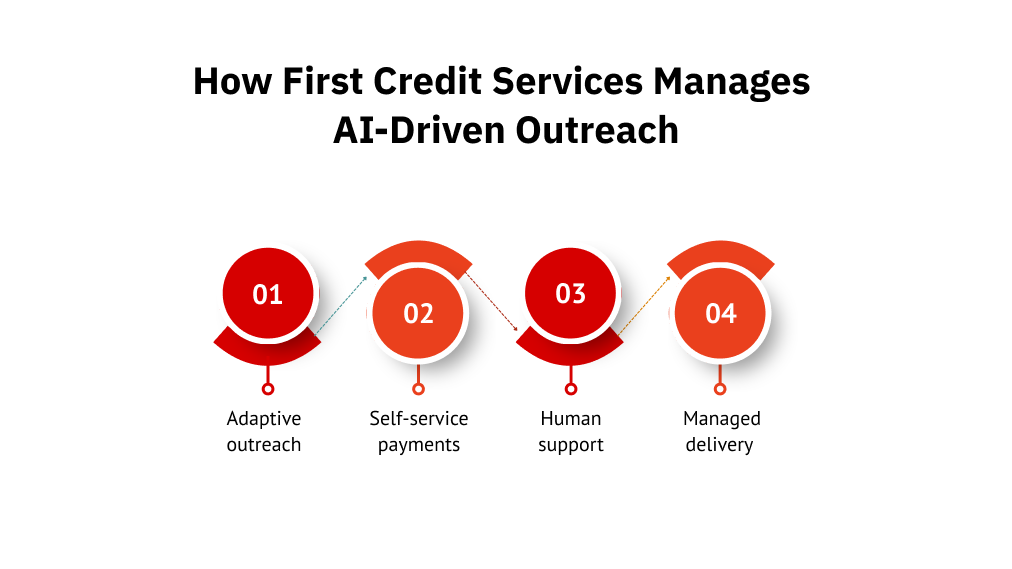
How First Credit Services manages AI-driven outreach
The Consumer Financial Protection Bureau’s chatbot review adds another concern. Automated assistants can provide inaccurate answers or miss when customers assert their rights. Therefore, practical safeguards should include approved response content, clear AI disclosures, and a reliable route to a person.
At First Credit Services, we combine AI-driven outreach with human support through our managed service:
- Adaptive outreach: We use our Unified Consumer Engagement Platform (UCEP) to select the channel and timing for each customer.
- Self-service payments: We give customers a self-service payment portal to view balances, make payments, and choose available plans or settlement offers.
- Human support: We arrange your access to our professional collectors for sensitive conversations, including hardship requests and disputes, based on agreed workflows.
- Managed delivery: We operate UCEP on your behalf and provide reporting, giving your team visibility without requiring you to run the platform.
Our approach is designed for mid-market and enterprise creditors placing substantial annual debt volume.
AI ethics and compliance: what businesses need to check
The regulatory picture is shifting fast. Three developments deserve your attention right now.
State-level rules are arriving first
Colorado’s 2024 AI Act never took effect. Lawmakers replaced it with SB 26-189, an automated decision-making law effective January 1, 2027. If your collections partner uses automated tools to make significant decisions about your customers in Colorado, check the disclosure duties that apply.
Separately, California’s CPPA finalized its automated decision-making rules in September 2025, also effective January 1, 2027. Those rules create new requirements for customer notices, opt-outs, access requests, and risk assessments. These requirements apply to automated systems that process personal information for consequential decisions.
Federal policy is still catching up
Executive Order 14365 calls for a national AI framework and directs federal agencies to challenge certain state AI laws. However, it does not automatically override those laws. Your team must still follow applicable Colorado and California requirements unless their legal status changes.
When assessing AI in debt collection, start with applicable federal rules, including the FDCPA and Regulation F. Then layer on the state-specific requirements that apply to your program.
Questions to ask before you trust a partner’s AI
Assurances sound good in a sales pitch, but evidence holds up in an audit. Ask these seven questions and request the documentation behind each answer.
| Question to put to your partner | Evidence to request | Warning sign |
| How do your models perform across comparable segments of our customers? | Recent segment comparison results and any fixes made | “We don’t use sensitive data, so there’s no bias” |
| If one of our customers asks why they got a certain offer, can you tell us? | A sample decision record with its reason code | “That’s proprietary” |
| Which data points about our customers go into each model, and which are left out? | Approved input list and documented exclusions | “We use everything we have” |
| When does a person take over from automation? | Written hand-off triggers and sample escalation records | Automation handles disputes end to end |
| Are our customers told when they’re dealing with AI? | Disclosure scripts and message templates | No defined approach |
| How long do you keep our customers’ conversation data? | Data retention policy | No set deletion schedule |
| Who approves model updates? | Model register and change log | No named owner or change history |
The warning signs share a pattern: they all replace specific evidence with broad reassurances. A partner that produces the documents has already done the work.
Smarter recovery starts with AI you can defend
Responsible AI does not slow recovery. It removes the risks that derail it: regulatory penalties, reputational damage, and customer trust that never comes back. The six principles in this guide give your program a framework for using AI to recover more while treating every customer fairly.
The businesses that move first on AI governance will set the standard. The ones that wait will spend more catching up than they would have spent getting it right from the start.
Talk to us about building an AI-assisted collections program to recover your revenue and protect your customer relationships.
FAQs
1. Can recordings or transcripts of customer conversations be reused to train AI models?
Only with careful controls. The data was collected for a different purpose, so responsible programs restrict reuse, strip identifying details, and document the legal basis. California’s CPPA rules also require a risk assessment when personal information trains automated decision-making tools.
2. What is “ethics debt” in AI, and why does it matter for collections?
Ethics debt accumulates when fairness, explainability, or accountability gaps go unaddressed, similar to technical debt in software. These flaws become embedded over time, making small fixes insufficient. Catching problems early costs far less than rebuilding a model later.
3. Should customers be told when they are communicating with AI during the collection process?
Yes, and several upcoming state laws will require it. Beyond compliance, disclosure builds trust. Customers who know they are dealing with AI can request a human when they need one. That transparency reduces complaints and strengthens your brand’s reputation over time.
4. Does ISO/IEC 42001 certification prove a partner’s AI is responsible?
It is a positive indicator, though it does not tell the full story. The certification confirms a structured AI management system is in place. However, it does not verify that a specific collections model treats your customers fairly. Still request segment-level results.
5. Do these principles apply if we collect our own accounts in-house?
Yes. The FDCPA may not apply directly to first-party collection. However, businesses using AI on their own accounts still face UDAAP standards, state privacy laws, and the same reputational risk.
6. How can a smaller business build responsible AI practices on a limited budget?
Start by listing every AI tool involved in your collections workflow and assigning each one an owner. Check one customer segment’s outcomes for fairness each quarter. NIST’s free AI RMF Playbook provides a ready-made structure without outside consultants.