


Two outsourcing providers may promise identical back-office support while placing vastly different demands on your team. A lower quote may cover transaction processing but leave validation, exceptions, and reporting to your staff. What looks like savings on paper can become another operational burden.
For finance and operations leaders, choosing back office outsourcing services requires looking beyond service lists and quoted rates. When responsibilities are vague, errors return to your team, account updates stall, and oversight consumes valuable time. Meanwhile, unresolved exceptions can undermine the efficiency outsourcing was meant to improve.
To avoid added work, clarify which tasks transfer, who approves decisions, how problems escalate, and the standards for completed work. Then compare each provider’s actual responsibilities with its total cost.
This guide helps you evaluate proposals, verify benefits, and choose an outsourcing arrangement that reduces workload without weakening operational control.
Which back-office outsourcing services fall within your scope of work?
Finance administration, receivables support, document processing, and data maintenance can be outsourced when tasks and approval rights are defined. Your scope of work should specify which processes a provider completes, what records it needs, and what deliverables you receive.
Back office outsourcing services transfer defined administrative tasks to an external team, while your business retains policy decisions and oversight. A clear scope also identifies who handles rejected work and who approves corrections.
The table compares common market services by required inputs, deliverables, and retained responsibilities. Confirm which activities each provider offers before comparing proposals.
| Function | Inputs supplied | Provider deliverables | Client retains |
| Bookkeeping | Transaction records, coding rules | Updated ledgers, reconciled entries | Approval of adjustments |
| Receivables administration | Account data, invoices, payments | Balance updates, exception reports | Billing policies, dispute decisions |
| Document processing | Source files, classification rules | Indexed, validated documents | Approval of unclear classifications |
| Data maintenance | Authorized records, update instructions | Corrected fields, processing logs | Authorization and acceptance |
Finance, accounting, and accounts receivable support
An updated ledger may still contain unmatched transactions, so bookkeeping deliverables must identify those exceptions. Specify reconciliation schedules, supporting records, and the format of reports sent to your finance team. When reviewing accounting and bookkeeping services, ask who investigates discrepancies and who approves adjustments before reports are finalized.
For active accounts receivable, agree who posts payments, corrects balances, and reviews missing information. Early-stage recovery can use first-party collections under your brand; seriously delinquent or written-off accounts may require third-party collections. Define when the handoff occurs and which team manages subsequent outreach.
Data processing and administrative support
Document handling and data maintenance require different checks depending on the information being processed. Indexing files may follow clear rules, while resolving inconsistent records could require business judgment.
Ask for file formats, validation rules, and evidence of completed work. When records fail those checks, clarify whether the provider corrects them or sends them back for review. Otherwise, work may return to your team even after processing has been outsourced.
| Scope check: Before approving a proposal, confirm who provides source records, validates completed work, corrects rejected outputs, and approves exceptions. Make sure these responsibilities are documented in the proposed scope. |
How can you measure the benefits of outsourced back office services?
Measure outsourced back office services against current results using cost, speed, quality, and capacity. Without a baseline, lower quotes cannot prove time savings or less rework.
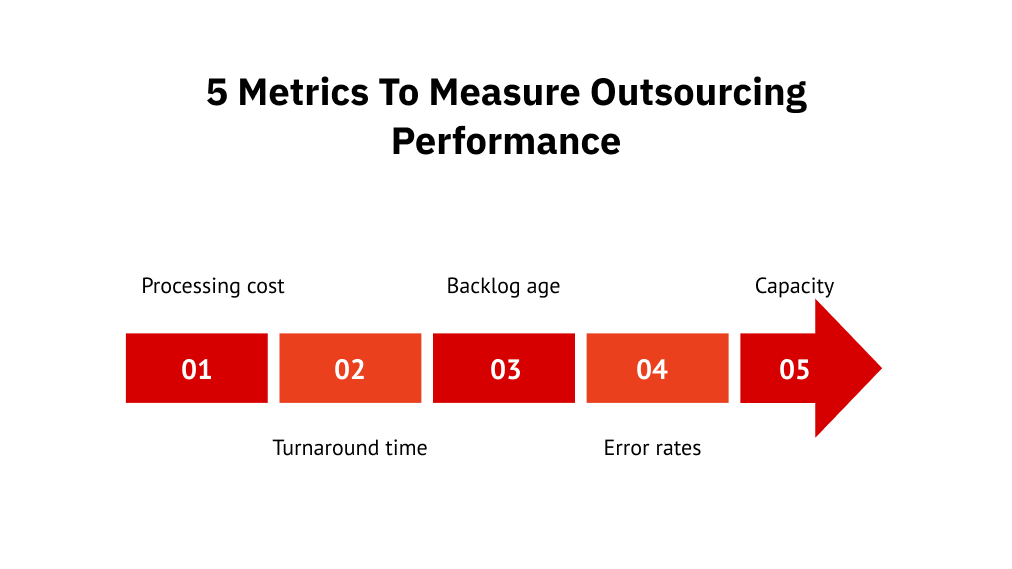
Before requesting proposals, record these indicators over a representative period:
- Processing cost: Include labor, supervision, and correction work per completed transaction.
- Turnaround time: Track how long work takes from receipt to accepted completion.
- Backlog age: Measure how long unfinished items remain open.
- Error and correction rates: Record rejected outputs, repeat submissions, and time spent fixing mistakes.
- Capacity: Compare completed work with incoming volume and staff availability.
Faster processing saves little staff time if employees must repeatedly check and correct completed work. Compare staff time spent reviewing and fixing outputs before and after outsourcing.
The same measurement discipline applies when business process outsourcing (BPO) providers promise innovation. In its 2026 State of BPO findings, Information Services Group (ISG) reports 70% of surveyed decision-makers expect more innovation. Those proposals should identify measurable improvements, such as shorter processing delays or less correction work. Therefore, ask providers to specify which processes will improve and how they will prove it using your baseline.
Which back office outsourcing delivery and pricing model fits your business?
Managed services suit businesses seeking provider-led execution, while dedicated staffing suits teams that can supervise daily processing. The pricing decision also depends on transaction complexity, service expectations, and fluctuating workloads.
Managed business process outsourcing vs. dedicated staffing
A provider delivering managed business process outsourcing services typically coordinates staffing, daily processing, and agreed quality checks. Your team defines expected outcomes and reviews performance.
Dedicated staffing keeps more day-to-day direction with your managers. They assign work and prioritize tasks, even when the provider supplies the personnel. Before choosing either model, ask who trains staff, covers absences, and resolves processing errors.
Delivery arrangements define how work is managed, while pricing methods determine how charges are calculated. They can overlap, so compare both dimensions:
| Arrangement or pricing basis | Best suited to | Typical fee structure | Client oversight |
| Delivery: Managed services | Ongoing, defined processes | Scope-based service fee | Review service performance |
| Delivery: Dedicated staffing | Continuous work needing daily direction | Time or seat commitment | Direct priorities and workflow |
| Pricing: Transaction-based | Repeatable, countable tasks | Per defined transaction | Monitor volume and exceptions |
| Pricing: Project-based | Time-limited assignments | Project or milestone fee | Approve milestones and changes |
Transaction-based, project-based, and total-cost evaluation
For repeatable tasks, transaction pricing works best when every completed item has a clear acceptance standard. However, unusual cases may carry additional charges or fall outside the contracted scope. Project pricing suits defined assignments with agreed outputs and completion dates.
For transaction-based work, more items increase the bill; for projects, added requirements may mean additional fees. Under either pricing approach, tighter deadlines may require additional staffing or extended coverage. To assess the full cost, ask how each provider handles peak demand, minimum commitments, and these additional charges:
- Transition: Workflow mapping, data preparation, training, and testing.
- Technology: System access, data transfer, and required tools.
- Management: Internal supervision, quality checks, and issue resolution.
- Changes: Rework, complex cases, and amendments to scope.
Before choosing a provider, calculate costs for both normal workloads and peak periods. In that calculation, include how rejected items are billed and the work your team still handles. Then compare providers by cost per accepted output, rather than the advertised price per item.
| Cost lens: Request quotes based on identical workload assumptions. Compare transition, oversight, and rework costs before selecting the lowest per-task price. |
What should a back office outsourcing service agreement include?
A back office outsourcing service agreement should establish deliverables, acceptance standards, approval rights, performance measures, and information safeguards. It should also explain who resolves rejected work, how problems escalate, and what happens when the arrangement ends.
A task description alone leaves room for disputes. Attach agreed acceptance criteria and a procedure for resolving disputed outputs to the contract. This allows both teams to assess rejected work against the same standards.
Service levels, performance reporting, and accountability
Service-level agreements should set measurable turnaround times, accuracy standards, and reporting frequency for each process. Likewise, reports should distinguish accepted work from rejected or pending items, so completion totals cannot conceal unresolved cases.
When targets are missed, assign responsibility for investigation, correction, and escalation. For hospitals considering Extended Business Office services, the agreement should name who investigates unresolved billing accounts. It should also establish when issues require escalation to the hospital team.
Data protection, regulatory responsibilities, and exit terms
The contract should limit access to sensitive records and define permitted uses, confidentiality, retention, and incident reporting. Include continuity arrangements for outages that could interrupt billing or financial processing.
For healthcare billing operations, specify which patient records outsourced staff can access and who authorizes those permissions. The agreement should also establish how suspected data exposure is reported and addressed.
The same attention to data access and accountability should extend to contract termination. Specify when access closes, who finishes outstanding work, and the deadline for returning records. Identify file formats your systems can import and reconcile returned files against an agreed account and document inventory. Resolve missing records before the provider’s access ends.
How should you compare back office outsourcing service providers?
Compare back office outsourcing service providers through a weighted scorecard covering delivery fit, demonstrated performance, security, and total cost. To make the scores meaningful, examine examples of similar work and the results each provider can document.
Evaluate operational expertise and service fit
Start with a workflow your team knows well, including its difficult cases. Invite shortlisted providers to explain how they handle incomplete records, unusual transactions, and volume increases. Their responses should distinguish decisions they can make from approvals your team must retain.
Client references can help verify a provider’s experience, while operational questions clarify its responsibilities. As you narrow the shortlist, verify these areas:
- Comparable experience: Request references involving similar transaction complexity, sensitive records, and recurring exceptions.
- Performance under pressure: Ask whether processing accuracy remained consistent during volume spikes and how promptly problems were resolved.
- Delivery accountability: Confirm whether the provider accepts responsibility for processing errors and unfinished work across its technology and teams.
- Staff continuity: Establish how replacement staff is trained and which workflow changes require your approval.
Unclear answers may indicate that your managers will need to supervise more work than expected.
Verify reporting, governance, and quality controls
Request a sample performance report and ask how its figures are calculated. It should separate accepted work, rejected items, corrections, and unresolved exceptions. Otherwise, completion volumes may conceal problems still requiring your team’s attention.
A redacted exception log can show when issues arose, who handled them, and how closure was verified. Follow up by identifying who investigates errors, updates processing instructions, and confirms that corrective actions worked.
For security, National Institute of Standards and Technology (NIST) SP 1305 recommends defining cybersecurity requirements and communicating them to suppliers. Request evidence of access controls and incident procedures that meet your requirements. Security claims should reflect controls applied to the records and systems involved.
Use a consistent vendor shortlisting scorecard
Compare providers using the same evidence and weights. This illustrative scorecard gives more weight to reliable service delivery than headline price. Adjust the weights to match your risks:
| Criterion | Evidence to request | Illustrative weight |
| Service fit | Workflow for your transactions | 25% |
| Accountability | Named owners for exceptions | 20% |
| Quality and reporting | Sample reports, correction procedures | 20% |
| Security | Access controls, assurance evidence | 15% |
| Implementation | Transition plan, training, dependencies | 10% |
| Total cost | Comparable pricing and exclusions | 10% |
Apply mandatory security and regulatory requirements before scoring. A provider that fails a critical requirement should not qualify simply because its fees are lower.
Finally, involve the managers who will review reports and handle escalations. Their questions may expose unexpected responsibilities your internal teams would retain. Record the evidence behind each score so your shortlist reflects delivery capability and operational needs.
How do you transition outsourced back-office operations without losing control?
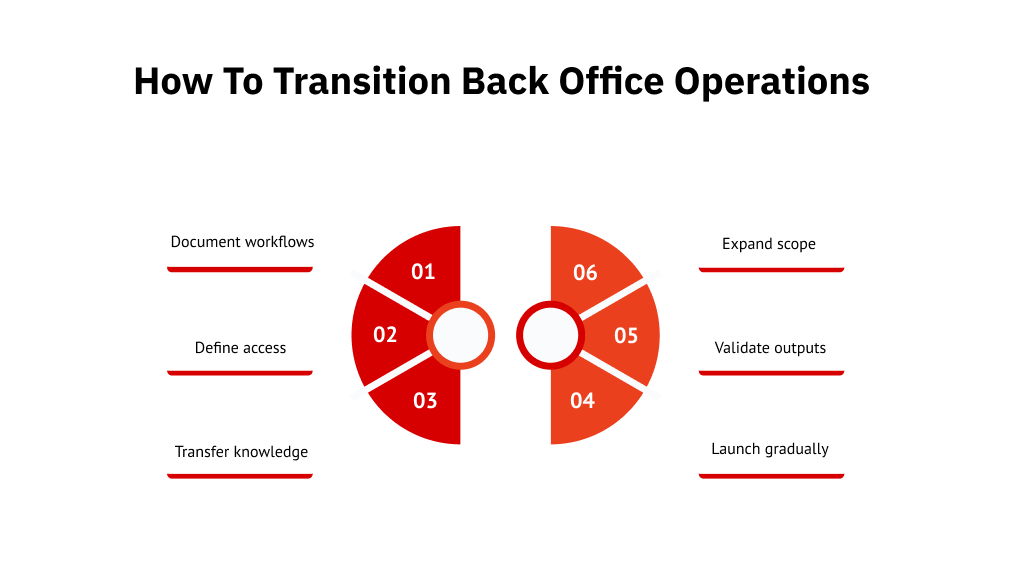
Transition outsourced back office operations in stages, using documented workflows, restricted access, and output checks before expanding the workload. Begin with source records and approval requirements, then test whether the provider produces acceptable outputs.
Establish clear operational handoffs
Map the path from incoming records to assigned tasks, including when exceptions return to your team for approval. Limit access to records and systems needed for assigned work.
Both teams should test routine and difficult records during knowledge transfer to identify missing instructions. Assign responsibility for distributing tasks, updating procedures, approving exceptions, and accepting finished work. If your agreement allows, begin with a smaller workload to test handoffs before expanding.
Review performance before expanding service scope
After initial processing, compare accepted outputs, corrections, and unresolved exceptions against your baseline. Review reports to confirm pending work is visible and each unresolved issue has an assigned owner.
If errors recur, investigate training gaps or source-data problems before increasing volume.
Expand only when outputs meet agreed standards, escalations receive timely responses, and your team monitors progress.
| Implementation tip: Track recurring exceptions separately from isolated mistakes. Agree who can authorize changes to processing rules before expanding service. |
Where does First Credit Services fit within enterprise back-office outsourcing?
At First Credit Services, we support financial administration, customer engagement, and revenue recovery through managed programs backed by compliance expertise. Inaccurate account information and unresolved payment questions can create repeat work for finance teams when follow-up responsibilities are unclear.
Our services address two operational needs:
- Financial administration: Accounting, bookkeeping, and healthcare Extended Business Office support for designated workflows and account records.
- Engagement and recovery: Consumer-account outreach, payment follow-up, and account resolution under the agreed recovery program.
An inaccurate balance may require your approval before our outreach team can continue customer follow-up. We document that approval handoff within the agreed program.
When digital engagement is appropriate, we operate our UCEP (Unified Consumer Engagement Platform) on your behalf. It supports consumer outreach and payment options within applicable programs, separate from general back-office processing.
Reduce rework and delays with back office outsourcing services
Well-scoped back office outsourcing services reduce rework and delays through clear responsibilities and measurable completion standards. A delayed account update can still trigger days of avoidable work when those controls are missing.
Payment questions remain unresolved, corrections bounce between teams, and managers investigate exceptions while new transactions arrive. As the backlog grows, staff must split their time between resolving old exceptions and processing new transactions.
Prioritize the workflow consuming the most staff time, then use existing benchmarks to define the results you expect. With those requirements, ask shortlisted providers how they correct rejected records, escalate unresolved cases, and report unfinished work.
Look beyond quoted fees to the hours your managers still spend supervising the process. The strongest proposal shows where workload decreases and how you can verify it.
Ready to reduce back-office bottlenecks without losing control? Discuss managed-service support with us for your priority workflows.
FAQs
1. Can businesses use more than one back-office outsourcing provider?
Yes, businesses can use multiple providers for different functions or regions. Align reporting standards and appoint an internal owner for work that crosses provider boundaries.
2. Who owns records created by an outsourced back-office team?
Ownership of outsourced records depends on the contract and applicable law. Specify rights to newly created files, supporting documents, and process instructions, including any limits on provider reuse.
3. How long does it take to implement back office outsourcing services?
There is no fixed implementation timeline for back office outsourcing services. Duration depends on workflow complexity, data readiness, and system access. Request milestones covering testing, approvals, and the start of live processing.
4. Can outsourced back-office teams work in our existing software?
It depends on the provider’s capabilities, your software, and access requirements. Confirm compatibility, user permissions, and licensing responsibilities before finalizing the arrangement.
5. How can outsourced finance teams meet month-end reporting deadlines?
Outsourced finance teams can meet month-end deadlines through agreed cut-off times, complete inputs, and timely reviews. Confirm coverage for close-period volume and procedures for flagging missing records before reports are due.
6. Does every outsourced healthcare billing service need a business associate agreement?
No. A business associate agreement is generally required when a vendor handles protected health information on a covered entity’s behalf. The parties’ roles and actual services determine applicability.