

Is your front desk struggling to answer patient calls while checking people in?
If so, healthcare call center outsourcing lets you hand part of that phone load to a specialized partner. Each missed call can mean a lost appointment, a delayed payment, or a patient who goes elsewhere.
Hiring more front-desk staff helps, but it takes time and still leaves peak hours exposed. A faster route is to decide which calls truly need your own team. You can then hand the repeatable ones, such as reminders, scheduling, and billing questions, to a secure partner. Along the way, measure the results against clear service levels.
This guide covers what to outsource, real costs, HIPAA safeguards, KPIs, rollout steps, and partner selection.
What is healthcare call center outsourcing?
Healthcare call center outsourcing is when a hospital or medical group hires a specialized partner to handle patient calls. The partner manages scheduling, reminders, insurance and billing questions, refills, and after-hours coverage under a HIPAA Business Associate Agreement (BAA).
The BAA sets how the partner may use and protect patient data. In addition, agents use your systems and follow your scripts. As a result, patients get the same experience as calling your office.
The scope varies by organization. For example, some start with after-hours coverage, while others build a full patient call center. Either way, outsourced calls form one part of a broader healthcare business process outsourcing strategy.
With that scope in mind, decide which calls a partner should take.
Outsource vs. keep in-house: where the line falls
The split comes down to clinical judgment. If a call requires a licensed clinician to answer, it stays with your team. By contrast, a trained partner agent can handle any call that follows a repeatable script.
Each call type below is rated on two factors: protected health information (PHI) exposure and clinical risk.
| Call type | PHI exposure | Clinical risk | Recommendation |
| Scheduling and rescheduling | Moderate | Low | Outsource |
| Reminders and recall | Low | Low | Outsource |
| Eligibility and benefits checks | High | Low | Outsource, with system access configured before launch |
| Billing and payment calls | High (plus card data) | Low | Outsource to a partner with PCI DSS-compliant payment handling |
| Refill request intake | Moderate | Medium | Outsource intake only, with a written escalation rule |
| Symptom or clinical questions | High | High | Keep with your licensed staff or a nurse triage line |
| Complaints and grievances | Moderate | Medium | Keep in-house or co-manage with the partner |
As a firm rule, agents recognize clinical calls and transfer them to your clinical team immediately. They never answer a clinical question themselves.
At the same time, the repeatable calls in this table are the ones that strain an in-house front desk the most.
Why patient calls are hard to staff in-house
Outsourcing makes sense when your in-house team has hit real limits. For most healthcare organizations, those limits appear in two places. Patients still rely on the phone, and the staff answering it are already doing another job.
The phone is still the front door
Patient portals handle routine tasks well. However, exceptions, urgent questions, refill issues, and billing disputes still send patients to the phone.
A December 2025 MGMA Stat poll asked 236 practice leaders to name their top patient-access focus for 2026. No-shows led at 27%, followed by online scheduling at 24%. Phone access came next at 22%, ahead of wait times at 21%. Even with online scheduling in place, the phone remains the channel patients choose for anything unusual.
| Did you know? Practice leaders focused on phone access for 2026 are expanding call centers and centralized phone operations. Many are also adding callback options and extra staff at peak times. |
Those calls land on a front desk that already has a full workload.
Front-desk staff are doing two jobs
Your front-desk team checks patients in, verifies insurance, and answers the phones. During peak hours, the phone is often the first task to slip.
Moreover, those calls are rarely quick. In a March 2026 MGMA Stat poll, eligibility and prior authorization topped the list of time-consuming phone tasks at 45%. Scheduling followed at 31%.
On top of that, staffing gaps are common. Almost half of physicians work short-staffed over a quarter of the time, per a 2025 JAMA Internal Medicine study.
Instead of hiring, you can hand that overflow to a partner. At First Credit Services, our four global call centers handle more than 125 million interactions a year. We tailor each healthcare customer service program to your requirements and budget.
Before you pick a starting point, see the full range of services a partner can cover.
What services can you outsource to a healthcare call center?
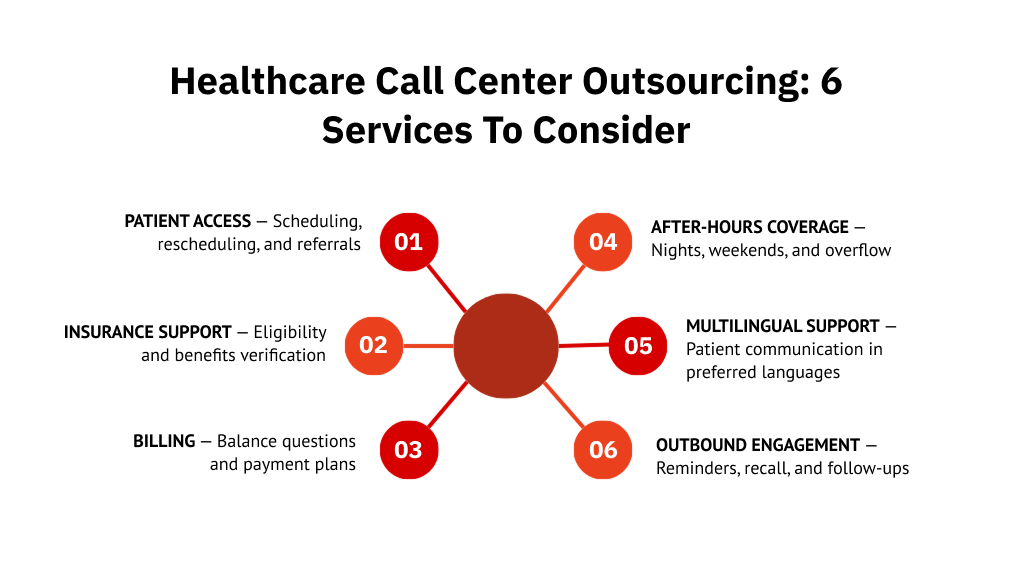
Medical call center outsourcing covers far more than incoming calls. The table below shows each service, what it protects, and the metric to track.
| Service | What it covers | What it protects | Metric to track |
| Patient access | Scheduling, rescheduling, cancellations, waitlist backfill, referral updates | Full schedules and new-patient revenue | Booking accuracy; appointments per 100 calls |
| Insurance and admin support | Eligibility checks, prior-auth status, pre-registration | Fewer denials and day-of-visit surprises | Share of visits verified before the appointment |
| Billing and payment calls | Balance questions, payment plans, card payments | Patient trust and faster self-pay resolution | First-call resolution; payment plans set up |
| After-hours and overflow | Nights, weekends, peak-hour spillover | Calls that would otherwise reach voicemail or a competitor | Average speed of answer at peak |
| Multilingual support | Spanish and other languages | Equal access for all patients | Calls handled in the patient’s preferred language |
| Outbound engagement | Recall, post-discharge follow-up, campaigns, surveys | Return visits and continuity of care | Contact rate; appointments from outreach |
Each service needs its own setup, and patient access is the natural place to start.
Patient access: scheduling, reminders, and referrals
First, share your scheduling rules by provider and visit type before go-live. That way, agents never book a slot your clinicians would reject. Agents should also read back the date, time, and prep steps before ending each call.
| Pro tip: Start with reminder and recall calls. They carry the least risk and let you test the partner’s quality before handing over live scheduling. |
Next, insurance calls depend on system access more than scripts.
Insurance and administrative support
Plan agent access to your practice management system and payer portals before launch, including the audit trail. Equally important, define which questions agents answer and which go back to your billing or authorization team.
Billing calls bring a further requirement: secure payment handling.
Patient billing and payment calls
These calls need their own scripts for plain-language balance explanations, payment-plan options, and PCI DSS-compliant card handling. Beyond that, build a warm handoff to extended business office support for balances that need follow-up.
Coverage also needs to hold up after your office closes.
After-hours, overflow, and multilingual coverage
Write and test an after-hours escalation path to your on-call provider before the first live call. Similarly, match language coverage to your patient population using your registration data. Otherwise, gaps surface fast as abandoned calls and complaints.
Outbound patient engagement
Run outreach across voice, SMS, and email from one patient record. That prevents duplicate contacts about the same issue. Before the first campaign, set opt-out handling and contact-frequency rules.
Once you know which services you need, the remaining question is how much of the work to hand over.
In-house vs. outsourced vs. hybrid: which model fits?
The right model depends on your call volume, clinical mix, and how much control you need over day-to-day operations. Here is how the three options compare:
| Factor | In-house | Fully outsourced | Hybrid |
| Staffing | You hire, train, and replace staff | Partner hires and trains agents | Core team in-house; partner covers set call types or hours |
| Peak and overflow | Limited by your headcount | Partner adds agents as volume rises | Overflow routed to the partner |
| After-hours | Requires night and weekend shifts | Included in the service | Usually the first function outsourced |
| Technology | You buy and maintain it | Partner supplies it or works in your systems | Shared; call routing must be configured carefully |
| Day-to-day control | Direct | Through SLAs and QA reviews | Direct for in-house calls, SLA-based for the rest |
| Cost profile | Fixed payroll | Variable, tied to volume or agents | Mix of fixed and variable |
| Best for | Low volume or highly clinical call mix | High volume, repeatable calls, multiple sites | Keeping clinical calls while offloading the rest |
A hybrid model is a common entry point into healthcare BPO. You keep clinical and complex calls with your own staff. Meanwhile, the partner takes repeatable, high-volume calls. Over time, a hybrid program can grow into broader customer service outsourcing as the partner proves itself.
That split now has a third player: AI that answers before a person does.
Where AI fits, and where it doesn’t
The same December 2025 MGMA poll found that phone-focused practices are adding AI for answering, triage, and call tracking. AI suits status checks, reminders, and after-hours intake. That said, billing disputes, anxious callers, and clinical questions still need a trained person.
Whichever model you choose, work out its true cost before you sign.
What healthcare call center outsourcing really costs
Cost is often the first question leaders ask. Before you compare outsourced pricing, work out what one in-house agent costs today.
The true cost of one in-house agent
To start, federal data gives you a solid baseline. The wage comes from the BLS Occupational Outlook Handbook, 2026. The benefits share comes from the BLS Employer Costs for Employee Compensation, June 2026.
| Line item | Figure |
| Median hourly wage, customer service representatives (May 2025) | $21.53 |
| Benefits as a share of private-industry compensation (June 2026) | 30.0% |
| Loaded cost per hour ($21.53 ÷ 0.70) | ≈ $30.76 |
| Loaded cost per year (2,080 hours) | ≈ $64,000 |
| Not yet included | Supervisors, QA, phone systems, EHR integration, recruiting, and retraining |
Even then, that $64,000 covers only one agent working standard hours. Add supervisors, quality assurance, technology, and turnover, and the real figure climbs higher. Consequently, staffing a full patient call center in-house costs far more than payroll alone.
By comparison, outsourced models spread those costs differently.
How outsourced pricing works
Partners typically price their services in one of four ways.
| Pricing model | How you’re billed | Best fit | Watch out for |
| Dedicated agent (per hour or FTE) | Flat rate per agent assigned to you | Steady daily volume, complex scheduling rules | Paying for idle time when volume drops |
| Shared agent (per hour) | Hourly, with agents serving several clients | Low or uneven volume, after-hours coverage | Less familiarity with your protocols |
| Per minute | Billed on talk time | Overflow and seasonal spikes | Long calls raise the invoice quickly |
| Per call or contact | Flat fee per call handled | Repeatable, well-defined call types | Disputes over what counts as a billable call |
| Pro tip: Compare partners on cost per resolved call: loaded hourly cost ÷ (calls resolved per hour × occupancy). At $30.76 an hour and 85% occupancy, six calls an hour costs about $6.03 per call. At four calls an hour, the cost rises to $9.05. |
Of course, a low rate means little if the partner cannot protect your patients’ data.
HIPAA and compliance: what a safe partnership requires
Compliance is the non-negotiable part of medical call center outsourcing. Above all, every arrangement that touches PHI needs legal and technical safeguards before the first call.
The Business Associate Agreement
Under HIPAA, any vendor handling PHI for you is a business associate, per HHS Business Associates FAQs, 2026. Your BAA must define permitted PHI uses, safeguards, and incident reporting. The vendor must also sign BAAs with its subcontractors. Even so, oversight of the relationship stays with your organization.
| Did you know? A carrier that only transmits PHI counts as a “conduit” and needs no BAA. Any vendor that accesses PHI regularly to do its job needs one. |
Alongside the contract, you need proof that day-to-day safeguards work.
Safeguards to verify
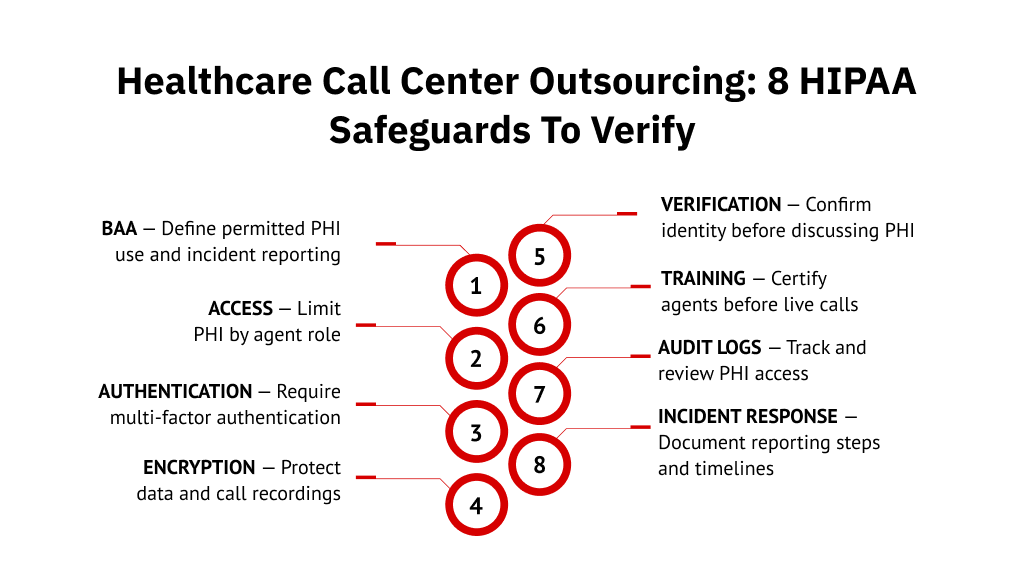
Ask the partner for evidence on each of these controls.
| Safeguard | What to verify | Evidence to request |
| Minimum-necessary access | Agents see only the PHI their role requires | Role-based access matrix |
| Strong authentication | MFA on every system holding PHI | Access policy |
| Encryption | Data and call recordings encrypted in transit and at rest | Security documentation |
| Caller verification | Identity confirmed before any PHI is discussed | Verification script |
| Workforce training | HIPAA training completed before agents take live calls | Training records |
| Offboarding | Access removed as soon as an agent leaves | Offboarding procedure |
| Audit logs | PHI access logged and reviewed | Sample log review report |
| Incident response | Defined steps and timelines for reporting incidents to you | Written incident-response plan |
Notably, payment data falls under its own standard.
Beyond HIPAA: payments and security attestations
Card payments taken by phone fall under the Payment Card Industry Data Security Standard (PCI DSS). Likewise, a SOC 2 Type II report shows whether a partner’s controls hold up over time. Request it before you sign.
At FCS, we are PCI DSS compliant and maintain AICPA SOC reporting. Our clients’ patient and payment data stays under independently audited controls.
With contracts and controls settled, your SLA numbers decide whether the partnership works.
KPIs that prove your outsourced call center is working
Ahead of launch, write these numbers into your service-level agreement (SLA). For a public benchmark, look to the Centers for Medicare & Medicaid Services (CMS). Its 2026 Part C and Part D call center monitoring memo sets standards for Medicare plan call centers.
Although those rules bind Medicare plans, they make a useful reference point for any healthcare customer service team.
| KPI | Benchmark | What it tells you |
| Average hold time | 2 minutes or less (CMS standard) | How long your patients wait before reaching a live person |
| Disconnect rate | 5% or less (CMS standard) | Share of calls dropped on the call center’s side |
| Average speed of answer | Your own 3-month baseline | How quickly calls are picked up overall |
| Abandonment rate | Your own 3-month baseline | Share of callers who hang up before getting an answer |
| First-call resolution | Your own 3-month baseline | Whether the issue was solved without a callback |
| Booking accuracy | Your own 3-month baseline | Whether the right appointment was booked |
| Did you know? CMS monitoring shows that hold times run longer than normal at the start of the year. CMS suggests call centers consider extra staffing during busier periods. |
For every other KPI, baseline your own three-month average and hold the partner to it. From there, review the SLA quarterly as volume and call mix shift.
Ultimately, clear targets make the move to a partner far easier to stage.
Moving patient calls to a partner, step by step
At this stage, the move itself follows five steps. Each one limits risk while your healthcare BPO partner proves itself.
- Baseline your calls. Pull three months of data by call type, hour, and outcome. This baseline shows what to outsource and sets your SLA starting point.
- Pick the first call types. Use the outsource vs. keep table from earlier. Start with repeatable, non-clinical calls such as reminders and recall.
- Set the rules. Sign your BAA and agree on SLA targets. Then write a clinical escalation tree so agents know exactly where each clinical call goes.
- Pilot small. Start with one location or one call type. Test scripts and system access thoroughly before go-live.
- Review, then expand. Hold weekly reviews at first. Add scheduling once hold time and booking accuracy stay on target for about six weeks.
| Pro tip: Ask the partner to walk you through these five steps for a healthcare client it already serves. Its answer shows how often it has done this before. |
Naturally, that request belongs in a wider set of questions for any partner.
Questions to ask before you choose a healthcare call center partner
A polished pitch tells you little about how a partner will run your patient call center. To that end, ask each candidate these questions and request evidence for every answer.
| Question to ask your partner | Evidence to request | Warning sign |
| Have you served healthcare organizations like ours? | References from organizations of similar size and specialty | Only non-healthcare clients |
| Will you sign our BAA and flow it down to your subcontractors? | Signed BAA and subcontractor list | “We only sign our own template” |
| How do agents escalate clinical calls? | Written escalation protocol | Agents answer symptom questions |
| What security reports can you share? | SOC 2 Type II and PCI DSS documentation | Badges on a website with no reports behind them |
| Have you worked in our EHR? | A reference client on the same system | Agents re-enter data in a separate tool |
| How many calls do you QA-score each week? | QA sample size and scoring guide | QA only after a complaint |
| Can you handle billing and payment calls? | Payment-plan scripts and PCI process | Billing calls routed back to your staff |
Additionally, watch for a few avoidable mistakes during selection.
Common mistakes to avoid
Even a careful selection process can stall on a few predictable errors. Thankfully, each one is easy to prevent once you know what to look for.
- No internal owner: Without one accountable person, SLA misses go unchallenged and issues drift.
- Moving every call type on day one: A pilot surfaces script and system problems while the stakes are still small.
- Measuring the wrong number: A high answer rate can hide repeat calls. Track first-call resolution to see whether problems actually get solved.
- Ignoring your revenue cycle: Check how the call partner fits your wider healthcare revenue cycle needs, especially billing follow-up.
In short, the right partner is the one that backs every answer with proof.
Better patient access starts with the right call partner
Healthcare call center outsourcing delivers the most value when it runs as a managed program. Each phase starts with a clear baseline and ends with a review that shapes the next one.
To recap, hand off repeatable, non-clinical calls to a partner and keep clinical judgment with your team. After that, sign your BAA and verify safeguards before any PHI changes hands. Pilot one call type, then expand once your KPIs hold steady.
Throughout, judge the partnership on hold time, resolution, and cost per resolved call. A high answer rate alone can make a struggling patient call center look healthy.
Find out how many more patient calls your team could answer. Contact us to discuss a patient call program that answers faster, protects patient data, and keeps billing calls respectful.
FAQs
1. What is the difference between a healthcare call center and a medical answering service?
A medical answering service mainly takes messages and passes them to your staff, often after hours. A healthcare call center resolves the request during the call and records the outcome in your systems.
2. Can an offshore call center handle our patients’ protected health information?
HIPAA does not prohibit offshore access to PHI, but the same BAA and safeguards apply. Medicare Advantage plans must collect safeguard details on offshore vendors for CMS. Some states, such as Florida, restrict offshore storage of patient records.
3. Who owns the call recordings and transcripts a partner creates?
Your contract should state that recordings and transcripts belong to your organization. Any recording containing PHI also falls under your BAA. Set retention periods, access rights, and deletion rules before go-live.
4. What happens to our patients’ data if we switch call center vendors?
HIPAA requires your BAA to provide for return or destruction of PHI at contract end, where feasible. Your contract should also set an export format, a timeframe, and written confirmation of destruction.
5. Do outsourced appointment reminder calls and texts need patient consent?
Automated calls and texts to mobile numbers fall under the TCPA. A 2015 FCC ruling exempts certain healthcare messages, like appointment reminders, from prior consent if they’re free to patients. Billing messages are not exempt.
6. Do state privacy laws apply to an outsourced healthcare call center?
Yes. HIPAA sets a federal floor, and stricter state health privacy laws still apply. Depending on where your patients live, your partner may face extra rules on consent or breach notice.