

Before an agency recovers your first dollar, it starts affecting how customers remember your business.
When overdue accounts pile up and your recovery team is stretched, outsourcing can offer breathing room. But additional capacity comes with a responsibility to examine how the agency pursues payment.
3rd party debt collection call center outsourcing means placing delinquent or charged-off accounts with a licensed outside agency. Its agents contact consumers, negotiate payments, and handle disputes under the agency’s name.
That arrangement can still expose your business to compliance risk. A missed consent revocation or mishandled dispute can lead to complaints and potential liability. Evaluate controls for the Fair Debt Collection Practices Act (FDCPA), Regulation F, the Telephone Consumer Protection Act (TCPA), and applicable state requirements before placing accounts.
This guide covers provider evaluation, compliance controls, operating models, costs, and KPIs. It also outlines a 90-day onboarding plan to establish oversight from the start.
What to evaluate in a third-party collection call center
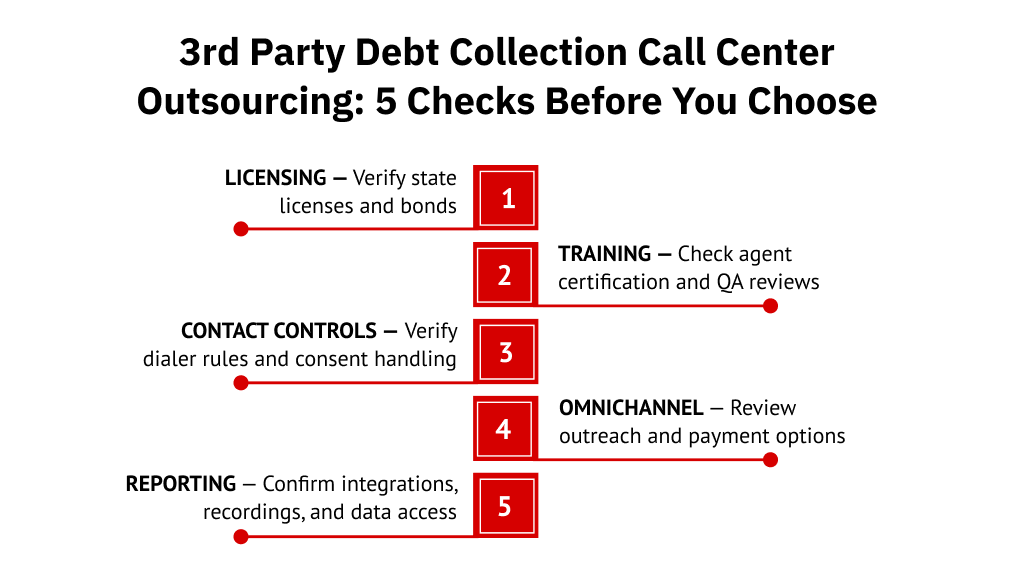
Assess these five capabilities to understand how a provider will manage your accounts and support your recovery goals.
1. Licensing and legal scope
Start by confirming that the provider is authorized to operate as a third-party collection agency under its own name. A business process outsourcing (BPO) provider that only supplies agents does not meet that requirement. Then verify the licenses and bonds required in each state where the agency will collect.
2. Agent training and quality assurance
Next, check how agents are prepared for live calls. Require documented training and competency assessments on the FDCPA and Regulation F, supported by practical scenarios involving hardship, vulnerable consumers, and disputes. To assess ongoing performance, ask for a written quality assurance (QA) scorecard and monthly calibration sessions.
3. Dialer and contact strategy
Agent training needs support from the right contact controls. The provider should prioritize accounts using balance, delinquency age, prior placements, and payment history. Skip tracing and best-time-to-call data can improve contact accuracy. Meanwhile, built-in dialer controls should enforce applicable call-frequency restrictions and calling hours.
4. Omnichannel outreach and payments
Beyond calls, look for SMS, email, letters, and a self-service portal connected through one omnichannel workflow. Across these channels, payment plans and settlements should remain within your approved limits. For card payments, verify compliance with the Payment Card Industry Data Security Standard (PCI DSS).
5. Reporting and integration
To oversee this activity, your team needs reliable access to account information. Account status, payments, and notes should sync with your servicing or billing system. Confirm access to dashboards, call recordings, and QA results, along with standard data exports that let you move providers without losing account history.
Use this checklist to compare providers:
| Criterion | What to verify |
| State licensing and bonding | Active licenses and bonds in every required state, held by a named entity |
| Contact rule enforcement | Dialer blocks calls that breach Regulation F limits or calling hours |
| Consent and opt-out handling | Revocations sync to the dialer, SMS, and email systems |
| Agent certification and QA | Pre-launch certification, written QA scorecard, monthly calibration |
| Call recording | 100 percent of calls recorded with retention long enough for complaints and exams |
| Dispute and hardship escalation | Collection pauses on written disputes; hardship cases route to senior collectors |
| Omnichannel coverage | Calls, SMS, email, letters, and self-service portal in one workflow |
| Security certifications | Current Service Organization Control (SOC) 2 report and PCI DSS attestation |
| Reporting transparency | Real-time KPIs, including complaint rates and QA results |
| Pricing transparency | Full fee breakdown, including pass-through costs |
| Pro tip: Do not just listen to a provider’s best recorded call. Ask for three: a payment, a dispute, and a consumer who says it is a bad time to talk. How agents handle the hard calls tells you more about the floor than how they handle the easy ones. |
A provider that pairs its call floor with a digital engagement platform gives consumers who miss calls a way to self-serve.
Why compliance decides the shortlist
Compliance is the first filter because the consequences of a violation land on your business, regardless of which agency caused it.
Why your business still carries the risk
Outsourcing shifts the work, but accountability stays with your business. You are still expected to oversee every provider that collects on your behalf.
U.S. household debt reached $18.8 trillion by the end of 2025. According to the New York Fed Q4 2025 report, 4.8 percent of balances sat in some stage of delinquency. As that volume reaches outside agencies, the compliance stakes rise with it.
One misconfigured dialer rule can repeat across thousands of your accounts in a single day. That is why compliance should be evaluated before rate or recovery claims.
Under Regulation F and FCC consent-revocation rules, a collection call floor must stay within these limits:
| Requirements | What’s allowed | What’s not allowed |
| Call frequency | Up to 7 attempts within 7 days per debt | An 8th attempt within 7 days, or calling within 7 days after a conversation about the debt |
| Contact times | Between 8 a.m. and 9 p.m. in the consumer’s local time | Contact outside those hours or at times the consumer has flagged as inconvenient |
| Required disclosures | Identifying as a debt collector in every communication | Calls or texts that omit the disclosure |
| Channel requests | Stopping a channel the consumer asks the collector not to use | Continuing on a channel the consumer has blocked |
| Consent revocation | Honoring revocation by any reasonable means within 10 business days | Requiring one specific method or missing the deadline |
| Validation notice | Providing accurate debt details in the first communication or within 5 days | Missing details, incorrect amounts, or ignoring a returned notice |
Compliance questions to ask every provider
- Can you show your dialer’s Regulation F settings and a sample exception report?
- How fast does a revoked consent or cease request reach every channel?
- What happens when a validation notice comes back undeliverable?
- What is your complaint rate per 1,000 accounts, and who investigates each one?
| Did you know? According to the Consumer Financial Protection Bureau 2025, the monthly average of complaints about attempts to collect debt not owed rose 115 percent in 2025 compared with the prior two years. Consumers also complained about calls made too often or outside permitted hours. |
The operating model you choose determines cost, control, and how fast the provider can scale.
1. Dedicated collection team
Agents work only your accounts, using your scripts and QA standards. This model gives your business the most control over tone and escalation rules, at a higher fixed cost. It fits large or regulated portfolios with steady volume.
Agents work several businesses’ placements on the same floor. This model costs less and flexes with seasonal or uneven volume. It suits mid-size portfolios or new programs.
3. Onshore, offshore, or blended delivery
Onshore teams simplify licensing and oversight but cost more per hour. Offshore sites lower labor costs, though they require tighter QA. Blended models keep licensed negotiation onshore and move skip tracing, data work, and back-office tasks offshore.
Here is an overview of these models:
| Factor | Dedicated team | Shared floor | Blended onshore/offshore |
| Who works your accounts | Agents assigned only to your business | Agents serving multiple businesses | Onshore collectors plus offshore support |
| Control over scripts and QA | Full | Limited to shared standards | Full for onshore; shared for support tasks |
| Cost structure | Highest fixed cost | Lowest cost | Moderate |
| Scalability | Slower; hiring tied to your volume | Fast | Fast for support tasks |
| Oversight effort | Low to moderate | Moderate | Higher, more sites to audit |
| Best fit | Large, regulated portfolios | Mid-size or seasonal portfolios | High-volume programs balancing cost and control |
It’s recommended to look for a partner with the operational infrastructure to scale with your volume.
What does a 3rd party debt collection call center outsourcing cost?
Pricing varies by service model, account volume, and the type of debt placed. To compare providers accurately, consider both the quoted rate and any additional charges.
Common pricing models
Start by understanding how the provider charges. The models below tie fees to the recovered revenue, staffing capacity, or a combination of both.
| Pricing model | How it works | Best fit |
| Contingency | Provider earns a percentage of the amount collected | Late-stage and charged-off placements |
| Per-agent or hourly | Fixed fee per agent or agent hour | Dedicated teams with steady volume |
| Hybrid | Base fee plus a performance bonus | Large programs that want shared risk |
What moves the rate
Within each model, account age, balance size, and prior placements influence the quoted rate. Additional channels, language requirements, and extended service hours can also increase complexity.
Documentation quality matters, too. Incomplete records can raise costs because agents need more time to verify details and resolve each account.
Hidden costs to ask about
Before comparing final quotes, request an itemized breakdown of charges that sit outside the main fee:
- Data mapping and integration: Check whether setup and system integration are included or billed separately
- Licensing pass-throughs: Ask whether state licensing or bonding expenses will appear as additional charges
- Messaging and carrier fees: Confirm how SMS, carrier, and dialer charges are calculated as volume grows
- Exit and data return: Clarify termination fees and the cost of exporting or returning your account data
Which KPIs and SLAs should be in the contract?
These metrics show whether the floor is recovering revenue and following the rules.
| Category | KPI | Formula | What it tells you |
| Recovery | Liquidation rate | $ collected ÷ $ placed | Headline measure of recovery performance |
| Recovery | Right-party contact rate | Right-party contacts ÷ accounts attempted | Whether outreach reaches the right consumer |
| Recovery | Promise-to-pay kept rate | Promises kept ÷ promises made | Quality of arrangements, not just volume |
| Efficiency | Cost to collect | Total program cost ÷ $ collected | True efficiency beyond the headline rate |
| Efficiency | Payment plan completion rate | Plans completed ÷ plans set up | Whether arrangements are affordable |
| Efficiency | Time to first contact | Days from placement to first right-party contact | How quickly the floor works new placements |
| Compliance | QA pass rate | Calls passing all checks ÷ calls scored | How consistently agents follow the rules |
| Compliance | Compliant | Complaints ÷ accounts worked × 1,000 | Early warning for regulatory and brand risk |
| Compliance | Dispute resolution time | Average days from dispute to resolution | Whether escalation works in practice |
| Pro tip: Tie part of the provider’s fee to compliance KPIs, rather than only liquidation. A floor paid solely for dollars collected has every incentive to push harder than the rules allow, and your business carries that risk. |
Common mistakes when outsourcing debt collection
Problems that surface after placement often begin with gaps in provider selection or oversight. Avoid these four mistakes:
- Comparing providers on headline rate alone: A low contingency or hourly rate reveals little about licensing coverage or QA. Instead, evaluate cost to collect alongside compliance controls and service quality.
- Skipping your own call reviews: Without regular reviews, problems may go unnoticed until consumers complain. Listen to recordings consistently, then follow up on corrective action.
- Treating every account the same: Fresh placements, aged balances, and previously worked accounts need different approaches. Segment accounts first, then adapt scripts and outreach strategies to each group.
- Letting the provider define success: Provider-selected metrics may emphasize activity over recovery outcomes. To establish clear expectations, agree on KPIs before the first placement as part of your process for hiring a collection agency.
How to onboard an outsourced collection floor
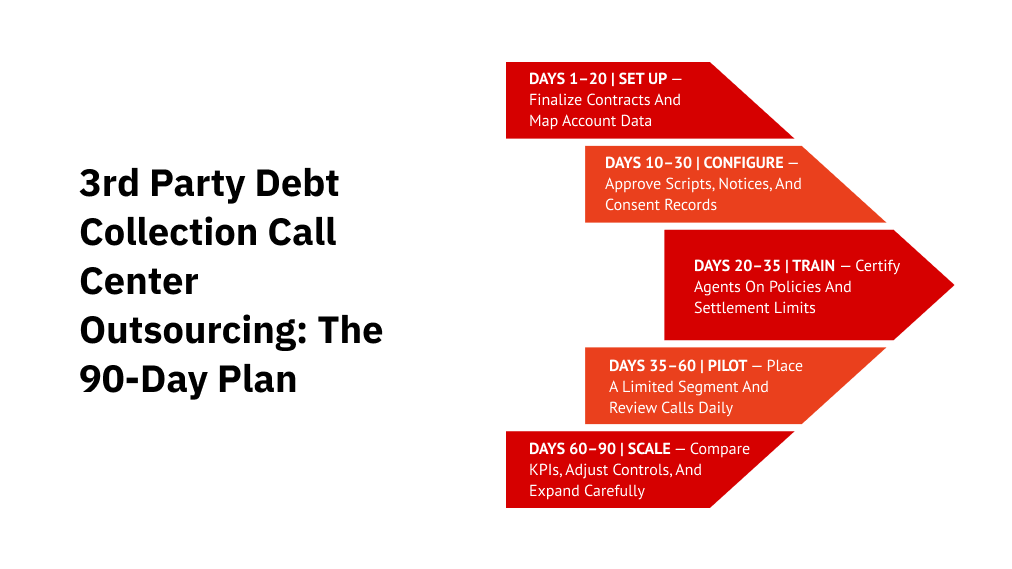
This phased plan keeps your portfolio under control during transition.
- Contract and data setup (Days 1 to 20): Sign the agreement, map placement fields, and agree on reporting formats.
- Compliance setup (Days 10 to 30): Approve scripts and validation notices, load consent and cease records, and run scrubs.
- Agent training (Days 20 to 35): Train and certify agents on your accounts, policies, and settlement limits.
- Initial placement (Days 35 to 60): Place one segment, review calls daily, and calibrate QA scores together.
- Review and scale (Days 60 to 90): Compare results against your in-house team or current agency, then scale, adjust, or exit.
| Pro tip: Run the new provider against your current process on matched account segments for the first 60 days. Comparable segments make the results hard to dispute on either side. |
How First Credit Services handles outsourced collection programs
At First Credit Services, we combine experienced collection teams with digital outreach to manage your outsourced recovery program. We bring more than 30 years of experience across four global call centers, handling over 125 million consumer interactions annually.
Here’s how we support your program:
- Agent training and oversight: We support our nationally licensed operation with dedicated training and compliance teams, alongside ongoing call monitoring.
- Data protection and industry standards: We follow HIPAA requirements and maintain PCI DSS Level 1 and SOC 2 Type II compliance. We also maintain our affiliation with ACA International.
- Coordinated omnichannel outreach: We operate our Unified Consumer Engagement Platform (UCEP) on your behalf, coordinating SMS, email, chat, and phone outreach based on each consumer’s engagement patterns.
- Self-service payment options: Through our digital payment portal, we give consumers a way to view balances, arrange payment plans, and pay without calling an agent.
We tailor this managed approach to mid-market and enterprise businesses that need capacity for high-volume placements in regulated industries.
Build a third-party collection program worth scaling
The value of outsourcing becomes clear when you can verify both the money recovered and how consumers were treated. Your partner should make that assessment straightforward, with transparent reporting and clear ownership when issues arise.
Start with a controlled pilot against agreed recovery and compliance targets. Then use the results to decide whether to expand placements. This gives your team a practical way to add collection capacity while maintaining oversight.
Talk to our collections team about planning your next account placement.
FAQs
1. Will my customers know which business placed their account with the collection agency?
Yes. Under Regulation F, the validation notice must name the creditor the debt is owed to. For debts tied to consumer financial products, it must also name the creditor as of the itemization date. Prepare your service team to confirm placements when consumers call.
2. Can an outsourced collection agency report my customers’ accounts to the credit bureaus?
Yes, if your contract allows it. However, the collector cannot furnish this information until it has spoken with the consumer or sent a notice and confirmed delivery. Timing and documentation matter as well.
3. Can a third-party agency collect on debts past the statute of limitations?
Collection can continue, but Regulation F bars suing or threatening to sue on a time-barred debt. Statutes of limitations vary by state, and some states add disclosure rules for older debts. Thus, flag the original delinquency date on every placement.
4. What happens if a customer files for bankruptcy after their account is placed?
The filing triggers an automatic stay under federal law, which generally requires collection to stop. Regulation F also prohibits placing or selling a debt the collector knows was discharged. Agree on how quickly the agency will notify you and return these accounts.
5. How must payments be applied when a customer owes more than one placed account?
Under Regulation F, the collector cannot apply any part of a single payment to a disputed debt. It must also follow the consumer’s instructions on allocation. Ask the agency how its payment system enforces this rule.
6. How are collected payments sent back to my business?
Agencies typically use gross remittance, sending the full amount and invoicing their fee separately, or net remittance, deducting the fee first. Confirm how direct payments are handled, how often remittances arrive, and what reconciliation report comes with each.