

When someone else calls your customer about an unpaid bill, your business’s reputation enters the conversation too.
By that stage, your team may have spent weeks following up without a commitment to pay. The balance is still outstanding, newer accounts need attention, and continuing the same approach is consuming time without moving recovery forward.
A debt collector can take over that effort. These professionals pursue overdue payments, either on a creditor’s behalf or on accounts they have purchased. However, who collects and who owns the debt are separate questions.
For example, hiring a collection agency can leave ownership with your business, while selling the account transfers it to a debt buyer. That difference affects your recovery strategy and the legal framework governing collection.
This article explains what debt collectors do, the four main types, and their responsibilities. It also covers the rules you need to understand before choosing your approach.
What is a debt collector?
The Fair Debt Collection Practices Act (FDCPA) provides the legal debt collector definition. Under 15 U.S.C. § 1692a, a debt collector is anyone whose principal business is collecting debts. The definition also covers anyone who regularly collects debts owed to another party.
Several types of entities qualify, such as:
- Third-party collection agencies fall under the FDCPA, along with law firms that regularly collect consumer debts.
- Creditors collecting under a different name also count when their approach suggests a third party is involved.
However, certain parties are excluded. For example, original creditors collecting under their own name fall outside the FDCPA’s scope. Their employees are also excluded, as are government officials acting in their official duties.
An important distinction is that the FDCPA applies only to consumer debts, such as credit card balances, medical bills, auto loans, and utility accounts. Commercial debts owed by businesses, however, generally fall outside its scope.
| Did you know? A creditor that collects under a different name can be treated as a debt collector. This applies when the approach suggests a third party is involved. |
What does a debt collector do? 6 core responsibilities
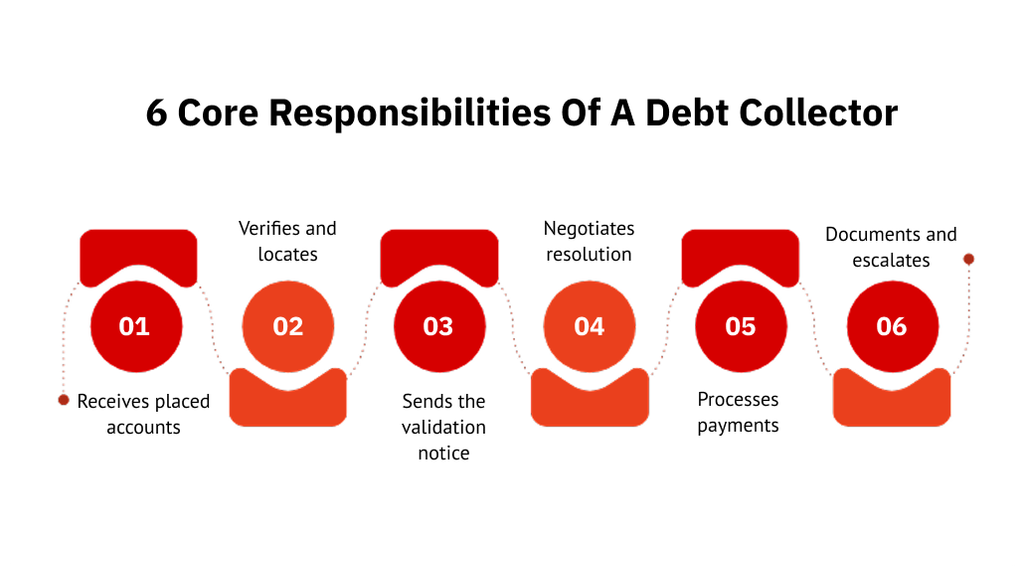
A debt recovery agent handles a creditor’s accounts from placement through resolution. Each step involves specific duties that protect both the creditor’s interests and the consumer’s rights.
- Receives placed accounts: The creditor transfers the balance, itemization, payment history, and contact details to the collector.
- Verifies and locates: The collector checks the data for accuracy and uses skip tracing to find current contact information.
- Sends the validation notice: This notice is due within five days of first contact. It states the amount owed, the creditor’s name, an itemized breakdown, and the consumer’s dispute rights.
- Negotiates resolution: The collector arranges lump-sum payments, installment plans, or settlements within the creditor’s authority.
- Processes payments: The collector accepts payments, remits funds to the creditor after deducting fees, and reconciles the account.
- Documents and escalates: The collector records every contact attempt, reports to credit bureaus where permitted, and returns or escalates unresolved accounts.
Thorough documentation at each stage protects the creditor in disputes. It also ensures the collector stays compliant with federal and state rules.
Types of debt collectors
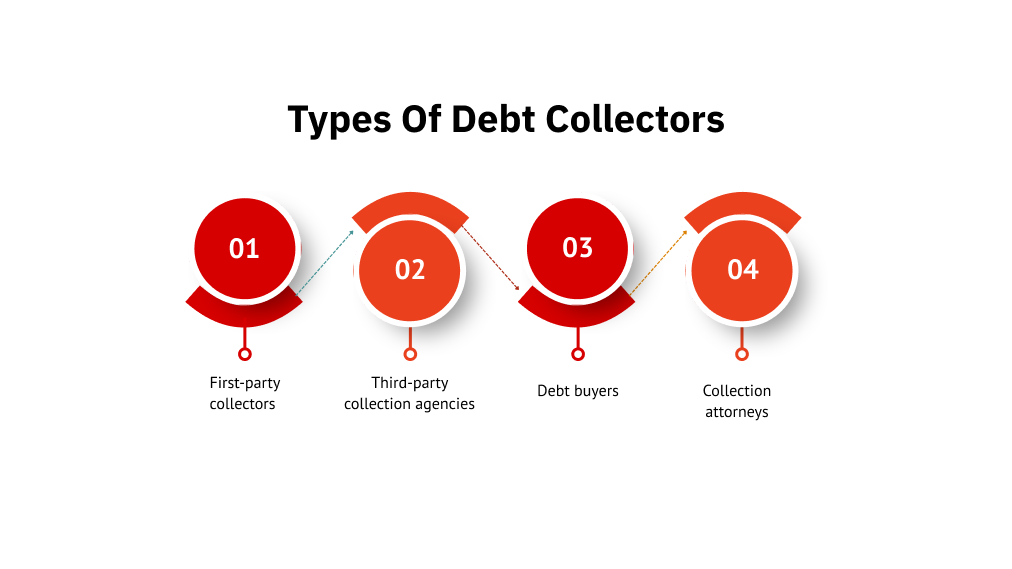
The following are the four main types of debt collectors operating in the U.S. market. Each one serves a different stage of the recovery timeline, and different rules apply depending on the type.
1. First-party collectors
First-party collectors work under the creditor’s brand. They handle accounts in-house or through an outsourced partner managing first-party collections.
These collectors focus on early-stage accounts, from the first missed payment through charge-off. Their primary goal is resolving the balance while keeping the customer relationship intact.
First-party collectors generally fall outside the FDCPA. Even so, they remain subject to state laws and federal UDAAP rules that prohibit unfair, deceptive, or abusive practices.
2. Third-party collection agencies
When internal and first-party efforts have been exhausted, the account typically moves to a third-party collection agency. These agencies collect under their own name on the creditor’s behalf.
The creditor retains ownership of the debt and sets the settlement limits. In return, the agency earns a contingency fee or a flat rate. Third-party agencies are fully covered by the FDCPA and Regulation F.
3. Debt buyers
In some cases, the creditor decides to sell the account rather than continue placing it. Debt buyers purchase portfolios of charged-off accounts at a discount and become the legal owner of the debt.
From there, they can collect in-house, place accounts with other agencies, or resell the portfolio. Yet, the FDCPA coverage depends on the business model. Many states also license debt buyers separately.
4. Collection attorneys
When recovery efforts reach a legal impasse, the matter may move to a collection attorney. These attorneys file lawsuits, obtain judgments, and enforce them through garnishment or liens.
Under the FDCPA, attorneys who regularly collect consumer debts count as debt collectors. The Supreme Court confirmed this in Heintz v. Jenkins (1995). Creditors, agencies, or debt buyers typically retain them as a last resort.
| Pro tip: Decide whether to place or sell an account before it leaves internal collections. Placing keeps ownership and control over how customers are treated. Selling brings immediate cash but hands the customer relationship to the buyer. |
Debt collector vs. creditor vs. debt buyer vs. collection agency: key differences
The FDCPA’s definition of a debt collector shapes how these four parties compare. Here is an overview:
| Factor | Original Creditor | Collection Agency | Debt Buyer | Collection Attorney |
| Owns the debt? | Yes, until sold | No | Yes | No |
| Customer pays | The creditor | The agency, which remits to the creditor | The debt buyer | The law firm, for its client |
| Covered by FDCPA | Generally no | Yes | Depends on business model | Yes, if it collects regularly |
| Earns money from | Interest and fees | Contingency or flat fee | Gap between purchase price and amount collected | Legal fees or contingency |
| When it appears | First missed payment to charge-off | After internal efforts end | After charge-off and sale | At litigation |
Every collection agency qualifies as a debt collector under the FDCPA. However, the reverse is not always true. Debt buyers and collection attorneys follow different rules depending on their business model.
How an unpaid bill ends up with a debt collector
An unpaid account moves through several stages before it reaches a collector. Each stage involves different teams, timelines, and recovery odds.
- Missed due date: The creditor sends reminders and may add late fees. Most accounts are resolved at this stage.
- 30 to 90 days past due: Internal collections begin. The creditor’s team follows early-stage debt collection strategies to recover the balance before it ages further.
- Charge-off: Open-end credit is written off at 180 days past due. Closed-end loans hit charge-off at 120 days, per OCC Bulletin 2000-20. The debt is still legally owed.
- Placement or sale: The account goes to a collection agency, with the creditor keeping ownership. Alternatively, the creditor sells it to a debt buyer.
- Legal action: Unresolved accounts may be referred to a collection attorney for litigation.
Consider a practical example. A cardholder misses a $1,500 payment in January. The issuer sends reminders through March and starts calling in April. By July, the account is charged off and placed with an agency.
If the agency cannot recover the balance, the issuer may later sell the account. At that point, the debt buyer becomes the creditor of record.
What sets First Credit Services apart as a professional debt collector
These five standards separate a professional collector from one that creates risk for creditors:
- Accurate data: Account details are verified before the first contact, reducing disputes and wasted outreach.
- Preferred channels: An omnichannel approach reaches consumers by email, SMS, chat, and phone. Every channel honors opt-outs.
- Flexible payment options: Payment plans and settlements are tailored to each consumer’s situation, increasing the likelihood of resolution.
- Self-service access: Consumers can view balances, set up plans, and make payments online without waiting for an agent.
- Full documentation: Every interaction is recorded, creating an audit trail that protects the creditor in disputes.
First Credit Services builds these standards into its operations through UCEP (Unified Consumer Engagement Platform), its proprietary digital debt collection platform. The platform uses behavioral data to choose the right message, channel, and timing for each consumer. Our self-service portal lets consumers resolve balances on their own terms.
| Pro tip: Before placing accounts, ask a collection agency for sample customer letters and its complaint-handling process. How it writes to customers reflects how they will judge your business. |
What debt collectors can and can’t do
The Fair Debt Collection Practices Act sets clear boundaries on what third-party collectors may and may not do. Here are the key rules:
| Action | Allowed |
| Call between 8 a.m. and 9 p.m., consumer’s local time | Yes |
| Call outside those hours | No, unless the consumer agrees |
| Contact others to find the consumer’s location | Yes, for location only |
| Discuss the debt with family, friends, or an employer | No |
| Report an accurate debt to credit bureaus | Yes |
| Sue to collect a valid debt | Yes |
| Threaten violence or arrest, or use obscene language | No |
| Misstate the debt, or pose as an attorney or government official | No |
| Add fees not allowed by the agreement or state law | No |
Beyond this table, you should pay attention to two more rules.
The validation notice is due within five days of first contact, per 12 CFR § 1006.34. It must state the debt amount, the creditor’s name, and the consumer’s right to dispute.
The dispute window gives consumers 30 days to dispute the debt in writing. Once a dispute is filed, collection pauses until the debt is verified, as outlined in 15 U.S.C. § 1692g.
How legitimate debt collectors prove they’re real
Consumers often struggle to tell legitimate collectors from scammers. According to the FTC’s debt collection guidance, five markers separate the two:
- Identify themselves clearly: They name their company, the creditor they represent, and a mailing address.
- Validate first: They send written validation before pressing for payment.
- Use verifiable contact details: Their phone numbers and payment channels can be confirmed through their website or the creditor.
- Hold required licenses: They are licensed or bonded where state law requires it.
- Accept standard payment methods: They never demand gift cards, wire transfers, cryptocurrency, or same-call payment.
For creditors, this matters directly. A collection partner that follows these practices reduces complaints and protects the creditor’s reputation. Conversely, a partner that cuts corners exposes the business to regulatory risk and customer backlash.
Choose a debt collector you can hold accountable
Your recovery strategy needs clear expectations for both financial results and customer treatment. Before placing accounts, agree on communication standards and the reporting your team needs. Then use those commitments to assess how the collector performs.
At First Credit Services, we help businesses manage overdue accounts through a collections approach tailored to their needs. Our experienced team combines personalized support with the right tools and processes to help businesses recover outstanding payments while treating consumers fairly and responsibly.
Looking for a collections partner? Connect with our team to explore how First Credit Services can support your business’s recovery goals.
FAQs
1. Does paying a collection account remove it from a consumer’s credit report?
No. A collection account can remain on a credit report for up to seven years, counted from 180 days after the original delinquency. Paying it updates the account status to “paid” but does not remove the entry.
2. Can a debt collector pursue a deceased customer’s debt?
Yes, but typically only from the estate’s assets. Relatives are liable only if they co-signed, held a joint account, or fall under certain state community property rules for surviving spouses.
3. Is a debt collector the same as a debt settlement company?
No. A debt collector recovers money for a creditor. A debt settlement company works for the consumer to reduce the total owed, and it cannot charge fees before a settlement is reached.
4. Can a debt collector garnish wages without a court order?
Generally, no. The collector must first file a lawsuit and obtain a court judgment. From there, wage garnishment becomes possible. Many federal benefits, including Social Security and veterans benefits, are generally exempt.
5. Can a debt collector pursue a debt after the statute of limitations passes?
The collector can still request payment. However, it cannot file a lawsuit or threaten legal action once the statute expires. In some states, making a partial payment can restart the limitations clock.
6. Can a debt collector call a consumer at work?
Yes, unless the collector knows the employer prohibits such calls. Once the consumer communicates that their employer does not allow work calls, the collector must stop all calls to that number.