


Sending repeated payment reminders rarely solves the challenge of recovering an overdue balance. For creditors, understanding how to collect past-due accounts starts with a consistent process across the account lifecycle.
Each account needs accurate records, timely outreach, and a clear path toward resolution. Without that structure, follow-ups become inconsistent, customer conversations lose context, and unpaid balances demand more internal attention.
Recovery begins with verifying account details and prioritizing accounts based on their current status. Teams then contact customers through appropriate channels, explain realistic payment options, and document each interaction.
When internal efforts stall, organizations need clear, documented criteria for additional recovery support. Those decisions affect staffing capacity, customer relationships, and the time spent managing outstanding receivables across the entire portfolio.
This guide explains how to organize recovery efforts, improve customer engagement, and evaluate when specialized support makes operational sense.
What are past-due accounts and why do they require a structured recovery process?
Past-due accounts are customer balances left unpaid after an agreed due date. They require structured recovery because delays have different causes, risks, and next actions. For creditors, these balances may include unpaid customer bills, missed installments, or subscription payments. Age, status, and payment history guide how creditors classify these receivables.
A past-due designation confirms late payment, but cannot explain what prevented settlement. Some balances involve billing disputes or payment allocation errors. Others reflect missed commitments or changed customer circumstances. A billing dispute requires review, while an acknowledged balance may be ready for a payment discussion.
Those different circumstances are easy to miss when teams rely on partial records or unclear ownership. One employee may follow up after another discusses payment terms. A customer response might never reach the person responsible for the account. As accounts age, these gaps can delay reviews or trigger unnecessary contact.
A structured workflow connects status changes to defined responsibilities and review checkpoints. Shared records help teams recognize existing commitments, exceptions, and unresolved questions before acting. Managers can also distinguish accounts awaiting customer action from those awaiting internal correction. That separation makes outstanding balances easier to monitor across departments.
Maintaining consistent workflows becomes harder as volumes grow or accounts move between billing and recovery teams. Individual discretion still has a place, but clear decision rules prevent similar accounts from receiving conflicting treatment. They help managers identify bottlenecks instead of counting reminders alone.
How to collect past-due accounts: a step-by-step recovery process
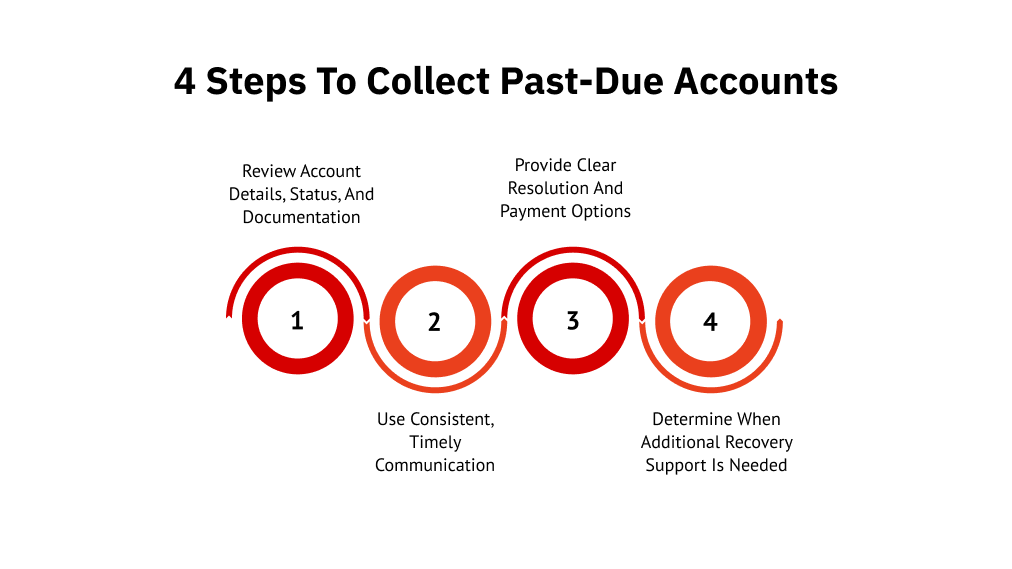
To collect past-due accounts, verify balances, coordinate outreach, offer practical resolution options, and escalate using defined criteria. Each action should reflect the account’s current status rather than follow an automatic reminder schedule.
Step 1: Review account details, account status, and documentation
Before contacting a customer, confirm the amount due and why it remains outstanding. Review these records together:
- Balance and due date: Reconcile charges, credits, and payment terms against the ledger.
- Payment history: Check receipts, failed transactions, previous commitments, and pending payments.
- Account status: Identify disputes, adjustments, existing arrangements, or restrictions affecting outreach.
- Contact history: Check the latest customer response, agreed next action, and available contact details.
Resolve discrepancies before requesting payment. Otherwise, staff may request payment on an incorrect balance or reopen a question another team already settled.
Record what was reviewed, who authorized any corrections, and when outreach can proceed. This preserves context when responsibility changes between billing and recovery teams.
Step 2: Use consistent, timely communication
Once the balance is confirmed, match outreach to the account’s history and appropriate contact channels. A documented sequence should specify the next contact date, channel, owner, and conditions for stopping or changing messages.
Within that sequence, phone conversations can clarify questions, while email can provide written account details. Text messages can offer a concise response path where permitted. A coordinated omnichannel debt collection approach connects responses across channels instead of sending isolated reminders.
The sequence should change when customers engage. A request for an updated statement needs a response before another payment reminder. Likewise, a promised callback should be recorded so another team does not send conflicting messages.
Use each channel within applicable communication requirements, permissions, and customer preferences. Track responses and completed actions so the next contact reflects what actually happened.
| Recovery tip: Align message timing and channel selection with account status and recent responses. A coordinated sequence avoids duplicate requests and gives each contact a clear purpose. |
Step 3: Provide clear resolution and payment options
Outreach should give customers a clear way to address an outstanding balance. Explain the verified amount, accepted payment methods, and how to raise questions or disputes.
Where policies allow, provide suitable payment arrangements, including installment plans. A realistic schedule can support repayment, while an unaffordable commitment often creates another failed payment.
Customers can also use digital self-service to review payment options and complete transactions without waiting for an agent. Keep human assistance available when disputes, exceptions, or arrangements require discussion.
After an arrangement is agreed, document its terms, due dates, and monitoring responsibilities. If an arrangement breaks down, review the account before restarting the usual contact sequence.
Step 4: Determine when accounts require additional recovery support
If outreach or payment arrangements stall, assess account age, response history, unresolved barriers, and internal capacity. A disputed balance and an unresponsive account require different assessments, even when both are overdue.
Record why the account may need specialized handling or additional capacity. Defined review points help prevent transfers based solely on account age.
Before transferring an account, organize verified balances, contact records, existing arrangements, unresolved issues, and relevant communication restrictions. An incomplete handoff can duplicate outreach or disrupt a payment commitment.
Internal and managed recovery approaches differ in staffing, outreach capabilities, and operational ownership:
| Internal recovery approach | Managed recovery approach |
| Existing staff handle follow-ups | Additional dedicated recovery resources |
| Internal communication schedules and channels | Expanded, coordinated engagement capabilities |
| Internal teams own daily execution | A partner manages agreed recovery workflows |
External support changes who performs recovery activity. Your organization still needs clear objectives, usable records, and program oversight.
What makes past-due account collection more effective?
Effective past-due account collection depends on prioritizing accounts by resolution opportunity, removing customer obstacles, and following documented controls. Contact volume alone cannot show whether a portfolio is moving toward resolution.
Prioritize accounts based on recovery opportunity
Prioritization should consider account age, previous engagement, unresolved issues, and available recovery resources. Reviewing these factors together helps managers distinguish actionable accounts from those requiring further investigation.
Allocate staff based on the attention each account requires. Accounts with unresolved balance questions may need billing specialists, while missed payment arrangements may require recovery follow-up. Reassess priorities when customer responses, disputes, or payments change account status.
Balance recovery goals with customer experience
Customer experience also shapes whether overdue accounts progress toward resolution. Repeated requests after a customer has already responded can undermine trust and consume staff capacity.
Monitor unanswered customer questions and the effort required to complete an arrangement. If customers repeatedly seek clarification, investigate the barrier before increasing outreach. Track completed payment arrangements alongside contact activity to identify which interactions lead to resolution.
Maintain documentation and compliance awareness
Document customer responses, communication preferences, dispute status, and account changes before deciding the next action. Supervisors can use those records to investigate exceptions and correct recurring workflow problems.
The Consumer Financial Protection Bureau’s Regulation F establishes communication requirements and debt-validation requirements for covered debt collectors. These provisions do not automatically apply to creditors collecting their own accounts. Other federal and state requirements may still apply.
Embed checks into approved messages, contact scheduling, dispute handling, and account handoffs. A change in agent or channel should never erase a known communication restriction.
| Did you know? Under Regulation F, electronic communication timing for covered debt collectors is determined when messages are sent. The customer’s reading time does not determine whether contact occurred at an inconvenient time. |
When should organizations consider additional recovery support for past-due accounts?
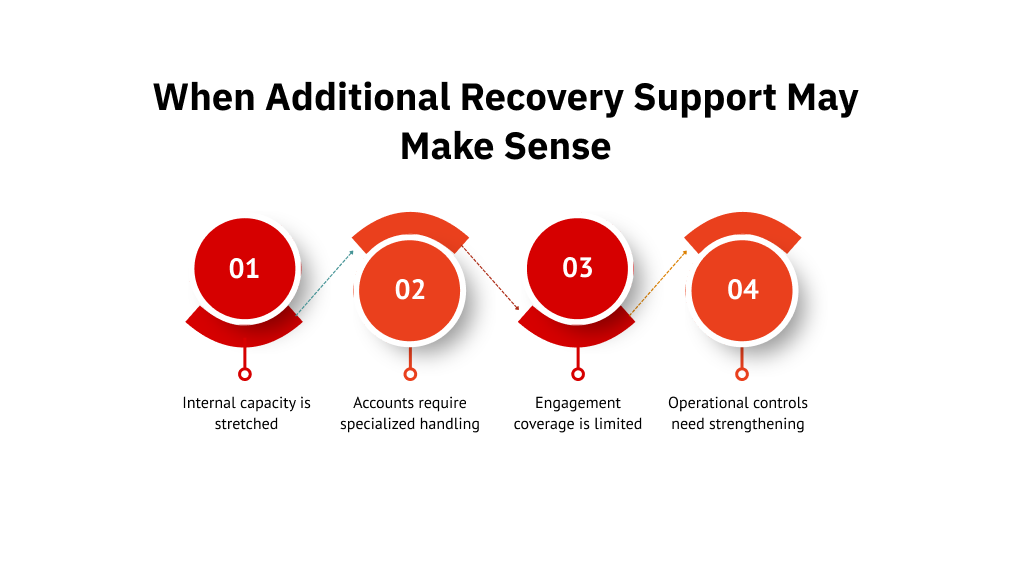
Organizations should consider additional recovery support when internal teams cannot consistently manage account volume, complexity, or required outreach. An overdue account alone does not establish a need for external placement.
Missed follow-ups can reflect unclear ownership rather than a lack of staff. Before expanding capacity, determine whether persistent delays stem from workflow gaps or sustained resource shortages.
Additional recovery support may make sense when:
- Internal capacity is stretched: Backlogs prevent timely follow-up or supervision.
- Accounts require specialized handling: Complex disputes, multiple account types, or changing delinquency stages exceed existing workflows.
- Engagement coverage is limited: The team cannot maintain appropriate outreach across the channels customers use.
- Operational controls need strengthening: Reporting, quality reviews, or exception handling cannot keep pace with account activity.
Once capacity and control gaps are clear, account stage helps determine which recovery model is appropriate. Early-stage accounts can remain under creditor oversight through internal teams or managed first-party collections.
In a managed first-party program, outreach can use the creditor’s brand where configured. Late-stage or written-off accounts may warrant third-party recovery, with communication under the collection partner’s identity.
Before choosing an approach, assess the staffing demands and implementation effort of strengthening internal operations. Compare those requirements with the oversight and coordination an external program would need.
Determine who will own reporting, resolve disputes, and monitor customer commitments. Clear responsibilities help prevent missed commitments and reporting gaps during the transition.
How First Credit Services helps organizations operationalize past-due account recovery
At First Credit Services, we manage past-due account recovery through trained teams, digital engagement, and compliance-focused operations. Our teams coordinate outreach and follow-up based on each client’s program requirements.
Combining managed recovery operations with digital engagement
In first-party programs, our agents can communicate under your brand using approved messaging and account information, where configured. We coordinate digital and voice outreach so customer responses inform subsequent contact. For third-party programs, we communicate under our own brand.
Depending on the program, we coordinate agent support to address account questions and payment arrangements. Shared contact history helps maintain continuity without asking customers to repeat earlier conversations.
Our first-party collections services include failed-payment recovery under the client’s brand. One coffee subscription company’s vice president of membership reported that we helped recover over 70% of failed payments monthly. This reflects the client’s specific experience rather than an expected outcome across programs.
Supporting recovery programs through operated technology
We operate UCEP (Unified Consumer Engagement Platform) on the client’s behalf. Our team coordinates text messages, email, chat, and phone through the platform. Clients do not operate or administer the platform themselves.
Our team manages integration planning, outreach sequencing, messaging strategy, and ongoing adjustments informed by consumer responses. Where configured, personalized links give consumers access to balances, payment plans, and offers.
To support those workflows, we establish data transfer and agent routing during onboarding based on client infrastructure and service requirements. We provide reporting tailored to available data and program needs while coordinating agreed recovery activity.
Our model fits creditor organizations with meaningful account volume that need managed recovery, coordinated engagement, and additional capacity. Your teams retain oversight while we handle agreed recovery workflows.
How to build a past-due account recovery strategy that scales
Build a scalable past-due account recovery strategy around clear priorities, repeatable workflows, reporting, and escalation criteria. Assign clear responsibilities and review performance regularly as account volumes grow.
The strategy should include these operational controls:
- Prioritization: Group accounts by stage, response history, and issues requiring specialized attention.
- Outreach workflows: Set review intervals, contact ownership, and clear triggers to revise planned activity.
- Channel planning: Coordinate phone, email, text messaging, and digital options based on permissions and customer responses.
- Resolution options: Specify which arrangements agents may offer and when approvals are required.
- Compliance review: Check approved messaging, contact restrictions, and exceptions against applicable requirements.
- Reporting: Track account movement, kept payment commitments, unresolved disputes, and overdue follow-up queues.
- Escalation: Define when stalled accounts require managerial review or another recovery model.
These controls depend on reliable status updates. A recorded payment or dispute should change the next action, regardless of which team receives the information. Otherwise, expanding contact capacity can multiply errors instead of improving recovery.
Review queue aging, staff workloads, and exception patterns regularly. If commitments remain unmonitored or handoffs create delays, adjust ownership or workflow rules before increasing outreach volume. These adjustments can reduce the strain of growing account volumes on staff and recovery controls.
Build a recovery process that protects revenue and relationships
Before changing your recovery approach, assess what your team can handle and where additional support may be necessary. Use account history, customer responses, and escalation criteria to inform that assessment.
Identify where overdue accounts experience delays in recovery workflows. Are follow-ups late, payment arrangements unmonitored, or handoffs leaving account histories incomplete? Separate issues your team can fix from gaps requiring more capacity or specialist involvement. Evaluate recovery options based on account stage, implementation effort, and ongoing oversight.
Track account movement, resolved exceptions, and completed payment commitments to assess whether changes improve results. Revisit escalation rules when volumes or customer response patterns shift. Use those findings to prioritize internal improvements, then decide whether external support addresses the remaining gaps.
Ready to improve recovery without stretching your team? Discuss your past-due recovery needs with First Credit Services to evaluate managed support options.
FAQs
1. Is a demand letter required before referring an overdue account to collections?
A demand letter is not required for every referral. Notice obligations depend on the account type, agreement, and applicable law. Confirm those requirements before placing an account with a collection agency.
2. Can businesses add late fees to past-due accounts?
Late fees depend on the account agreement and applicable law. Review contractual authorization, required disclosures, and any state or product-specific restrictions before adding charges. Collection partners should receive balances that include only permitted amounts.
3. Does the creditor retain ownership after hiring a collection agency?
Yes. The creditor typically retains account ownership when an agency collects on its behalf. The service agreement should define payment handling, account updates, dispute procedures, and reporting obligations for both parties.
4. How much does it cost to hire a collection agency?
Collection agency fees vary by account stage, service scope, and contract terms. Third-party recovery can use contingency pricing. First-party programs may charge per seat for live agents or use contingency pricing for digital-only recovery.
5. How long does it take to set up outsourced collections?
Timelines vary by program type and complexity. First-party programs typically require more preparation than third-party placements. Request a launch schedule covering data transfer, messaging approvals, agent training, and testing milestones.
6. What happens to an existing payment plan when an account goes to collections?
An existing payment plan may continue or require changes after referral, depending on its terms and the creditor’s instructions. Confirm who receives payments and communicates approved changes before new outreach begins.