


A consumer opts out of collection texts, but your next message still goes out. One missed update can become a repeated compliance failure, exposing your business to complaints and legal claims.
The WebRecon 2026 report says that 72.2% of Telephone Consumer Protection Act (TCPA) lawsuits filed in August were proposed class actions. The figures cover multiple industries, underscoring the potential scale of communication disputes.
When used thoughtfully, AI and automation in debt collection compliance can help teams apply regulatory requirements before calls, texts, or emails go out. Consent checks, contact restrictions, and disclosure requirements govern each interaction, while audit trails document the decisions behind it.
This guide explains the controls collection teams need and where human oversight remains essential. It also shows how to evaluate whether a collection partner can prevent, detect, and document compliance failures.
What AI-driven compliance means for debt collection
AI-driven compliance embeds regulatory rules directly into the technology stack. Every SMS, email, and voice interaction runs through coded checks before it reaches a consumer. Those checks govern Fair Debt Collection Practices Act (FDCPA) disclosures, TCPA consent requirements, and Regulation F frequency caps. Time-stamped audit trails log each action as it occurs.
This shift changes how regulators evaluate collection programs. Examiners now expect statutory requirements in testable, versioned system logic, with evidence the platform applied each rule correctly.
| Pro tip: Build compliance checks into your collection workflows, and update them as regulations change. Where technology supports it, maintain versioned rules and audit trails so your team can demonstrate how compliance requirements are applied and tested. |
The regulatory rules AI and automation must encode
Compliant debt collection automation starts with translating federal and state rules into enforceable system logic. Four regulatory layers apply to every automated interaction.
FDCPA and Regulation F essentials
The FDCPA works as the base for all collection activity. In addition, Regulation F adds specific, measurable requirements your platform must enforce, such as:
- Validation notice delivery within five days of initial contact, including debt amount, creditor name, and a 30-day dispute right
- Mini-Miranda disclosure on every contact attempt
- A 7-in-7 call frequency cap per account under Reg F Section 1006.14
- Time-of-day restrictions limiting outreach to 8 a.m. through 9 p.m. in the consumer’s local time zone
TCPA requirements
The TCPA governs how automated messages reach consumers. The following three requirements demand real-time enforcement:
- Prior express written consent for automated texts and prerecorded messages.
- Immediate opt-out honoring across every channel
- Channel-level consent tracking that carries across SMS, email, and voice
Consumer Financial Protection Bureau (CFPB) posture in 2026
The CFPB has stated clearly that no technology carve-out exists. Thus, automated platforms face the same supervisory examinations as human-staffed operations. Plus, the Bureau now expects explainability for AI-driven decisions, including segmentation, contact treatment, and settlement offers.
State overlays
Compliance starts with federal rules. State laws may introduce the following further obligations:
- The California Rosenthal Act extends FDCPA-style protections to original creditors and adds licensing disclosures.
- New York DFS Part 500 imposes cybersecurity oversight on financial services entities handling consumer data.
- Colorado’s Fair Debt Collection Practices Act expands consumer protections beyond the federal baseline.
Where manual compliance breaks down at volume
Manual compliance works at a small scale. At volume, it creates the gaps regulators look for.
Human error patterns
The CFPB’s 2025 FDCPA Annual Report shows debt collection complaints reached roughly 207,800 in 2024, nearly double 2023’s total. Among those closed with an explanation or relief, 45% involved debts consumers said they did not owe. Disconnected systems compound these risks:
- Miscounted calls: Separate manual and dialer logs undermine checks against Regulation F’s call-frequency presumptions, including the seven-in-seven-day threshold per person and particular debt.
- Mistimed outreach: A system uses your office’s time zone and contacts a consumer at an inconvenient local time.
- Third-party disclosures: An agent reveals debt details before confirming the recipient is authorized to receive them.
- Missed opt-outs: A consumer’s request is recorded in one system, while another sends the next text.
Each of these errors reaches the consumer as a completed violation. There is no draft mode in live collection outreach.
Why post-call sampling misses the real risk
Manual QA teams review a fraction of total interactions. The vast majority of calls, texts, and emails go unheard. Violations that reach consumers are already a legal event. A single misconfigured SMS campaign can create hundreds of TCPA violations in a single day.
| Did you know? Regulation F Section 1006.100 requires agencies to retain records evidencing compliance from the start of collection activity until three years after the last activity. The most common CFPB supervisory finding is an audit trail gap, not a bad activity |
How AI enforces compliance in real time
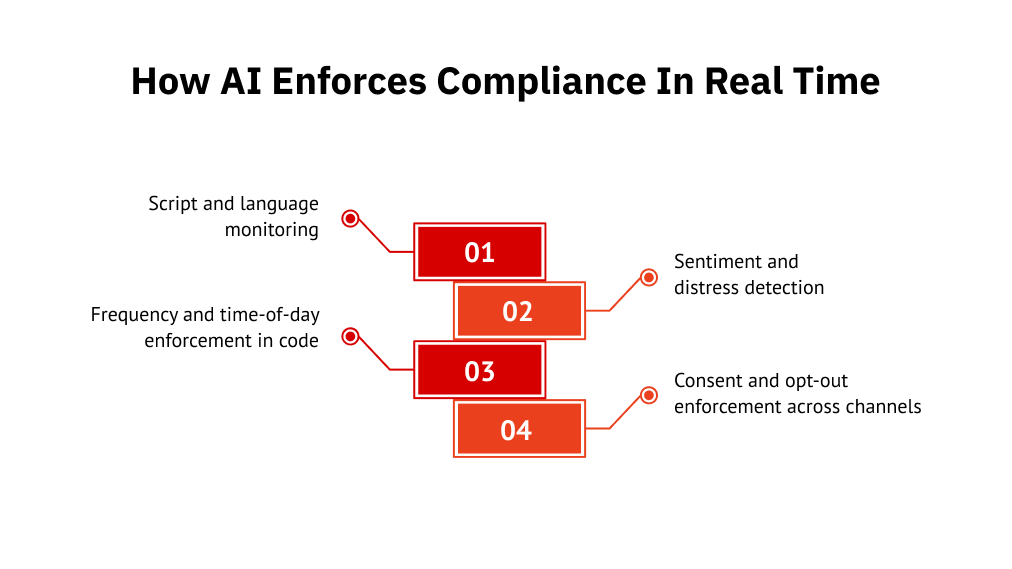
For debt collection agencies, real-time enforcement is where collection technology earns its compliance value. Each subsystem below operates during the interaction, catching violations before they reach the consumer.
1. Script and language monitoring
Compliance monitoring starts at the word level. AI scans every outbound message and live conversation against a prohibited-phrase library. Blocked terms never leave the system.
During live calls, the system delivers real-time coaching prompts. If an agent’s language drifts toward harassment territory, a flag appears immediately. In parallel, script enforcement confirms every interaction includes the mini-Miranda and other required disclosures.
SMS templates, email content, and chatbot responses pass through the same engine before delivery.
2. Sentiment and distress detection
Natural language processing adds a behavioral layer, analyzing tone, word choice, and conversational patterns during every interaction.
When a consumer signals confusion, hostility, or financial hardship, the system triggers automatic escalation to a trained human agent with full context preserved. This routing prevents conversations from crossing into Unfair, Deceptive, or Abusive Acts or Practices (UDAAP) territory.
3. Frequency and time-of-day enforcement in code
The system checks the consumer’s local time before each call, text, or email. Under Regulation F § 1006.6, contact before 8 a.m. or after 9 p.m. local time is generally considered inconvenient. The platform also respects other times the consumer has flagged.
Rolling counters track calls by person and particular debt. Regulation F generally presumes a violation at more than seven calls within seven consecutive days, or a call within seven days after a conversation about that debt. For texts and emails, separate controls address timing and opt-outs.
4. Consent and opt-out enforcement across channels
When a consumer replies “STOP,” the suppression applies instantly. It propagates across SMS, email, voice, and portal channels per TCPA requirements.
Suppression lists update in real time and sync across all teams. No secondary system holds stale consent data. In turn, channel-level consent records carry expiry dates, and the platform re-verifies permission before reactivating any channel.
| Pro tip: Every unified audit trail starts with real-time enforcement. When you catch violations only after the fact, the record becomes a list of incidents. Proof of compliance requires prevention at every step. |
How automation creates the audit trail regulators expect
Compliance enforcement only holds up if you can prove it happened. Automated collections platforms solve this by writing every interaction into a structured, retrievable record as it occurs.
What a defensible audit trail contains
A complete audit trail captures more than call recordings. It includes:
- Time-stamped interaction logs across every channel
- Consent records with source, date, and channel of origin
- Disclosure delivery proofs for validation notices and mini-Miranda statements
- Opt-out status changes with propagation timestamps
- Frequency calculations showing the platform applied the 7-in-7 rule correctly
- Time zone validation logs confirming each contact fell within permitted hours
Each record ties to a specific consumer, account, and interaction. Together, they form the evidence package a regulator expects during an examination.
Three-year retention under Regulation F
Call recordings, message logs, and payment interaction records all fall under this obligation. Automated platforms handle retention scheduling by default, removing the risk of premature deletion.
Why documentation gaps drive most examination findings
Even compliant activity becomes a liability when records are incomplete or inaccessible. Fixing documentation gaps after the fact requires lengthy legal review. Build recordkeeping requirements into the platform decision at implementation.
How exam readiness changes
Retrieval of any interaction’s full record within 24 to 48 hours is now the benchmark. Automated indexing and immutable logs replace manual sampling that once took weeks to compile.
The compliance-by-design framework for modern collections
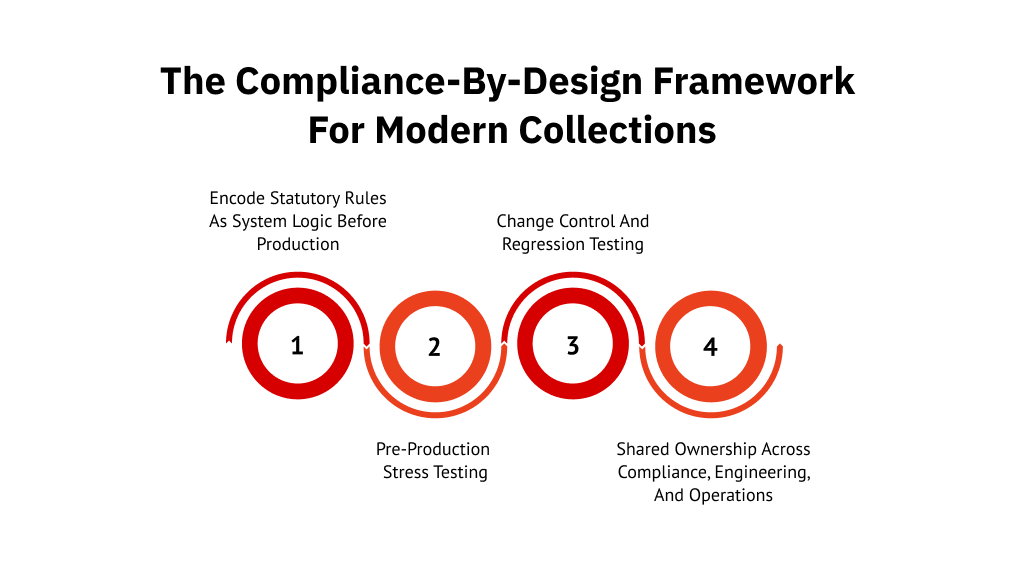
Reactive compliance catches problems after they create risk. On the other hand, compliance by design helps prevent them before workflows go live in the following ways:
1. Encode statutory rules as system logic before production
Each regulatory requirement becomes a versioned, testable object in the platform. FDCPA disclosure rules, Regulation F frequency caps, and TCPA consent requirements load into workflows before a single call or SMS goes out. Therefore, compliance lives in the code path, not in a policy PDF.
2. Pre-production stress testing
Synthetic environments stress-test conversation flows against regulatory boundaries before they go live. Red-team scenario libraries cover high-risk situations, including distress language, active disputes, and third-party disclosure risks. In turn, teams can identify failures during testing and address them before launch.
3. Change control and regression testing
Every rule change carries an approver, an effective date, and a version history. Regression tests confirm that a state law update did not break federal rule enforcement. This layered testing prevents the silent conflicts that surface months later during an examination.
Compliance officers hold veto power over deployment, while engineers own the code and operations manages the workflow. Every rule change requires sign-off from all three teams before release.
| Dimension | Reactive audit model | Compliance by design |
| Coverage | Manual sampling of a small fraction of interactions | 100% of interactions |
| Timing | After the call | Before and during the call |
| Cost | High QA headcount | Fixed platform investment |
| Exam defensibility | Weeks to compile evidence | Hours to retrieve records |
Treating compliance as a product feature separates a 2026 agency from a 2020 one.
Where human judgment still governs AI decisions
AI handles pattern recognition and enforcement at scale. Several categories of decisions still require human judgment and empathy.
Legally required human handoffs
Consumer requests for debt validation under Reg F § 1006.38 require human review and response. Formal disputes and cease-and-desist notices also follow the same path.
When the system detects signs of distress during a call, it can transfer the conversation to a trained collector with the account details and conversation history intact. This gives the collector the context needed to respond sensitively and assess the next steps.
Adverse action and explainability
The CFPB expects organizations to articulate why an AI system made a specific decision, covering segmentation, contact treatment, and settlement offers. Documentation of decision logic is now a baseline regulatory expectation.
Model governance
Start by checking the historical data used to train the model for bias. Then review its decisions regularly for potential discrimination risks, taking applicable fair lending requirements into account. Also track each model version, with an audit trail for every update showing what changed, who approved it, and when it took effect.
The augmentation principle
AI flags patterns and enforces routine checks. Human agents handle negotiation and sensitive conversations. Clear role definitions, oversight, and documented decisions tie the two together.
What to look for in an AI and automation partner built for compliance
Ask a collection partner to demonstrate its compliance controls using real account scenarios. Focus your evaluation on these four areas:
1. Regulatory engine depth
Confirm how the platform applies FDCPA, Regulation F, TCPA, and relevant Fair Credit Reporting Act (FCRA) requirements. Also check applicable state rule coverage and how updates are tested and deployed before regulatory deadlines.
2. Audit trail retrieval time
For audit readiness, test an internal retrieval target, such as 24 to 48 hours, using a sample account. Records should include consent history, disclosure delivery, and complete communication history across channels.
3. Data security posture
Review a current SOC 2 Type II report covering the service you will use. For payment card handling, request a PCI DSS Attestation of Compliance at Level 1. For healthcare accounts, verify HIPAA safeguards and a business associate agreement where required. Check the penetration-testing schedule and remediation evidence.
4. Vendor governance under Dodd-Frank
The Dodd-Frank Act gives the CFPB authority to supervise certain financial service providers. Outsourcing debt collection does not automatically remove a covered company’s responsibility to comply with applicable consumer protection laws.
Before partnering with a collection agency, businesses should review its compliance practices, define responsibilities in the contract, monitor performance, and establish a process for addressing any issues that arise.
How First Credit Services delivers compliance-grade automation
At First Credit Services, we built our Unified Consumer Engagement Platform (UCEP) specifically for this shift. UCEP runs FDCPA, Regulation F, and TCPA rules as system logic across our omnichannel outreach. It enforces message frequency caps, consent status, disclosure delivery, and opt-out honoring on every SMS, email, and voice interaction we send.
Every touchpoint writes to a unified, time-stamped audit trail. It gives our compliance teams and our clients’ compliance teams exam-ready evidence without stitching data across systems.
We operate UCEP as part of our managed collections service. This gives our clients built-in compliance controls without needing an internal engineering team to maintain the platform.
| Pro tip: Score every AI collections partner on these eight criteria before signing:Regulatory engine depthAudit trail retrieval speedSecurity certificationsModel governance documentationHuman escalation designState-level rule coverageIntegration depthFinancial defensibility |
Turn embedded compliance into a competitive advantage
Every collection interaction tests your compliance controls. Build compliance into the platform, give it clear ownership, and fund it as part of your recovery strategy.
Connect that investment to measurable goals. These include more accounts reached, higher recovery rates, lower cost per dollar collected, reduced litigation exposure, and faster exam turnaround.
For a 2026 collections program, AI and automation in debt collection compliance defines the operating model. So, judge success by both recovery performance and the strength of your controls.
Schedule a consultation with us to explore how AI and automation can support your recovery goals within a managed collections model.
FAQs
1. Is AI-generated debt collection communication legal under the FDCPA?
Yes, when properly implemented. The FDCPA applies the same rules to AI-driven and human communication. AI systems must deliver required disclosures, honor cease requests, respect frequency and time-of-day limits, and avoid harassment, misleading language, or third-party disclosure. Vendors who hardcode these rules pass regulatory scrutiny; those who bolt them on later usually do not.
2. How does the CFPB view AI in debt collection in 2026?
The CFPB has stated there is no new-technology carveout. AI systems are held to the same FDCPA, UDAAP, and state consumer protection standards as human collectors. The Bureau actively examines whether statutory rules are translated into coded, auditable system logic and whether the platform can prove it.
3. Do consumers have to be told when they are interacting with AI?
Federal law does not universally require AI disclosure in collection calls today, but several states are moving toward it. The FTC has warned against AI systems that misrepresent themselves as human. Best practice is transparent AI identification at the start of the interaction, regardless of state requirement.
4. What role does human oversight play in AI-driven compliance?
Human agents remain legally and operationally required for disputes, validation requests, hardship cases, high-distress conversations, and adverse action reasoning. AI detects and routes these scenarios; trained collectors resolve them. The two work together, not in place of each other.
5. Can AI-driven collections trigger discrimination or fair lending risk?
Yes, if models are trained on biased historical data. The CFPB monitors AI systems for discrimination, explainability, and adverse action compliance. Regular model governance reviews, bias testing, and documentation of decision logic are non-negotiable for a defensible program.
6. How long does it take to deploy a compliance-aware AI and automation stack?
Basic rule-based automation with compliance controls typically deploys in 4 to 6 weeks. Advanced predictive scoring, omnichannel orchestration, and AI-assisted agent workflows usually take 8 to 12 weeks, depending on data readiness and integration scope. Managed platforms compress this further because the infrastructure is already built and certified.