

The most important part of a collection call may happen before the phone ever rings. Artificial intelligence (AI) can help analyze account data, prioritize accounts for follow-up, identify potentially effective outreach times, and inform decisions about which communication channels to use.
That role is expanding. According to TransUnion’s Debt Collection Industry Report 2025, the share of collection firms using or exploring AI and machine learning rose from 49% in 2023 to 93% in 2025.
However, wider adoption does not automatically improve recoveries. Poorly timed automation can frustrate consumers, while sensitive conversations still need human judgment. Effective strategies use AI for repetitive work and bring in trained collectors when empathy or negotiation matters.
This guide explains how AI in debt collection works, where it can improve performance, and what teams should consider before applying it across the recovery process.
What is AI in debt collection?
AI in debt collection refers to the use of artificial intelligence technologies to support different parts of the recovery process. These technologies can help teams analyze account data, prioritize accounts, personalize communications, and automate repetitive tasks. Each one supports a different part of the process, such as:
- Machine learning identifies patterns in payment histories and predicts repayment likelihood.
- Natural language processing powers chatbots and virtual agents that understand and generate human-like text.
- Predictive analytics scores each account’s probability of repayment using behavioral and demographic data.
- Conversational AI automates routine outreach across SMS, email, chat, and voice channels.
Together, these capabilities go beyond basic automation. A rule-based system sends the same reminder on a fixed schedule, regardless of the account. Then, an AI-powered system can learn from consumer behavior and adjust the channel, timing, and tone of each interaction.
Modern platforms also connect scoring, outreach, and compliance tracking in one pipeline. As a result, each interaction can inform the next action instead of remaining an isolated data point.
Why collections teams are adopting AI at record speed
Collections teams have to manage growing account volumes while keeping costs, compliance risks, and consumer expectations under control. Here are the key reasons AI is becoming a larger part of that work:
1. Account volumes are outpacing headcount
Many agencies handle more accounts each year without increasing staff at the same rate. AI helps close that capacity gap by automating high-volume, low-complexity tasks. Agents can then spend more time on accounts that need direct human attention.
2. Consumer expectations have changed
At the same time, consumers increasingly expect digital self-service. They want to review balances, arrange payment plans, and resolve accounts without making a phone call. Consequently, agencies that rely heavily on calls risk lower engagement and more complaints.
3. Compliance complexity is increasing
The regulatory environment is also becoming more challenging. State-level AI laws continue to emerge, while federal regulators are examining automated communications more closely. Because manual monitoring cannot easily keep pace, teams need systems that track requirements across jurisdictions.
4. Cost pressure is constant
Digital outreach, automated scoring, and self-service portals reduce the staff time required per account. For teams under margin pressure, those savings compound across large portfolios.
How AI-powered debt collection works
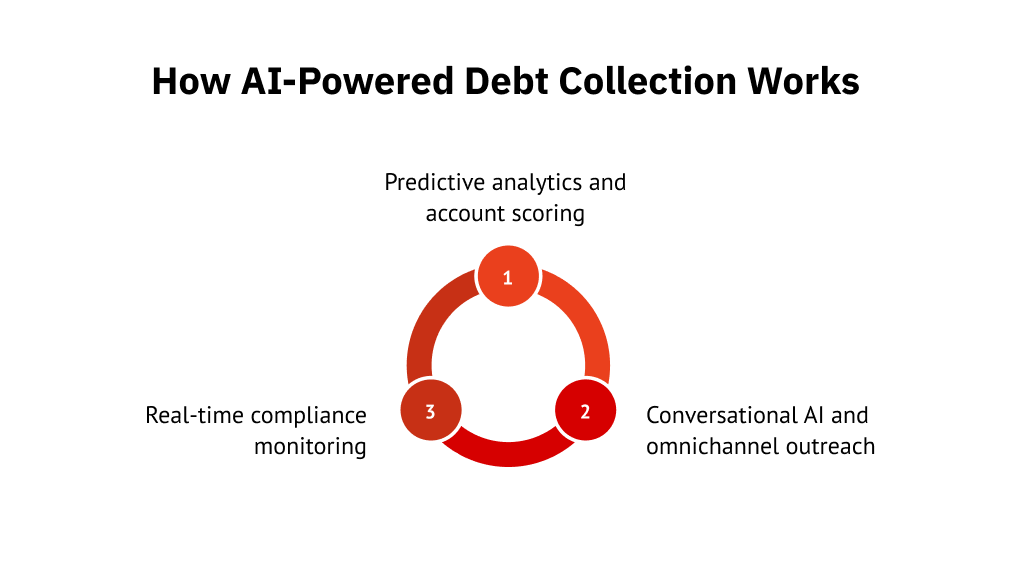
AI analyzes account data, communication history, and consumer behavior to guide collection activity. It then uses those insights to prioritize accounts, personalize outreach, and support collectors throughout the recovery process.
1. Predictive analytics and account scoring
Machine learning models analyze payment history, demographics, and behavioral data to calculate propensity-to-pay scores. These scores help distinguish consumers who may be unable to pay from those who have not paid. This allows collectors to focus their efforts where they can have the greatest effect.
Traditional prioritization often relies on static days-past-due (DPD) rankings. Here, dynamic scoring adds another layer by identifying accounts most likely to resolve and detecting early warning signs of default. Thus, teams can intervene before balances become harder to recover.
2. Conversational AI and omnichannel outreach
Conversational AI supports communication through SMS, email, chat, voice, and self-service portals. It can answer routine questions, send payment reminders, and help consumers navigate available resolution options.
AI can also support live collectors by summarizing account history, suggesting approved next steps, and flagging dispute or hardship language for escalation.
For example, First Credit Services operates its Unified Consumer Engagement Platform (UCEP) as a managed service. It analyzes consumer behavior and uses advanced analytics to select the message, channel, and timing across SMS, email, chat, and phone outreach.
3. Real-time compliance monitoring
As outreach expands across channels, AI can monitor configured calling hours, contact-frequency rules, and communication requirements. It can also flag potentially risky language in call recordings and generate audit trails for review.
These capabilities reduce manual monitoring. However, compliance teams remain responsible for reviewing alerts, validating controls, and updating workflows as regulations change.
Where AI delivers the biggest impact in collections
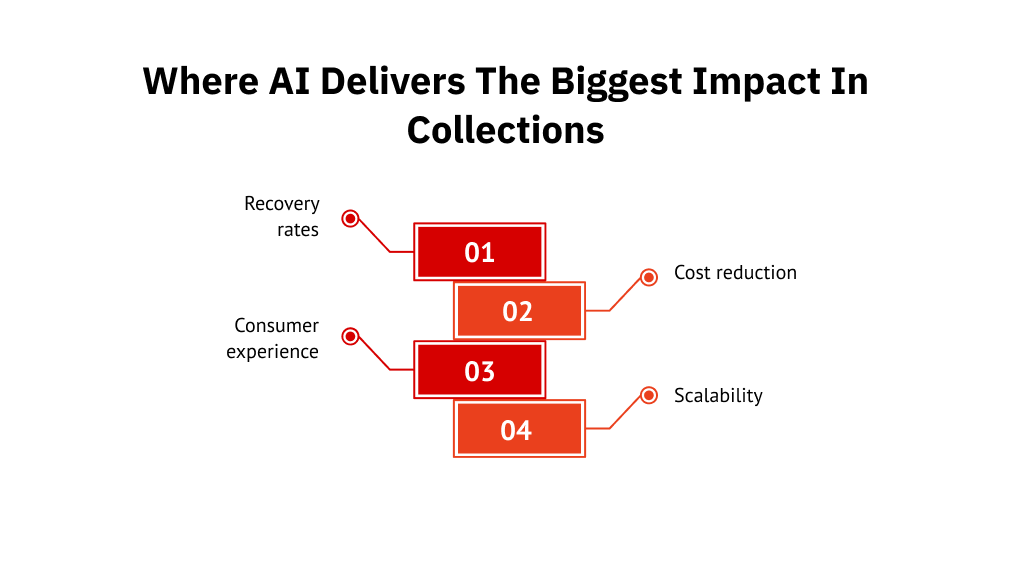
When these capabilities work together, AI-driven improvements tend to appear in four areas:
- Recovery rates: According to McKinsey’s 2024 report, organizations using advanced AI in customer assistance and collections can see roughly a 10% improvement in recoveries.
- Cost reduction: Automated early-stage outreach, scoring, and compliance monitoring reduce the staff time required for routine accounts.
- Consumer experience: Personalized outreach through preferred digital channels makes it easier for consumers to review and resolve balances.
- Scalability: AI helps teams absorb portfolio or seasonal volume increases without proportional headcount growth.
| Pro tip: The greatest return often comes from using omnichannel outreach to route each account to the appropriate channel at the right time. When AI handles prioritization and routine digital outreach, agents can focus on conversations that may change the outcome. |
AI vs. human collectors: what the research shows
Despite these benefits, AI does not perform equally well in every situation. The key question is where technology helps and where human involvement remains essential.
| Dimension | AI excels | Humans excel |
| Volume and speed | Handles many accounts simultaneously, around the clock | Manages cases that require sustained attention |
| Consistency | Applies the same programmed standards across interactions | Adapts based on experience and context |
| Routine outreach | Sends reminders and payment confirmations | Handles complex negotiations and hardship cases |
| Cost | Lowers per-interaction cost at scale | Can improve conversion on complex accounts |
| Empathy and trust | Supports simple, transactional interactions | Builds trust in sensitive conversations |
| Compliance | Creates audit trails and monitors programmed rules | Makes judgment calls in edge cases |
Compliance rules every AI-powered collection team must follow
Adding AI to your collection workflow does not reduce your compliance responsibilities. Your team remains accountable for how automated systems contact consumers. This makes the following federal and state requirements essential.
Federal regulations
Three federal frameworks directly affect AI-supported collections:
- FDCPA: AI-generated communications must include required disclosures, including the mini-Miranda warning and debt validation rights. Automated messages are subject to the same rules as human communications.
- Telephone Consumer Protection Act (TCPA): The Federal Communications Commission’s (FCC) February 2024 ruling classified AI-generated voice as an “artificial voice” under the TCPA. Hence, prior express consent is required for certain AI calls to cell phones, and violations can carry penalties of $500 to $1,500 per call.
- Regulation F: The 7-in-7 rule generally limits calls to seven per debt within seven consecutive days. Teams must apply the limit to AI-initiated calls as well.
The state-level surge
More than 1,000 state AI bills were introduced in 2025, and state-level regulation continues to expand into 2026. This growing patchwork creates different obligations for businesses operating across multiple jurisdictions.
For example, the Colorado AI Act and California Consumer Privacy Act (CCPA) amendments introduce requirements related to automated decision-making, consumer rights, and transparency. In New York, the SHIELD Act requires businesses to maintain reasonable data safeguards and expands breach-notification requirements.
| Pro tip: Compliance is mandatory and must be built into AI-powered collection workflows from day one. FCS embeds real-time compliance monitoring directly into its UCEP platform. It tracks Regulation F contact limits, TCPA consent status, and state-specific rules across AI-initiated and agent-led touchpoints. This approach helps reduce complaint exposure and builds credibility with creditor clients seeking clear evidence of responsible AI governance. |
Common mistakes to avoid when implementing AI in collections
Even with the right use cases, implementation decisions can limit the value of AI. Six mistakes appear repeatedly:
- Treating AI as a complete replacement for collectors: AI can manage volume, but trained agents are still needed for complex or sensitive cases.
- Deploying AI without clean, structured data: Predictive models cannot produce reliable insights when account data is incomplete or inconsistent.
- Ignoring compliance during implementation: Teams must embed FDCPA, TCPA, and other applicable rules into workflows from the beginning.
- Over-automating sensitive accounts: Disputes, hardship cases, and legally complex accounts require human judgment and empathy.
- Skipping the consumer experience review: Robotic or poorly timed outreach can damage trust and reduce engagement.
- Measuring the wrong key performance indicators: Contact volume alone says little about results. Teams should also track promise-to-pay conversion and liquidation rates.
How AI applies across different collection verticals
Collection challenges vary by industry. Therefore, AI workflows should reflect each sector’s account characteristics, regulations, payment patterns, and consumer expectations.
1. Credit card and consumer lending
AI can segment credit card and consumer loan accounts by delinquency stage, payment behavior, and likelihood of resolution. This helps teams prioritize early intervention while directing higher-risk or complex accounts to trained collectors.
2. Healthcare collections
In healthcare, AI can prioritize patient accounts using propensity to pay, insurance status, and balance size. Revenue cycle teams can then focus on balances with a stronger likelihood of recovery.
Meanwhile, automated outreach through preferred channels can reduce missed arrangements. At the same time, the compliance layer tracks Health Insurance Portability and Accountability Act (HIPAA) and FDCPA requirements.
3. Utility and telecom collections
For utility and telecom providers, seasonal payment patterns can help predict delinquency spikes. Once risk increases, AI-supported self-service portals allow consumers to arrange payment plans without calling an agent. This can reduce call-center volume while making resolution more convenient.
4. Fitness and subscription collections
Churn-prediction models can identify members or subscribers at risk of default. Automated micro-dunning sequences through SMS and email can then address early-stage delinquency before the account requires escalation.
FCS works across all three of these verticals. Our UCEP platform adapts AI-driven workflows to each industry’s specific compliance requirements, payment patterns, and consumer communication preferences.
A practical readiness checklist for AI in collections
Before implementing AI, review whether your organization has the following foundations:
- Reliable data: Are account records accurate, complete, and consistently formatted?
- System integration: Can the AI solution exchange current information with your CRM, payment platform, and collection system?
- Digital communication channels: Can consumers respond and make payments through their preferred channels?
- Compliance controls: Are calling hours, consent records, disclosures, opt-outs, and state-specific rules built into each workflow?
- Human escalation: Are disputes, hardship cases, legal notices, and sensitive conversations routed to trained staff?
- Model governance and measurement: Can you monitor model accuracy, drift, human overrides, recovery rates, complaints, opt-outs, and consumer outcomes?
If gaps exist, address them before scaling. A controlled pilot with one account segment or communication channel can reveal operational issues before a wider rollout.
Build a smarter collections strategy with AI and human expertise
The strongest AI strategy starts with a focused use case. Select one measurable problem, establish compliance and escalation controls, and compare the results against a clear baseline.
Once the workflow performs reliably, expand it gradually across additional account types and communication channels. This measured approach allows your team to improve recoveries while maintaining oversight and protecting the consumer experience.
FCS combines advanced technology with experienced collection professionals to build strategies around each client’s portfolio, industry, and compliance requirements. Contact our team to discuss an AI-supported collection program.
FAQs
1. How much does it cost to implement AI in debt collection?
Costs depend on account volume, integrations, communication channels, customization, monitoring, and support. When comparing solutions, consider the total cost of implementation and ongoing management. Managed services may reduce internal development and maintenance needs, but pricing and performance terms should still be evaluated carefully.
2. Can AI debt collectors legally leave voicemails or send text messages?
Yes, but restrictions apply. Under the TCPA, certain AI-generated voice messages to cell phones require prior express consent. Texts are also subject to consent requirements. Regulation F permits electronic communications but requires a clear opt-out method in every message.
3. What happens when an AI system makes an error during a collection interaction?
The collection agency remains responsible for violations caused by its systems. If AI provides incorrect debt information, omits required disclosures, or contacts a consumer at a prohibited time, the agency may face the same consequences that apply to a human-led violation.
4. How does AI handle debt disputes differently from human collectors?
AI can detect dispute language in written communications and route the account for review. However, it cannot independently complete every step of FDCPA-mandated dispute resolution, which follows specific verification requirements and timelines. Human oversight is therefore still necessary.
5. How long does it take to see results from AI in debt collection?
Implementation timelines depend on data quality, system integrations, approval processes, and whether the technology communicates directly with consumers. A limited pilot can launch sooner than a complete deployment. Establish a performance baseline first, then measure results across a full account cycle before expanding.
6. Which accounts benefit most from AI-powered collection?
Early-stage accounts with straightforward balances often benefit most because AI can process them efficiently through scoring and digital outreach. Accounts involving disputes, hardship, or legal complexity usually require human judgment and empathy.