

When does a past-due utility account need a utility debt collection agency instead of another internal reminder?
For most providers, the shift happens quietly, then all at once. Accounts that sit past your utility’s escalation point tie up internal resources and raise the odds of an eventual write-off. What looks like a routine servicing delay can eventually turn into a real hit to your operating margins.
The fix is a documented escalation path that routes each account to the right recovery approach: first-party, third-party, or a market-specific script. This is done before the balance ages any further.
This guide covers what changes across regulated and deregulated markets, when to escalate an account, and what to verify before choosing a partner.
Why utility debt requires a specialized collection partner
Recovering utility debt can look like a standard collections job at first glance. In practice, it runs through a regulatory maze that a generalist collection agency was never built to handle.
Public utility commissions attach specific requirements to every disconnection and reconnection decision. Depending on your state, these can include seasonal moratoria, medical-certification holds, mandated notice periods, and deposit rules.
A generalist collection approach can easily miss requirements like:
- Which accounts qualify for seasonal disconnection protection
- When a medical-certification hold pauses collection activity
- What notice period applies before reconnection is allowed
- Which deposit rules apply to a reconnected or new account
Utility service is generally treated as essential; therefore, standard collection remedies are often limited. For example, disconnection is rarely an early-stage lever, and many jurisdictions restrict it by season or account type.
Instead, recovery relies on structured communication, payment options, and assistance-program referrals, ultimately redefining “escalation” across your portfolio.
Getting this wrong is costly in two ways: a mismatched cadence or channel lowers recovery rates, and missteps on essential-service restrictions add exposure few other industries carry.
With 30+ years of first-party and third-party experience across regulated industries, First Credit Services builds a utility-specific outreach cadence instead of applying one generic collection script to every account.
That starts with treating debt collection compliance as a baseline requirement, tracked by account and by state rather than applied as a blanket policy across your entire portfolio.
| Did you know? The Brooklyn Union Gas Company Consolidated Financial Statements 2025 reported $80.8 million in bad debt expense for the fiscal year ended March 2025, more than double the $34.9 million recorded the year before. |
How market structure shapes the right collection approach
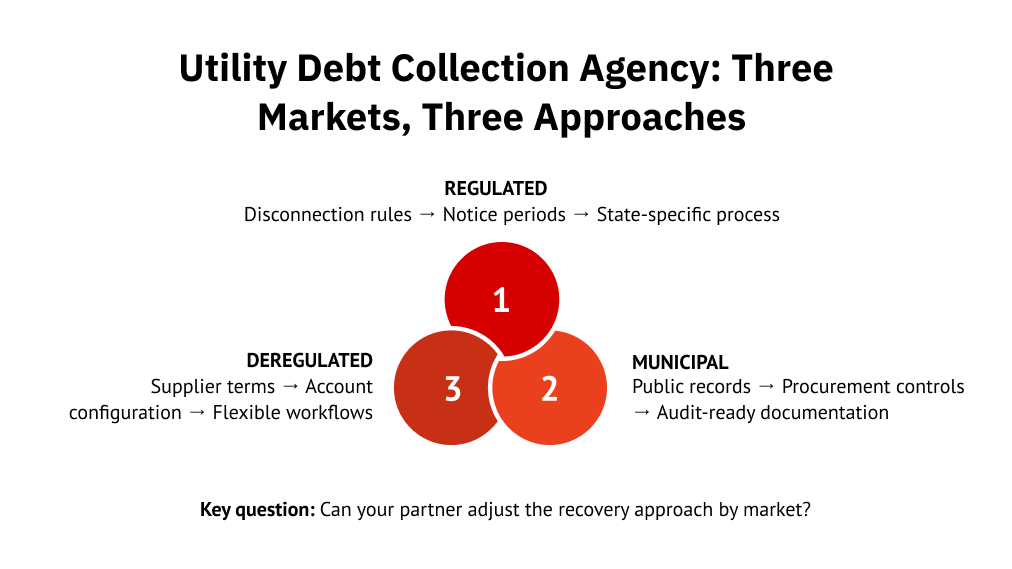
Before you evaluate any agency, check whether it can operate across market structures. The right compliance and outreach approach shifts depending on whether your market is regulated, deregulated, or served by a municipal utility collection agency with government-sector experience.
Whichever profile fits, it should sit inside one broader debt collection outsourcing services program rather than three disconnected vendor relationships.
Start with the most common structure, since most utility accounts still fall under some form of state oversight.
What changes in a regulated utility market
Utility operations and service delivery fall under state or other regulatory oversight in most markets. That oversight can dictate disconnection notices, reconnection timelines, and what collection activity is even allowed.
An agency working regulated accounts needs documented processes aligned to each state commission’s rules. Without that alignment, a single misstep can trigger a compliance complaint instead of a payment.
This is where agency selection gets practical. A partner that has only handled deregulated or non-utility accounts may lack the regulatory depth this environment requires.
Regulated oversight is only half the picture, since many utilities also compete in deregulated retail energy markets.
The added complexity of deregulated retail energy
Deregulated markets allow multiple retail energy suppliers to compete within the same market. A collection program has to account for supplier-specific account structures and contract terms, on top of the usual state and federal rules.
That means your agency needs to manage multiple client configurations rather than run one standardized script across every account.
Before you sign a contract, ask whether the partner can run regulated and deregulated models at the same time. Many utilities operate across both models, and a partner that only knows one will slow down the other.
Market structure covers regulation and competition, but government ownership adds a third layer worth understanding.
Municipal and public power: why government-sector experience matters
As per American Municipal Power, municipal and public power utilities often answer to public-accountability standards that private utilities do not face. This includes public records, open meetings, competitive bidding, and public budget hearings.
That accountability raises the bar for documentation. Outreach records, complaint handling, procurement controls, and audit trails all matter more when a public agency is the client.
| Pro tip: Confirm a prospective partner’s government-sector collections experience directly. Private-utility experience does not automatically transfer to municipal or public power accounts. |
Compliance and licensing: what your agency must have
Confirm compliance and licensing before you compare pricing, technology, or reporting. These are baseline requirements, not differentiators, for any partner handling utility accounts. This applies whether you’re vetting a broad-based provider or a specialized energy debt collection agency.
Start at the federal level, since every collector operates under it regardless of state or utility type.
Federal requirements (FDCPA and Regulation F)
The Fair Debt Collection Practices Act (FDCPA) sets rules for how third-party collectors may contact account holders and what practices are prohibited on covered debt. It applies to personal, family, and household debt, and utility balances generally qualify.
Regulation F, the Consumer Financial Protection Bureau’s modernized rule under the FDCPA, sets specific limits on outreach. It caps calls at seven attempts within seven days on a single debt, a rule known as the 7-in-7 limit. It created the limited-content message, a voicemail format that does not count toward that cap.
Debt collectors who reach out by email or text must offer a simple way to opt out. Regulation F also standardized the validation notice required at the start of collection, spelling out required disclosures and timing.
Ask a prospective partner how it operationalizes these rules day to day. A vague answer about being aware of the requirements is not the same as a documented call-frequency tracking system. The FDCPA and Regulation F cover the exact requirements referenced above.
Federal regulations provide the foundation, with state licensing and utility-specific requirements adding another layer of compliance.
State licensing, bonding, and PUC rules
Most states require collection agencies to hold a license and post a surety bond before they can operate. Requirements vary widely, and an unlicensed agency working your accounts creates direct liability for your business.
Utility accounts carry an added layer on top of that. Specifically, state public utility commission (PUC) rules can set shutoff moratoria, notice periods, medical certification holds, reconnection procedures, and deposit requirements that vary by jurisdiction.
For this reason, confirm that a partner tracks and applies these rules by state rather than relying on one national policy. After all, commission rules differ enough between states that a one-size approach eventually misses something.
To better understand these differences, the National Association of Regulatory Utility Commissioners is a useful starting point for understanding how state commissions differ.
Beyond licensing and state rules, legal standing is only one part of compliance; data security is a separate requirement.
Data security standards (PCI DSS, SOC 2)
Any partner that touches payments or sensitive account data needs verifiable data security credentials. That means current Payment Card Industry Data Security Standard (PCI DSS) compliance and a recent System and Organization Controls 2 (SOC 2) audit.
Ask for the actual documentation rather than a general compliance statement on a sales page. A current attestation of compliance or audit report tells you far more than a marketing claim.
The PCI Security Standards Council maintains the current version of the standard and a directory of qualified assessors.
| Important Note: This section provides general information, not legal advice. Utility collection requirements vary by jurisdiction, account type, and regulatory framework, so confirm specifics with counsel and your applicable regulator. |
What to look for in a utility debt collection agency
You already know the regulatory landscape and the compliance baseline a utility collection agency needs to clear. From here, evaluation comes down to a shorter, practical checklist.
Here is what to look for in a utility debt collection agency before you sign a contract:
- Compliance certifications and audit history: Ask for current attestations, not verbal assurances. A partner should produce Fair Debt Collection Practices Act and Regulation F documentation on request, along with recent audit history.
- Technology and self-service digital engagement capability: Confirm the agency can reach accountholders across SMS, email, and phone, and that it offers a self-service payment option available around the clock.
- Utility-sector or government-sector experience: Look for reference accounts in your specific market type, whether that’s a regulated utility, a deregulated retailer, or a municipal system.
- A transparent, tiered fee structure: Contingency pricing should scale with account age and difficulty, and the fee schedule should be documented in writing before you place a single account.
- Reporting and portfolio-level visibility: You need account-level and portfolio recovery services reporting you can actually use, not a static monthly summary that arrives after the numbers are stale.
- The ability to run regulated, deregulated, and municipal accounts without one flat script: If your utility operates in more than one market type, confirm the partner adjusts its approach by account rather than applying one national playbook.
Two industry groups are useful reference points as you vet candidates. ACA International sets accreditation and ethics standards across the collection industry. The Receivables Management Association International (RMAI) does similar work for receivables management.
How digital-first engagement is changing utility account recovery
Phone-only and mail-only outreach is losing ground across the utility industry. In fact, utility account holders increasingly ignore calls from unfamiliar numbers, and a letter sitting in a mailbox does nothing until someone opens it.
Mobile phone payments in the U.S. averaged 11 per month in 2024, nearly triple the four per month recorded in 2018, according to the Diary of Consumer Payment Choice 2025. As a result, that shift changes what channel mix should lead your recovery program, whether you run it in-house or through a utility bill collection agency. Today, a modern digital-first strategy often begins with SMS and email.
From there, the approach is supported by:
- Self-service payment portal: Available around the clock so customers can make payments when convenient.
- Flexible payment plans: Give customers options to resolve balances through manageable payment structures.
- Phone calls: Reserved for accounts that genuinely require direct assistance.
Beyond channel mix, selection should follow each account’s actual response history rather than one blanket sequence for every account. Meanwhile, every self-service interaction also creates a timestamped record of what was presented and agreed to.
In turn, that record strengthens your audit trail if a dispute or regulatory review comes up later. Ultimately, the business outcome that follows is fewer inbound complaint calls and a lower cost to service each account. This is the operating model FCS’ UCEP (Unified Consumer Engagement Platform) is built around.
In-house vs. outsourcing: what utilities often get wrong
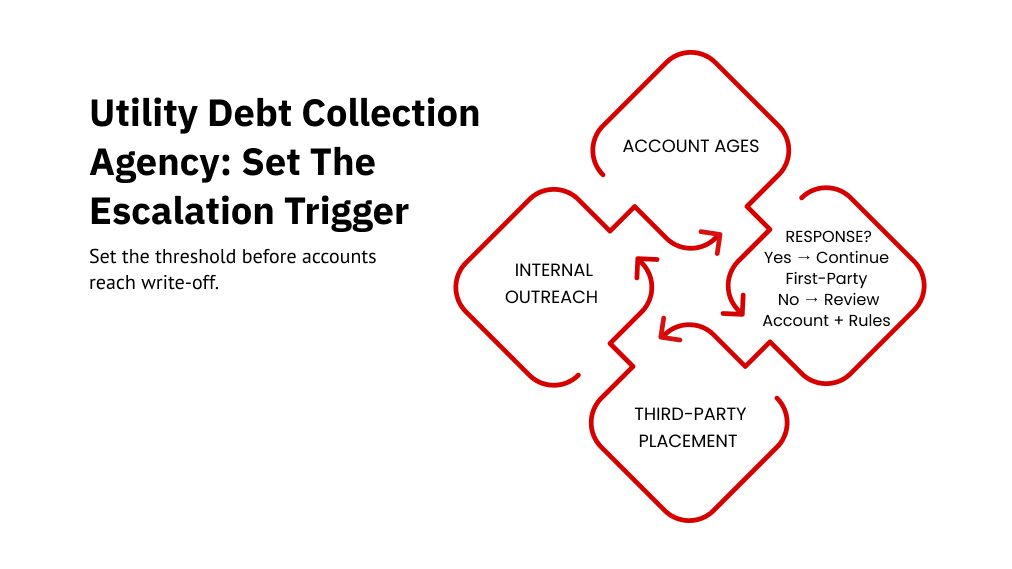
Utilities often frame this as an all-or-nothing decision. In practice, it usually comes down to matching the right account type to a first-party vs third-party collections agency model.
Here is how the three approaches compare across the factors that matter most before you bring in a utility collection agency:
| Factor | In-House | First-Party Placement | Third-Party Placement |
| Cost structure | Salary, benefits, and technology costs, paid regardless of what gets recovered | Contingency-based fee, tied to actual recovery | Contingency-based fee, typically higher given later-stage risk |
| Compliance exposure | Full exposure sits with your internal team, including every state and federal rule change | Shared with a partner that specializes in early-stage compliance | Largely shifts to the agency, which carries licensing and regulatory obligations directly |
| Recovery approach and scalability | Limited by internal staff bandwidth, making it difficult to scale during volume spikes | White-labeled outreach under your brand that scales with account volume | Full-scale recovery infrastructure built for aged and high-volume portfolios |
| Staff capacity impact | Ties up internal staff on collections instead of core utility operations | Frees internal staff while keeping the accountholder relationship under your brand | Removes late-stage collections from internal workload entirely |
Three factors should carry more weight than the rest when you decide which model fits your utility:
- Average account age at the point of write-off
- Staff capacity relative to your delinquent-account volume
- How often PUC and compliance rules change across your operating states, and whether your team can realistically track them
Beyond the model itself, utilities tend to make the same handful of mistakes when they compare these options.
Watch for these before you commit to either direction:
- No defined escalation threshold tied to account age
- Treating regulated and deregulated accounts with the same outreach script
- No tracking of moratoriums, notice periods, or other jurisdiction-specific restrictions
- Selecting a partner without utility- or government-sector reference accounts
- Evaluating cost before compliance history
FCS runs first-party and third-party placement under one contract, so escalating an account past your write-off threshold doesn’t require switching vendors mid-portfolio. Once you’ve ruled out the mistakes above, the real question left is exactly where that threshold should sit.
Choosing the right utility collection partner
Choosing a utility debt collection agency comes down to a handful of decisions, not a single vendor choice. Know which market type governs each account, since regulated, deregulated, and municipal utilities all carry different rules.
Know the difference between first-party and third-party placement, and the account-age threshold where one should give way to the other. Know which federal, state, and utility-specific requirements apply before you place a single account.
A partner that meets every obligation covered here is the standard to expect, and the basis for evaluating any agency you consider.
Considering where your escalation threshold sits? Connect with FCS Experts about how utility and municipal collections are handled at every stage.
FAQs
1. What is a utility debt collection agency?
A utility debt collection agency is a third-party firm that recovers unpaid electric, gas, water, or municipal utility balances on behalf of providers. Depending on the account and jurisdiction, it must comply with applicable federal and state collection laws, utility regulations, and service-related requirements while using structured outreach and payment options to recover revenue.
2. What compliance obligations does a utility take on when placing accounts with a third-party collector?
A utility should conduct appropriate vendor due diligence and oversee the collection activities it outsources. Requirements depend on the account, collector, jurisdiction, and utility-service rules involved. A prospective partner should document how it handles federal and state collection requirements and any applicable utility-specific restrictions.
3. How are utility collection agencies typically compensated?
Third-party utility collection agencies often use contingency-based pricing, where the agency receives a percentage of amounts recovered. First-party or early-stage programs may use a different fee structure, such as a per-account or service fee. Pricing varies by portfolio, account age, volume, and scope of services.
4. Does placing an account with a collection agency limit a utility’s own service-disconnection policy?
Service-disconnection and reconnection decisions generally remain with the utility and are governed by its own policies and applicable regulatory requirements. A collection agency’s role is to pursue the assigned balance and payment resolution within the scope of its agreement and applicable law, not to set disconnection policy.
5. What should a utility confirm before selecting a partner for regulated, deregulated, or municipal accounts?
Confirm the vendor’s compliance track record with the relevant utility regulator or commission, its experience with government or municipal accounts if applicable, its technology and reporting capabilities, and a transparent fee structure across account types and delinquency stages before you sign a contract.
6. When should a utility escalate an account from first-party to third-party placement?
The trigger should be a documented policy tied to account age, internal outreach results, account characteristics, and applicable regulatory requirements. Utilities should set this threshold based on their own portfolio and recovery performance rather than relying on a universal number that ignores account-specific risk factors.