

Same calls, same schedule, but recovery still isn’t moving; is it staffing, or the lack of a digital debt collection agency?
In practice, the category covers everything from a texting add-on bolted onto an old process to a fully managed omnichannel program. That range is exactly why comparing vendors can be harder than it should be. The bigger challenge is knowing whether digital outreach is actually improving recovery rather than simply adding another channel.
This guide breaks down how a digital debt collection agency actually works and how it differs from collection software. It also covers what drives the cost and which evaluation criteria separate a partner with documented controls from one relying on sales promises.
How digital debt collection agencies work
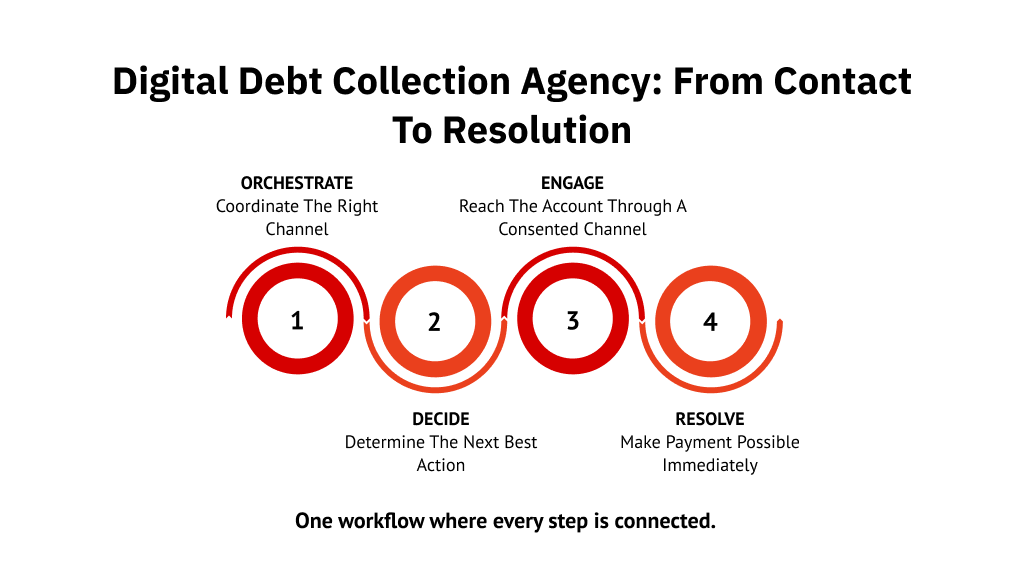
A digital debt collection agency is a managed service that recovers overdue accounts through digital channels such as email, SMS, and self-service payment portals. It combines collection operations, compliance processes, technology, and human oversight.
It runs on several connected layers:
- orchestration sequences outreach across channels,
- decisioning determines why one account gets a call and another gets a text, and
- self-service lets an account resolve a balance without waiting on a live agent.
Underneath all of it sits a placement question, first-party or third-party, that decides whose name actually reaches the account.
1. Omnichannel orchestration, not just a channel list
Multichannel and omnichannel outreach sound like synonyms, but they operate differently. Phone, email, and SMS run as separate, uncoordinated sequences in a multichannel setup.
Whereas an omnichannel debt collection agency routes all three through a single workflow governing timing, cadence, channel selection, and message content. It replaces a fragmented, phone-heavy process with timely, automated, and permission-based communication instead.
That difference shows up in how accounts experience contact. For instance, a multichannel setup might trigger a call and a text the same day from two systems that never talk to each other. In contrast, an omnichannel setup holds the text until the call goes unanswered and only reaches out through consented channels.
As a result, contact attempts drop, channel fatigue eases, and cadence stays standardized once volume outpaces manual tracking.
Still, coordinating channels only solves sequencing. What to say and when depends on how the system reads each account.
2. AI-driven decisioning
AI-driven decisioning scores each account first, using payment history, response patterns, and prior engagement, then decides the next action. A high-engagement account might get a payment-plan offer, while an unresponsive one gets a slower email cadence.
Traditional outreach treats every account the same. AI-driven decisioning, by contrast, personalizes at a volume no human team could manage.
The value shows up in three places:
- More targeted outreach, fewer wasted attempts
- Real-time strategy shifts, not manual review cycles
- No manual next-move calls on every account
| Pro tip: Ask any vendor what data trains their model and how often it gets retrained. An “AI-powered” answer with nothing behind it is a red flag. |
Decisioning determines when and how a business reaches an account. What happens next depends on whether that account can act without waiting for a callback.
3. Self-service payment portals
Contact is only useful if an account can act on it immediately, without waiting on a live agent to pick up. A self-service portal removes that limitation, and most link directly from an SMS or email so an account can go from message to payment without logging into a separate system.
Portal capabilities that matter most:
- Full balance payment, completed in one session
- Structured payment plans, with installment amounts set within approved limits
- Settlement offers, presented automatically based on account criteria
- Mobile-first design, since most links get opened on a phone rather than a desktop browser
Availability matters as much as design: a portal that works at 11 p.m. on a Sunday captures payments that business-hours-only outreach would miss.
Every digital collections program also answers a structural question: whose name reaches the account.
4. First-party vs. third-party digital placement
Digital collection programs run under one of two placement models, shaping which name reaches the account.
On one hand, first-party placement keeps the account under the creditor’s own name, with a digital partner handling outreach while the relationship stays intact. First Credit Services’ first-party collections, for instance, position early intervention as a way to recover failed payments before they escalate, under the client’s brand. This fits earlier-stage delinquency.
On the other hand, third-party placement moves the account to an outside agency under its own name, typically once first-party efforts run their course, with pricing set by the agreement.
Most buyers, however, underdefine that handoff, treating it as a last resort rather than a policy decision. A defined trigger, like 90 days past due, works better than waiting.
Placement, in short, explains who owns the relationship. It does not answer whether this needs a full agency at all, or whether software alone would do.
| Did you know? Many finance and revenue-cycle teams already run an internal collections process, yet recovery rates stay flat while customers ignore calls from unfamiliar numbers. AI or machine-learning adoption among collection companies jumped from 73% in 2024 to 93% in 2025, per the TransUnion Debt Collection Industry Report 2025, and phone-only processes are quickly becoming the exception. |
Digital debt collection agency vs. debt collection software: what’s the real difference?
The two terms get used interchangeably, but they describe different arrangements. An agency performs the work. Software gives your team tools to do it themselves. That distinction starts with who actually carries the risk.
Who does the work: agency vs. software
Compliance risk is where the two diverge first. An agency operates under the Fair Debt Collection Practices Act (FDCPA) and the Telephone Consumer Protection Act (TCPA) on your behalf. Software leaves that liability sitting with your own team.
| Factor | Digital Debt Collection Agency | Debt Collection Software |
| Who staffs it | A managed team works accounts on your behalf | Your internal team runs the platform and outreach |
| Who owns compliance risk | The agency carries FDCPA and TCPA liability for placed accounts | Your business retains full liability for every communication sent |
| Licensing and bonding | The agency holds required collection licenses and bonds | Your business needs its own licensing, where applicable |
| Deliverability and product upkeep | The agency’s own teams maintain channels and platform uptime | Your IT or operations team manages integrations and updates |
| Typical buyer | Businesses without a dedicated internal collections function | Businesses with an existing team that wants better tools |
The choice usually comes down to internal bandwidth. A team with the staffing, licensing, and compliance depth to run collections in-house often gets more value from software that sharpens what they already do.
A business without that internal expertise takes on real exposure trying to build it from scratch. In that case, an agency absorbs the operational and compliance load directly.
Staffing and compliance explain who does the work. A second question follows close behind: how that work actually reaches the account holder.
Digital-first vs. traditional: what actually changes
Every agency runs the same core service, but not every agency runs digital-first, and a digital-first debt collection agency changes more than just channel mix. It also changes compliance scope, timelines, and cost.
| Factor | Digital-First Agency | Traditional Agency |
| Primary contact method | Email, SMS, and self-service portals by default | Phone calls by default, with digital layered on top |
| Account holder experience | Resolves on their own schedule, often after hours | Requires answering or returning a call during business hours |
| Compliance complexity | Electronic communication rules govern timing, content, and opt-out handling | Call-frequency limits and required disclosures govern phone contact |
| Typical recovery timeline | Faster on responsive accounts, since payment is one tap away | Longer on average, since payment usually needs a live call |
| Cost-to-collect | Lower per account, since digital outreach scales without added headcount | Higher per account, driven by agent hours per contact attempt |
The compliance column deserves a second look before you assume digital-first means simpler.
Modern third-party collections build electronic communication rules into the workflow itself, and that’s exactly what the evaluation checklist below is built to confirm.
What to look for in a digital debt collection agency: evaluation criteria that matter
Vendor evaluation for a digital collections agency usually starts with a features list, but features rarely separate a strong partner from a weak one. What matters is whether a vendor can produce documented proof for the claims it makes on a call.
Three checkpoints do most of the work here: compliance depth, brand continuity, and integration transparency. Start with compliance, since it carries the most risk if it goes wrong.
Compliance depth and certifications
Ask every vendor for certifications relevant to your industry before signing anything. SOC 2 Type II and PCI DSS are common benchmarks, worth confirming for any partner handling account holder data.
Documented Regulation F procedures matter just as much, governing communication disclosures, contact frequency, and opt-out handling. A strong partner, First Credit Services included, walks you through its own written compliance program rather than offering a general assurance.
A vendor answering with specifics, policy documents, audit dates, and named frameworks has more to show than one offering reassurance alone.
Compliance proves the partner operates safely; brand continuity proves they protect your reputation while doing it.
White-label and brand continuity
Every touchpoint an account holder sees carries a brand, whether yours or the agency’s.
Start with the sending email domain: an unfamiliar address reads as a stranger, even if compliant. Caller ID works the same way, since an unrecognized number gets ignored more than a business name would.
The payment portal, however, deserves the closest look. A generic, unbranded portal breaks the experience right when an account holder is ready to pay. Therefore, ask whether the portal, domain, and caller ID carry your brand end to end.
In short, brand consistency protects the relationship, while visibility into the partner’s operations protects your team’s ability to manage it.
Integration speed and reporting transparency
Integration speed affects how quickly a program actually starts working.
First, ask how the partner connects to your existing servicing or accounts receivable platform, whether through a direct API, secure file transfer, or a CRM sync. Implementation management matters just as much. Hence, ask who owns onboarding, how long it takes, and what happens if account volume shifts mid-contract.
Finally, reporting transparency closes the loop: confirm whether it comes in real time, on a scheduled cadence, or another format. A partner that can’t answer clearly during evaluation is unlikely to improve once under contract.
| Pro tip: Request a sample compliant email or SMS template during evaluation. It tells you more about a vendor’s Regulation F maturity than any sales deck. |
Compliance, brand, and integration checks tell you whether a partner is built correctly. The metrics below tell you whether that build is actually working once accounts start moving.
The metrics that signal whether a digital collections partner is actually working
Evaluation criteria help you choose a digital collections agency partner. Once the program launches, a different set of numbers tells you whether the choice was right.
These four metrics catch problems before they show up as a bad quarter.
| Metric | What It Measures | What a Slip Signals |
| Right-party-contact rate | The share of outreach attempts that reach the actual account holder, not a wrong number or voicemail | Outdated contact data, or a channel mix that misses how account holders actually respond |
| Complaint rate | Formal complaints filed against the program, relative to account volume | Messaging that reads as aggressive, or a gap in compliance timing or frequency |
| Self-service adoption rate | The share of resolutions completed through a portal without agent involvement | A portal that is hard to find, poorly designed, or missing from outreach messages |
| Recovery rate by stage | Recovery performance broken out by how long an account has been delinquent | A program that performs well early but drops off sharply as accounts age |
Tracked together, these four numbers say more about a program’s health than any single quarterly recovery figure. They also point to where most digital collections programs start to break down in practice.
Where digital collections programs typically fall short
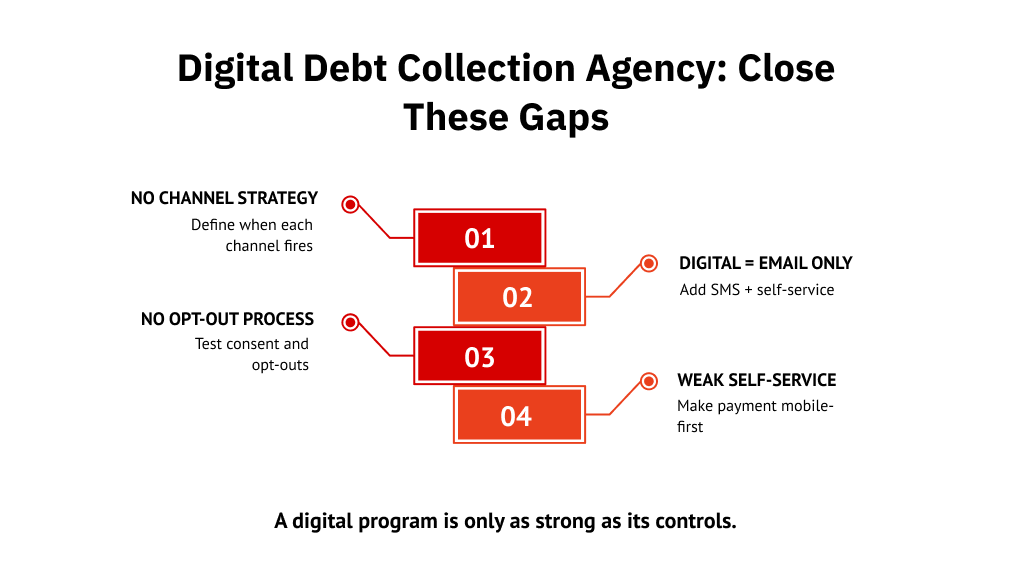
Even a well-funded digital program can underperform if a few structural gaps go unaddressed. Run this self-audit before trusting a vendor’s claims. These gaps show up most in programs that call themselves an omnichannel debt collection agency without running one.
Four gaps come up repeatedly:
- No defined channel-mix strategy. Channels get added without a coordinated plan for when each fires.
- “Digital” treated as email-only, while SMS, chat, and self-service sit unused.
- No documented consent or opt-out workflow, creating compliance exposure beyond a single bad interaction.
- A self-service portal that isn’t mobile-first, losing the traffic that opens payment links on a phone.
The consent gap carries the most legal weight. Electronic communications from covered third-party collectors fall under Regulation F, 12 CFR § 1006.6, governing contact information use, disclosures, and opt-outs. Skip any of the three, and the program is running exposed.
Run your own program against this checklist:
- Documented communication and consent procedures, reviewed on a set schedule
- Tested opt-out processes for every electronic channel in use
- A white-label quality assurance process
- Reporting accessible without a special request
- A named compliance owner, not a shared responsibility
Closing these gaps takes structure, not budget, which is why cost shouldn’t be the first question you ask a vendor.
How much does a digital debt collection agency cost?
Pricing structure matters as much as the rate itself, and the model used changes how cost behaves as volume shifts.
Pricing under a contingency collection agency model dominates third-party placements: the agency earns a percentage of what it recovers, so nothing recovered means no fee owed. On the other hand, flat-fee or subscription pricing shows up more when a provider positions itself as an AI debt collection agency built for technology-led programs.
Cost within either model depends on:
- Account age and delinquency stage
- Portfolio volume and pricing tier
- Service scope, first-party, third-party, or both
- Compliance and technology requirements
A blended rate applies one percentage across the portfolio, while a stratified rate scales by stage. That gap is where a blended rate quietly subsidizes hard accounts with margin from easy ones. Setup fees and minimum volume commitments often sit separate from the headline rate too, and providers don’t always volunteer them.
Still, the lowest quote isn’t the cheapest outcome. What matters is net recovery: a higher percentage with meaningfully higher recovery can net more than a lower fee with weaker results.
Ultimately, it comes down to one question: which partner proves it, rather than promises it.
Making the right call on a digital collections partner
Choosing a digital debt collection agency comes down to a few clear distinctions. Know the difference between an agency and software, understand where first-party ends and third-party begins, and confirm a partner’s Regulation F procedures before signing.
Track right-party-contact rate, complaint rate, self-service adoption, and recovery rate by stage once the program is live. Those four numbers will show whether the partnership is working, long before a quarterly review would.
Considering where your current vendor is falling short? Get in touch with FCS to discuss how digital collections are handled at every stage.
FAQs
1. What is a digital debt collection agency?
A digital debt collection agency is a managed collection service, first-party, third-party, or both, that recovers overdue accounts primarily through digital channels such as email, SMS, and self-service payment portals rather than phone-heavy outreach. It is a fully managed service, not software your team operates in-house.
2. How is a digital debt collection agency different from debt collection software?
The two differ in ownership. An agency is a managed service where the provider handles collection operations, technology, and compliance on your behalf. Software instead gives your internal team tools to run and oversee the process yourselves, while your business retains full compliance responsibility.
3. Is digital debt collection compliant with Regulation F?
Yes. Regulation F specifically governs electronic communications used by covered third-party debt collectors, including email, SMS, and self-service portals. It sets rules for contact information use, required disclosures, and opt-out procedures. Confirm a partner’s documented Regulation F procedures before signing any agreement.
4. How much does a digital debt collection agency cost?
Pricing varies by placement model. Common structures include contingency fees, where the agency earns a percentage of what it recovers, flat fees per account, and subscription or hybrid pricing. Cost drivers include account age, portfolio volume, service scope, and compliance requirements specific to your industry.
5. What channels do digital debt collection agencies use to reach accounts?
Email, SMS or text, secure self-service payment portals, and voice can all form part of a digital-first strategy. Channel selection depends on the account, applicable communication requirements, and recovery strategy, coordinated through a single workflow rather than run as separate, disconnected sequences.
6. How do you switch from a traditional to a digital-first debt collection agency?
Switching involves auditing the existing portfolio and delinquency stages, integrating with your servicing or accounts receivable platform, configuring compliant messaging and consent workflows, and launching in phases with a defined reporting cadence. Timeline depends on integration complexity, portfolio size, and transition scope.