


Unpaid patient balances create a difficult tradeoff for healthcare organizations: recover revenue without creating unnecessary friction for patients. Choosing among medical collections companies therefore requires evaluating how each provider operates and whether its model fits your organization’s portfolio and workflows.
Because operating fit shapes the outcome, healthcare organizations should compare collection stage, healthcare experience, and patient engagement. They should also assess compliance and security, reporting, implementation requirements, and pricing. Recovery percentages also need context because account age, placement stage, balance mix, and measurement methods can influence results.
This guide compares leading medical collection companies using consistent, business-focused criteria. It helps healthcare organizations choose a partner aligned with their recovery model and operational priorities.
Top medical collections companies to compare in 2026
Healthcare providers comparing medical collections companies should consider these eight vendors while matching each option to their recovery stage and operating needs.
| Company | Healthcare focus | Recovery model/stage | Engagement or service emphasis | Potential buyer fit |
| First Credit Services | Healthcare collections | First-party early-stage; third-party late-stage | Managed omnichannel | Enterprise providers |
| TSI | Healthcare revenue cycle management | Extended Business Office, third-party | Digital and agent | Large health systems |
| Americollect | Healthcare-only | Early-out, bad debt | Early-out and bad-debt outreach | Healthcare providers |
| AMCOL Systems | Healthcare-only | Self-pay, bad debt | Self-pay and bad-debt recovery | Health systems |
| Wakefield | Healthcare revenue cycle management | Revenue-cycle services, bad debt | Bad-debt and revenue-cycle support | Revenue-cycle-oriented providers |
| IC System | Healthcare collections | Early-out, bad debt | Early-out and bad-debt outreach | Multi-stage needs |
| Midwest Service Bureau | Medical collections | Early-out, bad debt | Multichannel | Varied providers |
| Summit AR | Medical collections | Pre-collection, collections | Pre-collection and recovery | Practices and providers |
The profiles below show how these models differ and where each vendor may fit.
Best medical collections companies: A detailed breakdown
The best medical collections companies depend on the collection stage, patient engagement needs, reporting requirements, compliance infrastructure, and operational fit. Comparing these dimensions helps healthcare leaders identify which services match their portfolios.
1. First Credit Services: Managed medical collections for enterprise healthcare organizations
At First Credit Services, we support healthcare organizations as a revenue recovery and customer engagement partner with more than 30 years of collections and receivables-management experience.
Our third-party programs support late-stage delinquent medical accounts. We also provide qualifying first-party programs for early-stage, brand-sensitive recovery where provider-brand continuity matters.
We operate UCEP (Unified Consumer Engagement Platform) on the client’s behalf. It supports coordinated SMS, email, chat, phone engagement, and self-service payment experiences within our managed programs.
Because we manage the technology and recovery workflows, healthcare organizations do not need to license or administer the platform themselves.
We have also completed a SOC 2 Type II examination, providing supporting evidence of our security and control environment.
Our model fits medium-to-large medical groups, hospital networks, and health systems needing managed recovery support alongside existing revenue-cycle operations.
2. TSI: Broad healthcare revenue-cycle and patient-pay support
TSI combines patient-pay recovery with a broader healthcare revenue cycle management portfolio. Its services include Extended Business Office (EBO) support, insurance claims services, and third-party collections for aged accounts and bad debt.
Within its EBO model, TSI provides brand-aligned first-party communications and billing support. Meanwhile, its third-party services address late-stage patient balances.
This breadth may appeal to health systems seeking one provider across several revenue-cycle functions. Procurement teams should still identify which functions support patient-balance recovery and which address adjacent work.
Buyers should also clarify ownership as accounts move between functions. That distinction helps determine whether the model fits existing teams and workflows.
3. Americollect: Healthcare-focused early-out and bad-debt collections
Americollect focuses its collection services on healthcare and supports both early-out and bad-debt programs. Its model emphasizes respectful patient communication while helping providers resolve outstanding balances.
Early-out can support patient engagement before balances progress further, while bad-debt services address late-stage recovery.
Healthcare specialization can support familiarity with patient-balance workflows, although portfolio characteristics, account stage, and execution still influence fit. Buyers should examine communication, payment access, reporting, and escalation across each stage.
They should also clarify how unresolved accounts move between early-out and bad-debt programs because the handoff affects communication continuity and account ownership.
4. AMCOL Systems: Healthcare-focused self-pay and bad-debt recovery
AMCOL Systems serves the healthcare industry and provides self-pay collections, bad-debt recovery, insurance claims resolution, and related revenue-cycle services. It works with hospitals, health systems, and physician groups.
Its collection offering spans patient-balance recovery within a broader revenue-cycle portfolio. Buyers should identify which services will manage their placements and how patient engagement, reporting, and account handoffs operate.
That distinction helps procurement teams evaluate collection capabilities separately from insurance-related or other revenue-cycle functions. It also clarifies which internal teams must coordinate with the vendor.
For bundled services, buyers should establish ownership for account updates, exceptions, escalations, and reporting before determining fit.
5. Wakefield: Healthcare collections within a broader revenue-cycle model
Wakefield provides healthcare revenue-cycle services extending beyond patient collections. Its stated capabilities include primary and secondary bad-debt collections, insurance billing, eligibility assistance, workflow services, and complex claims support.
Healthcare organizations should determine which proposed services directly address patient balances. They should also examine collection-stage coverage, communication practices, reporting, and handoffs between functions.
Its broader scope may suit organizations seeking additional revenue-cycle support when those functions align with internal staffing and workflows. Defining service boundaries early also helps teams compare the collection component against more specialized vendors.
6. IC System: Established healthcare collection and early-out capabilities
IC System supports both early-out and bad-debt healthcare collections. Its first-party early-out services operate as an extension of the provider’s business office. Its bad-debt services address late-stage recovery.
IC System also emphasizes patient-focused communication, compliance risk management, and healthcare-specific account resolution. Its healthcare materials describe reporting and online account-management capabilities.
Buyers with multi-stage needs should examine how these workflows connect and which controls apply at each stage. They should also clarify how account status moves between the provider and collection partner.
Placement criteria, account histories, payments, disputes, and recalls need defined ownership as accounts progress through recovery.
7. Midwest Service Bureau: Healthcare-focused medical account recovery
Midwest Service Bureau provides healthcare early-out and bad-debt recovery for hospitals, health systems, and physician groups. Its early-out model uses provider-branded outreach.
Its healthcare collection services include phone, SMS, email, mailed communications, and online payment access. Its materials also describe account-level reporting and healthcare compliance processes.
Buyers should focus on placement timing, communication controls, payment-plan workflows, reporting, and escalation between early-out and bad debt. Performance claims should be interpreted within the portfolio and measurement methodology behind them.
Healthcare organizations should also establish how account updates and patient responses move between internal teams and the vendor.
8. Summit AR: Patient-relationship-focused medical collections
Summit AR provides medical collections and pre-collection services alongside collection programs for other industries. Its medical offering emphasizes respectful patient communication and preserving provider relationships during recovery.
Summit AR also provides a client portal for monitoring account activity, payments, and reports. This may suit healthcare organizations seeking outsourced recovery with visibility into collection activity.
Buyers should assess account-stage fit, reporting requirements, compliance processes, payment options, and portfolio scale. Company-published performance figures should also be reviewed with their underlying measurement context.
Healthcare organizations should determine how pre-collection and collection activities align with existing patient-financial-services workflows. Clear placement and escalation rules define where internal responsibility ends and outsourced recovery begins.
What should healthcare providers look for in a medical collections company?
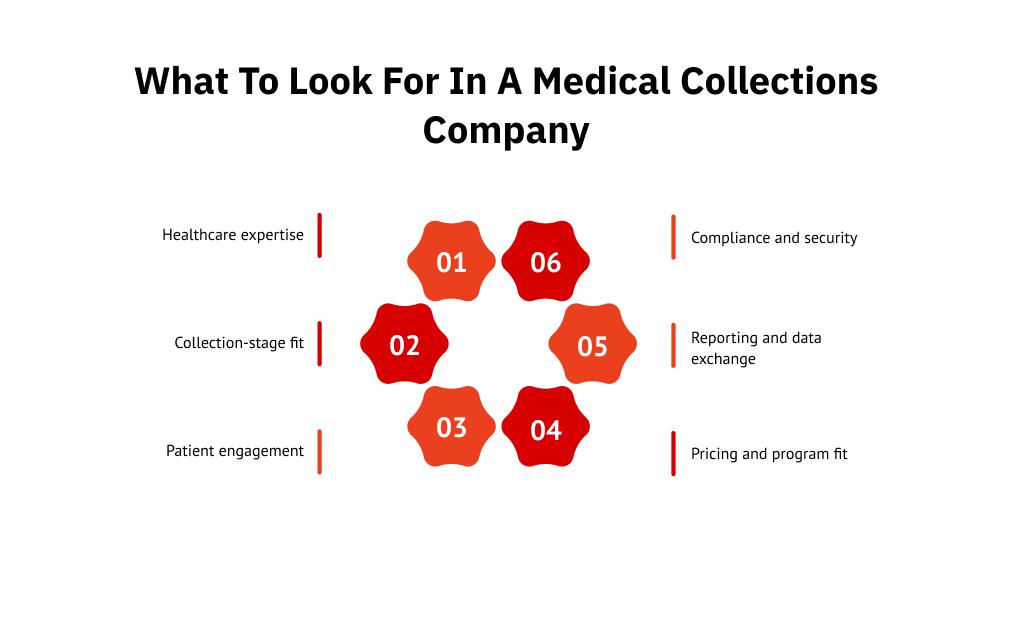
Healthcare providers should evaluate six areas when comparing a medical collections company. These are healthcare expertise, collection-stage fit, patient engagement, compliance and security, reporting and data exchange, and pricing and program fit.
Healthcare expertise should translate into workflows suited to patient balances and healthcare requirements. Collection-stage fit matters because early-stage and late-stage accounts require different operating models. Patient engagement should be assessed through payment access, complaints, escalations, and provider-brand continuity.
Compliance and security controls should align with the information involved and vendor activities. Pricing should likewise reflect program scope and account stage.
Recovery claims need context because account age, placement stage, balance mix, denominator, and portfolio composition can influence results. Buyers should understand how vendors calculate performance before comparing percentages.
Internal operating capacity also matters because organizations with limited recovery staffing may need more support, while the collection stage determines which recovery model that support should follow.
Digital engagement should operate as a coordinated workflow
Digital engagement works best when channels respond to account activity rather than operating as isolated touchpoints. A vendor’s omnichannel debt collection approach should coordinate SMS, email, phone, chat, and self-service payment options.
For example, workflows should account for payments, responses, disputes, callback requests, or promises to pay before determining subsequent outreach. This coordination helps healthcare organizations evaluate contactability, patient effort, unnecessary escalation, and workflow continuity.
Channel availability alone does not establish coordination. Buyers should determine whether activity in one channel changes what happens through others and how changes are recorded.
Reporting and integration should reflect operating reality
Reporting should provide visibility into placements, payments, account-status changes, recalls, disputes, and agreed performance measures. Buyers should also establish reporting cadence, governance responsibilities, and escalation processes.
Providers should confirm required data, transfer methods, update processes, testing responsibilities, and reconciliation. These details establish implementation expectations without assuming native or plug-and-play integration.
The same review should identify ownership for data-quality issues and account exceptions to reduce reconciliation delays or inconsistent account status.
Match the medical collections company to the right revenue-cycle stage
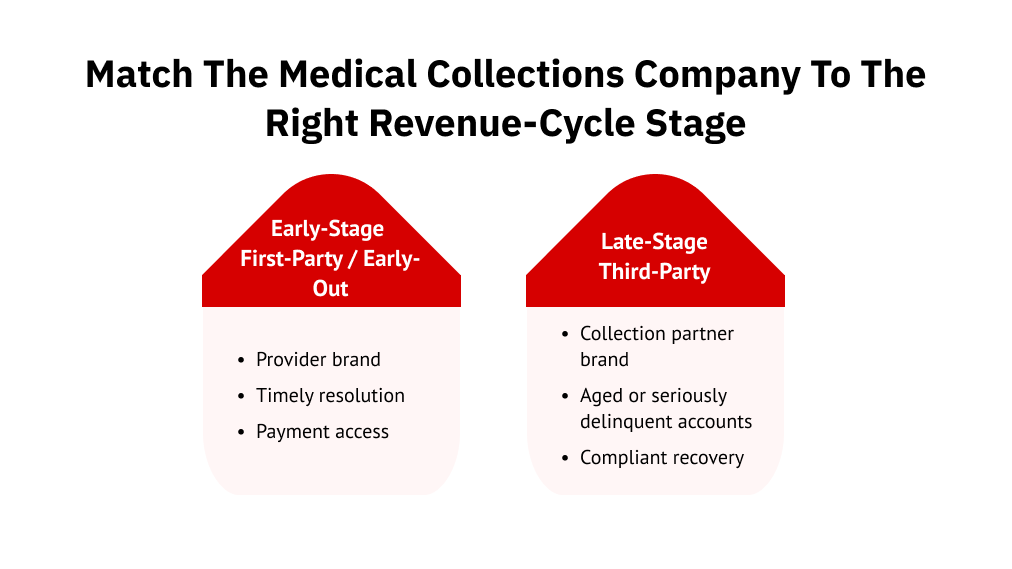
Healthcare organizations should determine where outside recovery begins within the healthcare revenue cycle before comparing technology, fees, engagement methods, or performance claims. That starting point determines the operating model required.
| Stage | Account status | Consumer-facing identity | Main operating priority | Key handoff question |
| Early-stage first-party or early-out | Active or recently delinquent | Provider brand where supported | Timely resolution and payment access | When should unresolved accounts escalate? |
| Late-stage third-party | Aged or seriously delinquent | Collection partner brand | Compliant recovery and account resolution | What triggers placement, and what data follows the account? |
Early-stage and first-party recovery
Early-stage first-party or early-out recovery focuses on reaching patients before balances become more difficult to resolve. Because these accounts remain closer to the active revenue cycle, outreach can prioritize payment access, account clarification, and timely follow-up.
Where supported, the collection partner can operate under the healthcare organization’s brand. Defined escalation rules also help ownership, account status, and communication history transfer cleanly when balances remain unresolved.
Establishing those rules before placement helps prevent overlapping activity, inconsistent communications, or unclear account ownership.
Late-stage third-party collections
Late-stage third-party collections generally address aged or seriously delinquent accounts under the collection partner’s identity. Workflows consequently emphasize compliant third-party communication, dispute handling, payment resolution, documentation, and reporting.
Healthcare organizations should define placement timing, required account data, recall procedures, and reporting responsibilities. Clear handoffs keep active accounts receivable management distinct from late-stage collection activity.
Account status, internal capacity, patient-financial-services workflows, and recovery objectives should inform where that handoff occurs.
What compliance questions should healthcare organizations ask collection vendors?
Healthcare organizations should ask how collection vendors protect patient information, govern collection activity, document controls, and demonstrate independent assurance. Due diligence should examine operational controls rather than broad compliance statements.
The Health Insurance Portability and Accountability Act (HIPAA) is particularly relevant when vendors handle protected health information. U.S. Department of Health and Human Services guidance confirms that covered entities may use collection agencies through business associate arrangements.
Buyers should therefore examine minimum-necessary practices, security, audits, training, governance, and business associate controls within debt collection compliance workflows.
SOC 2 Type II provides useful due diligence evidence because it examines whether specified controls operated effectively over a defined period. Buyers should review scope, covered systems, relevant controls, and availability rather than treating it as a universal compliance guarantee.
The Fair Debt Collection Practices Act and Regulation F require evaluation based on the covered entity and activity. For applicable nonprofit hospitals, Section 501(r)(6) also affects collection procedures.
| Compliance questions for your request for proposal (RFP):How are HIPAA and business associate requirements operationalized?What does the SOC 2 Type II report cover, and is it available?Which Regulation F procedures apply to the proposed work?Which state licensing and security-governance controls apply?How are nonprofit-hospital requirements addressed where relevant? |
These questions help procurement and compliance teams assess how documented controls translate into the proposed collection program.
Questions to ask before selecting a medical collections company
Before selecting a medical collections company, healthcare organizations should use an enterprise RFP checklist that makes proposals comparable. Questions should require vendors to explain responsibilities, performance definitions, and commercial terms.
Operating model and portfolio fit
Ask vendors where they enter the revenue cycle and which portfolios their model supports.
- Which account stages do you handle, and when does responsibility transfer?
- Whose brand appears in patient communications at each stage?
- Which organization sizes, balance types, account ages, and placement volumes fit your model?
- How are unresolved balances and escalations handled when accounts move between stages?
These answers show whether the proposed service matches the accounts the organization intends to place.
Implementation, data, and governance
Implementation questions should establish onboarding dependencies and how account activity moves between organizations after launch.
- What data fields, file formats, or system connections are required?
- How are placements, payments, recalls, disputes, complaints, and account changes exchanged?
- What testing, reconciliation, and reporting cadence is expected?
- Which provider and vendor teams own approvals, issues, and post-launch escalations?
Clear ownership helps prevent conflicting actions when payment status, disputes, recalls, or other account information changes.
Pricing terms and performance definitions
Require vendors to identify the pricing model for each service stage and disclose applicable setup, technology, minimum-volume, or other fees.
Because performance metrics can be calculated differently, buyers should also ask vendors to define recovery or liquidation calculations, denominators, reporting periods, exclusions, contactability, complaints, and payment-plan performance.
Using consistent definitions helps procurement teams compare proposals under equivalent assumptions and reduces distortions caused by different stages, reporting windows, or calculation methods.
The comparison should show both commercial terms and the operating conditions behind them, giving decision-makers a stronger basis for evaluating overall program fit.
Choose a medical collections partner that fits your recovery model
Healthcare organizations should choose a medical collections partner by matching each vendor’s operating model to their portfolio. Collection stage, healthcare expertise, patient experience, compliance, digital engagement, reporting, implementation, and pricing should shape the decision.
Buyers should also consider staffing capacity, revenue-cycle workflows, and patient-financial-services requirements. Clear ownership between internal teams and outsourced recovery helps align account, data, communication, and escalation workflows.
Ready to strengthen your healthcare recovery model? Discuss your portfolio, operating requirements, and recovery priorities with our team.
FAQs
1. Can healthcare providers use more than one medical collections company?
Yes. Healthcare providers can assign different vendors by account stage, facility, balance type, geography, or portfolio segment. Clear placement rules and ownership controls help prevent duplicate activity, inconsistent communication, and reporting conflicts.
2. When should a healthcare provider consider changing collection agencies?
A provider should consider changing agencies when performance, reporting, compliance controls, service quality, or operational support consistently fall below agreed expectations. The decision should rely on documented trends and contract requirements rather than isolated recovery results.
3. What happens to patient accounts when a healthcare provider changes collection agencies?
Account treatment depends on the provider’s contract and transition plan. Healthcare organizations should define recalls, data returns, payment updates, dispute histories, communication records, and new placements before transferring responsibility to another agency.
4. Who should manage patient complaints after collections are outsourced?
Responsibility should be defined between the healthcare organization and the collection vendor before launch. The process should specify complaint intake, escalation, documentation, response ownership, and how significant issues are communicated to provider teams.
5. Should healthcare providers place every delinquent account with the same collection agency?
No. Portfolio segmentation can help providers assign accounts according to balance type, age, service line, risk, or recovery stage. The segmentation approach should reflect internal policies, operational capacity, and the capabilities of each collection partner.
6. What contract terms should healthcare providers review before hiring a collection agency?
Healthcare providers should review service scope, pricing, placement rules, termination provisions, data handling, reporting obligations, compliance responsibilities, and account-return procedures. These terms define how the relationship operates and what happens when accounts or vendor responsibilities change.