
Utility debt collection is the process of recovering overdue consumer payments for electricity, gas, water, waste, and other essential services. It can cover active-account arrears, final-billed or move-out balances, and late-stage accounts placed with a collection partner.
These balances can limit when and how providers escalate recovery. State utility rules may govern notices, disconnections, hardship protections, and payment arrangements. Those requirements can extend the time providers carry delivered-service revenue.
According to the NEADA Summer Cooling Outlook 2026, roughly one in six U.S. households is behind on energy bills. The same outlook projects residential energy arrearages could reach about $25 billion by the end of 2026.
For utility leaders, the challenge involves recovering overdue utility payments while managing compliance, customer experience, and internal day-to-day operating workload. Different account stages can also require different recovery decisions.
Providers need a process that matches account status with the right outreach, payment path, and escalation point. This guide covers the utility collections lifecycle, from early outreach through outsourced recovery and partner selection.
Why utility debt is different from other collections
Essential-service regulation changes the recovery tools available to utility providers. Account status, market structure, weather protections, and hardship rules can all affect escalation.
Essential service and regulated shutoff
Electricity, gas, and water providers often face rules governing when service may be disconnected. These rules can include notice requirements, seasonal protections, hardship provisions, and other conditions.
Disconnection is not a universal recovery lever. Workflows must reflect the protections applying to each account and jurisdiction.
Regulated vs. deregulated markets
Recovery requirements also depend on market structure. A regulated monopoly and a competitive retail energy provider can operate under different oversight and customer obligations. Before setting escalation rules, confirm the applicable regulatory framework, tariffs, contracts, and state requirements.
Seasonal and hardship overlays
Seasonal protections, medical-certification rules, and assistance programs can further shape utility bill collections. Low Income Home Energy Assistance Program (LIHEAP) referrals may also support account resolution.
| Pro tip: Map accounts against applicable shutoff-protection rules before escalating. A protected account may require a different workflow, notice sequence, or payment option. |
What’s driving the rise in delinquent utility accounts?
Higher household energy costs can increase payment pressure and expand delinquent utility accounts. Providers can then face larger arrears balances and heavier recovery workloads.
Affordability pressure
According to the NEADA Energy Hardship Project 2026, average monthly residential electricity bills rose from about $121 in 2021 to roughly $156 in 2025. That represents an increase of about 29%.
Higher bills can make payment arrangements, assistance referrals, and early communication more important for utility recovery teams.
The cost to the utility
Unpaid balances can increase bad-debt expense and pressure cash flow. They can also create more work across billing, service, and recovery teams. E Source also identifies affordability as an important customer-satisfaction factor for utilities. Recovery strategy therefore affects customer experience as well as finance.
| Did you know? Residential electric and gas arrears reached about $17.8 billion by winter 2023, according to NEADA. The figure provides historical context alongside newer arrears estimates. |
The utility debt collection process, step by step
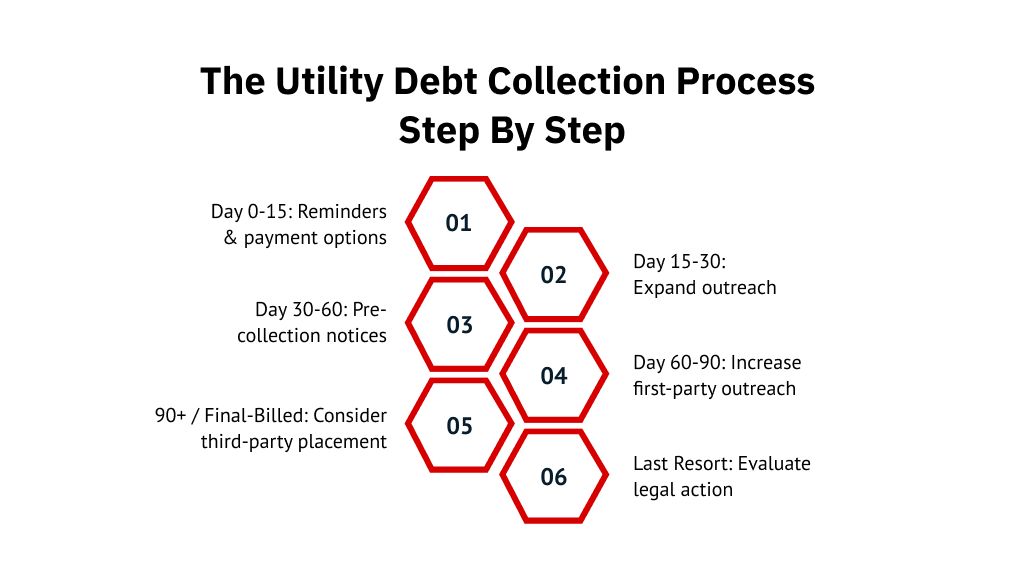
Utility payment recovery works best when each account moves through defined decision points. Exact timing should reflect state rules, account status, customer response, and internal policy.
A Day-0 to final-billed timeline
This timeline is an operating framework rather than a universal legal schedule. Utilities should adjust timing for applicable tariffs, rules, contracts, and program design.
| Stage | Illustrative timeframe | Action |
| 1 | Day 0-15 | Send reminders and present available payment options. |
| 2 | Day 15-30 | Expand outreach across approved channels and provide applicable assistance information. |
| 3 | Day 30-60 | Send appropriate pre-collection notices and explain relevant account terms. |
| 4 | Day 60-90 | Increase first-party outreach where the account remains eligible. |
| 5 | 90+ or final-billed | Consider third-party placement based on account status, policy, and prior response. |
| 6 | Last resort | Evaluate legal action only when appropriate and economically justified. |
In this lifecycle, first-party collections generally support earlier recovery under the utility’s brand. Third-party collections apply after eligible accounts are placed with an outside collection partner.
Because ownership can change as accounts progress, each stage should have a clear trigger, owner, permitted channels, and exit condition.
Pre-collection communication
Early communication gives customers more time to resolve balances before accounts require heavier intervention. Messages should be clear, accurate, and easy to act on. Use approved channels and provide a clear payment, assistance, or contact path.
When to escalate
Escalation should follow documented account signals rather than age alone. Common triggers include:
- No response after reasonable outreach across approved channels
- Broken payment arrangements or unresolved promises to pay
- Closed or move-out accounts with remaining balances
- Contact information that no longer reaches the account holder
Final-billed accounts often require faster operational review because the ongoing service relationship has ended.
Staying compliant: federal and state utility collection rules
Utility collections can involve different legal frameworks. Applicability depends on the actor, account type, debt purpose, and jurisdiction.
Fair debt collection practices act and Regulation F
Because this article focuses on consumer utility accounts, covered third-party activity may fall within the Fair Debt Collection Practices Act (FDCPA) and Regulation F. Business-purpose debts generally fall outside that consumer-debt scope.
Utilities evaluating outside recovery partners should review their debt collection compliance infrastructure, policies, monitoring, and controls.
For covered third-party activity, important Consumer Financial Protection Bureau (CFPB) Regulation F requirements include:
- Telephone frequency: The rule creates call-frequency presumptions for a particular debt. Review 12 CFR § 1006.14 before setting call policies.
- Limited-content messages: A debt collector may use a defined limited-content voicemail when the rule’s requirements are met.
- Email and text: Electronic communications require procedures addressing privacy and other rule requirements. They also need a reasonable opt-out method under 12 CFR § 1006.6.
- Validation information: A collector may provide validation information initially. Otherwise, notice generally must follow within five days under 12 CFR § 1006.34.
State utility rules and shutoff protections
State public utility commission (PUC) rules can add utility-specific requirements. These may cover weather protections, notices, medical certifications, deposits, reconnection, or payment arrangements. Utilities should map requirements to the customer, service type, jurisdiction, and account status before taking action.
Credit reporting and data accuracy
Credit reporting creates separate accuracy and dispute-management duties when applicable. Utilities and collection partners should maintain accurate account data and documented dispute processes.
The Fair Credit Reporting Act (FCRA) can impose duties on furnishers that provide information to consumer reporting agencies.
| Compliance note: This is not legal advice. Utility collection requirements vary by jurisdiction and program. Confirm applicable obligations with counsel and the relevant regulator. |
Best practices for utility debt collection
Strong utility collections programs connect outreach, payment access, account prioritization, and data quality.
Use communication before escalation
Clear communication should explain the balance, next action, and available payment or assistance options. Where permitted, omnichannel debt collection may use SMS, email, phone, mail, or self-service payment experiences. Channel choice should reflect permissions, account status, and applicable rules.
Offer flexible payment plans and connect to assistance
Utilities can offer available payment plans that create a more manageable path for resolving overdue balances. They may also connect eligible customers with LIHEAP or applicable arrearage-management programs.
Segment and prioritize accounts
Account segmentation helps teams direct effort toward the right treatment. Useful factors include:
- Balance size: Larger balances may justify different review or outreach.
- Age: Older accounts may require different placement decisions.
- Account status: Active and final-billed accounts need different workflows.
- Response history: Prior engagement can inform the next appropriate action.
Integrate collections data with billing and customer systems
A customer information system (CIS) or customer relationship management (CRM) platform often feeds collections workflows. Reliable data exchange reduces wrong-balance disputes, duplicate outreach, and missed account updates.
Buyers should verify transfer methods, update frequency, security controls, and ownership before onboarding.
| Utility collections readiness checklist:Shutoff-protection requirements are mapped by jurisdiction.Approved channel rules are documented.Payment-plan and assistance paths are current.Billing and collections data flows are tested.Escalation triggers reflect account status and response.Ownership is clear for disputes, holds, payments, and placement. |
Recovering final-billed and move-out accounts
Final-billed and move-out accounts create a distinct challenge because the service relationship has ended. Contact information can also become less reliable after a move.
Why closed accounts are harder to resolve
A former customer may no longer engage with routine account communications, making accurate placement data more important. Utilities should confirm balances, service dates, contact details, and account status before transfer.
Skip tracing and right-party contact
When permitted, compliant skip tracing can help locate an account holder whose original contact details no longer work. Verification reduces wasted outreach and unnecessary risk. Programs should evaluate data-source quality, permissible use, privacy controls, and update workflows.
| Pro tip: Review final-billed accounts promptly instead of leaving them in an active-account queue. Use a separate workflow with clear placement criteria. |
In-house vs. outsourced utility collections: how to decide
Most utilities can use both internal and outsourced recovery. The better question is which account stages and workloads each operating model should handle.
In-house vs. specialized agency: a comparison
The right split depends on the account stage, internal capacity, compliance coverage, data needs, and portfolio complexity.
| Factor | In-house | Specialized agency |
| Account stage | Best suited to active, early-stage accounts where the utility still manages the customer relationship | Better suited to aged, final-billed, move-out, or higher-volume placements requiring dedicated recovery resources |
| Compliance | Requires the utility to maintain policies, training, monitoring, and jurisdiction-specific expertise internally | Provides dedicated collections compliance infrastructure, training, monitoring, and audit processes |
| Staffing | Uses internal headcount and management capacity, which can become strained during volume spikes | Adds scalable recovery capacity without requiring equivalent internal hiring |
| Customer experience | Gives the utility direct control, but overloaded teams may struggle to maintain consistent outreach and follow-up | Can provide structured outreach across digital and agent-supported channels while preserving defined customer-treatment standards |
| Cost model | Carries ongoing labor, technology, training, and management costs regardless of recovery volume | Can align late-stage recovery costs with results through contingency-based third-party pricing |
| Account location | Internal teams may have limited resources for locating customers after move-out or contact-data changes | Can bring dedicated recovery workflows for harder-to-reach final-billed and moved accounts |
| Reporting and oversight | Visibility depends on the utility’s internal systems and reporting resources | Can provide structured reporting and dashboards based on available program data and agreed reporting requirements |
When to keep it In-House
In-house recovery often fits active accounts where the utility still owns the customer relationship. Examples include early arrears, payment-plan accounts, and workloads the internal team can manage consistently.
The model becomes harder to sustain when delinquency volume grows faster than staffing capacity. Internal teams must also maintain training, compliance controls, outreach processes, technology, and reporting alongside their other responsibilities.
When to outsource
Outsourcing can make sense when account requirements exceed internal capacity or need specialized recovery infrastructure. Examples include:
- Aged accounts after appropriate internal efforts
- Final-billed or move-out balances
- Temporary volume spikes
- Multi-jurisdiction portfolios requiring additional compliance infrastructure
The handoff should define placement criteria, data requirements, dispute ownership, and return rules. Third-party collections can support late-stage placements where that model is a good fit.
What to look for in a utility collections partner
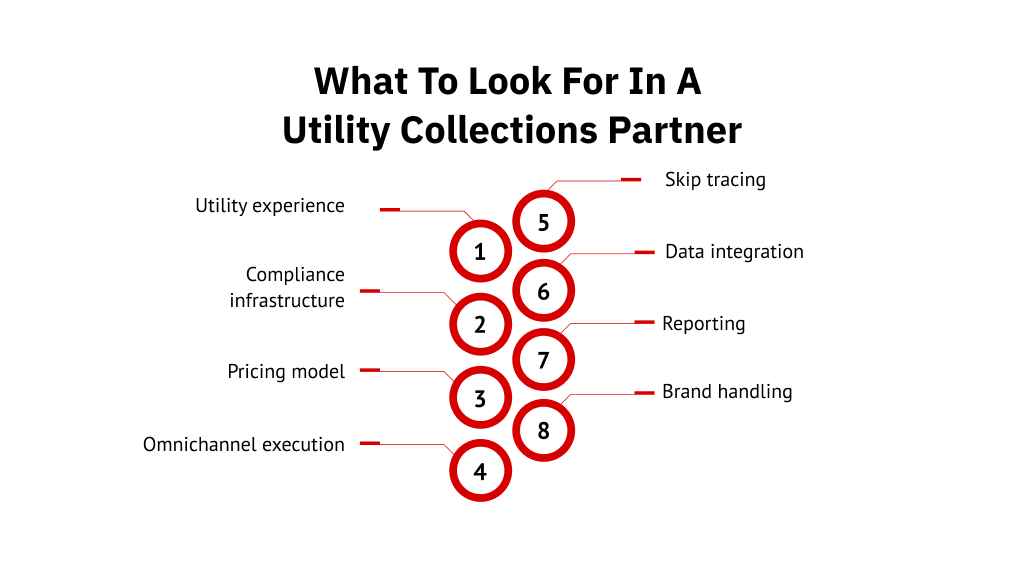
A utility collections partner should fit the portfolio’s regulatory, operational, data, and customer-experience requirements. Buyers should verify capabilities rather than assume every provider offers the same model.
Selection criteria
Evaluate potential partners across these execution areas:
- Utility experience: Ask how the provider handles account stages, state requirements, and final-billed placements.
- Compliance infrastructure: Review licensing, policies, monitoring, training, audits, and applicable Regulation F processes.
- Pricing: Confirm the model for each service stage rather than assuming universal contingency pricing.
- Omnichannel execution: Verify supported channels and how messaging, timing, and handoffs are coordinated.
- Skip tracing: Confirm availability, eligible account types, and data controls.
- Data integration: Review transfer methods for billing, payment, dispute, and status updates.
- Reporting: Confirm available reports, included data, refresh frequency, and delivery method.
- Brand handling: Determine whether first-party communications can use your brand and how third-party outreach is identified.
Questions to ask a vendor
- Where is the provider licensed or bonded for your placement footprint?
- How does it measure recovery by account age and portfolio segment?
- How are complaints tracked, reviewed, and reported?
- Which data-security and compliance certifications are current?
- What audit trail is retained for consumer interactions?
- What does onboarding require from your billing and customer systems?
How First Credit Services supports utility collections
At First Credit Services, we support utility providers through managed revenue recovery and customer engagement programs. Our programs can combine digital outreach, live agents, self-service payment access, reporting, and compliance-aware operations.
We bring more than 30 years of collections and receivables-management experience to these programs.
For early-stage programs, our first-party collections can operate under the utility’s brand. For late-stage placements, we provide third-party recovery under our own branding and on a contingency basis.
We operate UCEP (Unified Consumer Engagement Platform) on the client’s behalf. It supports coordinated SMS, email, chat, and phone engagement, plus configured self-service payment options.
Data movement can use API, SFTP, or direct customer relationship management sync. Clients can receive reporting and dashboards tailored to available program data.
This model fits medium-to-large and enterprise utility organizations that need managed recovery capacity across digital and agent-supported workflows.
Strengthen utility debt collection with the right recovery model
Utility debt collection works best when recovery decisions reflect account stage, compliance requirements, internal capacity, and customer experience.
For utility leaders, the priority is choosing where internal recovery remains effective and where outside support adds operational value. Clear handoffs can reduce avoidable delays while keeping recovery activity aligned with portfolio requirements.
Ready to strengthen recovery across aged and final-billed utility accounts? Discuss your utility collections strategy with our team to evaluate the right recovery model for your portfolio.
FAQs
1. Can a utility company send an unpaid bill to collections?
Yes. Utilities can place eligible unpaid consumer accounts with a third-party collection partner. Requirements depend on the account, debt purpose, collector, and jurisdiction. Covered consumer debts handled by covered debt collectors can fall under the FDCPA and Regulation F.
2. When should a utility outsource debt collection?
Outsource when defined account segments exceed internal capacity or need specialized recovery infrastructure. Final-billed, aged, high-volume, or multi-jurisdiction placements may warrant outside support. Timing depends on utility policy, account status, applicable rules, and prior outreach.
3. What rules govern utility debt collection?
Rules can include state utility requirements, the FDCPA and Regulation F for covered third-party consumer-debt activity, and applicable credit-reporting requirements. Scope varies by account type, actor, jurisdiction, communication method, and debt purpose.
4. Can a utility shut off service for unpaid bills?
Sometimes, but disconnection rules vary by jurisdiction and service type. State requirements may govern notices, weather protections, medical circumstances, or payment arrangements. Confirm the applicable tariff, rule, and account status before using disconnection in a recovery workflow.
5. How can utilities collect overdue bills without losing customers?
Use accurate, plain-language outreach and provide practical payment or assistance paths where available. Resolve disputes before escalating, keep account data current, and match channels to applicable permissions. These steps reduce avoidable friction while preserving customer experience.
6. What is the difference between first-party and third-party utility collections?
First-party collections usually occur earlier under the utility’s brand. Third-party collections use an outside partner for late-stage or placed accounts. Branding, pricing, legal requirements, and operating responsibilities can differ between the two models.