

A missed credit card payment can begin a progression from delinquency to internal recovery, charge-off, and eventual third-party placement. For issuers, credit card debt collection requires decisions about timing, account treatment, compliance, and when outside support becomes appropriate.
Those decisions matter as serious delinquency remains elevated. TransUnion’s Q2 2026 Credit Industry Insights Report found that 2.26% of credit card borrowers were 90 or more days past due. That was up from 2.17% a year earlier. Rising delinquency can pressure teams balancing customer experience, regulatory requirements, and portfolio performance.
Oversight must account for both internal and external recovery programs. This guide explains the collection lifecycle and the operational choices issuers must evaluate as accounts move from early delinquency through external recovery.
What is credit card debt collection?
Credit card debt collection is the process issuers use to recover past-due balances as accounts move through delinquency. It can include early-stage, issuer-led, or first-party recovery under the issuer’s brand, followed by late third-party placement when appropriate.
The account stage determines who manages recovery and which controls matter most. Early delinquency may remain with the issuer, while seriously past-due accounts can move to external collections after internal efforts or charge-off.
Charge-off changes how an issuer accounts for a seriously delinquent balance. It does not erase the debt or automatically stop recovery activity. For issuers, that distinction affects placement timing, documentation, reporting, and oversight throughout the broader credit card debt collection lifecycle.
Placement changes branding, operational responsibility, and issuer oversight requirements.
How does credit card debt collection work?
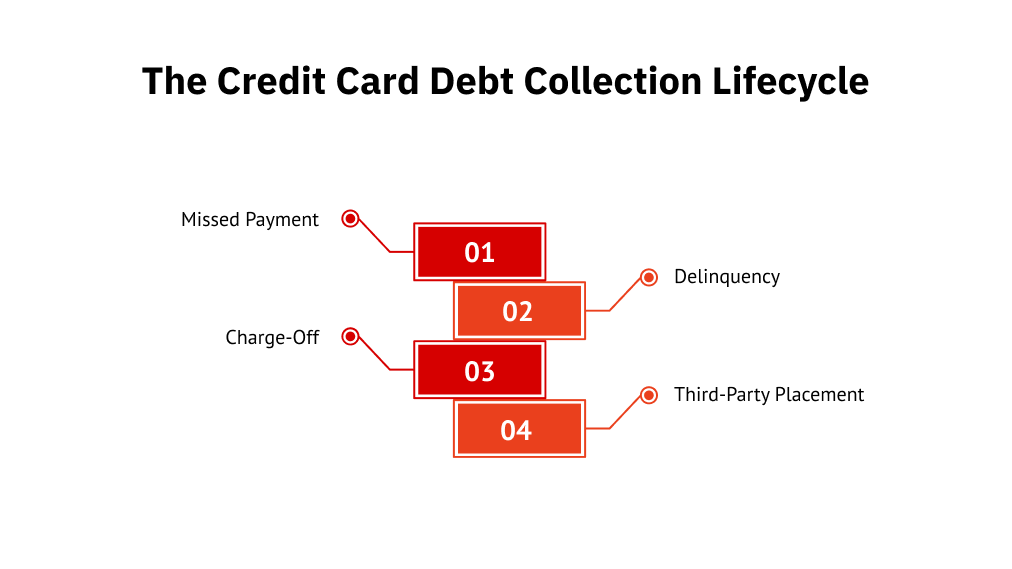
Credit card debt collection usually progresses from a missed payment through delinquency, issuer-led recovery, charge-off, and possible third-party placement. The sequence is common, but timing and treatment vary by issuer, account status, and policy.
The debt collection process can involve handoffs between internal teams and external partners. Each stage can change workflow ownership, information needs, and available resolution options for recovery teams over time.
| Stage | Account status | Who manages recovery | Potential next stage |
| Missed payment | Past due | Credit card issuer | Delinquency |
| Delinquency | Increasingly past due | Issuer or authorized first-party team | Internal recovery or charge-off |
| Charge-off | Classified as a loss | Issuer | Continued internal recovery or third-party placement |
| Third-party placement | Seriously delinquent or charged off | Collection agency | Continued recovery, reporting, or legal escalation |
Missed payment and delinquency
An account becomes past due when the required payment is missed. Issuer-led recovery may begin with reminders, account review, and stage-based outreach. Delinquency does not automatically trigger placement. Issuers may retain the account while assessing payment behavior, risk, and resolution options.
Issuer-led and first-party recovery
During first-party recovery, the issuer or an authorized partner manages outreach under the issuer’s brand. Accounts may be prioritized by age, balance, payment history, or portfolio criteria.
Depending on policy and account circumstances, the issuer may discuss hardship support, repayment arrangements, or approved options. The objective is to resolve the balance before a later handoff becomes necessary.
Charge-off and external collection
For open-end retail credit, the Federal Reserve’s uniform retail-credit policy generally calls for charge-off at 180 cumulative days past due. Charge-off changes how the issuer accounts for the balance, while recovery activity may continue.
After charge-off, an issuer may continue recovery internally or place the account with a third-party collection agency. Later activity can include outreach, reporting, or legal escalation, depending on the account and applicable requirements.
| Myth vs. fact: “Charged off” does not mean “no longer owed.” The balance may remain collectible through internal recovery or third-party placement. |
What happens when credit card debt moves to third-party collections?
When an issuer places an account with a third-party collector, day-to-day recovery responsibility shifts to the outside agency. The issuer retains ownership in an agency placement, while the collector communicates under its own identity and reports activity back to the issuer.
This third-party collections handoff requires accurate account data, defined reporting expectations, and clear responsibility for account updates.
| Area | Before placement | After placement |
| Account ownership | Issuer | Issuer |
| Recovery management | Issuer or first-party team | Third-party collection agency |
| Consumer-facing identity | Issuer brand | Agency identity |
| Account data | Maintained internally | Relevant placement data transferred |
| Reporting | Internal recovery reporting | Agency reports activity and outcomes |
How the third-party handoff works
The agency needs reliable placement information to work the account accurately. The initial handoff should establish the current balance, account status, dispute history, and supporting records needed for recovery.
After placement, issuers also need a process for sending material account updates and receiving agency dispositions. That exchange helps keep balances, payments, disputes, and account status aligned across both parties.
Poor handoff controls can create downstream problems. Outdated information may affect communications, account treatment, and reporting. Clear update and reconciliation procedures therefore matter throughout the entire placement period. Issuers should also define who authorizes account changes, how updates move, and how exceptions return for review before outreach continues across active account placements.
Validation, disputes, and account accuracy
Under Regulation F §1006.34, covered debt collectors must provide required validation information. This includes creditor information, account information, the current amount owed, and information about disputing the debt.
The Consumer Financial Protection Bureau’s debt-validation guidance explains how timely written disputes affect collection activity. Collection of a qualifying disputed amount may pause until the collector responds.
For issuers, that makes accurate dispute status and timely supporting documentation important to uninterrupted account handling. The agency needs a defined path for escalating account issues and receiving corrected information.
Digital collection communications
Third-party recovery can use permitted email, text, voice, and other communication channels. Each channel requires controls around consumer identification, account information, privacy, and applicable communication requirements.
Digital outreach should also connect consumers with secure, accurate payment paths. Coordinated channel activity helps reduce conflicting messages and keeps outreach aligned with current account information.
What compliance requirements shape credit card debt collection?
Credit card debt collection is shaped by federal and state rules governing how third-party collectors communicate, handle disputes, protect consumers, and conduct recovery. Third-party programs must operate within the Fair Debt Collection Practices Act (FDCPA), Regulation F, and applicable state laws.
For issuers, effective debt collection compliance requires oversight of agency controls, communications, disputes, complaints, and account handling.
Contact timing and frequency controls
Under Regulation F §1006.6, debt collectors are generally prohibited from contacting consumers before 8 a.m. or after 9 p.m. local time. The rule also considers whether the collector knows a particular time or place is inconvenient.
Call frequency also requires careful monitoring because Regulation F establishes presumptions around repeated telephone contact. Regulation F §1006.14 addresses the seven calls within seven days framework for a particular debt.
The same provision addresses calls placed within seven days after a telephone conversation about that debt. These thresholds are regulatory presumptions rather than universal permission to place seven calls.
Harassment, false statements, and third-party disclosure
Collectors cannot use harassment, deceptive representations, improper threats, or unauthorized disclosure to unrelated third parties. Issuers should therefore monitor scripts, channel practices, complaint patterns, and escalation procedures.
State laws can impose additional requirements, making jurisdiction-specific controls important for multi-state portfolios.
When collection activity can escalate legally
Routine collection activity, litigation, judgment, and garnishment are separate stages. A collector cannot treat possible legal remedies as automatic consequences of nonpayment.
For most creditors, CFPB garnishment guidance explains that wage or benefit garnishment generally requires a court judgment first. Federal and state protections can also limit what may be garnished.
Issuers should ensure legal escalation follows documented authorization, applicable law, and clear agency procedures.
What should issuers track during credit card debt collection?
Issuers should track recovery together with account aging, disputes, complaints, compliance exceptions, and cost-to-recover trends. A single recovery percentage can hide problems that become visible only when performance is segmented.
Breaking results down by delinquency stage, balance characteristics, and portfolio type helps distinguish normal portfolio variation from operational or vendor-performance issues.
Recovery and account-aging performance
Recovery results should be evaluated alongside account age and delinquency stage because older accounts may behave differently from early-stage placements. Balance profile and portfolio segment also matter when comparing performance across groups.
This view helps issuers identify whether changes stem from account mix, placement timing, or collection execution rather than assuming one overall rate explains performance.
Disputes, complaints, and compliance indicators
Patterns in disputes, complaints, and compliance exceptions can expose weaknesses that recovery results alone will not show. Repeated balance disputes may point to data-quality problems, while communication complaints can indicate process or vendor-management concerns.
Tracking these indicators over time also helps issuers determine whether issues are isolated or concentrated within a specific segment, channel, or placement group.
Reporting that supports issuer decisions
Useful reporting should provide visibility into placements, payments, resolutions, account status, dispositions, and developing patterns. Issuers also need enough detail to compare segments and reconcile changes across reporting periods.
Together, these measures help recovery leaders evaluate performance in context, identify emerging issues earlier, and make better decisions about placement strategy and partner oversight.
How should issuers manage credit card debt that moves to collections?
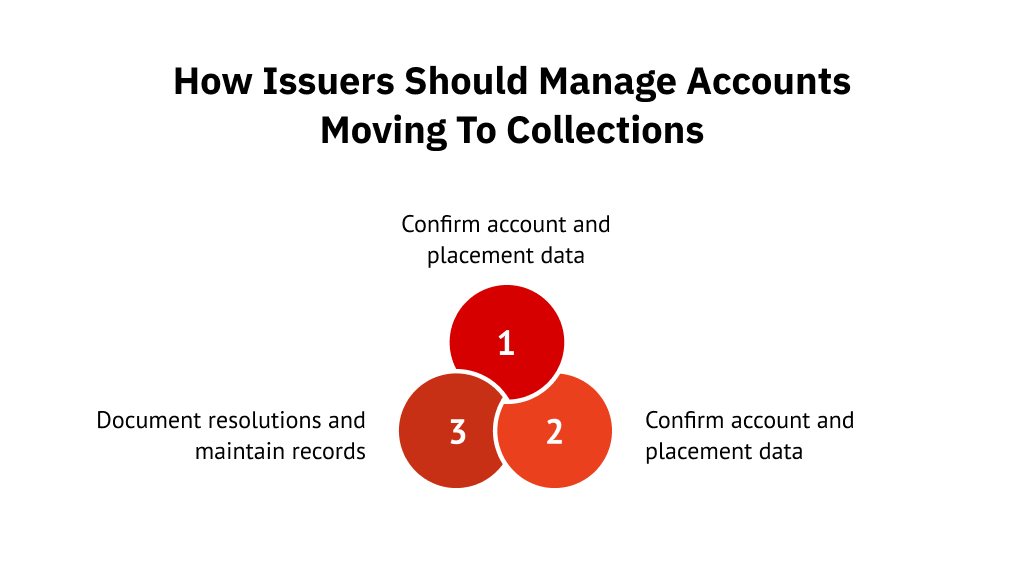
Issuers should manage accounts moving to collections through three controls: verify placement data, define authorized resolution pathways, and document outcomes. Clear handoffs reduce avoidable errors once a third-party agency begins recovery.
Step 1: Confirm account and placement data
Before placement, verify account ownership, current balance, account status, payment history, dispute status, and supporting documentation. The agency should receive accurate information about what is owed and any issue that affects treatment.
This review helps prevent outdated balances, missing payments, or unresolved disputes from carrying into external recovery. Incomplete placement data may require additional research before meaningful outreach can continue.
Step 2: Define available resolution options
Issuers should establish which resolution paths the agency may offer and under what conditions. Depending on policy and account circumstances, those options may include payment in full, repayment plans, settlements where authorized, or other approved arrangements.
Clear parameters matter because eligibility varies by account. The agency also needs instructions for exceptions, approval thresholds, and cases requiring issuer review.
These controls help issuers evaluate credit card and consumer loan collection services against their placement, authorization, and reporting requirements.
Step 3: Document resolutions and maintain records
Once recovery begins, both parties need consistent records of disputes, payment terms, account-status changes, receipts, and completed arrangements. Reporting and reconciliation should confirm that payments and resolutions are reflected accurately across systems.
Documented outcomes also support later account review, complaint handling, compliance monitoring, and portfolio analysis.
| Pre-placement checklist: Before transferring an account, confirm:Account ownership, balance, and status are accurate.Dispute status and prior payments are documented.Supporting records are available.Authorized resolution options are defined.Placement instructions are clear.Reporting and reconciliation requirements are established. |
A disciplined handoff gives the collection partner a reliable starting point while helping issuers maintain control as responsibility shifts externally.
How First Credit Services supports credit card debt collection
At First Credit Services, we support credit card issuers as a revenue recovery and customer engagement partner for managed third-party recovery. Our approach combines recovery operations, digital engagement, and compliance expertise.
We manage account engagement and recovery workflows while tailoring reporting to available portfolio data and program needs. We operate UCEP (Unified Consumer Engagement Platform) on the client’s behalf to coordinate digital and voice engagement.
Because we manage outreach strategy and program execution, issuers retain visibility without operating the platform themselves. Our model fits enterprise financial-services organizations managing high-volume recovery programs.
Match recovery decisions to the account stage
Effective credit card debt collection depends on matching recovery decisions to the account’s current stage. As account status changes, the appropriate outreach, documentation, compliance controls, and reporting requirements can change with it.
Clear handoffs become especially important when recovery responsibility moves outside the organization. Understanding these shifts helps recovery leaders decide when internal treatment remains appropriate and when third-party support fits the portfolio.
Ready to improve how your team manages late-stage recovery? Discuss your portfolio stage and third-party collection needs with our team to evaluate an approach aligned with your recovery model.
FAQs
1. Can credit card debt go to a collection agency before charge-off?
Yes, depending on the issuer’s recovery policy and account circumstances. Third-party placement does not inherently require charge-off, although seriously delinquent or charged-off accounts are common candidates for external recovery.
2. When should issuers move credit card debt collection to a third-party agency?
Issuers should consider third-party placement when internal recovery is no longer the appropriate treatment. The decision should reflect delinquency stage, account status, dispute history, documentation readiness, recovery capacity, and portfolio strategy.
3. Can first-party and third-party collections be used in the same recovery strategy?
Yes. First-party and third-party programs can cover different stages of the same recovery strategy. Clear handoff rules should define account ownership, consumer-facing branding, authorized treatment, and responsibility at each stage.
4. What happens if an issuer receives a payment after an account is placed with a collection agency?
The issuer should update the collection partner and reconcile the account balance promptly. Defined payment-posting procedures help prevent inaccurate balances, unnecessary outreach, and conflicting account records after placement.
5. Should disputed credit card accounts be placed with a collection agency?
It depends on the dispute status, supporting documentation, and applicable requirements. Issuers should ensure the agency receives accurate dispute information and understands any restrictions or escalation procedures affecting account treatment.
6. Can an issuer recall credit card debt from a collection agency?
Yes, subject to the placement agreement and program procedures. When an account is recalled, the parties should reconcile account status, payments, disputes, and pending updates to prevent overlapping recovery activity.