
If you’re reading this, you’ve already made the decision. Outsourcing AR management makes sense for your business. What you need now is a clear framework to evaluate the vendors in front of you and hold them to a measurable standard.
A Wakefield Research study commissioned by Billtrust found that 99% of companies using AI-driven AR workflows reduced their DSO, with 75% cutting it by at least six days. That’s the kind of performance you should treat as a baseline expectation, not a bonus.
This guide covers the ROI benchmarks, evaluation criteria, and questions you need before you sign.
One thing worth flagging upfront: not every AR outsourcing provider covers the same scope. Some manage the full receivables lifecycle. Others only step in after your internal process has already failed. That distinction matters more than most buyers realize, and the next section clears it up before you start comparing vendors.
What outsourced AR management covers (and what it doesn’t)
AR outsourcing is not the same as hiring a collections agency. The distinction is simple but important.
A collections agency enters the picture after your internal process has already failed. By that point, accounts are delinquent, escalated, and often damaged. AR outsourcing starts much earlier, at billing, and owns the workflow from there.
A full-service AR outsourcing provider typically handles:
- Invoice generation and delivery
- Payment follow-up across aging buckets (30, 60, 90+ days)
- Cash application and reconciliation
- Dispute intake and resolution
- Early-stage and late-stage collections
- Client-facing reporting and dashboards
Some providers offer both AR management and collections under one roof. That’s worth looking for. It means you’re handing off one workflow instead of coordinating between two vendors.
The question to confirm with any provider before you go further: are they handling the full receivables cycle, or just the back end? The answer changes what you should hold them accountable for.
The ROI case: what good AR outsourcing actually delivers
Before you take this to leadership, you need three numbers. Here they are.
1. Working capital math
For a company doing $10 million in annual revenue, every single day of DSO represents roughly $27,400 sitting in unpaid receivables. A 10-day DSO gap is $274,000 in trapped cash.
Run this against your own numbers: take your annual revenue, divide by 365, then multiply by the number of excess DSO days you’re currently carrying. That’s the cash your business is essentially lending to slow-paying customers for free.
2. In-house cost vs. outsourced cost
A fully loaded in-house AR hire, including base salary, benefits, payroll taxes, and software, runs approximately $71,000 to $85,000 per year for most mid-market businesses. That’s based on Robert Half’s 2026 AR Specialist salary benchmarks ($54,750-$65,750) with a 29.5% employer benefits burden applied, per the 2024 BLS Employer Costs for Employee Compensation report.
The outsourced cost is harder to benchmark cleanly because pricing models vary significantly. Contingency-based engagements, where the provider earns a percentage of what they recover, carry no fixed annual cost. Flat-fee arrangements depend on account volume, scope, and industry. The more useful comparison isn’t a number; it’s the cost per dollar recovered. A stretched internal team chasing aging accounts is expensive in ways that don’t show up in a headcount line.
3. DSO reduction benchmark
The Wakefield Research study commissioned by Billtrust surveyed 500 finance decision-makers at North American companies above $250 million in revenue. It found that 99% of companies using AI-powered AR workflows reduced their DSO. 75% cut it by at least six days. (Billtrust, October 2025)
Treat that six-day mark as the performance floor you hold any provider to. If a vendor can’t show you how they’ve moved DSO for clients in your industry, press harder.
| Pro Tip: Before your first vendor call, calculate your current DSO and your industry average. The gap between those two numbers is your negotiating baseline. If a provider can’t explain how they close it, that’s your answer. |
These numbers won’t make the decision for you. But they give you something concrete to anchor the internal conversation, especially if you’re presenting to a CFO who wants to see the math before signing off.
What separates a strong AR outsourcing partner from a weak one
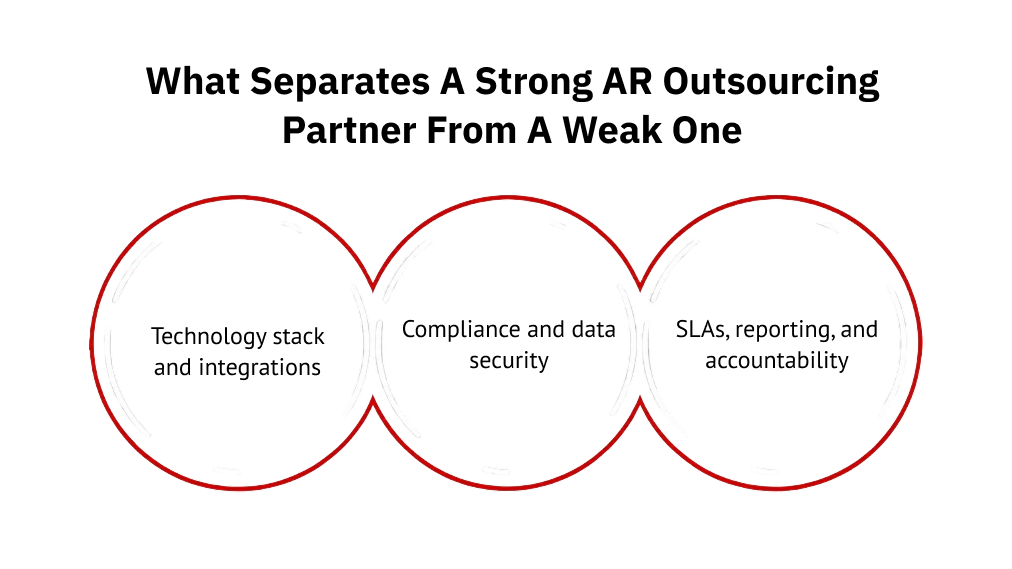
This is where most vendor evaluations go wrong. Buyers compare pricing and case studies but miss the operational details that actually determine whether a provider delivers. Here are the four areas that matter.
1. Technology stack and integrations
The first thing to establish is whether a provider can connect with your existing systems or whether you’ll be managing manual data transfers indefinitely.
Ask specifically:
- Does the platform integrate with your ERP? NetSuite, SAP, Oracle, and QuickBooks are the common ones. If the answer is vague, push for specifics.
- What is the data exchange method: API, SFTP, or direct CRM sync?
- Is reporting visibility real-time or batch? Batch reporting means you’re always looking at yesterday’s picture.
A provider who can’t answer these questions precisely is not enterprise-ready. Integration depth is not a technical detail. It determines how much manual work your team absorbs after the contract is signed.
2. Compliance and data security
In regulated industries, compliance is not a checkbox. It’s a hard disqualifier if it’s missing.
The certifications to look for:
- SOC 2 Type II — the non-negotiable baseline for data security
- ISO 9001:2015 — signals process standardization and operational discipline
- PCI DSS — required if payment processing is in scope
- HIPAA — essential for healthcare receivables
If a provider can’t produce compliance documentation on request, stop the conversation there. Asking for proof is not excessive due diligence. It’s standard practice.
3. SLAs, reporting, and accountability
This is the area where weak providers reveal themselves fastest. If a vendor is reluctant to commit timelines in writing, that tells you something.
What a serious provider should commit to:
- Defined follow-up timelines per aging bucket (30, 60, 90+ days)
- Dispute resolution windows documented in the contract
- Client-accessible dashboards with real-time data, not monthly PDF reports
- Structured performance reviews on a defined cadence
The pricing model is worth examining carefully because it shapes the provider’s behavior. A contingency-only provider focused on late-stage accounts has no incentive to catch accounts early. A flat-fee provider has limited motivation to push harder on difficult accounts. Misaligned pricing is the most common source of vendor disappointment, and it rarely comes up in the initial sales conversation.
What can go wrong with AR outsourcing
Outsourcing AR delivers real results when done right. But there are failure modes worth knowing before you sign, because most of them are preventable with the right contract and the right questions.
1. Loss of control over customer interactions
Your customers don’t know they’re talking to a third party. If the vendor’s tone, timing, or approach doesn’t match your brand, you feel it in relationships, not just in recovery rates. This is especially true for first-party engagements where outreach goes out under your name.
2. Data security exposure
Every integration is a transfer risk. Client account data, payment history, and contact information moving between your systems and a vendor’s creates exposure if the provider’s security controls aren’t tight. Ask for SOC 2 Type II documentation before you share a single file.
3. Weak SLAs with no exit clause
Some providers lock you into long contracts with vague performance commitments. If recovery rates disappoint in month four, you need a defined escalation path and an exit clause that doesn’t cost you more than the underperformance did.
4. Hidden costs
Contingency pricing sounds clean until dispute handling, onboarding, or platform fees appear as line items. Confirm in writing what the base engagement covers and what triggers additional charges.
Questions to ask before signing with an AR outsourcing provider
Use these in your vendor conversations. They’re specific enough to separate providers who actually know their operations from ones reading off a capabilities deck.
- How does data flow from our systems to yours, and how frequently does it sync?
- What ERP and billing platforms do you integrate with natively, and what requires custom work?
- What is your average DSO reduction across clients in our industry specifically?
- How do you segment accounts, and what signals does your system use to prioritize outreach?
- What is your dispute resolution process, and what is the documented SLA for closing a dispute?
- How do you handle consumer consent for SMS and digital outreach at scale?
- What compliance certifications do you hold, and can you share documentation today?
- Who is our day-to-day point of contact, and what does the escalation path look like?
- What does onboarding require from our team, and how long until we are fully live?
- What happens to an account if all digital and phone outreach fails? What is your escalation protocol?
If a vendor hesitates on any of the compliance, SLA, or integration questions, note it. The best providers answer these without needing to check with someone else. They’ve been asked before because their serious clients always ask.
What to expect during onboarding
Most AR outsourcing engagements take four to six weeks to go fully live. That timeline depends heavily on how clean your data is and how complex your system integrations are. Here’s what the transition typically looks like.
Weeks one and two: Data mapping and system integration. The provider connects to your ERP or billing platform and establishes the data transfer method, whether that’s API, SFTP, or direct sync. This is also when account segmentation rules are configured.
Weeks three and four: Pilot run. A subset of accounts goes live so both sides can catch errors in reporting, messaging, or data flow before full volume comes across.
Week five onward: Full account transfer and live operations. Your day-to-day contact should be established by this point, reporting cadence confirmed, and SLAs active.
What slows this down almost every time: incomplete or inconsistent client data, delayed access to internal systems, and unclear escalation ownership on the client side. Have these sorted before kickoff and you’ll cut at least a week off the timeline.
How to measure whether your AR outsourcing engagement is working
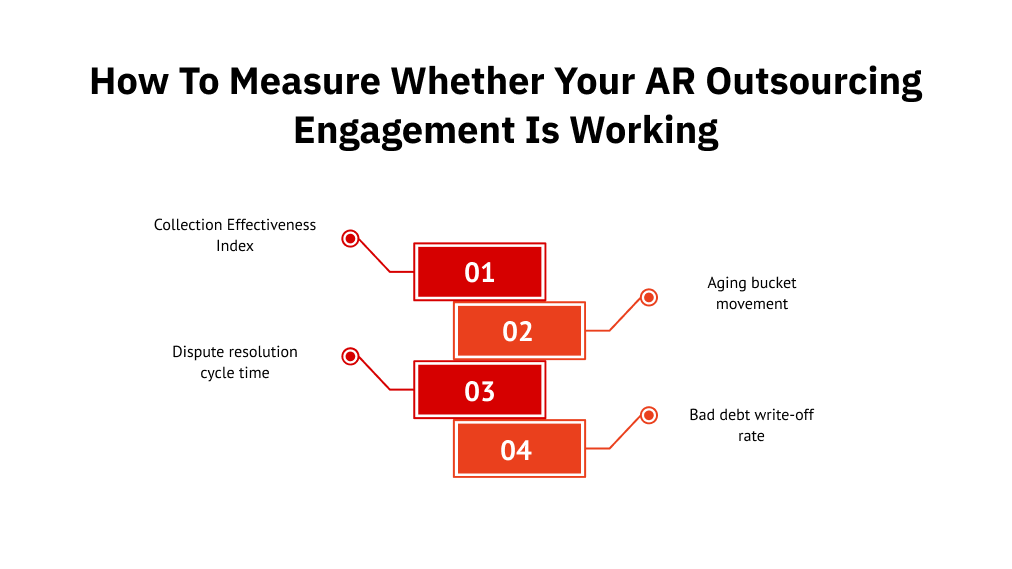
DSO gets most of the attention, but it’s a lagging indicator. By the time DSO moves, a lot has already happened upstream. Track these alongside it from month one.
- Collection Effectiveness Index (CEI): Measures what percentage of collectible receivables were actually collected in a given period. A CEI above 80% is generally considered strong. If it’s dropping, the provider’s outreach isn’t converting.
- Aging bucket movement: Are accounts moving from 90+ days toward 60 and 30, or staying stuck? A good provider shrinks the 90+ bucket consistently over time.
- Dispute resolution cycle time: How long does it take to close a dispute from the moment it’s flagged? Anything beyond 14 days for a standard dispute is worth questioning.
- Bad debt write-off rate: If this number isn’t declining after 90 days of outsourcing, the early-stage outreach isn’t working. Push for a breakdown by account segment.
Ask your provider to report on all four in every performance review, not just DSO.
How First Credit Services handles outsourced AR management
First Credit Services has been operating in the receivables space for over 30 years, working across healthcare, auto lending, fintech, banking, utilities, and subscription businesses.
On the operational side, here is what the engagement covers:
- AI-driven account segmentation that prioritizes outreach based on payment behavior, delinquency stage, and contact history
- Structured multi-channel follow-up across phone, SMS, email, and digital portals
- 24/7 self-service payment portals so consumers can resolve accounts without agent involvement
- Real-time client dashboards with full visibility into account status and recovery performance
- Both first-party collections (operating as an extension of your brand) and third-party collections for escalated or aged accounts
Pricing is contingency-based. You pay when they collect.
The platform behind all of this is UCEP, the Unified Consumer Engagement Platform. It handles outreach orchestration across channels, behavioral analytics that determine contact timing and method, and white-label delivery for first-party accounts, meaning consumers interact entirely within your brand at every touchpoint.
On compliance, FCS holds SOC 2 Type II, HIPAA, and PCI DSS Level 1 certifications, covering the core requirements for healthcare, financial services, and any engagement where payment data is in scope.
If you want to understand how the engagement model works in practice before committing, the accounts receivable outsourcing page covers the workflow in detail.
Conclusion
Choosing an AR outsourcing partner is not a procurement decision. It’s an operational one. The provider you pick will interact with your customers, sit inside your systems, and directly affect your cash position every month.
You now have the framework to make that decision with your eyes open: the ROI math to build the internal case, the criteria to evaluate vendors honestly, the risks to screen for before you sign, and the metrics to hold any provider accountable once you’re live.
If you want to see how First Credit Services fits against the criteria in this guide, the conversation starts here. Talk to the FCS team today.
FAQs
1. What does outsourced accounts receivable management include?
It typically covers invoice generation, payment follow-up, cash application, dispute resolution, early and late-stage collections, and reporting. Some providers also include consumer-facing digital portals and multi-channel outreach. Scope varies, so confirm the full coverage before signing.
2. How long does it take to go live with an AR outsourcing partner?
Timelines vary based on integration complexity and how much data needs to be migrated. A straightforward engagement with standard ERP integration can go live in four to six weeks. Custom builds or heavily regulated environments may take longer.
3. What is the difference between AR outsourcing and a collections agency?
AR outsourcing starts at billing and manages the full receivables workflow. A collections agency typically steps in after accounts have already failed internally. AR outsourcing is proactive. Collections is reactive.
4. How much does outsourced accounts receivable management cost?
Contingency-based engagements charge a percentage of what is recovered, so you pay nothing upfront. Flat-fee models run roughly $12,000 to $30,000 annually for mid-market businesses, depending on volume and scope. Always confirm what the pricing model incentivizes.
5. What compliance certifications should an AR outsourcing partner have?
At minimum: SOC 2 Type II for data security, PCI DSS if payment processing is in scope, and HIPAA for healthcare receivables. ISO 9001:2015 is a strong signal of process standardization. Ask for documentation, not just a list on a slide.