


Failed cards, returned Automated Clearing House (ACH) payments, missed renewals, cancellations, and temporary hardship can create overdue balances that require different recovery responses. Effective membership debt collections begin by identifying why the balance became overdue and whether the account is ready for escalation.
The Federal Reserve’s 2026 household report found that 28% of people surveyed in the U.S. struggled to pay bills in the prior month. For gyms and high-volume membership organizations, that pressure can turn routine billing failures into growing arrears, unresolved disputes, and heavier staff workloads.
A recent payment failure may need fast billing support, while an aged, documented balance may require a more formal recovery path. The key is matching treatment to account validity, member status, delinquency stage, and prior recovery activity.
This guide explains how membership recovery works, compares internal and outsourced options, and helps you decide when escalation or specialized support makes sense. That distinction affects staffing, customer experience, and eventual placement decisions.
What is membership debt collection?
Membership debt collection refers to the recovery of overdue membership dues, recurring fees, subscription balances, and legitimate contractual charges. The process can involve early intervention, first-party support, or third-party collections, depending on the account stage, member status, balance validity, and whether routine billing efforts have resolved the issue.
The category covers gyms, associations, clubs, recreational organizations, and subscription programs. It includes membership dues recovery, association membership collections, and subscription membership debt recovery across both active and former member accounts.
What types of membership debt need recovery?
Membership debt generally requires recovery when it falls into one of four categories: recent payment failures, early arrears, aged unresolved balances, or disputed accounts. The right treatment depends on the cause of nonpayment, delinquency stage, current membership status, and whether the balance is valid and documented.
| Type | Typical cause | Member status | Treatment | Next step |
| Failed payment | Expired card, insufficient funds, returned ACH, or outdated billing details | Usually active | Rapid payment correction | Resolve quickly |
| Early arrears | Unresolved recent billing failure | Often active | Structured outreach | Escalate if needed |
| Aged debt | Persistent delinquency or repeated non-response | Often inactive | Documented recovery | Consider third-party placement |
Failed payments and early arrears
Expired cards, insufficient funds, returned ACH payments, and outdated billing details often need fast intervention. Prompt resolution can preserve an active membership and prevent a billing issue from becoming longer-term arrears.
Aged or unresolved membership debt
Older balances require stronger documentation and a clear distinction between uncontested debt and administrative disputes. Former members, repeated non-response, and persistent delinquency may support escalation.
Cancellation, freeze, renewal, or billing disputes require review before formal placement.
How to collect unpaid membership fees: a 5-stage recovery process
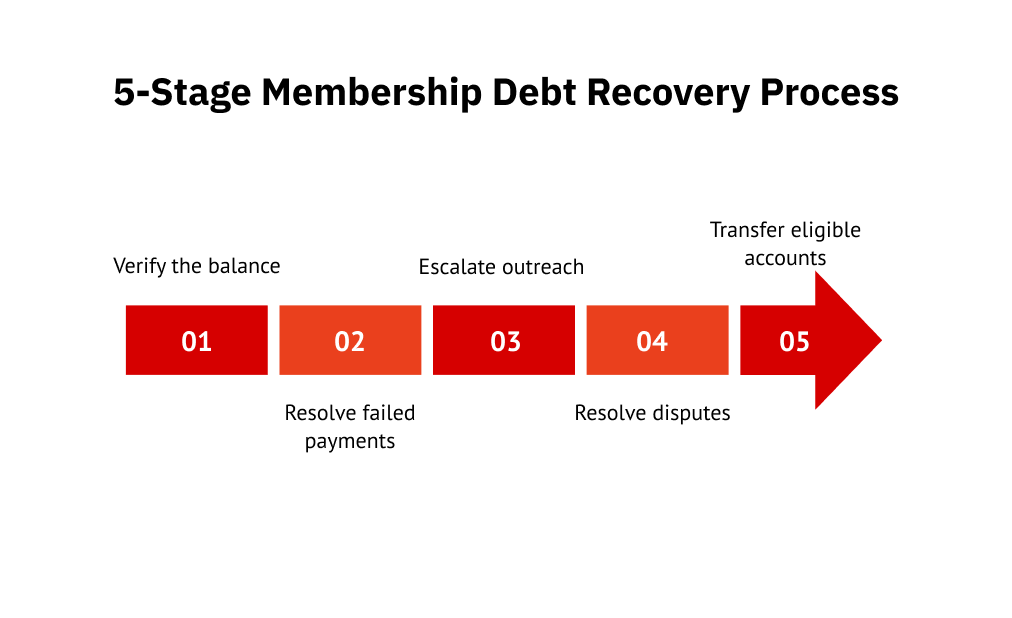
To collect unpaid membership fees effectively, use five stages: verify, resolve recent failures, escalate outreach, address disputes, and transfer eligible accounts. Treatment should reflect balance validity, delinquency stage, member status, response history, and previous recovery activity.
1. Verify the balance
Start by confirming that the amount is accurate and collectible. Review the membership agreement, renewal terms, payment authorization, ledger activity, freezes, refunds, credits, and cancellation records.
This step prevents billing errors or unresolved administrative issues from moving into recovery. It also establishes the documentation needed if the account requires later escalation.
2. Resolve failed payments
Recent failures often need a billing fix before a collections response. Use appropriate payment retries, updated card or bank details, reminders, and direct payment paths while the account is still recent.
Fast resolution matters because an active member may only need a corrected payment method. Delays can turn a simple payment failure into avoidable arrears and increase the number of follow-ups your team must manage.
3. Escalate outreach
When reminders do not resolve the balance, increase outreach in a controlled sequence. Coordinate email, text messaging, phone, and digital engagement so members receive consistent information and clear resolution options.
Qualifying early-stage programs may use outsourced first-party collections to extend recovery capacity while preserving brand experience.
4. Resolve disputes
Do not treat every unpaid balance as uncontested debt. Investigate cancellation, freeze, renewal, refund, payment-authorization, and balance disputes before formal placement.
Resolving these issues first reduces the risk of transferring inaccurate or incomplete accounts. It also separates operational billing problems from balances that genuinely require collections activity.
5. Transfer eligible accounts
Transfer accounts only after confirming that the balance is legitimate, documented, and unresolved. Include complete account history, agreements, prior communications, payment activity, and relevant dispute records.
Complete placement data gives the receiving recovery team context for prior activity. It also reduces avoidable back-and-forth when account history, member status, or earlier dispute handling needs review.
| Pro tip: Segment accounts by balance validity, account age, membership status, response history, and previous recovery activity, rather than days past due alone. |
How to reduce future membership arrears
Reduce future membership arrears by making billing expectations clear and addressing payment issues before balances age. Use clear renewal and cancellation terms, timely billing notices, fast failed-payment outreach, and simple ways for members to update payment details.
Your recovery workflow should also separate different causes of nonpayment. Payment failures may need updated billing details, while temporary hardship may require another resolution path. Administrative disputes need review, and persistent delinquency may require escalation.
Using one recovery path for every account can create unnecessary friction and obscure the underlying cause of arrears.
| Pro tip: Track why accounts enter recovery alongside recovered dollars. Recurring patterns can reveal billing, renewal, cancellation, or payment-update problems that deserve operational attention. |
When should membership debt be sent to collections?
Membership debt should move to collections when internal recovery has failed, and the account is ready for formal placement. There is no universal timeline because readiness depends on documentation, balance validity, prior outreach, and unresolved disputes.
Signs an account is ready
Repeated non-response, an inactive membership, an aging balance, and rising staff effort can signal that internal recovery is losing efficiency. However, account age should be considered alongside documentation quality, prior outreach, member status, and unresolved disputes before placement.
If your program uses an aging review point, treat it as a program benchmark rather than an automatic handoff. A newer account with complete records may be more placement-ready than an older account with unresolved cancellation questions.
Make the account collection-ready
Before transfer, confirm the records needed to explain and support the balance. Review:
- membership agreements and renewal terms;
- payment authorization and ledger activity;
- current balance and contact information;
- payment history;
- cancellation or freeze status;
- refunds and credits; and
- documented disputes.
This preparation reduces rework after placement and gives the receiving team a clear account history. It also separates eligible balances from incomplete or disputed accounts before transfer.
| Placement readiness rule: Confirm what is owed, why it is owed, and what happened before placement. The balance should trace clearly to the agreement, billing history, member status, prior outreach, adjustments, and any unresolved dispute. |
Resolve compliance questions first
Canceled, frozen, refunded, or genuinely disputed balances should remain separate from uncontested debt until the underlying issue is resolved.
For third-party collections, the Fair Debt Collection Practices Act (FDCPA) and Regulation F govern covered debt collectors. Regulation F implements the FDCPA and addresses communications, validation information, disputes, and other collection practices.
State requirements can also affect licensing, disclosures, communications, and other obligations. Your workflow should define who reviews disputes, validates account information, controls communications, and approves placement. A documented debt collection compliance process helps connect these requirements to day-to-day recovery decisions.
In-house vs. a membership dues collection agency: how to decide
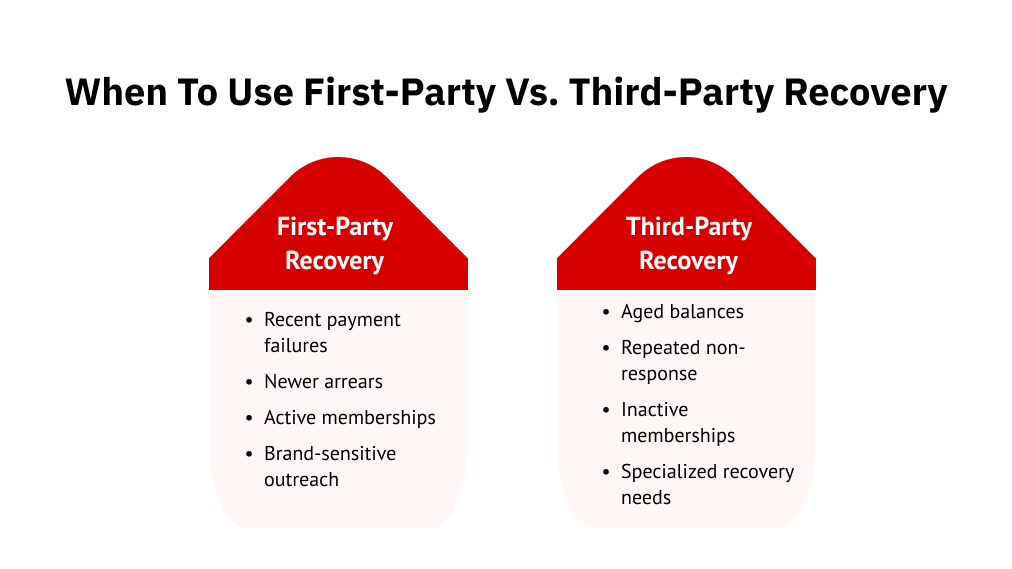
Choose between in-house recovery, outsourced first-party support, and third-party collections based on account stage, member status, internal capacity, and brand requirements. Recent failures often fit internal or first-party recovery, while aged unresolved balances may be better suited to third-party collections.
When internal or first-party recovery fits
Internal teams usually fit recent payment failures, newer arrears, active memberships, and billing issues that may still be resolved quickly. Your team remains responsible for follow-up, payment questions, disputes, and channel coordination.
Outsourced first-party recovery can extend that capacity while keeping communication under your brand. Program responsibilities for data, account updates, approvals, and recovery activity should be defined during onboarding.
Because the operating model can vary, pricing also depends on program design. Digital-only first-party programs can be contingency-based, while live-agent programs can use per-seat pricing. This distinction matters when comparing proposals because a lower headline fee may reflect a different staffing scope, channel mix, or account stage.
When third-party recovery fits
Third-party collections fit aged, repeatedly ignored, or higher-volume unresolved balances that need specialized recovery. At that stage, the member relationship may already be inactive, and the priority shifts toward documented recovery.
Third-party outreach uses the collection partner’s brand. Pricing is typically contingency-based, and third-party debt collection services can reduce internal effort on older accounts.
What to look for in a Membership collections partner
Evaluate whether the partner can match its operating model to your portfolio. Review:
- recurring-payment and membership experience;
- fit across early-stage and late-stage accounts;
- omnichannel engagement and self-service payment options;
- reporting and dispute-handling processes;
- compliance controls; and
- the commercial model for each recovery stage.
A strong fit should explain how responsibilities, communications, disputes, and pricing change as accounts move from early-stage recovery into late-stage third-party placement
How First Credit Services supports membership debt collections
At First Credit Services, we support membership recovery across account stages, including qualifying first-party programs and third-party recovery for documented aged balances. Our approach combines trained teams, digital engagement, payment access, and compliance expertise. More than 4,000 health and fitness clubs use our collection services.
Early-stage first-party recovery
For qualifying recent arrears and failed-payment programs, we can operate under the client’s brand to support early-stage recovery and preserve continuity. We operate UCEP (Unified Consumer Engagement Platform) on the client’s behalf for coordinated digital and voice engagement plus self-service payments.
Pooled programs for smaller gyms use third-party service rather than first-party white-label recovery.
Late-stage third-party recovery
Documented aged balances can transition to recovery under the First Credit Services brand when early-stage efforts have failed, and the account is ready for placement.
Our model separates late-stage collection activity from the client-branded early-stage experience. It fits high-volume membership organizations that need stage-specific recovery without operating separate outreach technology internally.
Smaller gyms may qualify through pooled third-party health-and-fitness programs.
Recover membership revenue with the right escalation path
A stronger membership recovery process begins with account readiness. Verify the balance, address recent failures promptly, and resolve cancellation, freeze, refund, or other disputes before formal escalation.
When early-stage recovery activity fails, valid and documented balances can move into the appropriate late-stage third-party recovery model. This staged approach helps your team use internal resources deliberately and create clearer handoffs for accounts needing specialized support.
For organizations managing recurring membership arrears, the goal is a consistent process that reflects member status, prior recovery activity, and account readiness. That structure supports more defensible escalation decisions and clearer recovery workflows across the portfolio. It also gives your team a clearer basis for deciding when internal recovery has reached its practical limit.
Ready to build a recovery model that fits your membership portfolio? Discuss your membership recovery needs with our team to evaluate the right approach for high-volume membership portfolios and qualifying gym programs.
FAQs
1. How long does it take to onboard a membership collection partner?
It depends on portfolio complexity, data transfer, compliance requirements, and the recovery model. Branded early-stage programs generally require more coordination because workflows, communications, staffing, and account updates must be defined.
2. Can a membership collection partner work with an existing billing system?
Potentially, depending on the systems, required data, and agreed transfer method. Before onboarding, confirm data fields, transfer frequency, security requirements, update responsibilities, and how account-status changes will flow between both teams.
3. How are recovered membership payments reconciled?
Reconciliation depends on the program design. The business and recovery partner should define how payments, adjustments, remittances, balance changes, and account statuses are recorded and exchanged before placements begin.
4. Can membership debt collections support multi-location organizations?
Yes. Multi-location programs can work when locations follow consistent placement rules, data standards, and escalation processes. Standardization helps reduce exceptions and gives finance or recovery teams clearer portfolio-level reporting.
5. How should a business measure membership debt collection performance?
Measure membership debt collection performance by recovery stage, account type, and the operational outcomes that matter to your program. Track recovered dollars alongside dispute volume, resolution timing, placement quality, payment-failure causes, and movement between recovery stages.
6. What reporting should a membership collection partner provide?
A membership collection partner should provide reporting that helps your team track placements, payments, account statuses, and recovery activity. The exact reporting structure depends on available data and program needs, so requirements should be defined during implementation.