

Finance teams are being asked to handle more work even when internal capacity is limited. As transaction volumes grow, backlogs build, or specialized skills become harder to maintain in-house, finance BPO services can provide additional operational support. For buyers considering outsourcing, the key decision is which model fits their processes, systems, risk requirements, and customer-facing responsibilities.
Finance and accounting (F&A) business process outsourcing (BPO), often called F&A BPO, transfers defined finance activities to an external provider. The work operates under agreed workflows, controls, and service expectations.
Unlike adding individual contractors or offshore staff, managed outsourcing places responsibility for specific processes with a provider while preserving agreed internal oversight.
That distinction matters because F&A BPO providers vary significantly in scope. Some concentrate on accounting, accounts payable, or transaction processing, while others support broader finance operations, transformation initiatives, or receivables management.
As a result, buyers need to look beyond provider size or service lists and evaluate how well each operating model matches their actual requirements. This guide will help you compare finance BPO models, assess provider fit, and determine which approach best supports your finance and receivables operations.
Which finance and accounting processes can be outsourced?
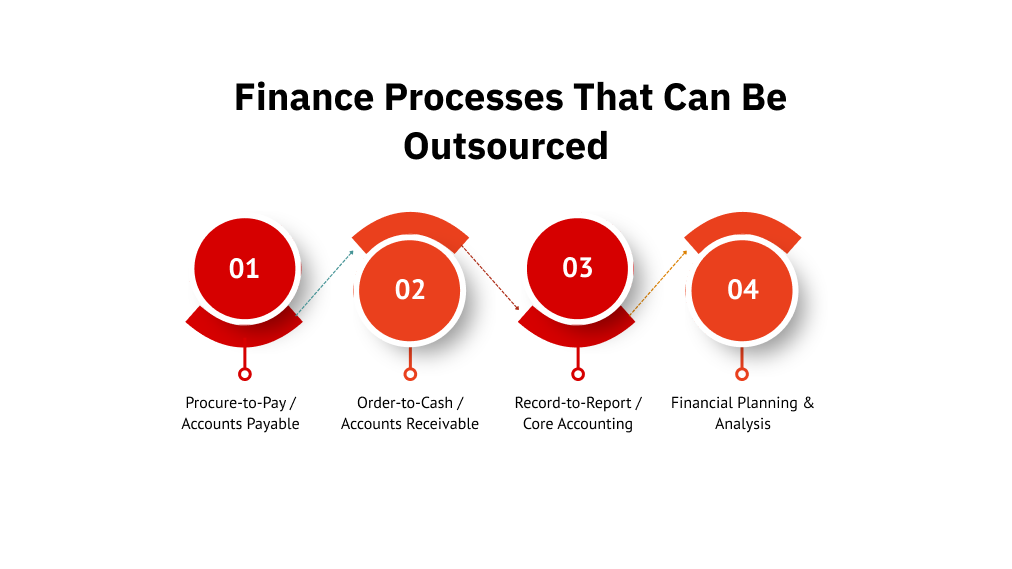
Finance and accounting processes that can be outsourced include accounts payable, accounts receivable, record-to-report, accounting, and financial planning and analysis. The right scope depends on provider coverage, controls, system complexity, judgment, and customer interaction.
| Process family | Typical activities | Common outsourcing objective | Key buyer question |
| Procure-to-pay (P2P) / Accounts Payable (AP) | Invoice processing, approvals, reconciliation, payment administration | Support transaction handling and control | How are approvals and exceptions managed? |
| Order-to-cash (O2C) / Accounts Receivable (AR) | Invoicing, cash application, receivables monitoring, payment follow-up | Support receivables execution | Where does routine accounts receivable management end and recovery begin? |
| Record-to-report (R2R) / Core Accounting | General ledger, reconciliations, close support, reporting | Support accurate accounting | Which accounting responsibilities remain internal? |
| Financial planning and analysis (FP&A) | Forecasting, budgeting, modeling, decision support | Add analytical capacity | How much judgment does the provider own? |
Procure-to-pay and accounts payable
P2P covers vendor-side finance operations, from invoice intake through approval, reconciliation, and payment administration. Outsourcing can shift recurring transactional work to an external provider while preserving clear approval and exception responsibilities.
Order-to-cash and accounts receivable
O2C typically includes invoicing, cash application, receivables monitoring, and payment follow-up. Routine accounts receivable management generally precedes formal recovery, so buyers should define the handoff carefully. Early-stage delinquency may move into first-party recovery, while seriously delinquent or written-off accounts may enter third-party collections.
Record-to-report and core accounting
R2R can include general ledger work, reconciliations, close support, and financial reporting. Because providers differ in the depth of their accounting, buyers should verify which tasks, controls, and review responsibilities are included.
Financial planning and analysis and higher-judgment finance work
FP&A may cover forecasting, budgeting, modeling, and decision support. These services often require broader enterprise F&A capabilities because they depend on context, judgment, and collaboration with internal finance leaders.
Finance BPO provider models and companies to compare in 2026
The finance BPO providers to compare in 2026 include First Credit Services, Accenture, Genpact, Infosys BPM, and IBM Consulting. However, they represent different operating models, so the right choice depends on required processes, transformation depth, and receivables responsibilities.
Some providers focus on enterprise finance transformation, while others suit managed finance operations or receivables-focused BPO. Comparing them by fit avoids treating every provider as a direct substitute.
| Provider | Delivery/operating model | Core F&A scope | Technology/transformation depth | Relevant AR/recovery capability | Best fit |
| First Credit Services | Managed BPO and customer engagement | Accounting, bookkeeping, and related finance support | Managed technology supporting engagement and recovery | Receivables management and revenue recovery | Mid-market and enterprise organizations combining finance support with receivables needs |
| Accenture | Global managed services and transformation | Broad enterprise F&A | Extensive transformation and technology capabilities | Customer-to-cash operations | Large enterprises pursuing end-to-end finance transformation |
| Genpact | Global finance operations and transformation | AP, invoice-to-cash, R2R, FP&A, and consulting | Analytics, automation, and transformation focus | Invoice-to-cash capabilities | Enterprises requiring broad, multi-process F&A transformation |
| Infosys BPM | Global business process management | P2P, quote-to-cash, R2R, FP&A, and related services | Digital, automation, and analytics-led transformation | Quote-to-cash includes collections and cash application | Global enterprises seeking broad F&A process coverage |
| IBM Consulting | Technology-enabled finance transformation | Bill-to-cash, record-to-analyze, P2P, and FP&A | Artificial intelligence-led workflow and operating-model transformation | Bill-to-cash includes billing, cash application, and disputes | Enterprises prioritizing technology-led finance transformation |
1. First Credit Services
At First Credit Services, we support buyers whose outsourcing needs connect accounting and bookkeeping with receivables management, revenue recovery, and customer engagement. With more than 20 years of Business Process Outsourcing experience, we focus on managed execution rather than enterprise-wide finance transformation.
For engagement and recovery workflows, we operate UCEP (Unified Consumer Engagement Platform) on the client’s behalf. It supports managed digital engagement and payment workflows while we retain operational responsibility as part of the managed service.
Our model can suit mid-market and enterprise organizations that want finance support alongside customer-facing receivables and recovery capabilities.
2. Accenture
Accenture is positioned toward large enterprises seeking broad finance transformation alongside managed services and technology modernization. Its finance operations span invoice-to-pay, customer-to-cash, record-to-analyze, financial planning and analysis, tax operations, and related control functions.
That breadth makes Accenture relevant when a buyer needs enterprise-wide operating-model change alongside outsourced process execution. Accenture is also a Leader in the 2026 Gartner Magic Quadrant for Finance and Accounting Business Process Outsourcing Services.
Its model fits organizations prepared for a larger transformation program involving technology, process redesign, and specialized finance operations.
3. Genpact
Genpact provides finance and accounting services spanning accounts payable, invoice-to-cash, record-to-report, financial planning and analysis, and finance consulting. Its model combines managed process delivery with analytics, automation, and finance operating-model transformation.
Consequently, Genpact is relevant for enterprises outsourcing several interconnected finance processes instead of one isolated function. Its invoice-to-cash capabilities extend into customer-facing cash-flow processes, while its broader portfolio supports finance transformation across complex operations.
This breadth is relevant when buyers need multi-process F&A support with significant transformation and automation requirements.
4. Infosys BPM
Infosys BPM supports finance and accounting operations across procure-to-pay, quote-to-cash, record-to-report, financial planning and analysis, and related services. Its model combines global process delivery with digital technology, automation, analytics, and finance transformation.
For buyers evaluating receivables scope, its quote-to-cash services include billing, collections, dispute management, cash application, and customer reconciliation. These capabilities matter when customer-facing receivables processes must operate within a broader finance delivery model.
Infosys BPM is therefore relevant for global enterprises seeking broad process coverage, digital transformation, and coordinated delivery across several finance functions.
5. IBM Consulting
IBM Consulting approaches finance and accounting outsourcing through technology-enabled operating-model transformation. Its current finance and accounting outsourcing offering includes bill-to-cash, record-to-analyze, procure-to-pay, and financial planning and analysis. IBM frames these capabilities within an artificial intelligence-led operating model.
Within bill-to-cash, IBM describes capabilities spanning billing, cash application, and dispute resolution. That orientation makes IBM relevant for enterprises seeking to redesign finance workflows around technology, orchestration, and automation.
Its model is most suitable when the outsourcing decision includes significant process transformation instead of primarily adding managed accounting capacity.
Which finance BPO model is the right fit for your organization?
Global transformation firms fit broad, multi-process change, while accounting specialists suit focused execution, and staff-augmentation models add capacity. Revenue and receivables BPO partners can fit organizations that need accounts receivable support alongside a defined handoff into recovery.
The right choice still depends on scale, process complexity, customer interaction, regulatory requirements, and the financial capabilities your organization plans to retain internally.
| If your priority is… | Provider model to consider | What to verify |
| Enterprise-wide finance transformation | Global finance and accounting outsourcing (FAO) transformation firm | Process breadth, global delivery, technology depth, and change-management requirements |
| Additional financial capacity | Staff-augmentation model | Role ownership, supervision needs, continuity, and internal management burden |
| Bookkeeping and accounting execution | Accounting specialist | Transaction scope, review controls, close support, and reporting responsibilities |
| Accounts receivable with downstream recovery needs | Revenue recovery/receivables BPO partner | Accounts receivable scope, recovery handoff point, customer interaction, and governance |
| Specialized regulated processes | Provider with relevant controls and domain experience | Data handling, assurance requirements, workflow controls, and applicable compliance obligations |
Your internal operating model should also shape the shortlist. A company retaining strategic finance leadership may need focused accounting and bookkeeping support instead of enterprise transformation.
Conversely, a business outsourcing several interconnected functions may require broader governance, systems integration, process ownership, and stronger cross-functional coordination. Where finance overlaps with customer service, receivables, or recovery, broader outsourced business services may provide a more suitable structure than accounting-only support.
| Key takeaway: Start with the required process scope, operating model, and internal responsibilities. Once those are clear, provider names become easier to evaluate against the work your organization actually needs. |
How should you choose an F&A BPO provider?
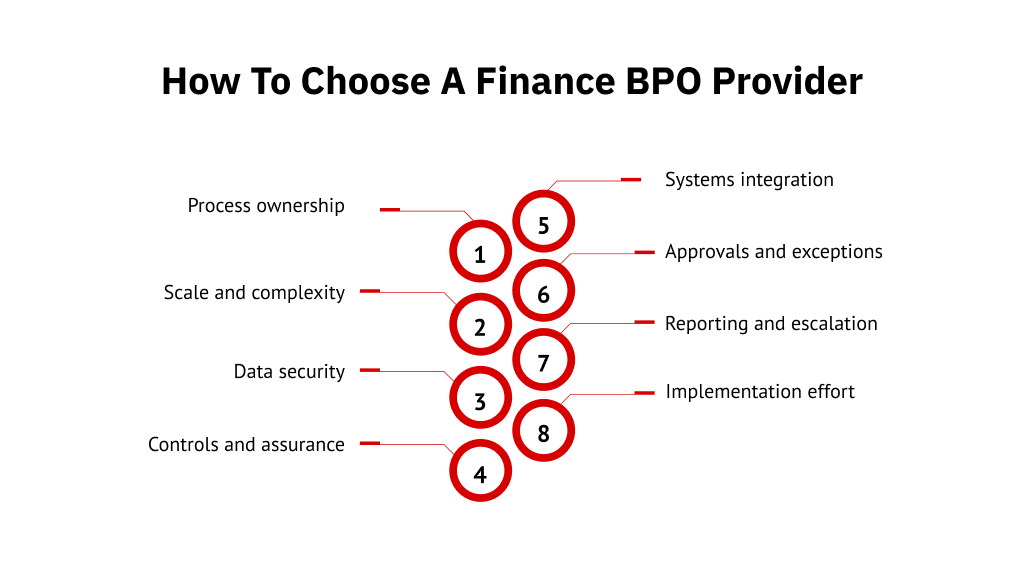
Choose an F&A BPO provider by matching its operating model to your required processes, risks, systems, and decision rights. Operational fit should shape the shortlist before price comparisons begin.
Use these eight questions during due diligence:
- Which processes will the provider own, support, or leave in-house?
- Does its delivery model match our required scale and complexity?
- How will sensitive financial and customer data be protected?
- Which controls and assurance reports can we review?
- How will data move between our systems and the provider?
- Who owns approvals, exceptions, and access permissions?
- How will service quality, issues, and escalations be reported?
- What implementation effort will our internal teams need to provide?
Match the provider to the processes you actually need
Start with process scope because provider models solve different operating problems. Accounting support may require transaction expertise, while broader outsourcing can span several process families.
Receivables and recovery add customer interaction and lifecycle handoffs. Staff augmentation adds people and capacity, but usually leaves more process ownership and supervision with the client. Hybrid models divide execution between internal and external teams.
Evaluate security, controls, and compliance
Finance outsourcing extends operational access, making control design part of provider selection. Review data handling, role-based access, auditability, segregation of duties, and applicable assurance reporting.
The AICPA System and Organization Controls (SOC) resources explain how SOC assurance reports address risks associated with outsourced services. Where cardholder data is relevant, assess applicable Payment Card Industry Data Security Standard (PCI DSS) requirements using PCI Security Standards Council resources.
Evaluate technology and systems fit
The provider must work within your actual technology environment. Determine how information moves between enterprise resource planning, accounting, customer, and payment systems.
Then clarify reporting access, permissions, data ownership, and integration dependencies. Operational friction can emerge when system responsibilities remain unclear.
Evaluate service governance and accountability
Finally, define accountability before work transfers. Specify who approves transactions, resolves exceptions, performs quality checks, reviews reporting, and handles escalation.
Governance should establish review rhythms and continuous-improvement ownership. That structure gives both teams a defined path for recurring issues.
What does finance BPO implementation actually require?
Finance BPO implementation requires a controlled transition across process scope, systems, data, controls, training, exception handling, and governance. The broader the outsourced scope, the more carefully buyers must manage dependencies before work moves to the provider.
Implementation usually follows four stages:
1. Define scope and process ownership
Start by documenting which activities transfer to the provider and which remain internal. This should include approval rights, judgment-based decisions, exceptions, and any responsibilities that cannot move outside the organization.
Clear ownership prevents gaps where both teams assume the other is responsible for a task. It also creates a practical baseline for service levels and accountability after launch.
2. Map systems, data, and controls
Next, identify the systems, data fields, permissions, transfer methods, documentation, and audit requirements supporting each process. Buyers should also map dependencies between enterprise resource planning, accounting, customer, and payment systems.
Complexity rises when multiple platforms, regulated data, or tightly controlled access requirements are involved, so these dependencies should be resolved before transition.
3. Transition workflows and train teams
Before go-live, document procedures, quality expectations, escalation paths, communication protocols, and service requirements. Provider and internal teams should understand how routine work, exceptions, and approvals move through the operating model.
Training should reflect the actual workflow rather than rely only on written procedures.
4. Measure performance and govern the relationship
After the transition, governance keeps the operating model accountable. Establish service levels, quality indicators, exception metrics, reporting cadence, escalation ownership, and review responsibilities.
Regular reviews should connect performance data with operational issues, so teams can address recurring exceptions and adjust workflows without weakening control.
Build a finance BPO shortlist that fits your operations
A useful finance BPO shortlist should make proposal differences easier to evaluate against your real operating requirements and internal capacity. Map process ownership, controls, customer interaction, implementation dependencies, and provider accountability before comparing broad capability claims or commercial terms.
For finance leaders, that preparation clarifies where internal teams retain decision rights and where an external provider must take responsibility. It also helps expose proposals that appear comprehensive but leave important workflow, governance, or receivables responsibilities unresolved.
The strongest shortlist will therefore reflect your operating requirements closely enough to support meaningful provider comparisons, sharper questions, and more focused commercial discussions. That clarity can also help procurement and finance teams compare proposals on the same operational basis.
Ready to find a finance BPO model aligned with your finance and receivables requirements? Discuss your finance BPO requirements with our team to explore accounting and bookkeeping, business process outsourcing, revenue recovery, and customer-engagement needs.
FAQs
1. How are finance BPO services typically priced?
Finance BPO services are typically priced according to scope, transaction volume, process complexity, staffing requirements, and delivery model. Buyers should compare what each fee includes and which responsibilities remain internal before comparing headline costs.
2. How long does it take to transition finance operations to a BPO provider?
Transition time varies based on process scope, system complexity, data access, controls, documentation, and internal readiness. Buyers should evaluate proposed timelines against the dependencies that must be resolved before work transfers.
3. What happens if finance transaction volumes increase after outsourcing?
The provider may need to adjust capacity, workflows, or service arrangements as transaction volumes change. Buyers should clarify how volume changes affect staffing, service levels, responsibilities, and pricing before selecting a provider.
4. Can finance BPO services support multiple business entities or locations?
Yes, some finance BPO providers support operations across multiple entities or locations. Buyers should verify system requirements, reporting consolidation, governance, and any jurisdiction-specific needs before assuming one delivery model can support every operation.
5. Do finance and accounting BPO services include tax preparation or advisory work?
Some finance and accounting BPO providers offer tax or advisory services, while others focus on operational finance processes. Buyers should verify the exact scope, applicable jurisdictions, required expertise, and whether advisory work is included or provided separately.
6. What should a finance BPO exit plan cover?
A finance BPO exit plan should define how work, data, access, documentation, and outstanding activities transfer when the relationship ends. It should also establish responsibilities for maintaining operational continuity during the transition.