


The front desk may look busy, the classes may be full, and the member base may seem healthy. But behind the scenes, failed payments can quietly turn active memberships into aging receivables.
That is the problem with gym AR. The revenue loss does not always appear as one major drop. It builds through declined cards, missed dues, unresolved freezes, unclear cancellation terms, and overdue balances that staff may not have time to pursue consistently.
As these balances age, they consume more staff time and become harder to recover. This guide explains how gym accounts receivable collections work, how to segment overdue accounts, which recovery steps protect member trust, and when to bring in a specialist partner.
What is gym accounts receivable collections?
Gym accounts receivable collections refers to the process of tracking, following up on, and recovering unpaid membership balances. It usually covers failed recurring payments, overdue dues, unpaid fees, lapsed balances, and aged accounts that remain open after normal billing attempts.
It is not the same as chasing one-off invoices. Fitness AR collections is a recurring revenue discipline. The goal is to recover membership receivables quickly, keep payment data current, and protect the member relationship where possible.
There are two main balance types to manage:
- Recent failed payments: Usually caused by declined cards, expired cards, insufficient funds, or billing interruptions.
- Aged overdue accounts: Older balances that need structured outreach, negotiation, documentation, or escalation.
Recent failures need speed and convenience. Aged accounts need a more formal recovery process.
Why Gym receivables behave differently from normal AR
Gym receivables are not like traditional B2B invoices. A gym may have thousands of small recurring balances instead of a few large invoices. That makes volume, timing, and automation more important.
The scale of the market makes this even clearer. According to the 2025 report by Health & Fitness Association, a record 77 million Americans, or 25% of people aged six and older, belonged to a gym, studio, or fitness facility in 2024.
For operators, that means failed payments, missed renewals, and overdue membership balances are not occasional back-office issues. They are recurring revenue risks that need a repeatable recovery process.
There is another important difference. Gyms deal with both involuntary churn and voluntary churn.
- Involuntary churn happens when a member wants to stay, but the payment fails.
- Voluntary churn happens when a member cancels or stops using the gym by choice.
Those two problems need different fixes. A failed card may need a retry, card updater, or self-service payment link. On the other hand, a canceled membership may need contract review, cancellation-policy validation, or no collection action at all.
Contracts, freeze rules, pause terms, and cancellation windows also affect collectability. Before any outreach begins, the gym must know what is owed, why it is owed, and whether the account is valid.
| Pro tip: Much of “lost” gym revenue is not refusal to pay. It is payment friction. Fix the payment path early, and many accounts can self-cure before they become aged debt. |
Failed payment recovery vs long-term debt recovery
The best gym collections strategy starts by separating fresh payment failures from older overdue accounts. Treating both the same way leads to poor recovery and unnecessary member frustration.
Start with accounts that still have the highest chance of quick resolution.
1. The fast track: 0 to 60 days
The first 60 days after a failed payment are the most important. At this stage, many members still recognize the balance and may want to stay active.
The goal is simple: make payment easy before the account becomes a relationship problem.
A fast-track recovery flow should include:
- Automated payment retries.
- Card updater tools.
- SMS and email reminders.
- In-app or portal alerts.
- Secure self-service payment links.
- Clear explanation of the failed charge.
- Friendly support if the member has a billing question.
This stage should feel like billing support, not collections. The tone should be helpful and direct: “Your payment did not go through. Here is how to update it.”
FCS supports this type of early-stage recovery through first-party collections, where outreach can stay aligned with the business’s brand.
However, older accounts need a different path.
2. The recovery track: 60 to 90+ days
Once a balance ages past 60 or 90 days, simple reminders usually stop working. The member may have changed contact details, ignored previous outreach, disputed the balance, or moved on from the club.
At this stage, the process needs more structure.
Long-term recovery may include:
- Phone outreach.
- Formal notices.
- Payment negotiation.
- Settlement options.
- Skip tracing where appropriate.
- Documentation review.
- Escalation to a specialist partner.
This is where gyms often lose money. When older accounts are sent through a basic reminder flow, they usually underperform because the balance already needs stronger follow-up.
At the same time, sending fresh failed payments into a hard collections process can damage retention when the issue may only be an expired card or missed update.
Instead, the better model is to match outreach to account age and member behavior. With its digital-first recovery approach, FCS helps gyms manage recent failed-payment workflows and create a clear escalation path for accounts that continue to age.
The gym AR aging model: segment before you chase
Aging tells you how urgent the account is and what type of outreach makes sense. Without segmentation, teams often chase the loudest account instead of the most recoverable one.
Use aging buckets before deciding the channel or tone.
Aging buckets and recommended actions
- 0 to 30 days past due: Use automated retries, card updater tools, app reminders, email, SMS, and self-service links. Keep the tone friendly and fast.
- 31 to 60 days past due: Add stronger reminders, member-service outreach, payment-plan options, and confirmation of whether the balance is disputed.
- 61 to 90 days past due: Move into structured first-party recovery. Use phone, email, SMS, and formal notices with clear next steps.
- 90+ days past due: Review for specialist collections, skip tracing, settlement authority, or write-off rules.
Prioritize by recoverability and value. A recent $80 failed payment from an active member may be more valuable than a two-year-old $300 balance with stale contact information.
Then tie each bucket to a channel. Early-stage accounts often respond to SMS, email, app alerts, or portal links. Older accounts may need phone support, formal written notices, and documented escalation.
| Pro tip: The longer an account stays unpaid, the harder it becomes to recover. Speed in the first 30 to 60 days protects the most cash. |
A 6-step gym collections process that protects the member relationship
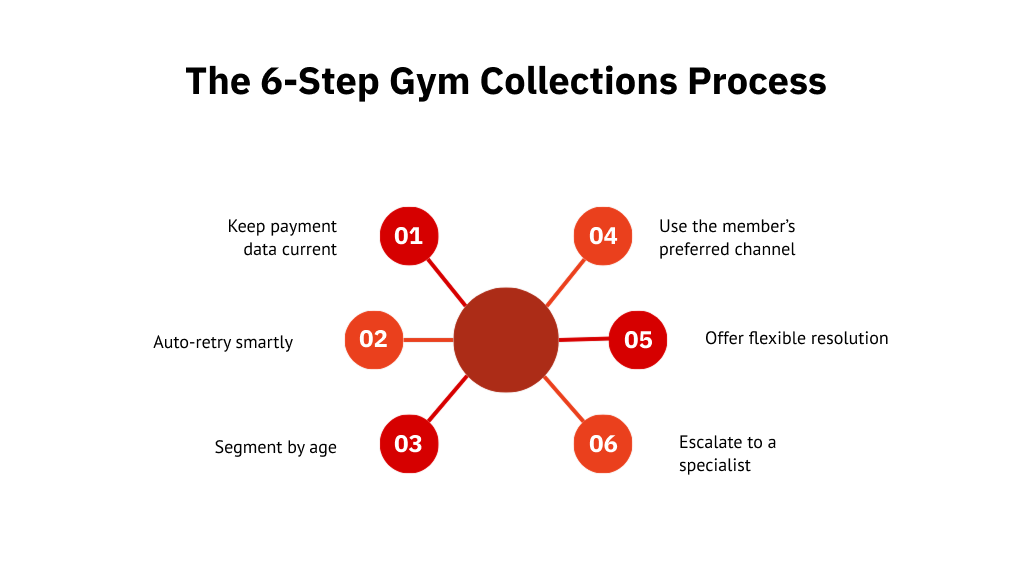
Gym collections should not feel like punishment. It should feel like a clear path to resolution. That balance matters because recovery should bring money back in without pushing away members who are still willing to stay.
Use this six-step process.
- Keep payment data current: Use card updater tools, member reminders, and portal prompts before billing dates.
- Auto-retry smartly: Do not retry randomly. Space attempts based on processor rules, member behavior, and decline reason.
- Segment by age. Separate fresh failed payments from accounts that are 60, 90, or 120+ days overdue.
- Use the member’s preferred channel: Reach members through email, SMS, portal, app, and phone when appropriate.
- Offer flexible resolution: Allow members to update cards, pay in full, set up a short plan, or ask a billing question.
- Escalate to a specialist: When accounts age or internal capacity runs out, move them into a structured recovery workflow.
For example, a boutique studio may recover a declined card within 48 hours if the member receives a secure link and updates payment details. If that same account is ignored until day 120, the balance may require formal collections or be written off.
| Case study: failed payment recovery in fitness A low-cost, high-volume health club chain was seeing 500 to 700 failed payments per club each month. Internal follow-up was costly, inconsistent, and difficult to manage alongside daily club operations. FCS implemented a 60-day failed-payment follow-up process using phone and email outreach under the client’s brand. Members felt like they were hearing directly from the club, while FCS managed the recovery workflow in the background. Outcomes: Recovered up to 70% of monthly failed payments Helped retain approximately 400 members per club each month Recovered about $6,000 in failed-payment revenue per club each month Reduced internal follow-up pressure on club staff Supported recovery while preserving the member relationship Read the full failed-payment management case study. |
Staying compliant: FDCPA, credit reporting, and member trust
Compliance matters because gym balances are often small, but complaints can be expensive. A single mishandled account can cost more than the balance recovered.
First, clarify which rules apply to your recovery model.
FDCPA basics for gyms
The Fair Debt Collection Practices Act mainly applies to third-party debt collectors. First-party outreach by the gym is treated differently, but that does not mean gyms can ignore communication standards.
A compliant gym collections process should still document:
- Who contacted the member.
- Which balance was discussed.
- What agreement or dispute was recorded.
- Which channels were used.
- Whether the account was paused for review.
If a third-party partner is involved, FDCPA and Regulation F requirements become more important. Contact frequency, disclosures, validation rights, and dispute handling all need structure.
FCS’s debt collection compliance resources explain how compliance controls support responsible outreach.
Reporting to credit bureaus
Gyms may be able to report unpaid balances to credit bureaus, directly or through a partner, if the reporting follows the Fair Credit Reporting Act. The information must be accurate, verifiable, and disputable.
Still, credit reporting should not be treated as a default step. It can affect member trust, create disputes, and damage community reputation.
Many fitness operators reserve credit reporting for verified aged balances. Others avoid it altogether and focus on direct recovery, settlement, or write-off rules.
The safer approach is to define credit reporting policy in writing. Staff and partners should know when reporting is allowed, when it is restricted, and how disputes are handled.
Measuring AR health: KPIs gyms should track
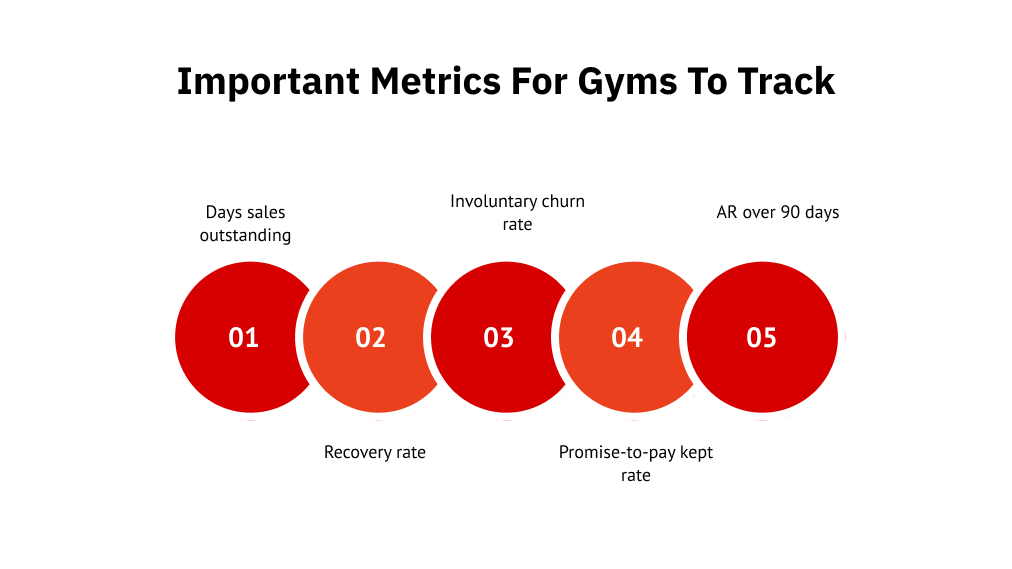
You cannot manage gym receivables if you only track total unpaid dollars. The right metrics show whether balances are aging, whether members are self-curing, and whether recovery is keeping pace with billing volume.
Track these KPIs:
| Metric | Healthy signal | At-risk signal |
| Days sales outstanding | Stable or declining | Rising month over month |
| Recovery rate | Improving by aging bucket | Dropping after 60 days |
| Involuntary churn rate | Low failed-payment loss | Rising failed-card churn |
| Promise-to-pay kept rate | Most plans completed | Frequent broken arrangements |
| AR over 90 days | Small share of total AR | Growing aged balance pool |
Clean data matters here. Your CRM, billing system, and accounting platform should reconcile member status, payment history, cancellation terms, and account age.
| Pro tip: If you cannot see DSO and aged-AR percentage on one dashboard, you cannot manage recovery with confidence. |
In-house vs outsourced gym collections
Not every gym needs to outsource immediately. The right model depends on member count, account volume, staff capacity, compliance exposure, and how much AR is aging.
Begin with the cases your internal team can still manage.
When in-house works
In-house recovery can work when the member base is small, balances are recent, and staff has time to follow up consistently.
It is usually enough when:
- Most failures are under 30 days old.
- Members respond to email, SMS, or app reminders.
- Staff can review disputes quickly.
- Cancellation and freeze policies are simple.
- AR over 90 days is low.
- Compliance exposure is limited.
The advantage is relationship control. Your team knows the member, the club, and the billing history.
But internal recovery breaks down when volume grows.
When to outsource
Outsourcing makes sense when aged AR is rising, staff time is stretched, or compliance risk is increasing. It can also help earlier, especially when failed payments are high-volume and need consistent digital outreach before they become aged debt.
Consider outsourcing when:
- AR over 90 days keeps growing.
- Staff spends too much time chasing small balances.
- Failed payments are hurting monthly recurring revenue.
- Accounts need skip tracing or formal escalation.
- You need better documentation and compliance controls.
- Your team lacks capacity for structured outreach.
A partner can also separate early recovery from long-term collections. That matters because a 15-day failed payment and a 120-day balance should not be treated the same.
The right model depends on how old the balance is, how much staff capacity you have, and whether the account needs simple follow-up or structured recovery.
| Model | Pros | Cons |
| In-house | More brand control and direct member context | Limited capacity and compliance burden |
| Outsourced | Specialist recovery, scale, tools, and documentation | Requires partner oversight |
| Hybrid | Keeps early member care internal while outsourcing harder accounts | Needs clear handoff rules |
FCS can support both tracks under one fitness-focused recovery program, including early-stage outreach, digital engagement, and later-stage recovery for accounts that need structured escalation.
Common gym AR mistakes and best practices
Most gym AR problems come from inconsistent processes, not bad intent. The fix is to make recovery structured, segmented, and member-aware.
Common mistakes include:
- Treating all overdue accounts the same: Segment by age, balance, and member status.
- Waiting too long to act: Start recovery in the first failed billing cycle.
- Using phone-only outreach: Add email, SMS, portal links, and self-service payment paths.
- Ignoring cancellation terms: Verify contract, freeze, and cancellation rules before outreach.
- Skipping dispute documentation: Record member questions, balance reviews, and resolution steps.
- Chasing balances that damage retention: Use judgment on active members with strong lifetime value.
Once those mistakes are clear, the next step is to build a recovery process that prevents them from repeating.
Best practices include:
- Keep billing data current.
- Automate early retries.
- Segment accounts before outreach.
- Match tone to account age.
- Offer flexible resolution.
- Escalate older balances to a specialist.
| Actionable takeaway: Recover early, segment carefully, document every step, and outsource the hard tail before it becomes uncollectable. |
Recover more membership revenue without damaging member trust
Gym accounts receivables collections is not an ad-hoc debt chasing. It is a segmented, speed-sensitive, and compliance-aware process for protecting recurring revenue.
The best operators act early on failed payments, keep outreach member-friendly, and reserve formal recovery for accounts that need it. They also know when internal teams have reached the limit.
If overdue memberships, failed payments, or aged accounts are draining revenue, FCS can help you build a fitness-industry AR recovery program.
Contact us to discuss a compliant recovery strategy for your gym or fitness portfolio.
FAQs
1. How long before a gym sends an account to collections?
Most gyms attempt automated recovery for the first 30 to 60 days after a payment fails. Accounts that remain unpaid past 90 days may move into collections, depending on the gym’s billing policy and member agreement.
2. Can a gym report unpaid memberships to credit bureaus?
Yes, unpaid memberships may be reported if the reporting follows the Fair Credit Reporting Act and the balance is accurate and disputable. Many gyms reserve reporting for aged, verified balances because it can affect member trust.
3. What is the difference between failed payment recovery and debt collection for gyms?
Failed payment recovery targets recent declines, expired cards, or insufficient funds. Debt collection handles older balances that need structured outreach, negotiation, skip tracing, or escalation.
4. Is it worth outsourcing gym membership collections?
Yes, if aged receivables are growing, staff lack time, or compliance risk is increasing. Gyms can also outsource earlier when failed payments are high-volume and need consistent digital outreach before accounts age.
5. How can gyms collect overdue payments without losing members?
Use recovery-first outreach. Explain the failed payment clearly, contact members on their preferred channel, and offer flexible options. Reserve firmer collections steps for accounts that ignore repeated good-faith contact.
6. What metrics show whether a gym’s receivables are healthy?
Track days sales outstanding, recovery rate, involuntary churn rate, percentage of AR over 90 days, and promise-to-pay kept rate. Rising DSO and 90+ AR are signs that recovery is falling behind.