

Every overdue account creates the same decision point: should your team keep working on it, or is it time to hand it to a specialist? The choice shapes recovery performance, payroll costs, compliance exposure, customer relationships, and how quickly aging accounts turn into write-offs.
The pressure is rising. According to the Federal Reserve Bank of New York, U.S. household debt reached about $18.8 trillion in Q1 2026. As balances grow, finance leaders need a clearer collections model.
This guide compares in-house vs outsourced debt collection across cost, compliance, recovery, control, and scalability. It also helps you decide which accounts to keep and which to hand off.
In-house vs outsourced debt collection: the short answer
In-house collections works well when a business has the capacity, systems, and expertise to manage accounts directly. Outsourced collections can support early-stage first-party work under the creditor’s brand and late-stage third-party recovery under the agency’s brand. It is especially useful when volume, aging, or compliance complexity outgrows the internal team.
Here is a brief comparison:
| Factor | In-house collections | Outsourced collections |
| Cost model | Fixed payroll and tools | Contingency or flat fee |
| Compliance ownership | Mostly internal | Shared, but creditor still has risk |
| Recovery lift | Strong on fresh accounts | Stronger on aged accounts |
| Collection stage and identity | Commonly early-stage; outreach uses the creditor’s brand | Early-stage first-party outreach can use the creditor’s brand; late-stage accounts placed for third-party collection use the agency’s brand |
| Best-fit volume | Low to moderate | Moderate to high |
The right answer is usually not either-or. The better decision is knowing where each model performs best.
What “in-house” and “outsourced” collections actually mean
Before comparing models, it helps to define what each one includes.
In-house or first-party collections
In-house collections means your own team contacts customers under your brand. This is also called first-party collections because the creditor still leads the outreach.
It usually works best for early-stage balances, often between 0 and 90 days past due. At this stage, the customer may still recognize the relationship, respond to reminders, or resolve the account through a payment plan.
In-house teams usually handle payment reminders, billing questions, dispute intake, payment plans, customer-service-led recovery, and early escalation reviews.
For businesses that want brand-aligned support without fully handing off the account, first-party collections can extend internal capacity while keeping the customer experience familiar.
However, as balances age, the work often needs stronger recovery infrastructure.
Third-party or outsourced collections
Outsourced collections means a licensed agency or BPO partner recovers overdue accounts on your behalf. The partner may contact customers under its own name, depending on account stage, contract terms, and compliance requirements.
This model is often used for 90+ day accounts, charge-offs, skipped accounts, high-volume portfolios, or balances that internal teams no longer have time to work.
Pricing usually follows one of two models:
- Contingency pricing: The agency earns a percentage of recovered dollars.
- Flat-fee pricing: The agency charges a fixed amount per account or project.
Outsourcing is not only about labor. A strong agency brings recovery expertise, compliance controls, digital outreach, reporting, and account segmentation.
In-house vs outsourced debt collection: side-by-side comparison
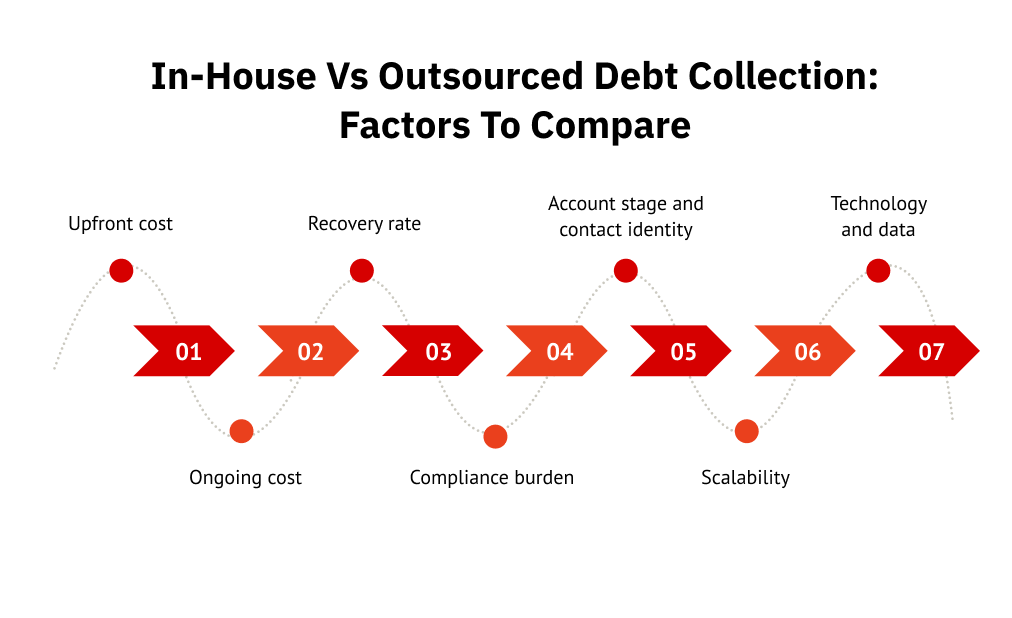
The best model depends on what your business needs most right now. Some teams need control over early customer conversations. Others need a partner that can handle aged accounts, compliance-heavy outreach, and higher placement volumes without adding fixed headcount.
The table below shows where each model usually performs best.
| Dimension | In-house collections | Outsourced collections |
| Upfront cost | Higher, because you need staff, tools, training, and management oversight | Lower, because the partner already has the team, systems, and workflows |
| Ongoing cost | Fixed payroll and technology cost, whether recovery is strong or weak | Usually variable, especially under contingency pricing |
| Recovery rate | Stronger on fresh accounts where the customer relationship still matters | Often stronger on aged accounts that need specialist workflows |
| Compliance burden | Internal team owns training, scripts, documentation, and monitoring | Partner supports execution, but the creditor still needs oversight |
| Account stage and contact identity | The creditor contacts customers under its brand while accounts remain in internal collections | Outsourced first-party programs can use the creditor’s brand; after placement for third-party debt collection, including charged-off or written-off accounts, contact comes from the agency’s brand |
| Scalability | Limited by headcount and internal bandwidth | Easier to scale across larger portfolios or sudden volume spikes |
| Technology and data | Requires internal tools, dashboards, and integrations | Partner may bring digital outreach, reporting, segmentation, and payment workflows |
The table shows the trade-offs, but the decision usually comes down to two questions: what does recovery really cost, and who can manage compliance better at scale?
Pros and cons at a glance
Before looking at cost in detail, separate control from performance. In-house collections gives your team more ownership, but that control can become expensive when account volume grows. On the contrary, outsourcing can improve scale and recovery, but only when the partner is closely managed.
In-house collections works well when:
- You are handling fresh or early-stage accounts.
- Customer relationships are sensitive.
- Your team has enough capacity to follow up consistently.
- Compliance requirements are manageable internally.
- You already have strong reporting and payment workflows.
In-house collections becomes harder when:
- Account volume exceeds the team’s follow-up capacity.
- Accounts age past 90 days.
- Staff spends too much time chasing low-recovery balances.
- Recovery depends on manual follow-up.
- Compliance monitoring is inconsistent.
- Reporting does not show cost-to-collect by aging bucket.
Outsourced collections works well when:
- Accounts are aged, high-volume, or difficult to contact.
- Internal teams are at capacity.
- Recovery requires skip tracing, segmentation, or omnichannel outreach.
- You need stronger documentation and compliance controls.
- You want the collection cost to scale with recovered dollars.
Outsourced collections becomes risky when:
- The partner does not match your brand voice.
- Compliance controls are unclear.
- Reporting is too high-level.
- Service levels are not defined.
- Data security is not reviewed before placement.
The takeaway is simple. In-house collection is strongest when the account is still fresh, and the relationship still carries weight. Outsourcing becomes more valuable when accounts age, risk rises, and internal effort no longer produces enough recovery.
The real cost comparison: cost-to-collect vs contingency fees
Cost is not just the collection agent’s salary or the agency’s fee. The better question is what it costs to recover each dollar.
Start with the hidden internal costs.
What in-house collections really costs
In-house collections includes more than payroll. A true cost view should include AR staff salaries, benefits, turnover, dialers, telephony, messaging tools, payment portals, manager review time, compliance training, call monitoring, reporting, legal support, and audit support.
That is why in-house collections may look cheaper than they are. A team may spend hours chasing low-value aged accounts while newer balances wait.
Once volume rises, fixed cost becomes harder to justify.
How agency pricing works
Most agencies use contingency pricing for third-party recovery. That means they are paid only when they recover money. Rates vary by account age, balance size, industry, and placement quality.
Flat-fee pricing may fit cleaner, repeatable work where the effort is predictable. Contingency pricing is usually better for older or harder-to-collect accounts because payment depends on what the partner actually recovers.
FCS’s contingency-based model can help convert fixed internal collection cost into a variable recovery cost. That matters when businesses want support without adding permanent headcount.
To compare fairly, use cost-to-collect per dollar recovered, not cost per account.
A worked break-even example
Imagine a business spends $12,000 a month on internal collections staff, tools, and management time. If the team recovers $40,000, the cost to collect is 30 cents per recovered dollar.
If an agency recovers $35,000 from aged accounts at a 25% contingency fee, the fee is $8,750. Gross recovery is lower, but the cost-to-collect is lower too.
That does not mean outsourcing always wins. It means the decision should be based on recovered dollars after cost.
| Pro tip: A cheaper process is not cheaper if it leaves more cash behind. |
Compliance and liability: who is actually on the hook?
Debt collection compliance is not just a legal checkpoint. It affects customer trust, recovery quality, complaint risk, and vendor selection. If your team handles collections internally, you need to build controls into training, scripts, documentation, and channel rules. If you outsource, the partner’s compliance posture becomes part of your risk posture.
The risk can hit before recovery does. According to the CFPB’s 2025 FDCPA Annual Report, debt collection generated about 207,800 complaints in 2024. One unclear disclosure, missed dispute step, or excessive contact attempt can turn a collectible balance into a complaint.
Start with the rules that shape collection outreach.
The compliance checks that should shape your model
The rules do not change just because an account moves from your team to an agency. What changes is who manages the day-to-day controls, who documents them, and how quickly issues are escalated.
- Fair Debt Collection Practices Act (FDCPA): If you outsource to a third-party agency, confirm how the partner trains agents, controls scripts, handles disputes, and prevents conduct restricted under the FDCPA.
- Regulation F: Any outsourced model should show how validation notices, call-frequency controls, digital communications, and consumer preferences are documented under Regulation F.
- Telephone Consumer Protection Act (TCPA): If your collections process uses calls, texts, autodialing, or prerecorded messages, review how consent is captured, stored, and honored under the TCPA.
- Unfair, Deceptive, or Abusive Acts or Practices (UDAAP): Review whether payment options, disclosures, fees, settlement language, and dispute handling could create risk under UDAAP standards.
- State collection laws: Multi-state portfolios need state-level licensing, disclosure, timing, fee, interest, and documentation checks before placing accounts.
The key question is not whether compliance exists. It is whether your internal team or your agency partner can prove it consistently across every account, channel, and exception.
Vicarious liability and partner risk
Outsourcing collections does not outsource all liability. Creditors can still face exposure if a partner mishandles communication, disputes, data, disclosures, or payment practices.
That is why vendor due diligence matters before the first account is placed. Hence, review the partner’s training process, scripts, call monitoring, complaint handling, audit logs, licensing coverage, data security, and reporting cadence.
Also ask how exceptions are handled. A strong partner should show what happens when a consumer disputes a balance, requests validation, revokes consent, raises hardship, or complains about contact frequency.
FCS supports compliance-managed recovery with documented controls and collection workflows built around debt collection compliance and regulations.
Recovery rate and performance: what actually moves the needle
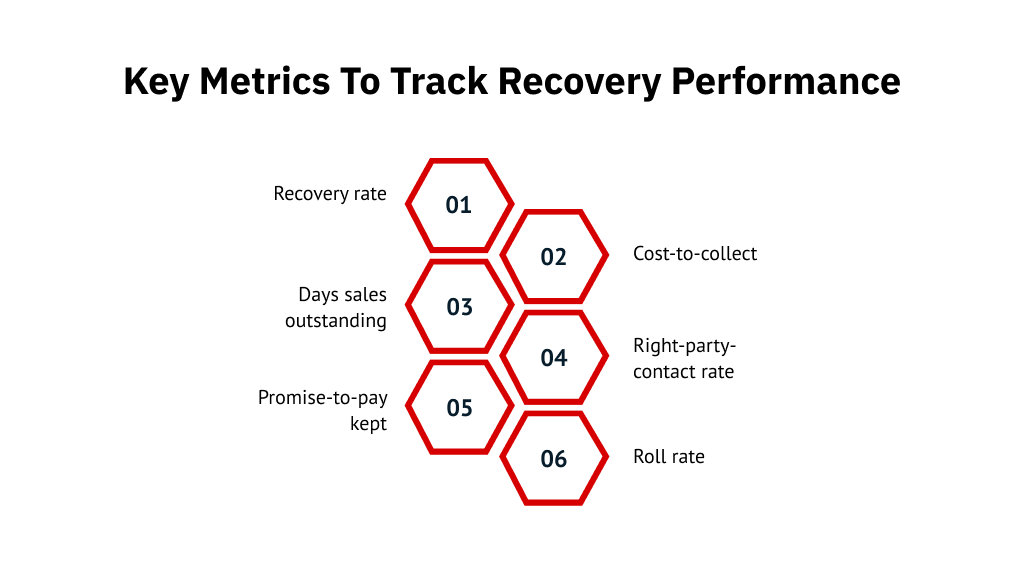
Recovery depends on more than the number of calls placed. It depends on account age, data quality, channel mix, segmentation, and follow-up discipline.
To compare models, track the right metrics.
| Metric | What it shows |
| Recovery rate | Share of placed dollars collected |
| Cost-to-collect | Cost required to recover each dollar |
| Days sales outstanding | How long balances stay unpaid |
| Right-party-contact rate | Ability to reach the correct customer |
| Promise-to-pay kept | Whether arrangements turn into payments |
| Roll rate | How quickly accounts move into worse aging buckets |
These metrics show whether your model is improving recovery or only increasing activity. For aged accounts, specialist focus often matters more than internal familiarity.
Why specialists often recover more on aged debt
Aged debt needs a different operating model. Internal teams usually focus on current accounts, fresh delinquencies, and customer service priorities. Older balances can fall to the bottom of the queue.
Specialists can bring skip tracing, omnichannel outreach, behavioral segmentation, dedicated recovery teams, settlement workflows, compliance documentation, and portfolio-level reporting.
FCS’s digital debt collection platform supports outreach across digital channels and self-service paths, helping customers resolve balances with less friction.
The decision framework: 6 questions to choose your model
The right model depends on your account mix and business goals. Use these six questions before choosing in-house, outsourced, or hybrid.
- What is your account volume and mix? – Low-volume, fresh accounts may stay internal. High-volume aged accounts usually need support.
- What is the cost of carrying overdue AR? – If balances age faster than your team can work them, internal control may be costing you recovery.
- How much regulatory exposure do you have? – More rules, states, and account types increase the need for specialist controls.
- What customer experience is required? – Relationship-sensitive accounts may need first-party handling before escalation.
- Do you have internal capacity and expertise? – If staff are overloaded, process quality drops.
- What stage of growth are you in? – Growing portfolios often outpace internal collections faster than leaders expect.
Once you answer the questions, score the model.
Score it with a simple matrix
Rate each question from 1 to 5 for in-house fit and outsourced fit.
| Question | In-house score | Outsource score |
| Account volume and mix | ||
| Carrying cost of overdue AR | ||
| Regulatory exposure | ||
| Customer experience needs | ||
| Internal capacity | ||
| Growth stage | ||
| Total |
A higher in-house score means your team can likely manage more internally. A higher outsource score means a partner may improve recovery or reduce risk. If the scores are close, a hybrid model usually makes the most sense.
Where the score points to outsourcing or hybrid support, FCS can plug into the recovery process without forcing you to rebuild your internal team.
Why most businesses land on a hybrid model
Many businesses do not need to choose one model forever. A hybrid approach lets each account follow the path that fits its age, risk, and relationship value.
Start with the cleanest rule of thumb.
Match each stage to the right collection model
Early-stage collections do not have to stay in-house. A business can manage them internally or use an outsourced first-party partner that communicates under the creditor’s brand. Once an account is placed with a third-party collection agency for late-stage collection, including after charge-off or write-off, the agency communicates under its own brand and applies specialist recovery workflows.
Early-stage accounts often need reminders, payment links, dispute review, and customer support. Aged accounts may require stronger outreach, skip tracing, settlement authority, and documentation.
How the handoff works
A clean handoff should include:
- Customer contact details
- Account history
- Balance records
- Payment records
- Dispute notes
- Prior outreach history
- Settlement rules
- Required disclosures
- Reporting expectations
- Data security requirements.
Shared reporting matters after the handoff. Your internal team should still see placement status, recoveries, disputes, complaints, and account outcomes.
FCS’s omnichannel debt collection services can help connect first-party and third-party workflows. Thus. accounts move through one recovery pipeline instead of two disconnected silos.
Common mistakes to avoid when choosing or switching
The model matters, but execution matters more. Avoid these common mistakes:
- Outsourcing too late: Dead accounts recover poorly.
Fix: Escalate by age, response behavior, and recovery probability. - Choosing on price alone: Low fees mean little if recovery is weak.
Fix: Compare net recovery after cost. - Skipping compliance due diligence: Vendor gaps can become creditor risk.
Fix: Review audits, scripts, training, complaints, and security controls. - Ignoring data security: Collection data is sensitive.
Fix: Confirm encryption, access controls, PCI practices, and reporting permissions. - No shared reporting or SLAs: Lack of visibility creates loss of control.
Fix: Define dashboards, cadence, service levels, and escalation rules before go-live.
Choose the model that protects recovery and control
The best debt collection model is not always fully in-house or fully outsourced. It is the model that matches the account stage. Keep the accounts your team can resolve well. Hand off the ones that are aging, costly, or too risky to manage without specialist support.
That is the decision FCS helps finance leaders make. With compliant first-party and third-party recovery options, the team can help you identify which accounts to keep internal and which ones to escalate before another quarter of aged debt writes itself off.
Consult with FCS to know which accounts your team should keep in-house and which should move to a specialist recovery partner.
FAQs
1. Is it better to collect debt in-house or outsource it?
Neither model wins universally. In-house collections fits low-volume, early-stage, relationship-sensitive accounts. Outsourcing fits aged, high-volume, or compliance-heavy debt. Many businesses use a hybrid model.
2. How much does outsourced debt collection cost?
Many agencies work on contingency, meaning they take a percentage of recovered dollars. Compare that fee against your fully loaded internal cost to collect, not just staff salaries.
3. When should a business outsource debt collection?
Consider outsourcing when accounts age past 90 days, recovery rates stall, internal teams reach capacity, compliance risk rises, or overdue AR costs more to carry than a contingency fee.
4. Does outsourcing collections remove my compliance liability?
No. A creditor may still face risk for a partner’s conduct. That’s why you should review vendor compliance, training, audit trails, licensing, and complaint handling before outsourcing.
5. Will using a collection agency hurt my customer relationships?
It can if the agency is aggressive or off-brand. A reputable partner aligns to your tone, documentation standards, and compliance rules while recovering accounts your internal team cannot work efficiently.
6. What is a hybrid debt collection model?
A hybrid model keeps early-stage accounts with the internal team and routes aged accounts or charge-offs to a third-party partner. It combines brand control with specialist recovery.