


The most expensive account in a gym’s billing system is often the one no one acts on early enough. The member has not formally canceled, but they have stopped engaging. A payment fails, an annual fee goes unpaid, and the balance keeps rolling forward. What started as a simple billing issue can quickly become aged revenue that is harder to recover.
That is why gym membership collections need a clear recovery timeline. The process helps fitness operators identify unpaid dues early, follow up consistently, document every step, and escalate accounts before recovery becomes difficult.
The stakes are significant. The Health & Fitness Association 2025 report states a retention rate of 66.4%, meaning roughly one in three members leaves each year. For operators, that churn often shows up first as unpaid dues aging in the billing system.
This guide covers how to recover unpaid gym dues, when to escalate, which compliance rules apply, and when a collections partner makes sense.
What are gym membership collections?
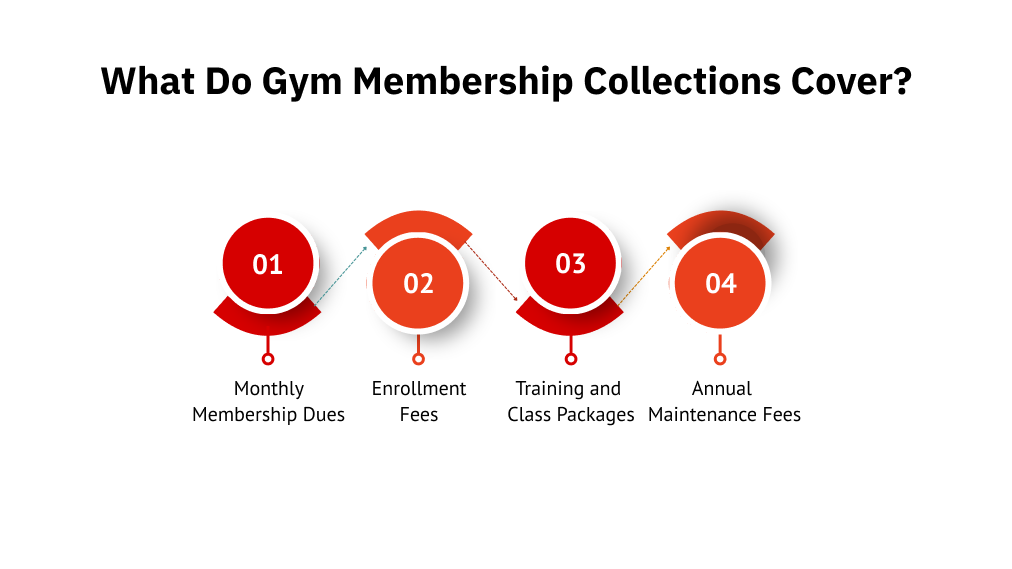
Gym membership collections refers to the structured recovery of unpaid charges that fitness facility members owe under their agreements. Those charges include:
- Recurring monthly dues: The core revenue stream and the most common source of delinquency.
- Initiation and enrollment fees: One-time charges that go unpaid when a member’s first payment fails.
- Personal training and class packages: Prepaid or installment-based charges tied to specific services.
- Annual maintenance fees: Periodic fees that catch members off guard, especially after they stop visiting.
The process can happen in-house under your own brand through first-party recovery. It can also involve a licensed agency through third-party collections when accounts have aged, or internal outreach has been exhausted.
Why unpaid dues quietly drain fitness revenue
Revenue loss in fitness does not always come from members refusing to pay. More often, it starts with a payment method that quietly stops working, while the account stays active inside the billing system.
The failed-payment leak
Most gym revenue loss comes from bounced recurring payments. Expired cards, insufficient funds, and failed Automated Clearing House (ACH) transactions are the primary causes. The member may not even realize the payment failed.
Because dues are small and recurring, each failure is easy to overlook. According to the 2026 U.S. Health & Fitness Consumer Report, 81 million Americans held gym memberships in 2025. At that scale, even a thin slice of payment failures creates a serious revenue gap.
That financial drain runs deeper than the missed balance alone.
The true cost
The direct loss is the unpaid balance. The indirect cost includes staff time, manual follow-up, awkward front-desk conversations, and inconsistent outreach that pulls attention away from member service and acquisition.
Replacing a lost member usually costs more than recovering a delinquent one. That makes unpaid dues a revenue priority, not just a billing cleanup task.
However, internal teams often struggle to keep the process consistent.
Why in-house effort stalls
Front-desk staff and trainers are hired to serve members, not collect overdue balances. Asking them to chase payments can create tension and inconsistency.
Without a structured process, overdue accounts sit inside billing software and age silently. By the time someone reviews them, the member may have disengaged, moved, changed contact details, or decided not to return.
| Pro tip: Track involuntary churn separately from voluntary churn. Failed cards, expired payment methods, and billing breakdowns are often recoverable. Measuring them separately shows how much revenue better retry logic and outreach can win back. |
When should a gym send an account to collections?
Timing is the most important variable in unpaid gym membership collection. Move too early, and you may alienate a member who simply forgot to update a card. Wait too long, and the account becomes harder to collect.
A clear aging timeline keeps accounts moving.
A day-0 to day-120 aging timeline
Use this sequence as a practical starting point:
| Days past due | Action |
| 0 to 7 | Auto-retry the payment. Send a branded reminder with a card update link |
| 8 to 30 | Launch a dunning sequence: email, SMS, and in-app update prompts. |
| 30 to 60 | Direct outreach by phone or email; offer a payment plan or catch-up arrangement. |
| 60 to 90 | Branded pre-collection notice with clear consequences. |
| 90 to 120 | Place the account with a third-party agency for formal recovery. |
This timeline should guide the process, but some behaviors need faster action.
Signals it is time to escalate
Watch for these signs:
- No response across email, SMS, and phone after multiple attempts.
- A broken payment promise.
- A permanently dead payment method with no update provided.
- The member has relocated or become unreachable.
Before moving an account forward, clean up the basics.
What to do before you escalate
Verify the balance, confirm the contract supports the charge, and resolve any open cancellation dispute. Then document every outreach attempt with dates, channels, messages, and outcomes.
This step protects both recovery and compliance. A poorly documented account is harder to collect, harder to defend, and more likely to create complaints.
| Pro tip: Most fitness accounts should move to a specialist around 60 to 90 days past due. Recovery odds drop after 90 days, so escalate on a set timeline instead of waiting until the account feels hopeless. |
Staying compliant with federal collection rules
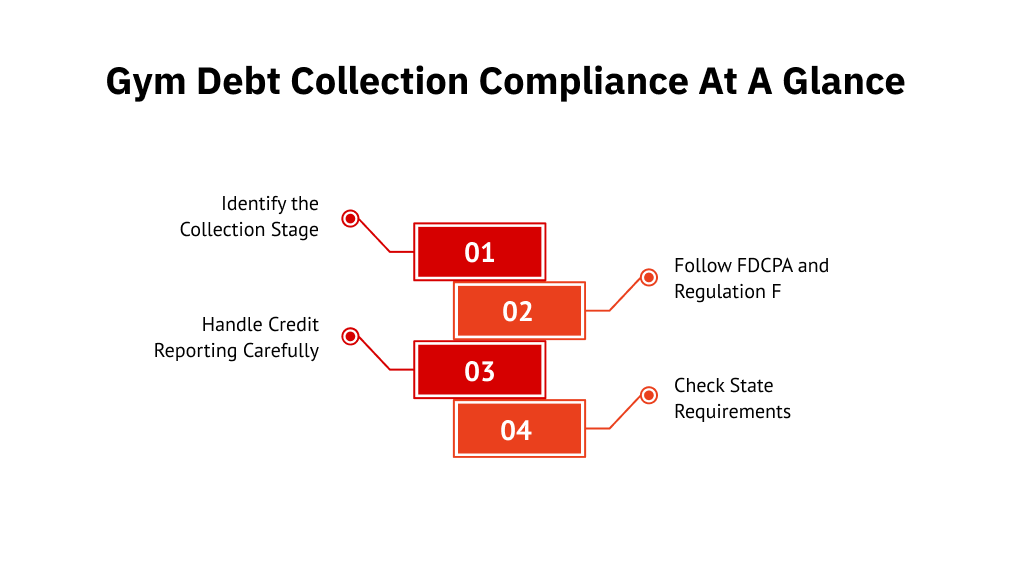
Compliance is where gym debt collection becomes more complex. Federal rules affect how, when, and how often you can contact a member about an unpaid balance.
The first rule is knowing which stage you are in.
Collection law basics for fitness operators
The Fair Debt Collection Practices Act (FDCPA) applies because an unpaid gym membership qualifies as a consumer debt. The law prohibits harassment, false statements, and unfair practices.
First-party outreach generally falls outside the FDCPA’s scope. The moment you hand an account to a third-party agency, however, that agency must comply in full.
The Consumer Financial Protection Bureau (CFPB) recorded approximately 207,800 debt collection complaints in 2024, per its 2025 FDCPA Annual Report. That volume underscores how closely regulators watch this space.
Regulation F: the 2021 rules
Four provisions matter most for gym operators:
- 7-in-7 call cap: Under 12 CFR § 1006.14(b), collectors should avoid more than seven calls per debt in seven days.
- Limited-content messages: Voicemails must follow specific content rules to avoid formal classification.
- Digital consent: Email and text outreach requires documented consent and opt-out rights.
- Model validation notice: The first written contact must include balance and dispute-rights details.
Reporting an unpaid balance to credit bureaus carries its own obligations.
Credit reporting rules
Under the Fair Credit Reporting Act, a gym or its agency can report unpaid balances to credit bureaus if the process follows applicable requirements. Once reported, the balance may appear on the member’s credit file, and the member can dispute inaccurate entries.
Reserve credit reporting for later-stage accounts that have moved through the full outreach timeline. It should not replace early recovery efforts.
State rules can add further restrictions. California, Oregon, and Washington impose additional requirements on health club contracts, cancellation rights, and collection practices. Therefore, confirm your obligations with counsel before escalating accounts.
First-party collections: recovering dues without losing members
The earliest recovery stage is the one gyms can control most directly. First-party collections happen under your own brand while the member relationship is still salvageable.
Start by reducing preventable failures.
1. Fix the payment data first
Prompt members to update expiring cards before they fail and capture a backup payment method at signup. Then send automated reminders 30 days before a card expires.
These small steps prevent a meaningful share of failed payments from ever reaching delinquency. Once payment data is current, the next step is structured outreach.
2. Build a dunning sequence that gets paid
A dunning sequence is a structured series of reminders that escalate in urgency. For gym accounts, an effective sequence might look like this:
| Timing | Outreach |
| Day 1 | Automated email with a one-click card update link |
| Day 3 | SMS reminder (if the member opted in) |
| Day 7 | Follow-up email with a firmer tone and a grace-period deadline |
| Day 14 | Phone call or personalized email from the membership team |
| Day 21 | Final notice tying account access to payment status |
Each message should give the member one clear action: a link to update their card, a number to call, or a page to visit. Even with consistent outreach, some members will fall behind. A realistic path forward often brings them back.
3. Offer a path back
Payment plans, partial catch-up arrangements, and reinstatement offers all lower the barrier to resolution. Recovering a $200 balance over four payments is better than writing it off entirely.
Throughout this process, how you communicate matters as much as what you communicate.
4. Keep the tone brand-safe
Keep every message focused on the account, the balance, and the next step. Frame it as a billing matter, because that is exactly what it is.
“Your account has an outstanding balance of $XX” works well. It is factual, professional, and gives the member a clear reason to act.
Recovering failed recurring payments and chargebacks
Failed payments and chargebacks are related, but they need different handling. A failed payment is usually a billing issue. A chargeback is an active dispute.
Start by separating the causes.
1. The mechanics
Recurring payment failures fall into a few common categories:
- Card declines: Often temporary. An automatic retry within 48 hours resolves many of these.
- Expired cards: Preventable with proactive update prompts before the expiration date.
- Insufficient funds: Best addressed by timing retries to common paydays, such as the 1st and 15th.
- ACH returns: Require direct outreach because the member’s bank rejected the transaction.
When a member moves beyond a missed payment and actively disputes the charge, the situation changes.
2. Handling chargebacks and cancellation disputes
Gym member chargebacks usually start with one claim. The member says they canceled, yet charges continued. If your cancellation process is unclear or poorly documented, these disputes are hard to win.
Document the membership agreement and cancellation policy at signup. Save written records of every cancellation request and the date it was processed.
On the payment side, automation handles the early work before human effort becomes necessary.
3. Smart retry logic
Automated retries recover a significant share of failed payments. The key is timing and restraint.
Retry too often, and you trigger bank fees or fraud filters. Retry too few times, and you lose payments that would have cleared on a second attempt. A practical approach: retry once within 48 hours, retry again around the next payday, then move to human outreach.
| Pro tip: Resolve any cancellation dispute before you attempt to recover the remaining balance. Collecting on an actively disputed account generates chargebacks and complaints faster than any other recovery mistake. |
In-house vs. a collections partner: how to decide
At some point, every gym operator faces the same question: keep handling overdue accounts internally or bring in a partner?
The answer depends on account age, volume, compliance exposure, and staff capacity.
Side-by-side comparison
| Factor | In-house | Collections partner |
| Recovery rate | Lower on aged accounts | Higher, especially past 60 days |
| Compliance coverage | Your responsibility entirely | Managed by the partner |
| Staff time | Significant and ongoing | Minimal after account placement |
| Member experience | Full brand control | Depends on the partner’s approach |
| Cost model | Fixed (staff salaries and tools) | Typically contingency based |
| Credit reporting | Requires bureau relationships | Usually included |
When to keep it in-house
Early-stage delinquency, under 30 days, responds well to in-house effort. Small balances, members you expect to retain, and straightforward payment failures are good candidates for internal recovery.
In-house support also works when your team has the time, tools, and documentation discipline to follow up consistently. However, as accounts age, the equation shifts.
When to bring in a partner
A fitness center collection agency adds value when accounts pass 60 days without resolution. High account volumes can overwhelm staff who already have member service responsibilities.
Accounts with compliance exposure also need stronger controls, especially when validation notices, credit reporting, or formal collection rules apply. A partner can also support earlier accounts through branded first-party outreach when your team lacks capacity.
If you decide to use a partner, evaluate the operating model carefully.
What to look for in a fitness collections partner
When evaluating a recovery partner, prioritize these capabilities:
- Industry experience with fitness and recurring-revenue businesses.
- Contingency pricing (“no recovery, no fee”) so you pay only for results.
- FDCPA and Regulation F compliance built into every outreach step.
- Omnichannel communication across email, SMS, phone, and digital portals.
- A real-time client portal for account visibility and reporting.
- Brand-safe communication that protects your gym’s reputation.
How First Credit Services handles gym membership recovery
Fitness operators need a recovery partner that understands recurring-revenue businesses. FCS offers a model built around the staged timeline this guide covers.
The approach starts with first-party, branded reminders under your gym’s name. Thus, members receive outreach that feels like it comes from your business. This preserves the relationship during the earliest recovery window. For accounts that remain unresolved, the process escalates into formal third-party recovery with full FDCPA and Regulation F compliance.
FCS manages over 125 million consumer interactions annually across its recovery programs. That scale runs on the Unified Consumer Engagement Platform (UCEP), which coordinates omnichannel outreach, self-service payment options, and compliance controls.
The result for gym operators: you hand off the account, and the recovery process runs on your behalf.
Can a gym actually send a member to collections?
Yes. An unpaid gym membership is a consumer debt, and gyms can place delinquent accounts with a collection agency. The process must follow FDCPA and FCRA rules, like any other consumer debt.
For operators, this means setting expectations at signup. Include the cancellation policy, the consequences of non-payment, and the membership terms in writing.
Recovery starts with a timeline
The thread running through this guide is timing. Failed payments need immediate retry logic and delinquent accounts need structured dunning. On the other hand, aged balances need a qualified partner with compliance infrastructure.
The strongest recovery process protects both revenue and member trust. It acts early, documents every step, and gives members a clear path to resolve the balance before the relationship breaks down.
That is especially important as unpaid dues move past 60 or 90 days. At that point, internal follow-up often becomes inconsistent, and recovery odds start falling.
Consult with FCS to bring structure, visibility, and stronger follow-up to overdue gym accounts.
FAQs
1. How much does it cost to hire a collection agency for gym dues?
Most fitness-focused agencies work on contingency, meaning you pay a percentage of what they recover. If the agency collects nothing, you pay nothing. Rates typically depend on account age, volume, and balance size.
2. What happens if a member disputes a gym collection?
The agency must investigate and verify the balance with the gym. If the dispute is valid, the account is corrected or withdrawn. Accurate membership agreements, payment records, and cancellation documentation strengthen the gym’s position.
3. Can a member cancel their membership to avoid collections?
Canceling stops future charges from accruing. It does not erase a balance already owed. If a member has unpaid dues at the time of cancellation, those charges remain collectible under the original agreement.
4. What information should a gym provide when placing an account?
Provide the member’s contact details, the balance amount, the membership agreement, payment history, any cancellation correspondence, and records of prior outreach. Complete documentation helps the agency work the account efficiently.
5. Can a gym collect on a membership that was already canceled?
Yes, if the agreement includes charges that accrued before the cancellation date. Annual fees, past-due monthly dues, and outstanding balances for services already rendered remain collectible after the membership ends.
6. Do state laws add restrictions beyond federal rules for gym collections?
They do. States such as California, Oregon, and Washington impose additional requirements on health club contracts, cancellation rights, and collection practices. Confirm your state’s rules with legal counsel before escalating accounts.