


Collections teams have spent years trying to make outreach more persuasive. But often, the real problem is the friction between intent and action.
A consumer may be ready to resolve a balance. That intent can disappear if the next step requires a call, an agent, or a hard-to-find payment link. Self-service debt collection closes that gap with a secure way to review the balance, choose an option, set up a plan, or raise a dispute.
This shift reflects how customers already prefer to get help. According to Gartner’s 2024 survey, 73% of customers use self-service at some point in their service journey.
This guide breaks down how self-service debt collection works, what to build, and how to stay compliant.
What is self-service debt collection?
Self-service debt collection is a digital collections model that lets consumers resolve overdue balances through a secure online portal. They can verify their account, review the balance, pay in full, set up a plan, accept an offer, raise a dispute, or request help without an agent call.
It is rising because expectations have changed and delinquency pressure is building. The New York Fed reported that 4.8% of outstanding household debt was in some stage of delinquency in Q1 2026.
Self-service does not replace the collections team. It gives routine accounts a lower-friction path to self-cure, while agents handle disputes, hardship cases, and higher-value conversations.
Why self-service collections is becoming the default
Consumers already use digital channels for banking, shopping, healthcare, and subscriptions. Collections is catching up.
What consumers actually want
Consumers want repayment to feel clear, private, and easy to complete. They want to see the balance, compare options, and resolve the account without being forced into a call.
That expectation already shows up in everyday payments. Mastercard’s 2024 Future of Payments report found that 94% of respondents expect businesses to offer multiple payment methods. It also found that 93% want to choose their preferred payment method. Yet only 51% said they can often do so.
For collections teams, that gap matters. Self-service gives consumers more ways to respond, from SMS and email to portal links, chat, callbacks, and agent support. The best programs pair choice with segmentation, timing, and connected channels.
Once the preference is clear, the next question is whether digital-first collections improves performance.
The performance case for going digital-first
Self-service collections is becoming a stronger performance lever as consumers expect fast, digital ways to resolve bills.
According to the 2025 ACI Speedpay Pulse Report, three out of 10 consumers now make urgent or same-day bill payments. That matters because payment intent can be time sensitive.
Digital-first collections reaches consumers earlier, gives them more ways to engage, preserves agent time for complex accounts, and creates a cleaner record of messages, offers, payments, disputes, and portal actions.
| Pro tip: Self-service works best for digitally native borrowers, lower-complexity accounts, and “forgot-to-pay” balances. |
How self-service debt collection works
A good self-service journey feels simple to the consumer. Behind the scenes, it depends on identity checks, decisioning, payment rules, compliance controls, and channel coordination.
First, the consumer needs a clear path from notice to resolution.
The consumer resolution journey, step by step
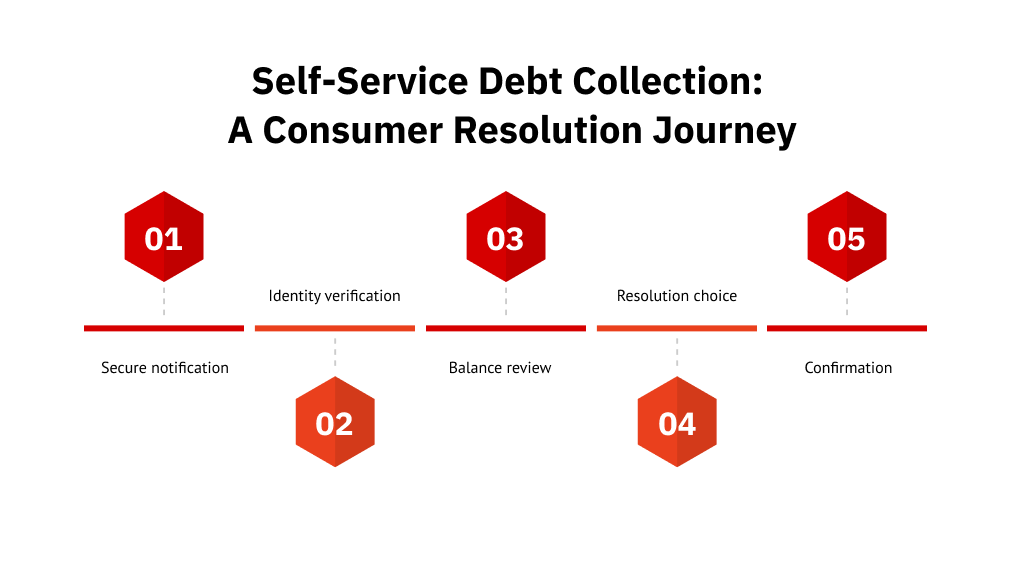
A self-service collections flow should remove uncertainty. The consumer should know who is contacting them, what the balance is, which options are available, and what happens after they act.
A typical journey looks like this:
- Secure notification: The consumer receives a secure link through email, SMS, IVR, or portal alert.
- Identity verification: The portal confirms the consumer before showing account details.
- Balance review: The consumer sees the amount owed, creditor name, and available actions.
- Resolution choice: The consumer can pay, set up a plan, accept a settlement, dispute, or request help.
- Confirmation: The consumer receives a receipt or next-step notice.
Many consumers do not refuse to pay. They drop off when the process feels unclear, inconvenient, or intimidating.
What happens behind the scenes
Self-service works best when it is orchestrated, not just posted online. The platform uses account data, balance age, contact history, past behavior, and response patterns to decide the right channel, message, timing, and offer.
For example, one consumer may respond to SMS, while another may need an email with a plan option. Higher-balance accounts may need agent review, while lower-balance accounts can stay digital.
This is where FCS’s UCEP-powered digital collections platform fits. The Unified Consumer Experience Platform uses AI-driven, white-labeled outreach to route consumers into a mobile-first portal where they can pay, set up plans, accept settlements, start a dispute, or request support.
What a self-service collections platform must include
Not every payment page qualifies as a self-service collections platform. A basic page can collect money, but it may not support disputes, settlements, hardship intake, compliance records, or agent escalation.
That difference shows up in the checklist.
The 7-point capability checklist
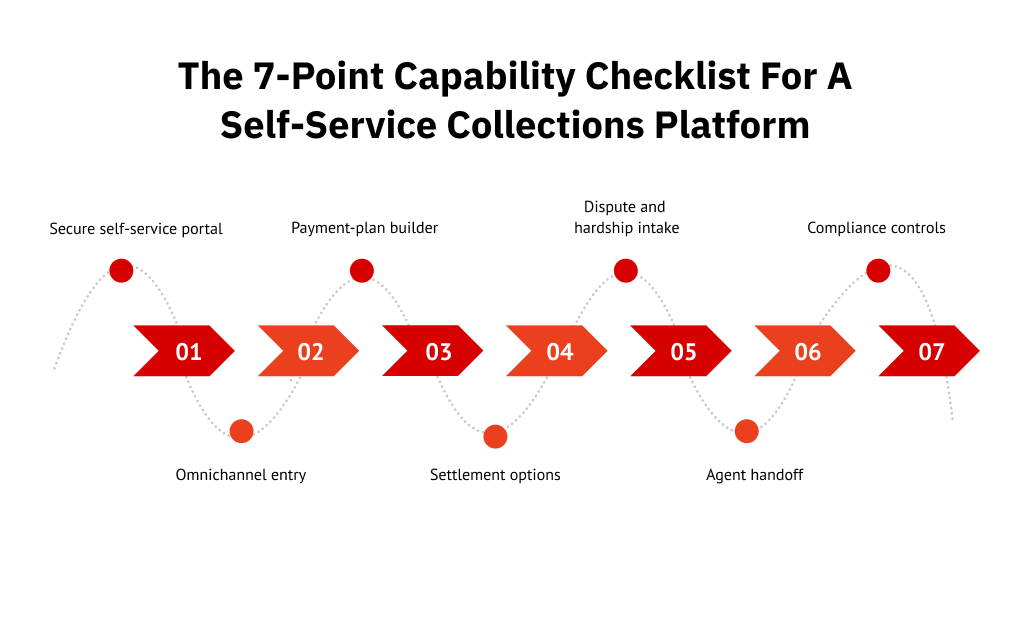
A strong self-service collections platform should include:
- Secure self-service portal: Verify identity, view balances, and take action.
- Omnichannel entry: SMS, email, IVR, web, and agent-assisted links.
- Payment-plan builder: Approved weekly, biweekly, or monthly plans.
- Settlement options: Clear offer terms for eligible consumers.
- Dispute and hardship intake: A way to raise issues without calling.
- Agent handoff: A transfer path for complex accounts.
- Compliance controls: PCI DSS, consent tracking, logs, and audit trails.
These capabilities work best when channels are connected. FCS’s omnichannel debt collection services support coordinated outreach across digital and human-assisted paths.
However, features alone do not guarantee completion.
Why design decides the outcome
Self-service fails when consumers cannot understand what to do next. Gartner’s 2024 survey shows that only 14% of customer service issues fully resolve through self-service. Even for very simple issues, that number rises to just 36%.
That is why debt collection needs a purpose-built journey. Consumers should not have to search for balances, guess payment rules, or call an agent to understand the portal.
Strong design gives consumers clear account information, simple language, transparent plan terms, visible dispute options, easy agent fallback, and immediate confirmations.
How FCS’s self-service model lifts recovery and speeds up collections
FCS treats self-service as part of a managed collections model, not a standalone software handoff. That matters for creditors that want digital performance without building the technology, compliance, analytics, and staffing stack themselves.
The first lever is better decision-making.
AI-driven, behavior-based resolution
FCS’s UCEP uses behavioral analytics and adaptive decisioning to guide each account toward the next best action.
Here’s how that works in practice:
- Behavior-based decisioning: UCEP evaluates account signals, response patterns, balance stage, and consumer behavior.
- Smarter outreach: The platform supports channel selection, message timing, offer presentation, and escalation rules.
- White-labeled journey: Consumers receive branded outreach, enter a secure portal, review the balance, and choose the next step.
- Managed execution: FCS manages outreach, portal engagement, reporting, and escalation through a service-as-software model.
The result is a simpler consumer experience and a more controlled recovery process.
The two levers FCS pulls
Self-service improves collections in two ways. First, it raises self-cure because consumers can resolve accounts without waiting for an agent conversation. Second, it reduces cost-to-collect because routine accounts move through digital workflows.
That does not remove people from collections. It puts agents where they create more value: high-balance accounts, disputes, hardship cases, and negotiations.
To prove the value, leaders need the right metrics.
The metrics FCS reports on
Self-service performance should be measured by more than total dollars recovered.
| Metric | What it shows |
| Self-cure rate | Share of accounts resolved without agent intervention. |
| Agent-deflection rate | Share of routine accounts handled digitally instead of by a rep. |
| Cost-to-collect | How much it costs to recover each dollar. |
| Digital resolution rate | Share of accounts resolved through portal, SMS, email, or chat. |
| Promise-to-pay kept | Whether consumers follow through on commitments. |
FCS custom reporting tracks these metrics by portfolio, segment, and campaign. Leaders can see which accounts self-resolve, where consumers drop off, and when human intervention is needed.
Is self-service debt collection compliant?
Self-service can make compliance easier because it logs every notice, click, payment, dispute, and consumer action. But the portal itself does not make a program compliant. Outreach strategy, consent controls, disclosures, payment security, and escalation rules must align with debt collection regulations.
These are the core requirements every self-service workflow should account for.
The core rules that apply
A compliant model should account for:
- Fair Debt Collection Practices Act (FDCPA): Sets conduct rules for third-party debt collection and protects consumers from abusive, misleading, or unfair practices.
- Regulation F: Implements the FDCPA and includes validation notices, disclosures, communication limits, and contact frequency rules. The CFPB’s Regulation F materials explain how it governs debt collection practices.
- Telephone Consumer Protection Act (TCPA): Covers calls, texts, autodialing, prerecorded messages, and consent requirements.
- Unfair, Deceptive, or Abusive Acts or Practices (UDAAP): Prohibits practices that mislead, harm, or take unreasonable advantage of consumers.
Self-service helps by keeping communication consistent, showing clear disclosures, and recording consumer choices.
Why compliance cannot be an afterthought
Debt collection is already under heavy scrutiny. According to the CFPB’s 2025 FDCPA Annual Report, the Bureau received about 207,800 debt collection complaints in 2024, making up 7% of all complaints that year. The most common issue was attempts to collect a debt not owed.
That is why self-service needs audit-ready records. The portal should show what the consumer saw, which notices were sent, what action was taken, and when an agent became involved.
Self-service only works when consumers trust the path in front of them. FCS builds that trust with secure payment workflows, documented audit trails, and outreach practices grounded in debt collection compliance and regulations. That way, digital resolution does not come at the cost of control.
Where self-service wins and where human intervention still matters
Self-service works best when it removes friction from simple resolution. Complex accounts still need human support, especially when there are disputes, hardship concerns, high balances, or negotiation needs.
Accounts that self-cure best
Self-service usually performs best when the barrier to payment is convenience, not complexity.
Good-fit accounts often include:
- Lower-balance accounts.
- Recently overdue accounts.
- “Forgot-to-pay” consumers.
- Consumers who have paid digitally before.
- Accounts with no active dispute.
- Accounts eligible for simple payment plans.
- Consumers who respond to SMS or email.
These accounts create quick wins, improve adoption, and reduce unnecessary agent work.
When to route to a human
Human intervention still matters when an account is complex, sensitive, or high value. A portal can support simple resolution, but some situations need context, judgment, and negotiation.
Route the account to an agent when there is a dispute, hardship concern, high balance, repeated failed payment, broken arrangement, validation request, or low confidence in self-service completion.
How to roll out self-service collections
A self-service program does not need to launch across every account at once. The safer path is to define the right model, test a segment, measure results, and expand from there.
First, choose the model that fits your team.
Build vs. buy vs. partner
| Option | Best fit | Watchout |
| Build | Large teams with engineering, compliance, and analytics resources. | Slow launch and high internal ownership. |
| Buy | Teams that want software but can manage workflows internally. | The team still owns adoption, compliance, and staffing. |
| Partner | Creditors that want managed recovery, digital engagement, and reporting. | Choose a partner with collections-specific expertise. |
For many creditors, a partner model is faster because technology, operations, compliance, and reporting work together.
Once the model is clear, rollout should happen in phases.
A phased rollout
Start with a pilot segment, such as low-balance accounts, early-stage delinquency, or consumers with prior digital engagement. Then measure self-cure rate, agent deflection, payment completion, promise-to-pay kept, portal drop-off, dispute volume, and complaint trends.
Next, expand channels based on what consumers actually use. Finally, integrate agent handoff so agents see portal actions, disputes, and prior messages before continuing the conversation.
FCS can launch white-labeled self-service collections for lending, fintech, healthcare, subscription, and other high-volume portfolios. Creditors get a faster digital resolution path without building the platform, staffing the workflow, or managing the compliance layer in-house.
Make self-service the fastest path to resolution
Self-service debt collection works when it turns intent into action. Consumers get a clear way to review their balance, choose an option, and resolve the account without unnecessary friction.
For creditors, that shift creates momentum where collections often slow down. More routine accounts can self-cure, and agents spend less time on repetitive follow-up.
It also gives complex cases a better path. Disputes, hardship concerns, and high-value accounts can move to the right support faster, with more context behind every handoff.
Need a self-service collections model that feels easy for consumers and manageable for your team?
Contact FCS to see how UCEP helps creditors launch compliant, white-labeled digital resolution without building the workflow in-house.
FAQs
1. What is a self-service payment portal, and how does it work in debt collection?
A self-service payment portal lets consumers verify account details, view an overdue balance, pay in full, set up a plan, accept an offer, raise a dispute, or request help through a secure online page.
2. Does self-service debt collection actually improve recovery?
Yes. It removes friction by giving consumers a simple digital path to resolve balances. It also frees agents to focus on disputes, hardship cases, and accounts that need direct negotiation.
3. Is self-service debt collection compliant with the FDCPA and Regulation F?
It can be when built correctly. A compliant model includes clear disclosures, communication controls, validation support, consent tracking, payment security, audit trails, and human escalation.
4. What features should a self-service collections platform include?
It should include a secure portal, omnichannel entry, one-tap payment, payment plans, settlements, dispute intake, behavioral analytics, agent handoff, compliance controls, and PCI DSS-grade security.
5. What is a self-cure rate in debt collection?
Self-cure rate is the share of overdue accounts consumers resolve without agent intervention. A higher rate means more accounts are being resolved digitally at a lower cost.
6. Does self-service debt collection replace human agents?
No. It handles routine accounts so agents can focus on complex cases. The best programs route hardship, disputes, and high-value negotiations to trained agents.