

Invoice recovery services are managed programs that collect overdue customer payments on your behalf, from the first reminder to later-stage recovery. Your accounts receivable (AR) team gets the capacity back, and your customers get a process that stays respectful, not adversarial.
U.S. household debt reached $18.8 trillion in Q1 2026, with 4.8% of outstanding balances in some stage of delinquency, per the Household Debt and Credit Report Q1 2026. Every invoice that ages past due ties up working capital and drifts toward write-off.
That tension is familiar if you run finance, AR, collections, or revenue cycle management (RCM) at a consumer-facing business. Your team has finite capacity, overdue balances keep climbing, and outreach rules keep tightening. This guide covers how invoice recovery works, what a compliant escalation process looks like, and when a managed partner makes sense.
What invoice recovery services do
Invoice recovery services move an unpaid account through two tracks: first-party recovery, handled under your brand, and third-party recovery, handled by a specialized agency once an account stays unresolved.
From overdue invoice to recovered payment
Here’s how the lifecycle usually plays out:
- Due: The invoice goes out with clear terms and a due date.
- Past due: The due date passes without payment. Early-stage outreach begins: reminders, payment links, and a chance to resolve the balance without friction. A $150 subscription charge often resolves at this stage alone.
- Delinquent: The account passes a set number of unresolved days, and outreach increases, shifting toward a concrete resolution.
- Recovery: A dedicated team, yours or a partner’s, handles the account until the balance resolves or it closes.
A managed invoice recovery service covers every stage under one process. It typically includes:
- Outreach across multiple channels: email, text, phone, and mail
- Follow-up sequencing based on account age
- Negotiation on repayment terms
- Payment plan setup
- Reporting to your finance or AR team on account status
First-party and third-party recovery
First-party recovery runs early, under your brand, while the account is still fresh, so customers assume they’re still talking to your business. This works best in the first 30 to 60 days past due, when a reminder alone often resolves it.
Third-party recovery takes over once an account stays unresponsive to first-party efforts, usually past 60 to 90 days. A specialized agency handles it on contingency, earning a percentage of what they recover, and brings deeper tools for skip tracing and negotiation.
| First-party recovery | Third-party recovery | |
| When it runs | 0–60 days past due | 60+ days past due, after first-party efforts stall |
| Branding | Under your name | Under a specialized agency’s name |
| Cost model | Part of your outreach process | Contingency fee on amounts recovered |
| Best fit | Fresh accounts, preserving the relationship | Aged or unresponsive accounts |
Most businesses run both together: first-party collections covers the early stage, and third-party recovery takes over once an account crosses your escalation threshold.
An extension of your receivables team
A managed recovery program extends your receivables team’s capacity. Your AR team already knows how to collect a balance; what runs short is time and headcount once overdue volume outpaces your staff.
A managed program adds:
- Trained staff who handle only overdue accounts, so nothing competes with new invoicing or reconciliation work
- Systems that handle outreach cadence and compliance tracking, in place of spreadsheets and manual follow-up
- Greater skill in negotiation and skip tracing for accounts that need more than a reminder
This keeps your internal team focused on current accounts, while overdue balances still get steady attention instead of slipping down the priority list.
The real cost of letting invoices age
The real cost of letting invoices age goes beyond the unpaid balance. Every day it sits, an overdue invoice ties up working capital, distorts your cash flow forecast, and moves closer to a write-off you’ll never recover. Two forces make this worse right now: overdue balances are climbing across the board, and recovery odds fall the longer an invoice waits.
Overdue balances are climbing
Delinquency is climbing. The share of all household debt flowing into serious delinquency, 90 or more days past due, rose to 2.83% in the first quarter of 2026, up from 2.45% a year earlier, according to the Household Debt and Credit Report Q1 2026.
Credit card accounts moved in the same direction: the transition rate into serious delinquency ticked up from 7.04% to 7.10% over the same period.
| Did you know? Student loan balances transitioning into serious delinquency jumped to 10.86% in Q1 2026, up from 8.04% a year earlier, the sharpest rise of any debt category tracked, according to the Household Debt and Credit Report Q1 2026. |
This trend adds pressure on the collections side too. The CFPB received about 387,400 debt collection complaints in 2025, up sharply from 207,800 the year before, according to the 2025 Consumer Response Annual Report. More accounts moving into delinquency means more room for outreach to go wrong, and weak communication is what turns a slow payer into a dispute.
The recovery curve
Every overdue invoice follows a curve. The longer a balance goes unaddressed, the harder it gets to recover. A few things drive this:
- Contact information ages. Phone numbers and email addresses on file get stale the longer an account sits untouched.
- The customer’s financial situation changes. A temporary cash crunch can turn into a permanent gap if nobody reaches out early.
- Competing claims stack up. The longer an invoice waits, other creditors and expenses move ahead of it in line for payment.
This is what finance teams mean by roll rate: the pace at which current accounts slide into delinquency, and delinquent accounts slide toward write-off. A high roll rate signals that accounts are aging past the point where outreach still works.
That’s why finance teams set firm triggers for escalation instead of waiting to see if an invoice resolves on its own.
How a structured invoice recovery process works
A structured invoice recovery process moves an overdue invoice through defined stages, each with its own trigger and outreach style. It starts soft, with reminders and self-serve payment, then escalates on a fixed timeline instead of guesswork. If an invoice still doesn’t resolve, it moves to late-stage recovery with deeper tools. Here’s how each stage works.
Early-stage outreach
Early-stage outreach is the soft, relationship-preserving phase. It runs through the customer’s preferred channel like email, text, or a call, and leads with clear payment options, often a self-serve link the customer can pay in two clicks.
Most overdue invoices resolve here, tied directly to first-party recovery: outreach that runs under your brand, with early intervention that keeps the roll rate down before an invoice ages into delinquency.
The escalation timeline
Timing runs on a schedule set in advance:
| Days past due | Stage | What happens |
| 15–30 | Reminder | Friendly reminders and a self-serve payment link |
| 45–60 | Firmer notice | Clearer deadline stated, direct outreach added |
| 60–90 | Formal step | Structured resolution attempt, escalation warning |
| 90+ | Specialized recovery | Invoice moves to a third-party or late-stage team |
Consistency matters more than aggression. The same firm, predictable outreach at day 60 every time builds trust in the process, even for a customer who misses the deadline.
| Pro tip: Set your escalation triggers by days past due before you need them, and apply them the same way every time. That removes the judgment call that lets invoices sit idle. |
Late-stage and third-party recovery
Once an invoice crosses 90 days, or the account stops responding to first-party outreach altogether, it moves into late-stage recovery. Third-party collections takes over here: deeper skip tracing to locate an unresponsive customer, direct negotiation on repayment terms, and legal escalation where the account and the law both support it. By this point, reminders alone rarely work, so a team that handles aged accounts daily takes over.
Meeting customers across channels
Chasing a customer through one channel alone slows invoice resolution down. Someone who ignores email might answer a text in minutes, or click a payment link the moment it lands in their inbox.
An omnichannel outreach strategy fixes this. Phone, email, text, and self-serve payment run together instead of in sequence, so outreach reaches the customer the way they actually respond. Both contact and resolution rates improve, without burying the customer in repeated attempts across every channel at once.
That coordination has to run inside federal contact rules.
Staying compliant during invoice recovery
Staying compliant while you recover your invoice means following the federal rules on how, when, and how often you can contact a customer about an overdue invoice. Break these rules, and you risk fines, lawsuits, and a customer relationship you can’t repair.
The rules that govern consumer recovery
Three federal rules set these guardrails. The Fair Debt Collection Practices Act (FDCPA) is the base law. The Consumer Financial Protection Bureau (CFPB) enforces it through Regulation F, which spells out the specific limits. The Telephone Consumer Protection Act (TCPA) adds separate rules for phone and text outreach.
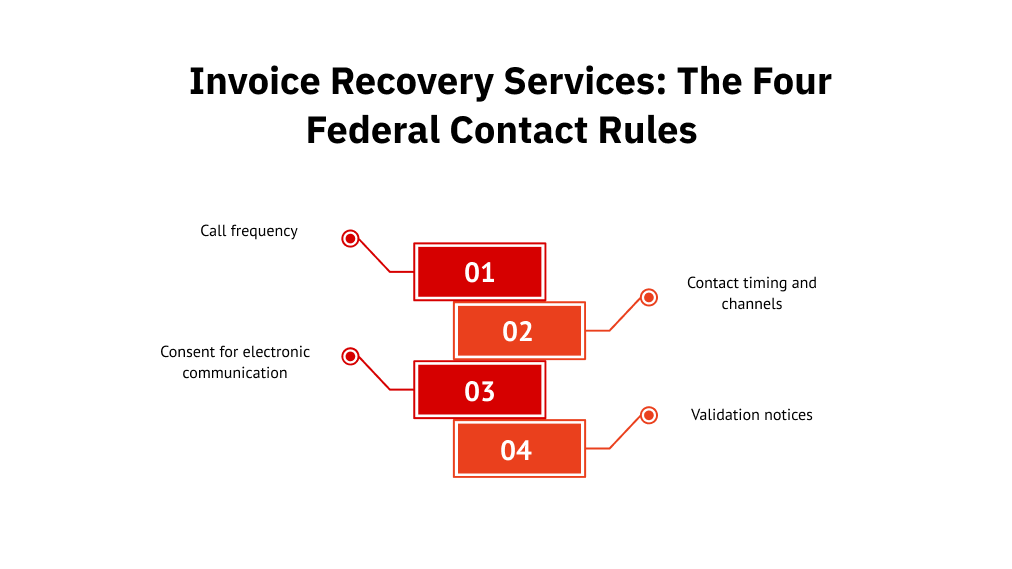
Together, they cover:
- Call frequency: No more than seven calls about a single debt within seven consecutive days, under Regulation F’s 7-in-7 rule.
- Contact timing and channels: No calls before 8 a.m. or after 9 p.m. in the customer’s time zone, and a customer can restrict which channels you use to reach them.
- Consent for electronic communication: Text and email outreach needs a valid opt-in, and every message must include an easy way to opt out.
- Validation notices: You must send written or electronic confirmation of the debt amount and the customer’s right to dispute it within five days of first contact.
These rules apply differently depending on who’s doing the outreach. Regulation F’s specific mechanics technically bind third-party debt collectors, as the FDCPA defines them. A first-party team collecting your own invoice under your own name generally sits outside that direct reach.
Even so, state mini-FDCPA laws and the CFPB’s broader authority over unfair practices can still cover you. That’s exactly why well-run first-party programs follow the same standard anyway: building the discipline in costs less than defending a complaint later.
Protecting your brand while you collect
A customer who falls behind on one invoice is often still a customer you want to keep. Many will renew a subscription, book another appointment, or take out another loan once their situation improves.
Recovery done badly on an overdue invoice costs you more than a fine. An aggressive call, a mistimed text, or a threat that oversteps the law turns a slow payer into a lost customer, and often into a complaint with the CFPB or a state regulator, part of your public record on how you treat people who owe you money.
A documented compliance program protects both sides of this: it keeps you out of regulatory trouble, and it keeps every interaction something a customer can walk away from calmly. That’s the standard for any recovery approach, in-house or outsourced.
| A compliance record you can verify First Credit Services maintains HIPAA, PCI DSS Level 1, and SOC 2 Type II compliance, with live call auditing and ongoing internal reviews built into every account it manages. |
In-house versus a managed partner
In-house invoice recovery works as long as your team’s capacity keeps pace with overdue volume. Once it doesn’t, the math shifts toward a managed partner, since a contingency fee on recovered dollars usually costs less than the revenue lost to accounts aging past recovery.
When in-house works
In-house recovery holds up when a few conditions hold together:
- Overdue invoice volume stays within what your existing headcount can work, with DSO, days sales outstanding, holding flat for the last several quarters.
- Most invoices sit inside the first 30 to 60 days past due, where a reminder alone resolves most of them.
- Your customer base is concentrated enough that your team already knows the typical objections and payment patterns.
- Your team has the bandwidth to track regulatory changes, like updates to Regulation F or state-level mini-FDCPA rules, without a dedicated compliance role.
Signals you have outgrown in-house
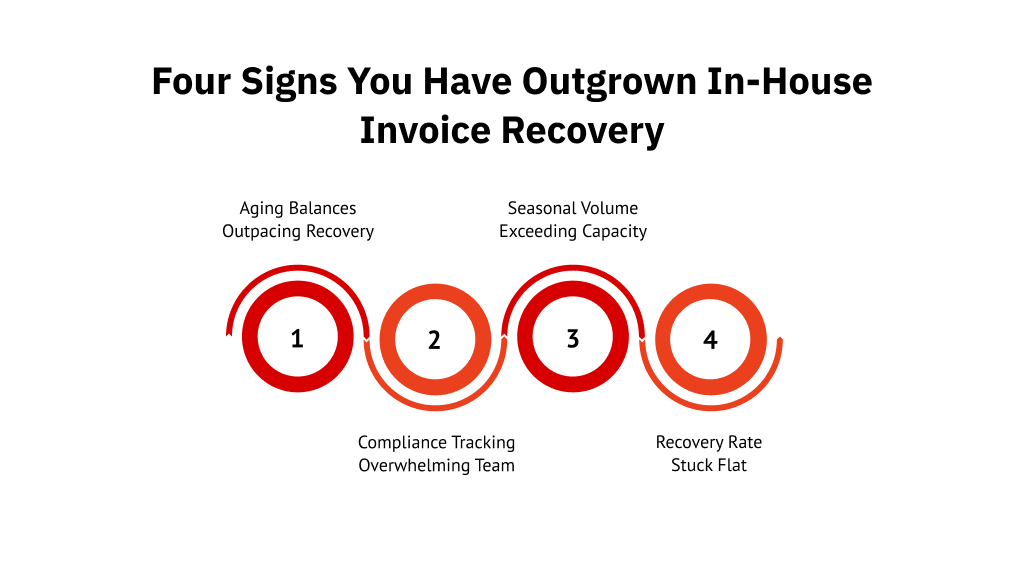
A few signals say the setup has stopped working:
- Your overdue balance and your pile of 90-plus-day invoices are both growing faster than your team’s recovery rate, a sign your roll rate is climbing even though headcount hasn’t changed.
- Compliance requirements have outpaced what one person or a small team can track across every channel and state.
- Seasonal spikes push volume beyond what your staff can process without falling behind on current accounts too.
- Your recovery rate has plateaued even as you add hours, which usually signals a process problem rather than an effort shortfall.
When these signals show up, the question shifts from whether to bring in help to what a strong recovery partner should actually bring. Here’s what that looks like at First Credit Services.
How First Credit Services approaches invoice recovery
First Credit Services runs first-party and third-party recovery on shared infrastructure, with different playbooks at each stage. The same platform, agents, and reporting carry an account end to end, while the outreach approach shifts as the account ages.
One platform across the recovery journey
UCEP, the Unified Consumer Engagement Platform, is the engine behind this. It scores each account, then picks the channel, timing, and message most likely to get a response, instead of running every account through the same fixed sequence.
What changes between stages is the playbook the platform runs. Early-stage first-party work stays under your brand and leads with reminders, self-serve payment links, and light-touch cadence. Once an account crosses your escalation threshold, third-party recovery brings skip tracing, direct negotiation on repayment terms, and legal escalation where the account supports it.
What stays the same is the infrastructure. One account history, one compliance standard, and one reporting view, so an invoice moves between stages without a handoff gap or a rebuild of context.
Built for accounts receivable across industries
This is the extension-of-your-team model in practice. First Credit Services runs first-party and third-party recovery under one roof, most often on a contingency basis, so you typically pay based on what gets recovered rather than a flat retainer.
That model covers lenders and finance companies, healthcare patient-pay and revenue cycle management (RCM), fitness and membership businesses, subscriptions, credit card and consumer loan collections, and fintech.
For consumer lenders specifically
If you collect on auto loans, leases, or other consumer credit, the details differ enough to warrant a dedicated resource. See how First Credit Services approaches auto and consumer-lender collections in more depth.
The bottom line on invoice recovery services
Overdue invoices lose value the longer they sit. A consistent escalation process recovers far more of that value than ad hoc chasing ever will. Compliant outreach protects the balance and the customer relationship at the same time, and the choice between in-house and a managed partner comes down to your volume and capacity.
The one thing that matters most: build the timeline once, then hold to it without exception.
Ready to see what a managed program looks like for your accounts? Talk to First Credit Services about a recovery program built to lift your recovery rates and protect your customer relationships.
FAQs
1. How much do invoice recovery services cost?
Most invoice recovery services price on a contingency basis, a percentage of what gets recovered rather than a flat fee. Rates vary by account age, balance size, and whether the work is first-party or third-party.
2. Do invoice recovery services report to customer credit reports?
Third-party recovery accounts are often reported to credit bureaus once placed for collection. First-party outreach usually isn’t reported, since the account hasn’t moved into formal third-party collections yet.
3. What happens if a customer disputes an invoice during recovery?
If a customer disputes the debt in writing during the validation period, federal law requires outreach to pause until the debt is verified. Recovery and credit reporting stop until verification is provided.
4. When do you receive funds recovered through invoice recovery services?
Providers typically remit recovered funds on a regular schedule, often monthly, minus their contingency fee. Reporting alongside each payment shows which accounts resolved and how much was collected.
5. Do invoice recovery services work for businesses with a smaller customer base?
Yes. Providers that price on contingency scale naturally to smaller portfolios, since cost tracks what gets recovered rather than a fixed minimum.
6. How long does invoice recovery take to resolve?
There’s no fixed timeline. Most early-stage accounts resolve within 30 to 60 days, while aged or unresponsive accounts in third-party recovery can take several months, depending on balance and responsiveness.