

Late-stage recovery is usually where the cost shows up. But the chance to prevent that cost comes much earlier, when a customer is newly past due and still within reach of a simple resolution.
That is the role of early out collections.
Federal Reserve Q1 2026 data show that the credit card charge-off rate across all commercial banks reached 3.84%. For high-volume consumer businesses, this makes early-stage outreach a loss-prevention strategy rather than just a collections workflow.
Early-out collections gives customers a practical way to resolve balances before recovery becomes harder and costlier. It helps reduce roll-forward, protect recoverable revenue, and preserve the customer relationship.
In this guide, we’ll explain what early out collections is, how it differs from third-party collections, and how to build a stronger early-stage recovery program
What Early Out Collections Is And How It Works
Early out collections is pre-charge-off outreach for accounts that are current, recently past due, or lightly delinquent. It usually happens before an account moves to a collection agency or becomes bad debt.
The goal is resolution, not pressure.
A strong early-out collections program helps customers understand their balance, access payment options, ask questions, dispute errors, or set up a plan. The account gets attention before it moves deeper into delinquency.
You may also hear early-out collections referred to as pre-collection services, soft collections, first-party collections, early intervention collections, or extended business office collections. The terms vary, but the idea stays the same: reach customers early enough to prevent avoidable escalation.
Where It Sits In The Account Lifecycle
Most consumer accounts move through this path:
| Current → 1 to 30 days past due → 31 to 60 days past due → 61 to 90 days past due → charge-off or third-party placement |
Early-out collections services usually fall within the 1- to 90-day window. However, the exact timing depends on the industry, account type, and risk policy. Some programs start earlier, especially for failed payments, healthcare balances, declined cards, subscriptions, and recurring billing.
The distinction is simple. Early out happens before the account becomes charged-off debt. Third-party collections usually begins after the account has aged, escalated, or moved beyond internal resolution.
Early Out Collections vs Third-Party Debt Collection
Early-out collections and third-party debt collection both recover unpaid revenue. But they operate at different points in the recovery lifecycle.
Early out is brand-sensitive and first-party in nature. Third-party collections is a later-stage model where an outside agency collects under its own identity. Let’s explore the key differences between them:
1. Timing And Account Status
Early out debt collection begins before default, charge-off, or serious delinquency. The customer still has a direct relationship with the creditor, provider, lender, or billing organization.
Third-party debt collection usually begins when the account is older, harder to recover, or already written off. At that point, the customer knows the issue has escalated.
This timing affects both recovery odds and customer perception. A customer contacted at 15 days past due may treat the message as a service reminder. On the other hand, a customer contacted after a charge-off may treat it as a collections event.
2. Tone And Brand Voice
Early out collections should feel like customer support with a recovery objective. The tone is clear, respectful, and practical. The message is not “pay now or else.” It is “your account needs attention, and here are your options.”
Third-party collections are more formal because the account has already been escalated. The agency must identify itself and follow the rules that apply to its role.
That is why businesses use early out to protect brand perception. Outreach can happen under the business’s name, with a white-labeled experience and service-led messaging.
3. Side-By-Side Comparison
Here’s how the two models compare across the factors that matter most when choosing the right recovery approach.
| Factor | Early Out Collections | Third-Party Collections |
| Account stage | Current or lightly past due | Seriously delinquent or charged off |
| Timing | Usually 1 to 90 DPD | After escalation or charge off |
| Customer perception | Original brand | Collection agency |
| Tone | Service-led | Formal and recovery-focused |
| Brand experience | Often white-labeled | Agency-branded |
| Primary goal | Prevent roll-forward | Recover aged debt |
| Cost profile | Lower cost to resolve early | Higher cost and harder recovery |
In simple terms, early-out collections preserve recovery potential before the account becomes expensive. On the contrary, third-party collections try to recover value after the account has already deteriorated.
How Early Out Collections Reduces Roll Rates And Charge-Offs
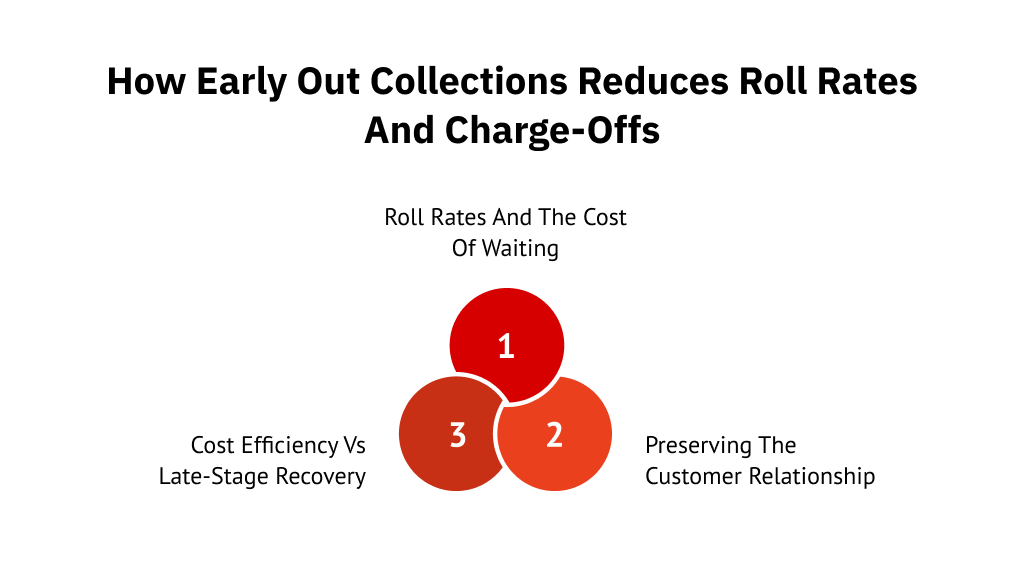
The strongest business case for early-out collections is not just the money collected today. It is the accounts that never become 60- or 90-day problems or charge-offs. The impact becomes clearer when you break it into the following areas:
Roll Rates And The Cost Of Waiting
A roll rate is the percentage of accounts that move from one delinquency bucket to the next. For example, if 1,000 accounts are 30 days past due and 300 move to 60 days past due, the 30-to-60 roll rate is 30%.
Early-out collections reduces roll rates by intervening before accounts gain negative momentum.
A customer at 10 or 15 days past due may respond to a text, email, payment link, or quick reminder. A customer at 90 days past due may need deeper negotiation, manual outreach, or agency placement.
Preserving The Customer Relationship
Collections are also a customer experience moment.
A customer who receives a timely reminder with simple payment options may resolve the account and continue doing business with you. Contrarily, a customer who receives delayed, confusing, or aggressive outreach may complain, churn, or ignore future communication.
Debt collection complaints often involve consumers disputing whether the debt is owed. Early outreach creates room to fix billing errors, insurance delays, duplicate charges, failed payments, or simple misunderstandings before escalation.
That is where omnichannel debt collection services can help. When SMS, email, phone, chat, and payment links work together, customers get a clearer path to resolution.
Cost Efficiency vs Late-Stage Recovery
Early out collections also changes the economics of recovery.
Once an account reaches a later stage, recovery becomes more expensive. The balance may still be collectible, but it often takes more contact attempts, more manual work, deeper negotiation, and higher-cost recovery activity.
Acting earlier reduces that burden. By resolving simpler issues before they escalate, early out can lower internal follow-up pressure, reduce third-party placement volume, limit charge-off exposure, and cut the cost per resolved account.
For CFOs and revenue leaders, this is where early out creates measurable value. It protects the margin by preventing accounts from becoming more expensive to recover.
Early Out Collections Compliance: FDCPA and Regulation F
Early out collections can feel less formal than third-party debt collection. This is because the outreach happens earlier and often under the creditor’s brand. But that does not make compliance less important.
The safest programs use clear contracts, documented workflows, approved messages, channel controls, opt-out management, and audit-ready reporting. Now, let’s understand the regulatory and operational standpoint for early-out collections.
When Early Out Is And Is Not “Debt Collection”
Under the Fair Debt Collection Practices Act (FDCPA), the distinction between first-party and third-party collection matters. A creditor collecting its own debt is generally treated differently from a third-party debt collector collecting on behalf of another business.
Account status also plays a role, especially whether the account was already in default when a service provider began handling it.
In an early out setup, a partner may act as an extension of the creditor before default or charge-off. However, classification depends on the contract, account status, provider role, branding, and communication practices.
So, do not rely on assumptions. The agreement should define whether the partner is acting in a first-party capacity, which brand will be used, which accounts qualify, and when accounts exit the early-out workflow.
Regulation F Guardrails That Still Apply
Even when an early out program is structured as first-party outreach, Regulation F and FDCPA principles should still shape operating standards.
Your program should define contact frequency, approved channels, opt-out handling, required disclosures, dispute routing, complaint documentation, and escalation rules.
The goal is not only compliance but also consistency. High-volume recovery programs become risky when agents, systems, and channels operate without a shared ruleset.
Documentation And Contractual Clarity
Your early out service agreement should clearly define the operating model by documenting:
- Account eligibility
- Delinquency stage
- First-party brand use
- Approved scripts
- Contact frequency rules
- SMS and email workflows
- Dispute handling
- Payment plan authority
- Reporting requirements
- Escalation rules
- Data transfer requirements.
This protects your business, your partner, and your customers. Everyone knows what can happen, when it can happen, and how the interaction should be handled.
How To Build An Early Out Collections Program
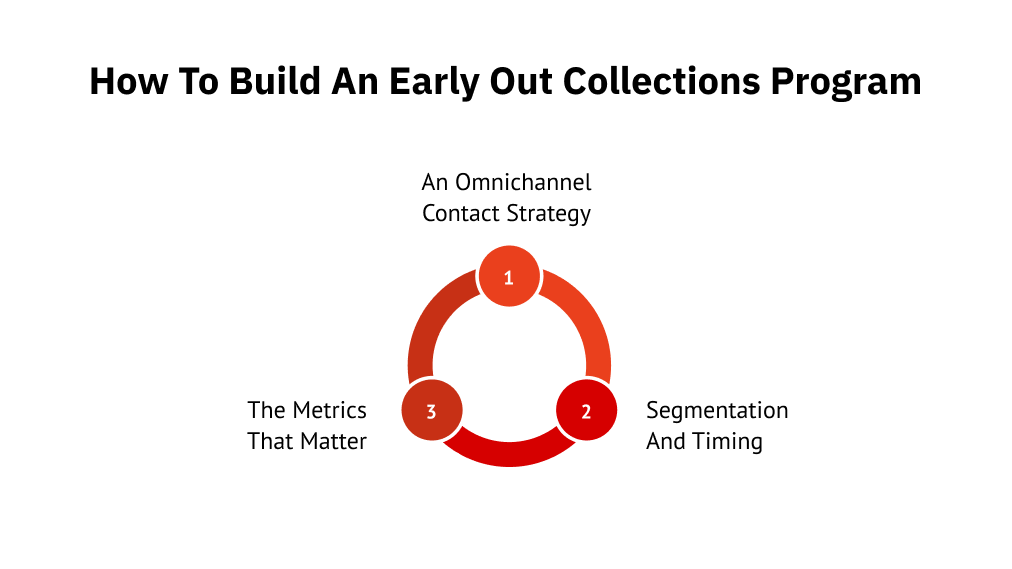
An effective early out program needs more than reminders. It needs a structured model built around timing, segmentation, channel strategy, payment options, compliance, and performance tracking. Here are the building blocks to focus on:
1. An Omnichannel Contact Strategy
Phone-only collections no longer match how many customers respond. Some customers answer calls, whereas others are more likely to click a text link, respond to email, use chat, or pay through a self-service portal.
An effective early out program should coordinate SMS, email, voice, live chat, payment links, digital payment plans, callback scheduling, and dispute routing.
But the most important thing is coordination. Omnichannel collections should not result in disconnected messages across different systems. It should mean a single controlled contact strategy in which every channel supports the same resolution path.
2. Segmentation And Timing
Not every past-due account requires the same treatment.
A low-balance account with strong payment history should not receive the same sequence as a high-balance account with repeated missed payments. Similarly, a customer who opened an email but did not pay may need a different next step than someone who has not engaged at all.
Segmentation should consider days past due, balance size, account type, payment behavior, promise-to-pay history, channel engagement, dispute history, and customer value.
Timing matters just as much. Experian’s Q1 2026 report shows that 30-day delinquencies rose to 2.00%, while 60-day delinquencies increased to 0.86%. For high-volume portfolios, this reinforces the need to act before accounts roll forward.
With the right segmentation and outreach timing, businesses can respond earlier instead of waiting until accounts enter a larger delinquency queue.
3. The Metrics That Matter
Early out collections should be measured by prevention, resolution, cost, and experience. Here’s what to track:
- Roll-rate reduction
- Contact rate
- Right-party contact rate
- Digital engagement rate
- Promise-to-pay conversion
- Payment plan enrollment
- Recovery rate
- Cost to collect
- Dispute rate
- Complaint rate
- Days to resolution.
Over time, the best dashboard should show whether the program is changing account movement. Are fewer accounts rolling from 30 to 60? Are more customers resolving through self-service? Are disputes getting routed faster?
Together, these signals show whether early out is improving the portfolio, not just adding more outreach.
Early Out Collections Services From First Credit Services
FCS supports early out collections for businesses that need more than basic reminders. Its model is built for first-party recovery, brand-sensitive outreach, and high-volume consumer engagement.
Here is how it supports early-stage recovery at scale.
First-Party Programs That Protect Your Brand
In a first-party early out program, FCS acts as an extension of your business. Thus, customers receive outreach under your brand, not as a separate early-out collections agency interaction.
This keeps the conversation closer to billing support or account resolution. Customers can pay, ask questions, set up a plan, or resolve a dispute before the account escalates.
UCEP: The Engagement Platform Behind It
FCS powers managed early-out programs through the Unified Consumer Engagement Platform (UCEP).
However, UCEP is not self-serve software. FCS manages the platform for clients, including outreach strategy, digital engagement, payment workflows, reporting, and support coordination.
Through UCEP, consumers can access branded links, view balances, make payments, choose plans, accept configured offers, schedule callbacks, or start chat where enabled.
This gives businesses a managed early out program without requiring internal teams to run the technology themselves.
Built For High-Volume Consumer Accounts
FCS is a strong fit for organizations that already have internal teams but need greater scale, stronger digital engagement, and a structured approach to reducing early-stage delinquency.
For that reason, it works well across industries such as auto lending, banking, credit unions, consumer finance, fintech, healthcare, fitness, subscriptions, and utilities.
Depending on portfolio needs, FCS can support digital-only programs or digital and voice programs. For example, some accounts may only need a payment link, while others may need agent support, dispute handling, or a structured payment conversation.
Resolve Earlier, Recover Better
Early-out collections is the point where recovery is still practical, trust is still recoverable, and charge-off is still preventable. If you wait until accounts become seriously delinquent, you accept higher costs, slower response times, compliance risk, and damage to the customer relationship.
A strong early out program gives you a better path. It combines timely outreach, first-party tone, omnichannel engagement, payment flexibility, compliance controls, and roll-rate tracking.
For high-volume consumer accounts, the real challenge is whether your current team can act early enough, consistently enough, and at scale.
Want to see how a first-party early out program could lower your roll rates and keep more customers engaged?
Schedule a consultation with FCS to explore a UCEP-powered early out program for your portfolio.
FAQs
1. What does early out mean in collections?
Early out in collections refers to outreach to accounts before a balance becomes seriously delinquent or charged off. The goal is to contact customers quickly, clarify the balance, offer payment options, and prevent the account from moving into later recovery stages.
2. How is early out different from third-party collections?
Early out happens before charge-off and usually uses your brand voice. Third-party collections happen later, often after serious delinquency, and the customer deals with an agency collecting under its own name.
3. Are early out collections regulated by the FDCPA?
It depends on account status, contract terms, provider role, and whether the partner acts as a first-party extension. Because classification is fact-specific, your legal team should review the program structure.
4. Does early out collections hurt a customer’s credit score?
Early out collections generally focus on resolving accounts before charge-off or third-party placement. The goal is to prevent escalation. Credit impact depends on your reporting policies, account status, and applicable credit reporting practices.
5. What is an extended business office?
An extended business office, or EBO, is an outsourced team that supports billing, follow-up, and early-stage collections under your brand. Customers experience the interaction as part of your organization, not a separate agency.
6. How does early out collections reduce roll rates?
Early-out collections reaches customers soon after a missed payment, offer clear options, and remove payment friction. Faster resolution means fewer accounts move from 30 to 60 to 90 days past due.