


Every overdue account reaches a point where another reminder is no longer enough. The balance may still be recoverable, but recovery becomes harder, more regulated, and costlier to manage internally.
The size of the collections market shows why this handoff matters. According to the Market Growth Reports 2025 survey, third-party debt collectors recover over 600 million accounts annually in the United States alone. The average balance per account is $1,350, underscoring how quickly overdue receivables can become a large-scale recovery challenge.
For businesses, the question is not only whether an account is overdue. It is whether internal recovery still has the capacity, controls, and cost structure to manage it well.
This guide explains how third-party collections work, when to use them, what compliant recovery looks like, and how to choose the right agency.
What are Third-Party Collections?
Third-party collections refer to the process of hiring an external agency, separate from the original creditor, to recover overdue accounts. The agency operates under its own name, contacts consumers directly, and manages recovery on the creditor’s behalf.
Difference Between First-Party vs Third-Party Collections
The main difference between first-party and third-party collections is who the consumer interacts with. In first-party collections, outreach happens under the creditor’s brand, usually during early delinquency.
In third party debt collection, the account has typically aged beyond internal recovery efforts, and the agency manages outreach under its own name.
Here is how the two models differ:
| Collection Model | Timing | Consumer Sees | Best Used For |
| First-party collections | Early delinquency, often 0–90 days past due | Creditor’s brand | Failed payments, early reminders, payment-plan recovery |
| Third party collections | Often 90+ days past due, near charge-off, or post-charge-off | Agency name | Aged, unresponsive, seriously delinquent accounts |
How Does Third-Party Debt Collection Work?
Once a creditor assigns accounts to a third-party agency, the agency takes over recovery outreach, negotiation, dispute handling, payment processing, and reporting. The creditor typically retains ownership of the debt unless the account is sold to a debt buyer.
Here is what the process looks like.
1. Account Placement
The creditor sends account records to the agency, including balance details, account age, payment history, previous contact attempts, dispute notes, and consumer contact information.
If balances, documentation, or contact details are incorrect, the agency spends the first cycle filling gaps rather than moving accounts toward resolution.
2. Contact Verification and Skip Tracing
The agency reviews available contact information and may use skip tracing to locate updated phone numbers, emails, addresses, or other permitted contact details.
This step becomes more important as accounts age. Older accounts are more likely to have outdated contact data, inactive phone numbers, or prior outreach records that no longer reflect the consumer’s situation.
3. Omnichannel Outreach
Modern third-party collection services use more than outbound calls. Outreach may include letters, calls, SMS, email, payment links, and self-service portals, depending on consent, regulations, and client-approved workflows.
The goal is not more contact. It is better-timed, better-documented contact based on account stage, consumer response, channel preference, and compliance requirements.
4. Negotiation and Resolution
The agency works with the consumer to resolve the account. Resolution may include payment in full, a payment plan, a settlement offer, or another approved option, as determined by the creditor’s rules.
A realistic payment path can help consumers resolve balances they cannot clear immediately.
5. Dispute Handling and Validation
If the consumer disputes the debt, the agency must follow the required dispute and validation procedures. That may include pausing or modifying collection activity, reviewing account records, validating the debt, and communicating the outcome.
Disputes become harder to resolve when account history is incomplete or scattered across disconnected systems. That is why organized records are central to third-party receivables recovery.
6. Reporting and Performance Review
The agency reports recovery performance back to the creditor. Useful reporting should include account-level activity, recovery rate, payment-plan activity, dispute volume, complaint activity, and portfolio trends.
Without transparent reporting, a creditor cannot tell whether the agency is improving net recovery or simply increasing contact attempts.
When Should a Business Use Third-Party Collection Services?
A business should consider third party collection services when account age, recovery effort, compliance risk, and internal workload start reducing recovery value.
Third-party collections may be the right next step when:
- Accounts are 90+ days past due and no longer responding.
- Payment plans are repeatedly broken.
- Internal AR staff spends too much time on low-response accounts.
- Delinquency volume grows faster than staffing capacity.
- Phone-only follow-up produces weak contact rates.
- Internal workflows lack compliant SMS, email, and self-service options.
- Disputes are increasing, and documentation is harder to manage.
- Recovery performance is declining across aged receivables.
Here’s how to choose the right path by account stage and recovery need:
| Situation | Best Fit |
| Early failed payment, usually 0–60 days past due | First-party or digital collections |
| Recently overdue but still brand-sensitive | First-party collections |
| 90–180 days delinquent and unresponsive | Third party collections |
| At or near charge-off | Third party collections |
| High complaint sensitivity | Compliant third party agency with documented workflows |
| Large account volume and limited internal capacity | Outsourced third party collections |
What Makes Third-Party Collections Compliant?
Once accounts are moved to a third-party agency, compliance becomes part of every recovery action, from the first message to the final resolution. Here’s what compliant third-party collections require:
FDCPA
The Fair Debt Collection Practices Act governs how third party debt collectors communicate with consumers. It prohibits deceptive, unfair, abusive, and harassing collection practices.
The Federal Trade Commission explains that the FDCPA bars practices such as threats, repeated calls at unreasonable hours, false statements about legal rights, and disclosure of debts to unauthorized third parties.
Regulation F
Regulation F implements the FDCPA and provides federal rules for debt collectors. The Consumer Financial Protection Bureau (CFPB) identifies key areas, including communications, validation information, disputes, time-barred debts, and record retention.
One important operational rule is the frequency of communication. According to CFPB rules, a debt collector is presumed to violate the rule if they place more than seven calls within seven days about a particular debt or call within seven days after speaking with the consumer about that debt.
TCPA and State Licensing
The Telephone Consumer Protection Act affects calling and texting practices, especially around consent and automated outreach. Collection agency licensing requirements also vary by state.
That means agencies must understand where they can collect and which state-specific rules apply. This becomes especially important for national creditors with consumers across multiple states.
Debt Validation, Disputes, and Audit Trails
When a consumer disputes a debt, the agency must follow proper validation and documentation procedures. This can include reviewing creditor records, balance history, payment activity, and supporting documents before continuing with the recovery process.
Every meaningful collection activity should also be logged and easily retrievable. That includes calls, letters, messages, payment links, opt-outs, disputes, payments, and settlement offers.
This matters because complaint volume in debt collection remains significant. The CFPB’s 2025 Annual Report mentions around 207,800 debt collection complaints in 2024.
A clear audit trail makes every third-party debt recovery action traceable, defensible, and easier to verify.
Third-Party Collection Agency Fees and Pricing Models
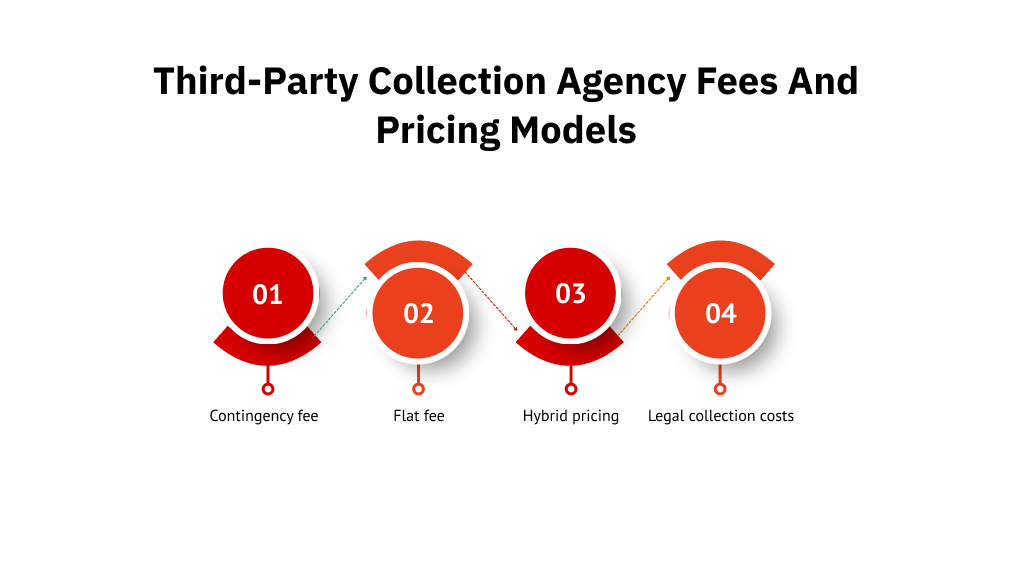
Most third-party collection agencies use contingency pricing. But fees vary by account age, balance size, debt type, placement volume, documentation quality, and legal involvement.
Here are the main pricing models to know before comparing agencies.
Contingency Fee
A contingency fee means the agency earns a percentage of what it recovers. This is common in third party debt recovery because the agency’s compensation is tied to actual collections.
The percentage usually increases as the account becomes harder to recover. That’s because older accounts, smaller balances, disputed accounts, and post-charge-off portfolios often require more effort.
Flat Fee
A flat fee is a fixed cost per account or placement. This is less common for traditional third-party collections and more common in early-stage reminder programs or pre-collection workflows.
Flat fees can work when the effort is predictable. However, it may not work well for aged debt portfolios with significant variations in account complexity.
Hybrid Pricing
Hybrid pricing combines a base service cost with a recovery-based component. This model may apply when a creditor needs dedicated agent capacity, custom workflows, specialized reporting, or high-touch account management.
Legal Collection Costs
Some accounts may require attorney involvement, litigation review, or legal escalation. These costs are usually separate from standard collection pricing.
Not every agency offers in-house legal escalation. Buyers should clarify whether legal collections are available, referred out, or excluded.
| Why Buyers Should Compare Net Recovery, Not Fee Percentage The lowest contingency rate does not always produce the best outcome. An agency charging a lower percentage but recovering fewer accounts may leave the creditor with weaker net recovery. A higher fee may be justified if the agency produces stronger liquidation, fewer complaints, better reporting, and less internal workload. |
What to Look for in a Third-Party Collection Agency
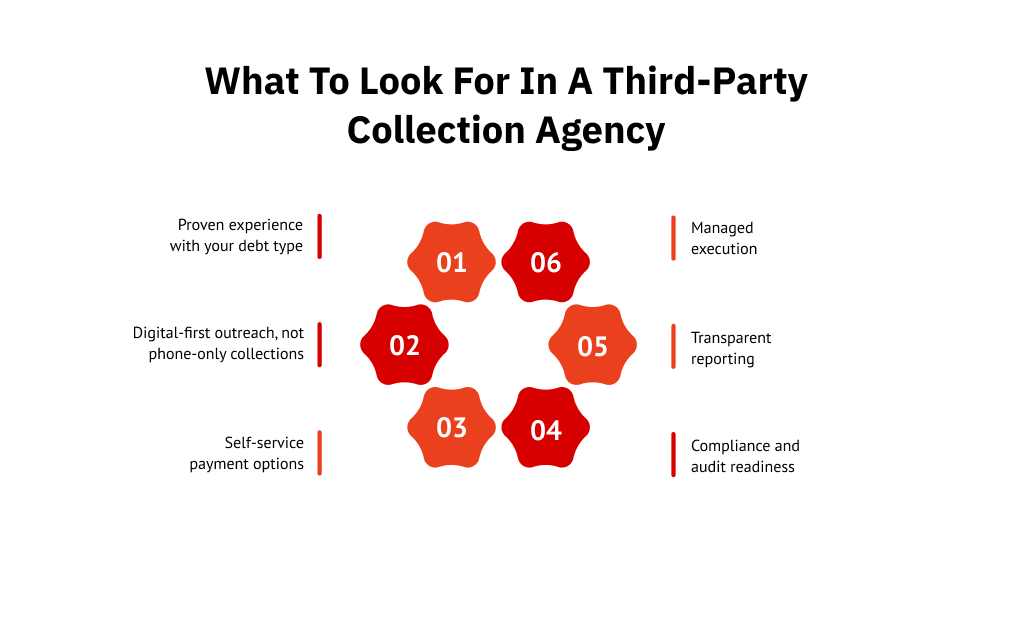
Choosing the right agency depends on whether it can recover your specific account type, operate compliantly at scale, and give you visibility into performance. Here’s what you should consider:
1. Experience with Your Debt Type
Agencies with sector experience understand the debt type, dispute patterns, documentation needs, and consumer expectations behind your portfolio.
Healthcare, auto finance, subscriptions, utilities, and fintech all require different recovery approaches. Ask whether the agency has handled accounts similar to yours by balance size, account age, geography, and dispute profile.
2. Digital-First Outreach Capability
Phone-only collections are no longer enough for many portfolios. Consumers may ignore unknown calls, prefer digital communication, or resolve faster through self-service links.
Evaluate whether the agency supports SMS, email, letters, calls, self-service payment portals, and coordinated omnichannel workflows. More importantly, ask how those channels work together.
3. Self-Service Payment Options
Consumers should be able to resolve balances on their own when they prefer, with human support available when needed.
Look for payment portals, mobile links, payment plans, settlement options, callback scheduling, and chat support.
4. Compliance Infrastructure and Audit Readiness
Do not settle for a general statement like “we are compliant.” Ask operational questions, such as:
- How does the agency track communication frequency?
- How are opt-outs honored?
- How are disputes documented?
- Is the agency licensed in the states where it will collect?
- Can it produce a full account-level audit trail?
These questions separate mature collection operations from manual, inconsistent workflows.
5. Transparent Reporting
A third-party collection agency should provide more than just a monthly recovery total. It should also give clarity on:
- Recovery rate
- Right-party contact rate
- Promise-to-pay rate
- Payment-plan completion rate
- Dispute rate
- Complaint rate
- Cost-to-collect
- Channel-level response
- Account-level status
Good reporting shows where accounts are recovering, stalling, or creating risk.
6. Operational Ownership
A third-party collection agency should clearly define who is responsible for day-to-day execution. Some providers give your team tools to run, while others manage outreach, disputes, reporting, and escalations for you.
For high-volume receivables teams, the stronger fit is often a partner that reduces internal workload instead of adding another system to manage.
How FCS Supports Third-Party Collections
For businesses evaluating third party collection models, FCS is one example of how managed recovery support can work in practice. Here’s how it supports the key parts of third-party collection:
Handles Aged and Charge-Off Accounts
FCS works with seriously delinquent and post-charge-off accounts that need more than routine reminders. These accounts often require updated contact information, payment negotiation, dispute routing, and account-level visibility.
Connects Third Party Recovery with Lifecycle Escalation
Many businesses use different recovery paths by account stage. Early delinquency may remain in first-party or digital collections, while aged or charge-off accounts move into third-party collections.
FCS fits into this lifecycle model by managing accounts after they move beyond internal recovery. This helps reduce handoff gaps when accounts escalate from early follow-up to third-party recovery.
Uses UCEP for Managed Digital Outreach
FCS uses its proprietary Unified Consumer Experience Platform (UCEP) to coordinate SMS, email, digital payment links, self-service portals, skip tracing, and AI-driven contact optimization.
Clients do not operate UCEP as standalone software. FCS runs the platform as part of its managed service, including outreach execution, workflow management, reporting, and follow-up.
Manages Complex Receivables Portfolios
FCS works with industries such as healthcare, financial services, fintech, auto finance, health and fitness, subscriptions, utilities, and government or municipal sectors.
These sectors often handle large account volumes, diverse consumer profiles, and state-level compliance requirements. Therefore, they require consistent recovery workflows across portfolios.
Move Aged Accounts into a Clearer Recovery Path
Aged receivables do not need more scattered follow-up. They need a clear recovery path, one that helps teams reach the right consumer, manage communication properly, resolve disputes faster, and make payment easier.
That is the real role of third-party collections. It gives overdue accounts the structure they need, while internal teams stay focused on newer accounts where faster action can still protect recovery value.
Want to know how FCS helps recover aged accounts without adding pressure on your internal team? Book a consultation.
FAQs
1. What is the difference between first-party and third-party collections?
First-party collections are managed under the creditor’s brand during early delinquency. Third-party collections involve an external agency operating under its own name, typically for accounts that are 90+ days past due, nearing charge-off, or already charged off.
2. Why do older accounts cost more to recover?
Older accounts usually require more effort to recover. Agencies may need more contact attempts, skip tracing, dispute resolution, account review, and payment negotiation. Because response rates often decline over time, aged accounts usually carry higher contingency fees.
3. Does a third party collection agency own the debt?
In most third party collection arrangements, the agency collects on behalf of the original creditor, and the creditor retains ownership of the debt. Ownership only transfers if the account is sold to a debt buyer.
4. What laws govern third party debt collection?
Third-party collections are governed primarily by the FDCPA, CFPB Regulation F, TCPA, and state-level licensing and collection laws. These rules cover communication frequency, disclosures, dispute handling, consent, documentation, and prohibited collection practices.
5. Are third-party collection services only for charged-off accounts?
No. Charge-off is a common trigger, but third-party collection services can also support seriously delinquent accounts before charge-off, especially when internal outreach has failed, and self-management has become inefficient.
6. How do third-party collection agencies handle disputes?
When a consumer disputes a debt, the agency must follow validation and documentation procedures. This usually includes reviewing account records, validating the debt, communicating the outcome, and documenting the full process.