


Most overdue customers are not actively avoiding payment at the start. Many simply miss reminders, delay responses, or need more time before financial stress turns into serious delinquency. But as accounts age, customer behavior changes, and so should the recovery strategy.
An approach that works at 15 days past due rarely works at 120 days delinquent. Customer responsiveness declines, recovery costs increase, and compliance pressure grows as accounts age. According to the Federal Reserve Bank of New York’s Q1 2026 report, U.S. household debt reached $18.8 trillion in early 2026, with delinquency levels remaining elevated across multiple debt categories.
This raises an important operational question: when should accounts remain in first-party recovery, and when should third-party escalation be necessary?
In this guide, we’ll explore the differences between a first party vs third party collections agency model, where each fits in the recovery lifecycle, and how hybrid recovery strategies support AR performance
What Is the Difference Between First and Third-Party Collections?
The difference between first-party and third-party collections comes down to timing, branding, and recovery strategy.
First-party collections focus on preserving customer relationships during early delinquency. On the other hand, third-party collections focus on recovering accounts after escalation or charge-off.
Each model solves a different recovery problem.
First Party Collections Explained
First-party collections operate under the creditor’s brand. The collections partner works as an extension of the business, so consumers still experience communication as coming from the original company.
This model typically supports early-stage delinquency before accounts move toward charge-off. At this stage, missed payments are often due to billing confusion, expired payment methods, missed reminders, or delayed responses, rather than intentional avoidance.
Modern first-party recovery focuses on reducing repayment friction through:
- Branded SMS reminders
- Email workflows
- Self-service payment portals
- Payment plan options
- Omnichannel engagement sequences
| An example: For example, a subscription company may use branded SMS reminders within the first 7–15 days of a failed payment. If the balance remains unresolved, self-service payment links and email follow-ups may continue through the 30-day delinquency window before escalation becomes necessary. This approach helps recover revenue early while protecting customer retention. |
Providers such as FCS’s first-party collections support this through fully white-labeled recovery workflows. Consumers interact entirely under the client’s branding while the recovery operation runs behind the scenes.
FCS also uses its UCEP platform to orchestrate omnichannel communication and AI-driven outreach timing to improve early-stage recovery without disrupting customer experience.
What Are Third-Party Collections?
Third-party collections typically begin after internal or first-party recovery efforts stop producing results.
At this stage, accounts are often severely overdue, unresponsive, or nearing charge-off. The focus shifts from preserving customer relationships to maximizing structured recoveries on aging debt.
Third-party recovery programs commonly manage:
- Charged-off balances
- Long-term delinquent accounts
- Broken payment arrangements
- Unresponsive consumers
| An example: A healthcare provider may manage balances internally during the first 60–90 days of delinquency. Unresolved accounts may then transition into third-party recovery after charge-off thresholds are reached. This allows businesses to protect customer relationships early while maintaining a structured recovery path for aging debt. |
Most third-party agencies operate on a contingency model, where creditors pay only when balances are recovered. Many businesses retain ownership of debt while assigning it, rather than selling portfolios outright, as this preserves greater account visibility and control.
For example, FCS’s third-party collections primarily operate through contingency-based recovery rather than debt purchasing. This allows businesses to scale recovery efforts without fully giving up customer ownership.
First Party vs Third Party Debt Collection: Key Operational Differences
Many businesses view first party vs third party debt recovery as competing models. In reality, both support different stages of the collections lifecycle and solve different recovery challenges as delinquency evolves.
Let’s explore the key differences across customer experience, compliance exposure, recovery timelines, and long-term AR strategy.
| Criteria | First-party collections | Third-party collections |
| Delinquency stage | Early-stage delinquency | Severe delinquency or charge-off |
| Brand ownership | Creditor brand | Agency brand |
| Recovery focus | Customer retention and resolution | Aged debt recovery |
| Communication style | Digital-first and customer-sensitive | Structured escalation workflows |
| Customer relationship impact | Preserves continuity | Higher relationship sensitivity |
| Compliance exposure | Federal Trade Commission (FTC) consumer protection standards and Telephone Consumer Protection Act (TCPA) communication requirements | Fair Debt Collection Practices Act (FDCPA) and Regulation F obligations |
| Pricing structure | Internal, flat fee, or hybrid | Contingency-based |
| Operational objective | Prevent escalation | Recover deteriorated accounts |
Where First-Party and Third-Party Collections Fit in the Debt Collection Lifecycle
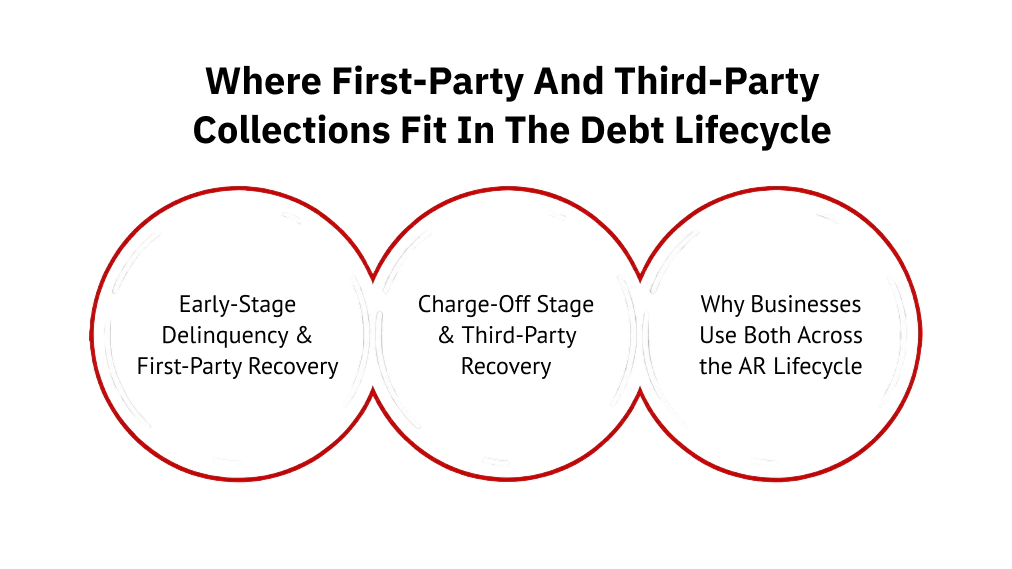
Most businesses do not use a single recovery strategy across the full delinquency lifecycle. Instead, they align recovery models with the stages of account deterioration.
Early-stage recovery focuses on resolving balances quickly, while late-stage recovery shifts toward structured escalation as engagement and repayment probability decline. This approach helps businesses better balance customer retention, recovery performance, and operational scalability.
Early-Stage Delinquency and First-Party Recovery
First-party collections usually operate within 0–90-day delinquency windows.
This is often the most recoverable stage in the collections lifecycle. Customers are still engaged with the brand, communication channels remain active, and repayment friction is usually temporary rather than intentional.
Digital-first outreach performs particularly well here because customers are more likely to respond before their balances age further. A quick SMS reminder or payment link can often resolve an account before escalation becomes necessary.
Consumer communication preferences have also shifted sharply toward digital channels.
According to the Wi-Fi Talents Debt Collection Statistics 2026 report, around 70% of consumers prefer debt notifications via email or text rather than phone calls, while 55% prefer resolving debt issues during the morning hours before work. It shows why timing and channel orchestration now matter heavily in collections strategy.
That’s why FCS uses AI-driven omnichannel communication via UCEP to optimize outreach timing across SMS, email, chat, and phone.
However, early-stage recovery windows do not stay open for long. As accounts move from 30-day to 60-day to 90-day delinquency buckets, roll rates rise, customer responsiveness drops, and recovery operations become harder to manage. This is usually the point where businesses begin shifting accounts into more structured third-party recovery workflows.
Charge-Off Stages and Third-Party Recovery
Accounts nearing charge-off require a more structured recovery approach.
At this stage, repayment behavior becomes less predictable, and resolution timelines lengthen. Recovery teams also spend more time managing documentation, disputes, and account tracing workflows.
Many businesses transition accounts into third-party recovery once:
- Outreach attempts stop generating engagement.
- Payment arrangements fail repeatedly.
- Balances cross 90–120 day delinquency thresholds.
- Internal teams reach capacity limits.
Recovery timing becomes critical during severe delinquency. The Gitnux 2026 Debt Collection Statistic report states that recovery rates can drop to around 11% once accounts become more than 180 days overdue. That decline is why businesses often escalate accounts before balances deteriorate further.
Why Many Businesses Use Both Models Across the AR Lifecycle
Most modern collections operations combine first-party and third-party recovery instead of treating them separately. Early-stage recovery focuses on preventing escalation, while third-party recovery handles accounts that are more difficult to resolve internally.
This lifecycle-based approach helps businesses:
- Improve recovery consistency
- Reduce avoidable write-offs
- Maintain customer continuity longer
- Scale operations more efficiently
It also creates smoother transitions between recovery stages, especially for businesses managing large account portfolios across multiple delinquency buckets.
Advantages and Limitations of First-Party vs Third-Party Collections
Both first-party and third-party debt collection models create different operational advantages and trade-offs as delinquency evolves. Some businesses prioritize customer retention and brand continuity, whereas others prefer scalability and recovery performance on aging debt.
The right approach usually depends on account volume, customer sensitivity, internal AR capacity, and recovery-stage complexity.
Advantages of First-Party Collections
First-party collections help businesses resolve delinquency while maintaining a more consistent customer experience. Because communication happens under the creditor’s brand, outreach often feels less disruptive for consumers.
This approach can improve:
- Early-stage recovery responsiveness
- Customer continuity
- Complaint reduction
- Repayment engagement
It works particularly well in industries where long-term customer value remains important, such as healthcare, fintech, telecom, and subscription services.
Digital-first communication channels also help consumers resolve balances more conveniently before accounts move into escalated recovery stages.
Limitations of First-Party Collections
The biggest challenge with first-party collections is operational scale.
As delinquency volumes grow, businesses must coordinate customer communication, compliance oversight, dispute handling, payment operations, and follow-up workflows across multiple channels simultaneously.
Many organizations outsource first-party recovery because maintaining this infrastructure internally becomes difficult as portfolios expand.
Advantages of Third-Party Collections
Third-party recovery becomes more valuable once accounts become harder to resolve internally.
By this stage, businesses often need:
- Specialized recovery expertise
- Scalable operations
- Structured escalation workflows
- Stronger delinquency management processes
Most third-party collection agencies operate on a contingency fee model, allowing businesses to pay only when balances are recovered. They also significantly reduce the internal collections burden. Instead of expanding staffing, businesses can transition aging accounts to specialized recovery operations designed for severe delinquency.
Limitations of Third-Party Collections
Third-party collections can increase customer sensitivity because communication moves outside the original creditor’s brand. This can impact trust, retention, engagement, and complaint levels.
Businesses also lose direct control over communication tone and customer experience once accounts are handled externally. In some cases, reporting practices may also affect credit visibility depending on how accounts are managed. For this reason, many organizations delay third-party escalation until internal recovery efforts no longer deliver results.
Compliance Differences Between First-Party and Third-Party Collections
Compliance obligations change significantly as accounts move through different recovery stages. Hence, communication rules, documentation standards, and consumer protection requirements become more complex as delinquency severity increases.
How FDCPA, CFPB Oversight, and Regulation F Apply Differently
The FDCPA primarily governs third-party debt collectors. These rules define how collectors communicate with consumers, what disclosures must be provided, and how disputes should be handled.
First-party creditors operate differently. They remain subject to FTC oversight and UDAAP expectations, meaning businesses still carry significant responsibility around communication practices even when accounts remain in first-party recovery.
Modern omnichannel collections workflows have also expanded compliance obligations under Regulation F and the Telephone Consumer Protection Act (TCPA). Collections teams must now manage:
- Communication restrictions
- Disclosure requirements
- Consent tracking
- SMS and email frequency controls
- Dispute handling across channels
- Auditability requirements
This is one reason digital collections operations require far more governance today than traditional phone-only recovery models.
Why Compliance Complexity Increases as Accounts Age
Compliance risk increases significantly as delinquency ages.
Longer recovery timelines create greater pressure around dispute handling, communication frequency, consent management, and auditability across channels.
According to the Consumer Financial Protection Bureau’s 2025 report, 51% of debt collection complaints about communication involve frequent or repeated calls, while 34% relate to continued contact after consumers request that it stop.
As accounts become more delinquent, even small gaps in outreach controls can create larger regulatory and operational risks.
What Results Can Businesses Expect From the Right Collections Strategy?
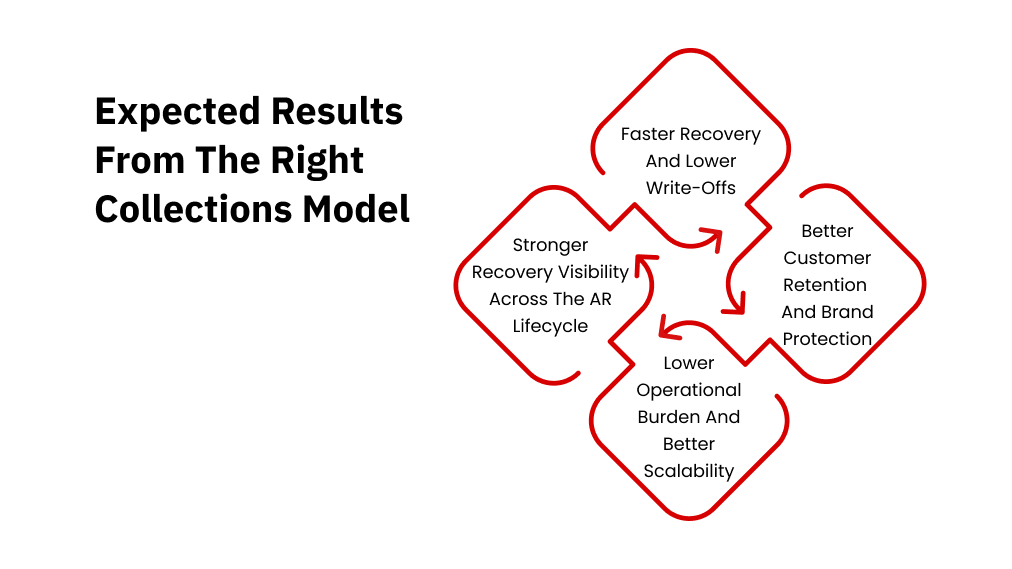
The right collections strategy does more than recover overdue balances. It influences how quickly accounts are resolved, how much revenue gets written off, and how efficiently recovery operations scale as delinquency volumes increase.
Here’s what you can expect:
Faster Recovery, Lower Write-Offs, and Better Customer Retention
Recovery outcomes improve significantly when businesses intervene early. Customers are more likely to resolve balances before delinquency worsens, especially when communication feels timely, convenient, and low-friction.
Digital-first engagement reduces escalation risk while improving repayment convenience for consumers.
Relationship-sensitive communication also supports stronger customer retention because the experience feels less disruptive during early delinquency.
The Market Growth Report 2026 collections survey states that multichannel communication strategies boosted engagement by 34%, with the strongest impact seen in early-stage debt recovery. These outcomes reflect how coordinated outreach across channels improves response rates and accelerates resolution.
Operational Scalability and Better Recovery Visibility
As delinquency volumes increase, collections operations become harder to manage manually.
Structured recovery workflows help businesses coordinate outreach, disputes, payment tracking, and account transitions more efficiently across recovery stages.
Centralized recovery systems also improve:
- Reporting accuracy
- Account tracking
- Recovery-stage visibility
- Communication consistency
This becomes especially important for businesses managing large account portfolios across multiple channels and teams.
First-Party, Third-Party, or Both? A Decision Framework for AR Leaders
For many businesses, the challenge is knowing when to use third-party collections as accounts become harder to recover internally. Customer behavior changes across the delinquency lifecycle, and the recovery strategy needs to adapt to it.
That is why many AR teams combine first- and third-party recovery across different lifecycle stages. The decision usually comes down to five operational factors:
| Decision Variable | Best Fit |
| Debt age at placement | First-party for early-stage, third-party for charged-off accounts |
| Brand sensitivity | First-party or white-labeled recovery |
| Debt volume | Hybrid models for large portfolios |
| Internal AR capacity | Outsourced first-party support |
| Recovery goal | Customer retention vs maximum aged-debt recovery |
This becomes especially important for businesses managing large account portfolios.
For example, a mid-sized fintech handling 10,000+ delinquent accounts may rely on first-party recovery during the first 60–90 days before escalating unresolved cases to contingency-based third-party partners once thresholds are reached.
This creates flexibility across the full AR lifecycle while balancing customer continuity, operational scalability, and recovery performance.
The Hybrid Collections Model: Managing the Full Recovery Lifecycle With One Partner
One of the biggest challenges in collections is operational fragmentation. Accounts move between teams, agencies, systems, and reporting environments. Every handoff increases the risk of inconsistent outreach, compliance gaps, and incomplete communication history.
That is why hybrid recovery models are becoming more valuable across the full accounts receivable lifecycle. They help businesses maintain:
- Unified communication history
- Centralized recovery visibility
- Smoother account transitions
- More consistent compliance controls
- Lower administrative overhead
FCS supports this lifecycle-based approach through one connected recovery model spanning early-out collections, third-party recovery, and digital engagement workflows.
With more than 30 years of collections experience, FCS manages recovery across every stage of delinquency.
Our proprietary UCEP platform orchestrates engagement across SMS, email, chat, phone, and self-service payment workflows while maintaining a single accountability layer throughout the recovery lifecycle.
However, some organizations may prefer to maintain in-house collections operations instead of fully outsourced recovery. For those businesses, FCS uses UCEP to support digital-first collections workflows alongside internal recovery operations.
Build a Smarter Recovery Strategy Across the Full AR Lifecycle
Recovery strategies lose effectiveness when they remain the same across all stages of delinquency. As accounts age, customer responsiveness declines, recovery costs increase, and operational complexity grows.
That is why strong AR programs are built as layered systems, not single-track processes. They intentionally combine first-party and third-party recovery based on account behavior and risk signals. Early-stage recovery is designed to preserve momentum and prevent escalation. Third-party recovery steps in when accounts require structure, persistence, and scale.
Still, escalation alone does not define success. The real difference comes from how communication is designed, how consistently compliance is maintained, and how clearly teams can see performance across the lifecycle. These elements determine whether recovery stays reactive or becomes controlled and predictable.
Want to explore how FCS unifies first- and third-party recovery under a single, connected strategy? Schedule a consultation today.
FAQs
1. What is the main difference between first-party and third-party collections?
First-party collections happen before charge-off. They operate under the creditor’s brand, even when outsourced to a collections partner. Third-party collections occur after an escalation or charge-off through an independent collections agency.
2. Does the FDCPA apply to first-party collections?
Generally, FDCPA applies to third-party debt collectors. However, first-party creditors remain under CFPB oversight. That is because some servicing structures may create additional regulatory considerations depending on how collections are handled.
3. When should a business switch from first-party to third-party collections?
Many businesses transition accounts after 90–120 days of delinquency, especially when customer engagement declines or charge-off risk increases.
4. Can one agency handle both first-party and third-party collections?
Yes. Full-service recovery providers such as FCS can manage both stages while maintaining communication continuity and centralized recovery visibility across the collections lifecycle.