

Healthcare revenue recovery is the process of recapturing revenue a health system already earned but never fully collected, whether it was delayed, denied, underpaid, or written off. It spans both payer balances, like denied and underpaid claims, and patient balances, like self-pay and aged accounts.
Denials keep climbing, underpayments hide inside claims that already look paid, and patient balances drift toward bad debt as deductibles rise. The industry could still save $21 billion a year by automating manual claims and eligibility work, according to the CAQH Index 2025. Every one of those manual touchpoints is a place revenue can quietly disappear.
If you lead revenue cycle or finance for a hospital or health system, this guide is for you. It covers denial recovery, underpayment and aged AR, patient and self-pay recovery, and how a recovery partner ties it together.
What healthcare revenue recovery covers
Healthcare revenue recovery, also called hospital or medical revenue recovery, covers every dollar your organization earned but has not yet collected, split across two connected tracks: payer balances and patient balances. The job is to pull earned revenue back from wherever it stalled.
This work sits inside your revenue cycle, picking up accounts that standard billing could not close, which is why recovery belongs in the same conversation as healthcare revenue cycle management, not as a function bolted on at the end.
Payer balances and patient balances
Payer balances are what insurers still owe after the claim leaves your system. Patient balances are what the person who received care owes directly, from deductibles and coinsurance to full self-pay amounts.
The two show up as different open accounts:
- Payer-side: Denied claims flagged for appeal, claims marked for rebill, and insurance balances waiting on a payer response.
- Patient-side: Post-insurance balances in early statement cycles, high-deductible balances after the claim closed, and aged self-pay accounts drifting toward write-off.
Most teams staff these separately, which creates a blind spot when neither team sees the whole account. An underpaid claim closes on the payer side while the patient balance keeps getting billed, and the missing insurance revenue never triggers an appeal.
Where revenue leaks
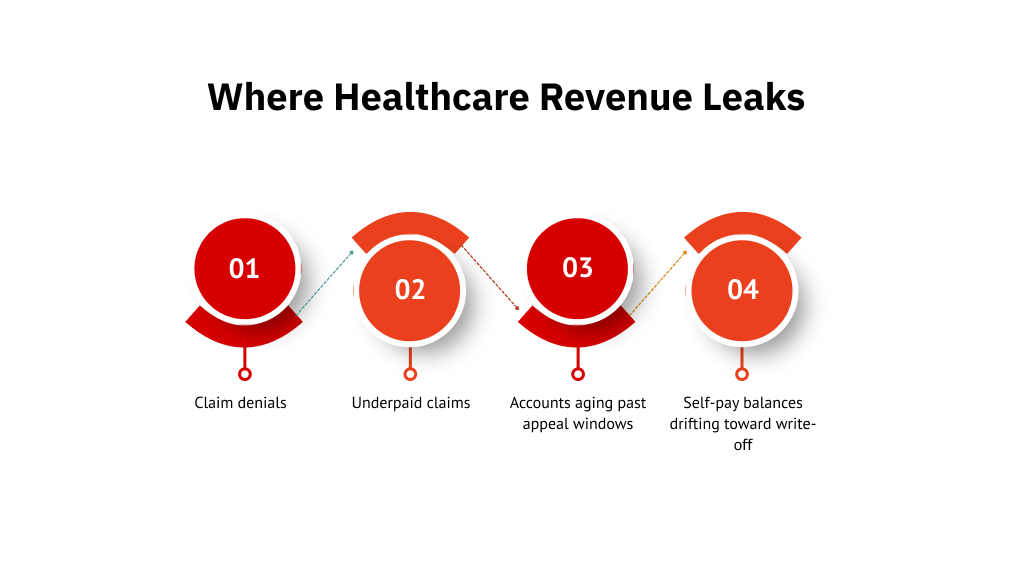
Revenue leaks at four predictable points:
- Claim denials: Categorize, appeal where the account supports it, rebill where a correction is enough.
- Underpaid claims: Same appeal or rebill treatment as an outright denial.
- Accounts aging past appeal windows: The payer’s dispute deadline closes, and the balance becomes unrecoverable.
- Self-pay balances drifting toward write-off: A patient balance goes unworked long enough to become bad debt.
Each leak looks small on its own. Together they are the gap healthcare revenue recovery services exist to close.
Tightened to 546 words. Cut the KFF stat from the H2 opener (kept it in the Did You Know so it’s not doubled), trimmed the driver bullets, compressed the numbered workflow steps, condensed the prevention section, and cut the “operating tempo has changed” closer that was echoing the H3 lead.
Denial recovery, the biggest lever
Denial recovery is the process of turning denied insurance claims back into paid revenue through categorization, appeal, and corrected resubmission before the payer’s appeal window closes. Denials are the biggest single source of leaked payer revenue.
Commercial care denials rose 20.2%, and Medicare Advantage denials rose 55.7% between 2022 and 2023, per the AHA 2024 report on hospital administrative costs. Most of that revenue is recoverable if the work happens on time.
Why denials keep climbing
Denials keep climbing because payers are tightening rules, expanding prior authorization, and using automation to deny claims faster than provider teams can respond. Four drivers matter most:
- Prior authorization scope keeps expanding: More services need pre-approval, and auth denials are a top-three reason at most health systems.
- Coding and medical necessity scrutiny is sharper: Payers challenge diagnosis-to-procedure alignment, inpatient status, and level-of-care decisions more aggressively than five years ago.
- Payer automation denies faster than teams can rework: Auto-adjudication flags thousands of claims in the time a denials team appeals one.
- Medicare Advantage is the fastest-growing pressure point: The 55.7% jump is the sharpest trend in the AHA data.
| Did you know? Insurers on HealthCare.gov denied 19% of in-network claims in 2024, matching 2023 as the highest denial rate since ACA marketplaces launched in 2015, yet fewer than 1% of those denials were ever appealed, per the KFF 2024 claims denials and appeals study. |
Building a denial recovery workflow
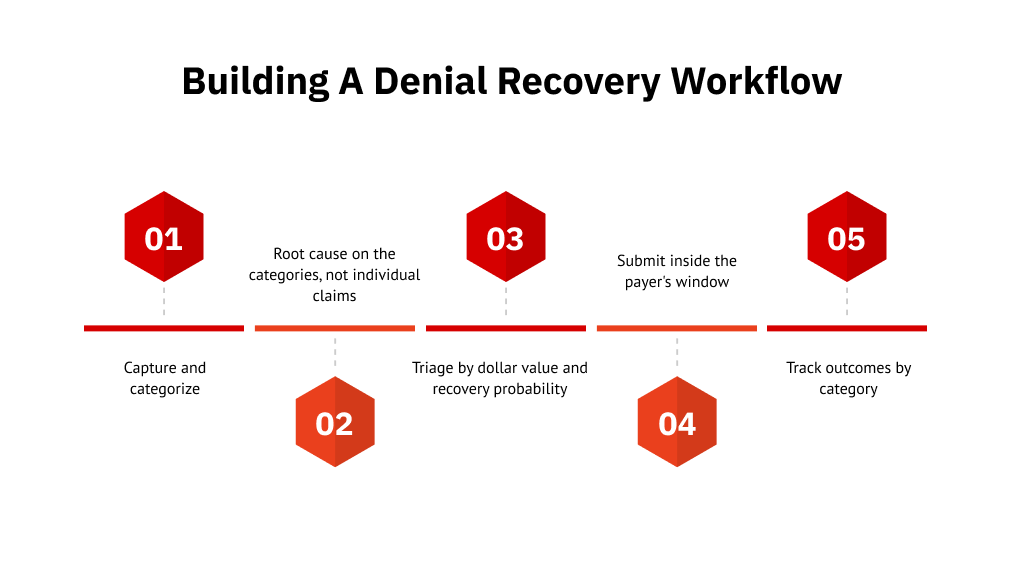
A denial recovery workflow captures every denial, categorizes it by root cause, triages by dollar value and appeal probability, then moves each account through appeal or corrected resubmission before the payer’s deadline closes.
- Capture and categorize. Pull denials from every payer feed into one queue, tag by denial reason, and stamp each with its appeal deadline.
- Root cause on the categories, not individual claims. Categories tell you whether the root cause sits upstream or at the payer.
- Triage by dollar value and recovery probability. High-dollar, high-probability denials go to appeal. Clear corrections get rebilled. Low-dollar, low-probability denials get closed.
- Submit inside the payer’s window. Commercial payers commonly allow 30 to 180 days, Medicare Advantage typically 60, though windows vary.
- Track outcomes by category. Overturn rates by category tell you which fights are worth having next quarter.
Scale is where in-house teams break. AI-driven contact strategy and machine-learning prioritization rank the denial queue in real time, so the next hour lands on the highest-yield account. Aged insurance balances that outrun internal capacity belong in a compliant third-party collections workflow that keeps documentation and appeal history intact.
Prevention paired with recovery
The strongest denial programs feed recovery data back into front-end processes. Prevention and recovery are one system, not two.
Every denial produces a signal: eligibility, coding, prior authorization, timely filing, or coordination of benefits. That signal only matters when it reaches teams that can close the gap upstream.
- Denials to registration. Eligibility and coordination-of-benefits denials become the shortlist for front-end training.
- Denials to coding. Medical necessity and coding patterns feed case reviews with coding leadership.
- Denials to prior authorization. Authorization denials become a weekly review queue for auth staff.
Prevention will not eliminate denials because payer rules keep changing. It brings the front-end denial rate down while recovery pulls back the claims that get through.
Underpayment and aged AR recovery
Underpayment and aged AR recovery is the work of pulling back money on the payer side that either came in below contract or has aged long enough to slip toward write-off. Denials are the visible leak. These two are the quiet ones.
Catching contractual underpayments
A paid claim is not always fully paid. Payers routinely process claims below the contracted rate, and the account gets posted and closed as if it were resolved in full. Because the claim shows a paid status, the shortfall stays invisible unless someone compares expected reimbursement to what actually landed.
Identification and recovery are two separate jobs:
- Identification sits with your revenue integrity function or the analytics your team uses to flag payment shortfalls.
- Recovery uses the same mechanics as denial work: an appeal on the underpaid amount, or a corrected rebill when the shortfall is coding-driven.
Once a shortfall is confirmed, the account moves back into the appeals queue, sits against the payer’s dispute window, and either gets overturned or documented and closed. That is why underpayment recovery scales well when it runs on the same infrastructure as denial appeals. Appeal writing, payer follow-up, and deadline discipline are already built.
Working-aged AR before write-off
Aged AR is accounts receivable that has moved past its clean-collection window. Most health systems track it across five aging buckets, with recovery odds falling in each older one:
- 0-30 days: Clean collection window, highest recovery rate.
- 31-60 days: First signs of drag, still workable.
- 61-90 days: Recovery odds start to fall meaningfully.
- 91-120 days: High risk of aging out before resolution.
- 121+ days: Write-off territory without focused, prioritized effort.
Days in AR (some teams call it days sales outstanding, or DSO) is the top-line metric that summarizes this movement. Aged AR left alone turns into bad debt on a predictable schedule.
Half of hospitals and health systems reported carrying more than $100 million in AR on claims older than six months in 2022, per the AHA 2024 report on hospital administrative costs.
The default habit is to work aged AR oldest first, on the logic that the oldest accounts are closest to write-off. That approach shrinks the pile without lifting the recovered number, because it treats every aged dollar the same. A stronger sort weighs two things together:
- Dollar value: Larger balances return more per hour of effort, so they get the front of the queue.
- Recovery probability: Clean documentation, a responsive payer, and no missed prior actions beat older, thinner records regardless of bucket age.
| Pro tip: Do not work aged AR strictly oldest first. Sort by dollar value and recovery probability together. A small high-value segment usually drives most of the recovered revenue, so that is where your hours should land. |
Capacity is the other constraint. Aged AR grows when the front end and denials queue already have your AR team fully loaded. A partner working aged balances under your workflow rules protects the write-off timeline without adding permanent headcount.
This is where first-party collections fit, running under your brand and inside your escalation rules while your internal team stays on newer, higher-touch work.
Patient and self-pay recovery
Patient and self-pay recovery is the work of collecting balances owed directly by patients: deductibles, coinsurance, and self-pay amounts owed after insurance has done its part. It is one of the fastest-growing recovery streams your program has to manage.
The rise of patient responsibility
Patient responsibility has moved from a rounding error to a core revenue line. Two structural shifts drive it:
- Higher deductibles: The average deductible for single coverage reached $1,886 in 2025, up 43% over the last ten years, per the KFF 2025 Employer Health Benefits Survey.
- More workers face them: 88% of workers with single coverage now have a deductible to meet before most services are paid for by the plan.
Every claim you send to a payer now generates a second recovery job on the patient side that used to be small enough to write off quietly. It no longer is.
Recovering patient balances with care
Recovering patient balances at scale takes an omnichannel program that meets patients on the channel they actually use, and a payment path that lets them resolve the balance in the same interaction.
A workable model runs on four elements:
- Omnichannel outreach: SMS, email, phone, chat, and a self-service portal, coordinated so patients get one message from one program, not five disconnected reminders.
- Segmentation: Balance size, prior payment behavior, contact history, and channel preference decide who gets a text with a payment link and who gets an agent call, so effort lands where it converts.
- Self-service payment: Patients can view the balance, choose a payment plan, set a promise-to-pay, or pay in full without waiting for an agent.
- Respectful tone: Outreach reads as patient support, not collection pressure. Recovery and patient experience only hold together at this tone.
A digital-first program with AI-driven contact optimization lifts right-party contact rates because it picks the channel and timing each patient responds to, rather than defaulting to a phone dial many patients now ignore.
This is where a managed omnichannel service does the coordination work an internal patient billing team rarely has capacity to run at scale.
Early-out and bad-debt recovery
Patient balances move through two recovery stages, with compliance obligations that shift between them.
- Early-out (pre-charge-off): Balances get worked under the provider’s brand as an extension of the internal patient billing team. Extended Business Office (EBO) support fits here, adding capacity for statements, patient calls, and payment plan setup without patients seeing a third-party name.
- Later-stage recovery: Balances that age past internal resolution move to third-party recovery under the collection agency’s name. This is where the full weight of the Fair Debt Collection Practices Act (FDCPA) applies.
Every patient interaction runs under HIPAA for protected health information. Collection interactions add the FDCPA, Regulation F for communication frequency and disclosures, the TCPA for consented SMS and calls, and any state-specific medical debt laws that apply to the patient’s location. Any partner also needs a signed business associate agreement (BAA) before placement.
Running early-out and later-stage recovery under one connected program keeps context on the account. Documentation, prior outreach, and patient preferences do not reset when the balance moves to the next stage, which is what protects both recovery rates and the patient relationship.
| Recovery that runs across payer and patient balances First Credit Services runs healthcare revenue cycle management as one connected program: Extended Business Office support for insurance appeals and rebills, first-party early-out for patient balances under your brand, and third-party recovery for aged accounts, all under HIPAA, PCI DSS Level 1, and SOC 2 Type II compliance. |
How First Credit Services approaches healthcare revenue recovery
First Credit Services approaches healthcare revenue recovery as one connected operation across payer and patient balances, running on a proprietary AI-driven engagement platform and the compliance posture healthcare requires. It replaces the vendor chain most health systems end up with: one partner for insurance follow-up, another for patient balances, a third for aged accounts, and puts the whole recovery lifecycle under a single contract.
One operation across patient and payer balances
First Credit Services works both sides of the account, not one:
- Payer-side recovery: Insurance balance follow-up, denied claim appeals, and claim rebills, run through Extended Business Office support that operates as an extension of your revenue cycle team.
- Patient-side recovery: First-party early-out under your brand for pre-charge-off balances, and third-party recovery for accounts that age past internal resolution.
Both tracks run under one contract. Documentation, prior outreach, and account context stay with the same team across the lifecycle, which is where connected recovery consistently beats a chain of vendor handoffs on both recovered dollars and patient experience.
UCEP, the engine behind the contact strategy
UCEP is First Credit Services’ proprietary Unified Consumer Engagement Platform, a purpose-built, in-house, AI-driven engagement and payment system that decides the next best touch per account and gives the patient a self-service path to resolve the balance.
What it does in practice:
- AI-driven contact scoring: UCEP scores each account and picks the best message, channel, and time per patient, so outreach lands when a patient is most likely to respond.
- Coordinated omnichannel outreach: SMS, email, chat, and phone run from one workflow instead of four disconnected campaigns.
- Self-service payment portal: Patients view the balance, take AI-driven settlement offers, set up a customizable payment plan, use promise-to-pay, or complete a one-click payment from any digital message. Available on mobile and tablet.
- White-labeled experience: On first-party accounts, the portal and outreach carry the provider’s brand, so patients see the health system’s name, not a collector’s, during the early stages.
Credentials and lifecycle coverage
The credentials that matter most for healthcare revenue recovery are HIPAA, PCI DSS Level 1, and SOC 2 Type II compliance. First Credit Services holds all three, signs a business associate agreement before placement, and operates within FDCPA, TCPA, and Regulation F frameworks.
The track record backs the compliance posture:
- Since 1993: Nationally licensed, headquartered in Piscataway, NJ, with 30+ years in receivables management and 20+ years in BPO.
- Scale: More than 125 million consumer interactions annually across three global call centers, with onshore and offshore delivery.
- Lifecycle coverage: Early-out under the provider’s brand, EBO support for insurance follow-up, and third-party recovery for aged accounts, handled without vendor handoffs that reset the account.
Compliance discipline, platform depth, and lifecycle coverage under one operation are what turn healthcare revenue recovery from a set of separate leaks into one recovered revenue number.
Conclusion
Healthcare revenue recovery works when it runs as one system across denials, underpayments, aged AR, and patient balances, not four separate teams chasing four leaks. The revenue is already earned. What decides how much comes back is whether your program moves before appeal windows close and accounts age out.
Two moves separate teams that recover most from ones that write off: connect the workflow so denials, underpayments, aged AR, and patient self-pay run under one program instead of a chain of vendors, and prioritize by dollar value and recovery probability so the next hour lands on the highest-yield account.
Ready to recover more of what your team already earned?
See how First Credit Services runs healthcare revenue recovery across both patient and payer balances, from denied claim appeals through aged AR and patient self-pay, with the UCEP platform doing the heavy lifting.
Book a demo with First Credit Services.
FAQs
1. What should you look for in a healthcare revenue recovery partner?
Look for HIPAA, PCI DSS Level 1, and SOC 2 Type II compliance, a signed business associate agreement, coverage across both payer and patient balances, digital-first outreach, and clear reporting on recovery by denial category, payer, and aging bucket.
2. How much do healthcare revenue recovery services cost?
Most healthcare revenue recovery vendors work on a contingency basis, taking a percentage of what they collect, so there is no upfront fee. Rates depend on account age, balance size, payer mix, and the complexity of the recovery work involved.
3. Should healthcare providers handle revenue recovery in-house or outsource it?
In-house teams manage current AR well, but often lack capacity for denials, appeals, and aged balances at scale. Outsourcing makes sense when volume outpaces headcount, appeal deadlines are being missed, or write-offs are climbing on aged accounts.
4. How long does it take to onboard a healthcare revenue recovery partner?
Onboarding usually takes four to eight weeks. That covers BAA execution, data integration through SFTP or API, workflow configuration, agent training on your systems and payer rules, and a compliance review before the first live outreach.
5. Does healthcare revenue recovery report medical debt to credit bureaus?
Credit bureau treatment of medical debt has shifted significantly following recent CFPB rules and voluntary changes by the major credit bureaus. Reputable revenue recovery partners focus on outreach, payment plans, and compliant resolution, not credit bureau reporting as leverage.
6. How do you measure the success of a healthcare revenue recovery program?
Track net recovery rate by aging bucket, denial overturn rate by category, days in AR, payment plan take rate, first-call resolution, and cost to collect. Segment every metric by payer and denial reason to see what to fix upstream.