


The easiest revenue for a gym to lose is often the revenue it has already earned. A member signs up, stays active, and remains in the billing cycle. Yet the payment can still fail because a card expires, an ACH pull declines, a billing update is missed, or a reminder goes unanswered.
That is where gym payment recovery protects revenue. It helps operators act while the member relationship is still intact, guide members to update billing quickly, offer flexible resolution when needed, and recover the balance before a simple payment issue becomes a collections problem.
The scale makes this process even more important. According to the Health & Fitness Association 2025 Consumer Report, U.S. fitness facilities reached a record 77 million members in 2024. With that many recurring payments moving through monthly billing cycles, even small failure rates can drain revenue, retention, and staff time.
This guide covers why gym payments fail, how recovery works, what compliance rules apply, and when to bring in a partner.
What is gym payment recovery?
Gym payment recovery is the process of recovering missed or failed recurring membership payments before they move into formal collections. It usually applies to recent declines, often within the first 30 to 90 days, when the balance is still easier to resolve, and the member relationship is still active.
The process can include automatic retries, branded reminders, card-update links, payment plans, and digital outreach. It helps recover the payment before friction turns into churn.
This is different from debt collection. Payment recovery is early and service-led. Debt collection is a later-stage escalation for accounts that have aged or exhausted internal follow-up.
Payment recovery sits between billing software and a third-party collections agency. It keeps small payment failures from becoming aged receivables.
What counts as a failed membership payment
Failed membership payments usually fall into two categories. The first is card lifecycle issues, such as expired cards, reissued cards, blocked transactions, or outdated payment credentials. The second is funding issues, such as insufficient funds, failed Automated Clearing House (ACH) pulls, or closed accounts.
There is also member-side confusion. A member may change banks and forget to update their billing information. Their card issuer may replace a card after a fraud alert, while the gym’s system keeps retrying the old number.
The key point is intent. A failed payment is not always a cancellation signal. In many cases, the member still wants access, but the payment path has broken. That difference should shape the tone, timing, and escalation path.
| Did you know? As per the Merchant Risk Council 2025 report, the involuntary churn from failed payments accounts for an estimated 20% to 40% of total churn for subscription businesses. Once a customer is lost to a payment issue, only about 5% ever resubscribe. |
Why recurring gym payments fail and what it really costs
Understanding why payments fail matters because each failure type demands a different response. Treating every decline the same way is the most common recovery mistake operators make.
The most common reasons payments fail
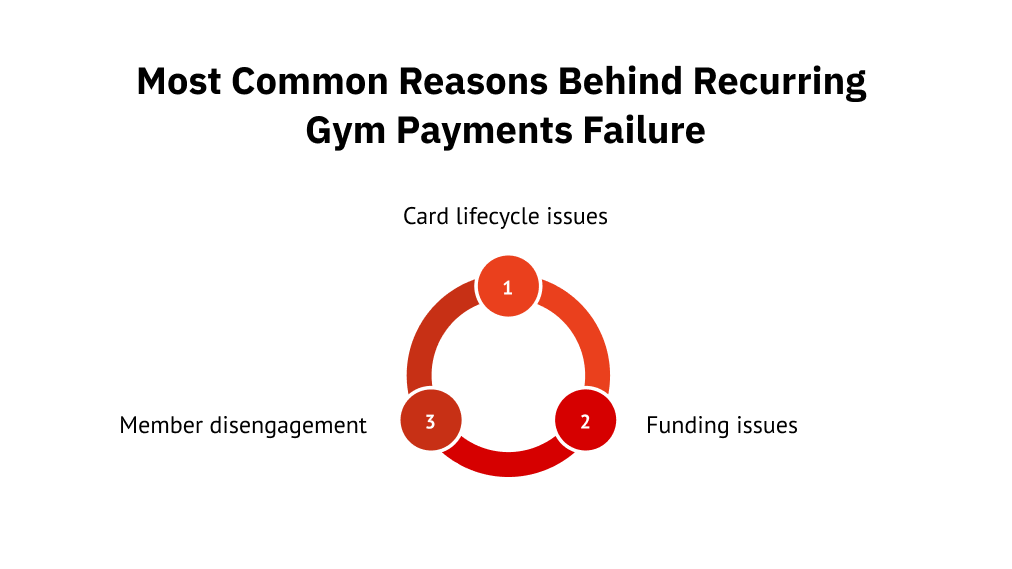
Recurring gym payments usually fail for three reasons. Each one needs a different recovery response, so gyms should not treat every decline as the same problem.
- Card lifecycle issues: Cards expire, issuers replace them after fraud alerts, or banks update account details, leaving the gym’s billing system with outdated payment credentials.
- Funding issues: A member may have insufficient funds when the ACH pull runs, even if the account has enough money a few days later.
- Member disengagement: A member may stop visiting, ignore billing reminders, and miss card-update requests, allowing the account to drift into delinquency without a clear cancellation decision.
The true cost of involuntary churn
A 5% monthly payment failure rate sounds manageable. However, over 12 months, it compounds. A gym with 2,000 members losing 5% of payments each month could see 100 failed transactions monthly. Even if half resolve through automatic retries, 50 unrecovered balances accumulate every month.
The direct revenue loss is only part of the cost. Each lost member also carries lifetime value. A member paying $50 per month who stays an average of 18 months represents $900 in future revenue.
Lose that member over a $50 payment failure, and the actual cost is 18 times the missed payment.
| Pro tip: Most failed payments are “can’t pay right now,” not “won’t pay ever.” Send a card-update link before sending a past-due notice. The tone of your first message sets the recovery rate for the entire sequence. |
The gym payment recovery process, stage by stage
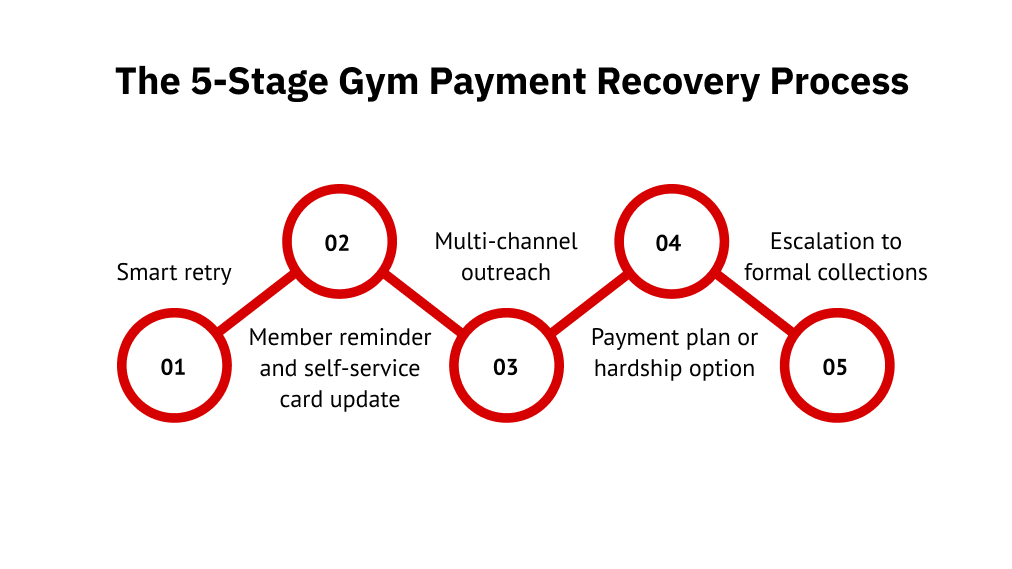
Recovery works best when it follows a structured sequence. Think of it as a waterfall, where each stage catches the accounts, the previous step missed.
At the same time, timing decides how well that sequence performs. Most recoveries happen in the first seven to ten days after a decline, so every day of delay makes the balance harder to resolve.
The 5-stage recovery waterfall
Start with the easiest fix, then escalate only when the account stays unresolved.
- Smart retry: Reattempt the charge within 24 to 48 hours. Retry on a different day of the week or at a different time. Many soft declines resolve on the second or third attempt.
- Member reminder and self-service card update: Send a branded email or SMS with a secure link to update payment details; no phone call required. The member fixes the issue in under a minute.
- Multi-channel outreach: Layer email, SMS, and phone over the next two to three weeks. Coordinate so the member receives a consistent message across channels.
- Payment plan or hardship option: Offer to split the balance into smaller payments or temporarily pause the membership. This preserves the relationship when the member has a legitimate financial constraint.
- Escalation to formal collections: Accounts that remain unresolved after 60 to 90 days move to a third-party collections agency. At this point, the goal shifts from retention to balance recovery.
Where recovery ends, and collections begins
The transition point matters. Move too early, and you lose members who would have paid with one more reminder. Move too late, and the balance becomes harder to collect.
Most operators set the handoff at 60 to 90 days past due. However, the decision should factor in balance size, member tenure, and prior payment history. A ten-year member with one missed payment deserves more patience than a new signup who has never paid.
A recovery partner that handles both stages eliminates the gap between recovery and collections. There is no vendor handoff, no data transfer delay, and no gap where accounts sit idle.
Payment recovery vs. debt collection: what’s the difference?
These two terms describe different stages, different tones, and different goals. Conflating them leads to the wrong approach at the wrong time.
| Factor | Payment recovery | Debt collection |
| Timing | 1 to 60 days past due | 60 to 90+ days past due |
| Tone | Friendly, service-led | Formal, notice-driven |
| Tools | Retries, reminders, payment links | Skip tracing, demand letters, credit reporting |
| Who handles it | In-house, billing software, or first-party partner | Licensed third-party agency |
| Primary goal | Retain the member and recover the payment | Recover the outstanding balance |
| Compliance framework | Billing and card network rules | Fair Debt Collection Practices Act (FDCPA), state licensing |
The key takeaway: recovery is fast, relationship-preserving, and focused on keeping the member. Collections is a formal escalation for aged accounts where the relationship is secondary.
First-party vs. third-party recovery
First-party recovery happens under your gym’s brand. Members see your name on the email, the text, and the payment portal. They experience the outreach as account support from their gym.
Third-party recovery happens under the agency’s name. This signals a formal escalation. It is appropriate for older accounts where first-party outreach has been exhausted.
A partner that offers both eliminates the handoff between two separate vendors. Accounts move from branded recovery to formal collections within one process. There is no rebuilding context, no duplicate data transfers, and no gap where accounts age without action.
How to recover failed payments without losing the member
Recovery is a retention strategy. The way you reach out after a failed payment shapes whether the member stays or cancels.
Start with outreach that makes resolution easy.
1. Retention-first outreach tactics
Begin with a simple, branded reminder. The subject line should read like account support. For example: “Your payment didn’t go through, update your card details here.”
Include a secure link to a self-service portal where members can update their card, view the balance, or choose a payment option. Many members prefer resolving the issue themselves.
Also consider a membership pause before cancellation. A member who pauses for 30 days is more likely to return than one whose account moves into collections. The revenue is delayed, but the relationship stays intact.
Once the message is clear, the channel sequence needs to support it.
2. Building an omnichannel recovery sequence
Match the channel to how members actually respond. Younger members tend to engage through SMS and email. On the other hand, older members may respond better to a phone call or a physical letter.
Front-load your outreach in the first week. This is where most recoveries happen. A strong first-week sequence might look like this:
| Day | Action |
| 1 | Automatic retry of the failed charge |
| 2 | Branded email with a payment link and card update option |
| 4 | SMS reminder with the same link |
| 7 | Follow-up email offering a payment plan option |
| 10 | Phone call or chat for accounts that have not responded |
After day 10, shift to weekly touchpoints. Every message should offer a clear, low-friction path to resolution.
Staying compliant while you recover
Compliance protects your gym’s brand, reduces legal exposure, and builds member trust. Treat it as a business advantage.
FDCPA Rules Operators Should Know
The Fair Debt Collection Practices Act applies when a third-party agency handles the account. Key rules include contact hour restrictions, written validation notices, and prohibitions against harassment, false threats, or misleading statements.
As the gym operator, you are responsible for choosing a licensed and compliant partner. After the handoff, the agency carries the direct compliance burden, but poor handling can still affect your brand.
Ask any potential partner about their compliance program before signing. Request documentation on call monitoring, agent training, dispute handling, validation workflows, and opt-out processes.
Compliance also starts upstream, before accounts ever reach collections.
Recurring-billing rules that prevent failures upstream
Card network account-updater programs can reduce failed payments before they happen. Visa and Mastercard maintain services that automatically refresh expired or reissued card data. Enrolling in these programs means fewer declines from outdated card numbers.
ACH billing has its own rules. The National Automated Clearing House Association (NACHA) limits how many times you can re-present a failed ACH transaction. Exceeding those limits triggers penalties and can damage your relationship with your bank. Typically, you get two re-presentment attempts per original transaction.
| Did you know? The Merchant Risk Council 2025 report mentions that over two-thirds of subscription businesses operate without a proactive churn-prevention plan, including account updater enrollment and structured retry logic. |
In-house, software, or a recovery partner?
The right approach depends on your gym’s size, failed-payment volume, and internal bandwidth. Here is a framework to help you decide.
Quick decision framework by gym size
- Single studio or small gym (under 500 members): Your billing software likely handles automatic retries. Assign one staff member to follow up on failures weekly. At this volume, in-house recovery is usually manageable.
- Multi-location or mid-size chain (500 to 5,000 members): Failed payments start to overwhelm front-desk staff. A dedicated recovery process, either through upgraded software or a recovery partner, becomes necessary. Compliance exposure also increases with volume and locations.
- Large chain or franchise (5,000+ members): The volume justifies a dedicated recovery partner. Internal teams cannot keep pace, and the compliance stakes are too high for ad hoc processes.
Pros and cons of each approach
| Approach | Strengths | Limitations |
| In-house staff | Full control, personal touch | Staff time, inconsistent follow-up, compliance gaps |
| Billing software | Automated retries, low cost | Limited to dunning; no outreach, no escalation path |
| Recovery partner | Full lifecycle, compliance built in, scalable | Cost per recovery, less direct control |
When outsourcing wins
Outsourcing makes sense when failed-payment volume exceeds what your team can handle consistently. Other signals include accounts regularly aging past 60 days and compliance concerns in states with strict consumer protection laws.
If your staff spends more time on payment follow-up than member service, that is another clear indicator.
The hidden cost of in-house recovery is inconsistency. A front-desk employee who skips follow-up during a busy week lets accounts age silently.
How First Credit Services recovers gym payments
The recovery waterfall outlined above works best as one connected process, from the first automated retry through formal collections. First Credit Services delivers that full lifecycle as a managed service.
For gym operators, this means omnichannel recovery across SMS, email, and phone. It includes a self-service member portal, retention-first messaging, and FDCPA-compliant handling throughout.
FCS operates its proprietary platform, Unified Consumer Engagement Platform (UCEP), on the client’s behalf. The platform scores each account and selects the right channel and timing. Members are routed to a self-service portal where they can update payment details or set up a plan.
This model fits multi-location gyms and fitness chains placing meaningful monthly volume. Smaller studios with low failure counts are typically better served by billing software and in-house follow-up.
Prevent failed payments from becoming lost gym members
Failed gym payments are recoverable, but the window closes fast. Operators that act early are more likely to recover the balance while the member relationship is still intact.
A strong recovery process does not rely on pressure. It relies on smart retries, branded reminders, self-service payment links, and flexible options. These steps help members resolve temporary issues before they turn into churn.
When failed payments outgrow your team’s capacity, a managed recovery process can stop balances from aging. It can also reduce manual follow-up and protect membership revenue.
Talk to FCS to see how managed gym payment recovery can help recover failed payments across your member base.
FAQs
1. How quickly should a gym act on a failed payment?
Within 24 to 48 hours is ideal. Automatic retries should fire immediately. A member reminder with a card-update link should follow within two to three days. Recovery rates drop sharply after the first week.
2. Does a gym need member consent to retry a failed payment?
Typically, yes. The original membership agreement should include authorization for recurring charges and re-presentment. Review your contract language with legal counsel to confirm it covers retries and updated card data.
3. Can a gym report unpaid memberships to credit bureaus?
A gym itself generally cannot report directly. However, a licensed collection agency can report unpaid accounts to credit bureaus after meeting proper validation and notice requirements under the FDCPA.
4. What is the difference between a dunning system and a recovery partner?
A dunning system automates payment retries and sends basic reminders through one channel. A recovery partner adds coordinated multi-channel outreach, self-service payment portals, payment plans, compliance management, and escalation to formal collections when needed.
5. How does a membership pause help with payment recovery?
Pausing keeps the member relationship intact while giving them time to resolve a temporary financial constraint. Paused members are far more likely to reactivate than cancelled members, preserving long-term lifetime value.
6. What happens to gym accounts that never get recovered?
Unresolved accounts are typically written off as bad debt after 90 to 120 days. At that point, the gym may place them with a third-party agency for formal collections, where recovery rates are significantly lower.