


Gym membership collections is the process a fitness business uses to recover unpaid dues after a payment fails or a member’s account lapses. Most gyms start with internal outreach under their own name, then escalate unresolved balances to a third-party collections partner once follow-up stalls.
Failed and canceled payments are common enough to matter. The Consumer Credit Card Market Report 2025 found that canceled recurring transactions, including subscriptions and membership fees, made up 40% of general-purpose card disputes in 2024.
For gym operators, that kind of billing failure turns into an unpaid balance fast. How you handle that account before and after it becomes delinquent affects recovery and the member experience.
This guide covers how an unpaid membership moves through the collections process and what separates first-party from third-party recovery. It also breaks down the compliance requirements at each stage and what to check before placing accounts with an outside partner.
How an unpaid membership moves into collections
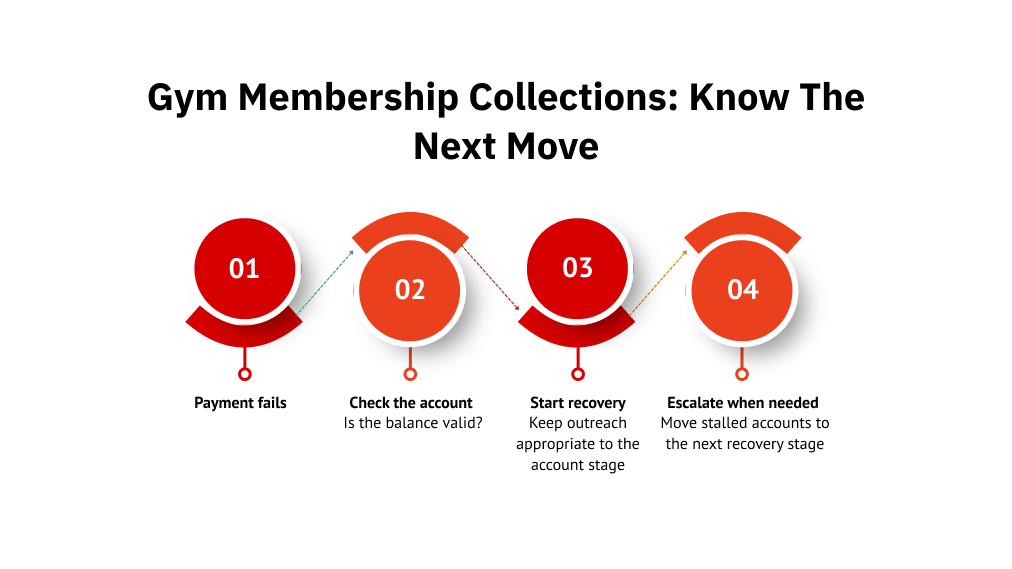
You control most of the path an unpaid membership takes into collections. That path runs from the first missed payment to the decision to bring in an outside partner. Getting this stage of gym membership debt collection right early on determines how much of the balance you actually recover.
Most operators treat first-party and third-party recovery as separate vendors. They work better as one continuum. An account starts with internal outreach and, when that stalls, moves to a third-party collector once it ages past what your team can resolve.
| Pro tip: Confirm the balance, the membership agreement, and any cancellation disputes before you place an account with a third-party collector. That check catches disputed or already-resolved balances before they escalate. |
Here is how each stage of that continuum actually works.
First-party (internal, client-branded) recovery
First-party recovery keeps outreach under your gym’s own name and brand. It happens early, while the balance is still fresh and the member relationship is still intact.
This stage typically covers accounts in the first 60 days past due. Your front-desk or billing team, or an internal collections function, contacts the member directly to resolve the failed payment or lapsed dues.
Providers that offer first-party or white-labeled recovery on a gym’s behalf often set volume or placement minimums. That can put the option out of reach for smaller, independent operators, which is one reason many single-location gyms handle this stage entirely in-house.
Once internal efforts have run their course, the account typically moves outside the gym’s own name.
Third-party collections
Third-party collections move the account to an outside agency once internal, or first-party efforts are exhausted. From this point, outreach happens under the collector’s own name and brand rather than the gym’s.
For covered third-party debt collectors, the Fair Debt Collection Practices Act (FDCPA) and Regulation F set requirements around communication frequency, disclosures, and prohibited practices. These rules protect the member and limit your liability exposure as the creditor placing the account.
Third-party collections are generally available to gyms of any size, including independent, single-location operators. That includes operators who fall below the volume thresholds some first-party programs require.
First-party vs. third-party collections: which do you need?
The right stage depends on where an account sits rather than which service sounds more comprehensive. The table below breaks down the practical differences.
| Factor | First-Party Recovery | Third-Party Collections |
| Whose name the outreach is under | Your gym’s own brand | The collector’s own brand |
| Typical account age at placement | 0 to 60 days past due | 60 to 90+ days past due |
| Volume or size fit | Often has volume or placement minimums | Generally open to gyms of any size |
| Pricing model | Contingency or per-account fee, depending on the provider | Contingency-based, paid on recovered dollars |
| Compliance scope | Governed by your own billing and collection practices | Governed by the FDCPA and Regulation F for covered collectors |
| Best fit trigger | Early, recoverable balances with an active member relationship | Aged or written-off balances after internal efforts stall |
Many fitness-focused recovery agencies run only one of these two stages rather than both. Few run a genuine gym dues collection service that spans early-stage and escalated recovery under one roof. It’s worth asking a prospective partner which stage they handle and at what account volume, before assuming full coverage.
First Credit Services works specifically at the third-party stage for this vertical, stepping in once internal or first-party efforts stall, with gym-specific recovery processes built around membership agreements and billing cycles.
What gym collections compliance actually requires
A signed membership agreement is a contract. Once a member falls behind, you or a collection partner can pursue the balance under that agreement if it was properly formed.
Compliance for a fitness membership collections agency runs on two tracks. One governs how a third-party collector can contact and pursue the member. The other governs how your own billing and cancellation practices hold up before an account ever reaches that stage.
Here’s what to check on the collector side first.
FDCPA: what it requires of your third-party partner
The FDCPA and Regulation F set the ground rules for any third-party debt collector working on your behalf. They restrict abusive, unfair, or deceptive collection practices and govern how, when, and how often a collector can contact a member.
As the gym owner, these rules govern your partner’s conduct rather than yours directly. Your job is due diligence: confirm that the partner you place accounts with actually operates within them.
Ask how the partner documents compliance, trains agents, and audits communications. A partner who cannot answer clearly is a liability you are choosing to take on.
That covers the collector’s side. The other half of compliance lives upstream, in your own billing practices.
Billing and cancellation practices are a business exposure
The Federal Trade Commission (FTC) enforces the Negative Option Rule, which governs how businesses handle recurring charges and cancellations at the federal level. A 2024 update to the rule, known as Click-to-Cancel, would have added stricter disclosure and cancellation requirements. The Eighth Circuit vacated it in 2025 on procedural grounds, and it never took effect.
The FTC restored the pre-2024 version of the rule in February 2026 and is now considering further amendments. Several states, including California, Colorado, and New York, impose their own automatic-renewal requirements that stay in effect regardless of the federal rule’s status. Gym cancellation practices specifically have drawn state-level enforcement in recent settlements.
| Pro tip: A strong collections partner can explain the compliance requirements that apply to its own recovery activity and flag upstream billing or documentation issues that could affect account quality. |
What “brand safe” collections actually means
“Brand safe” collections means a specific set of operational controls a partner has in place to collect unpaid gym memberships without damaging your reputation. It’s a standard you can verify against real documentation.
Every account a partner works either protects your relationship with the member or quietly erodes it, depending on whether these controls actually exist.
Four controls define whether a partner delivers on that standard:
- Documented tone guidelines: You review and approve messaging, tone, and scripts before any accounts are placed, not after a complaint surfaces.
- Defined escalation triggers: Clear rules govern when and how an account moves to the next stage. Without them, a single unresponsive week can push a recoverable account into aggressive outreach it never needed.
- Multi-channel outreach with a resolution path: Email, SMS, and phone give members more than one way to resolve the balance or reinstate their membership, rather than a single demand for payment.
- Audit access: You can review communications, account notes, and outcomes to verify exactly what was said to members and when.
These controls protect your brand and keep the member relationship intact while the balance gets resolved.
This is the operating standard FCS applies to gym clients at the third-party stage: client-approved messaging and scripts, omnichannel engagement, and documentation you can audit within your own system.
How to choose a gym membership collections partner
Choosing the right gym dues collection service comes down to a short list of questions. Ask each one directly, and treat a vague answer as a red flag.
- Service model: Confirm whether the partner offers first-party, third-party, or both, and how each stage is priced.
- Volume and placement fit: Ask what account volume or placement minimums apply to first-party service, and whether third-party recovery is available at your size.
- State licensing: Confirm the agency is licensed and registered to collect in every state where you place accounts.
- Complaint history: Ask for the agency’s complaint-to-account ratio rather than a general statement about complaint transparency.
- FDCPA compliance record: Confirm how the agency documents and resolves compliance issues when they come up.
- Reporting access: Confirm you get portal or reporting access to track placements, recovery, and accounts by stage.
- Fitness-industry specialization: Confirm the agency has direct experience in health and fitness collections rather than a generalist collections background.
- Reinstatement path: Ask whether the agency offers a reinstatement or win-back path for members who pay, beyond simply recovering the balance.
A partner who answers all eight clearly is worth a deeper conversation. One who dodges more than one or two is worth crossing off the list.
When does a gym need a collections partner?
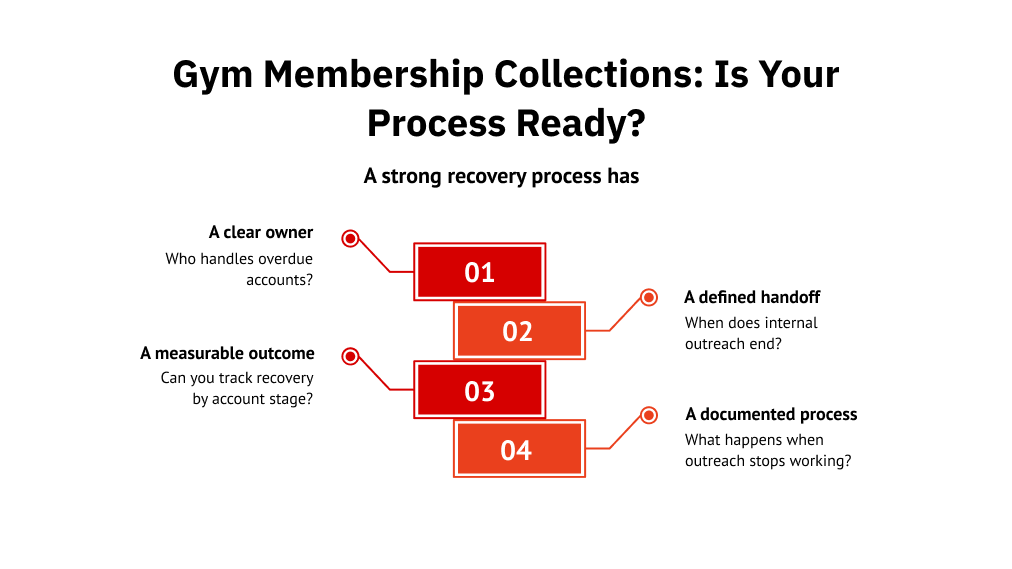
A few concrete signals tell you when it’s time to bring in a fitness membership collections agency. Check your own operation against each one:
- Signal 1: More than 15–20% of delinquent accounts are aging past 60 days without resolution. Internal outreach is no longer working for those accounts, and they’re continuing to lose value.
- Signal 2: Front-desk or billing staff are spending more than a few hours a week chasing overdue balances instead of running the gym.
- Signal 3: The gym has no documented process for what happens after the third or fourth failed outreach attempt. If the answer to “what do we do when they stop responding?” is “nothing,” that’s the gap a partner fills.
- Signal 4: The gym operates in multiple states or is expanding. State licensing, varying collection rules, and compliance exposure increase with geographic reach.
- Signal 5: Recovery rates on accounts older than 90 days are flat or declining. The longer an account sits without specialized recovery efforts, the harder it becomes to recover.
If two or more of these signals apply, the gym is past the point where internal follow-up alone is a realistic strategy.
First Credit Services works with gyms across this range, from multi-location chains placing high volumes of aged accounts into third-party collections to independent operators placing smaller batches once internal efforts stall.
The right approach to gym membership collections
Gym membership collections come down to three decisions. You need to know which stage each account is in and what compliance applies there. Confirming whether a prospective partner actually runs the stage you need matters just as much.
Getting those decisions right shows up in cleaner receivables and lower write-off rates. It also means more members resolve their balance and come back, instead of leaving with a complaint.
Ready to deal with your gym’s aged accounts? Explore third-party recovery with FCS and find the right approach for your delinquent membership accounts.
FAQs
1. What’s the difference between first-party and third-party gym membership collections?
Third-party collection happens under the agency’s own name once internal or first-party efforts are exhausted and the account has aged further. For covered third-party collectors, the FDCPA and Regulation F govern how, when, and how often the agency can contact the member during outreach.
2. Can an independent, single-location gym use a first-party collections service?
First-party or white-labeled recovery often carries volume or placement minimums that vary by provider, which can put it out of reach for smaller, single-location operators. Third-party collections are generally available across a much broader range of account volumes, regardless of gym size or location count.
3. When should a gym place an account with a third-party collector?
Once internal or first-party outreach has stalled and the account has aged past what your team can reasonably resolve, typically beyond 60 days past due, it’s time to escalate. Waiting longer than that usually lowers the odds of full recovery on the balance.
4. What should a gym look for when evaluating a collections partner?
Look for fitness-industry specialization, documented FDCPA compliance, transparent stage-by-stage reporting, and clarity on whether the partner runs first-party, third-party, or both, plus at what account volume each applies. A vague answer to any of these is worth treating as a red flag.
5. Is gym membership debt collection legal?
Gym membership balances can be pursued when validly owed under a properly formed membership agreement. If the account is placed with a covered third-party agency, that agency must follow applicable federal and state requirements, including the FDCPA and Regulation F, throughout the recovery process.
6. Does gym size affect which collections model makes sense?
Yes. Third-party collections work for gyms of any size, including independent, single-location operators. First-party service often carries minimum volume or placement requirements that vary by provider, which can make it a better fit for larger, multi-location operations instead.