

Are you recovering enough from the credit card and loan accounts your borrowers have stopped paying?
Credit debt collection services help lenders recover overdue accounts, but keeping late-stage debt in-house too long or choosing an agency based on price alone can reduce recoveries and leave compliance risks in place.
The path forward is clear. Recoveries are the one variable you can still control after charge-off. The gains come from three decisions: how you structure placements, how you vet each agency, and which metrics you hold that agency to.
This guide covers what credit debt collection services include and how placements move from primary to quinary. It also explains how to evaluate a recovery partner and which metrics show whether that partner is performing.
What are credit debt collection services?
Credit debt collection services help lenders and financial institutions recover overdue balances from consumer credit accounts. Banks, credit unions, credit card issuers, retail card programs, and fintech lenders may partner with a debt collection agency to manage delinquent accounts, improve recovery outcomes, and handle high-volume collections.
Depending on the account’s delinquency stage and recovery strategy, businesses may manage collections internally, work with a first-party collections partner, or outsource accounts to a third-party collection agency. These services can cover a range of consumer credit products, including credit card balances, personal loans, lines of credit, and other consumer financing accounts. The right credit debt collection services can help lenders manage growing account volumes, streamline recovery efforts, and support consistent, compliant consumer communications.
These services can cover several types of consumer credit accounts, depending on the lender’s portfolio and recovery needs.
Credit and consumer loan accounts agencies recover
The four consumer credit account types listed below cover most of what agencies recover for lenders:
- Credit cards and private-label retail cards: These revolving accounts have well-established charge-off timelines.
- Personal installment loans: These accounts carry fixed terms and fixed payments. Consequently, missed payments roll in a predictable pattern from 30 days past due through charge-off.
- Lines of credit: These open-end accounts follow the same 180-day charge-off timeline as credit cards under Federal Financial Institutions Examination Council (FFIEC) guidance.
- Buy now, pay later (BNPL) and fintech loans: These portfolios often skew younger and more mobile. As a result, digital channels and self-service payment options carry more weight than phone outreach.
Each of these accounts follows a similar path once a payment is missed, and the next section maps that path.
How credit debt collection works, from first missed payment to recovery
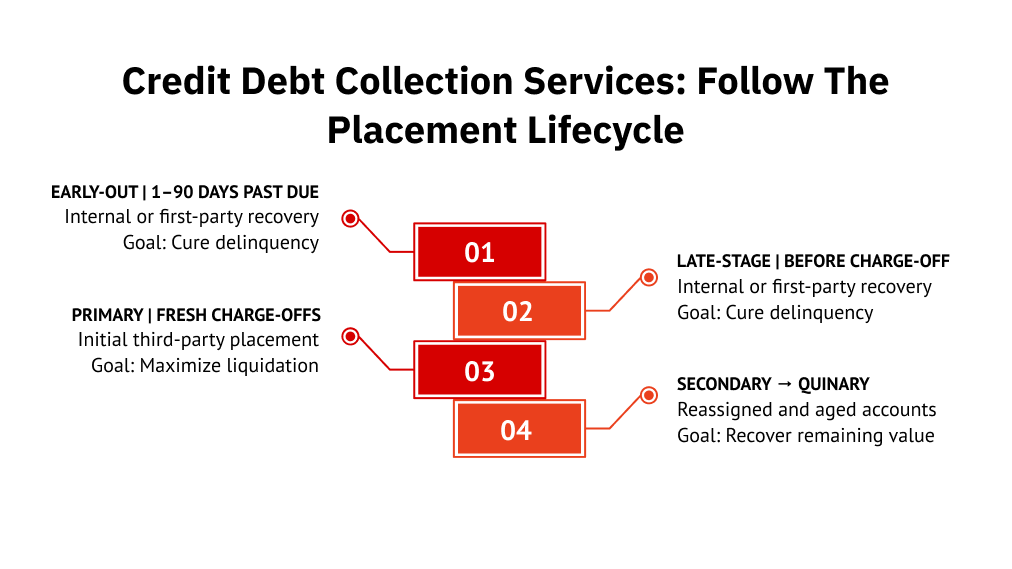
Every consumer credit account follows a regulated timeline from delinquency to charge-off. Under FFIEC guidance, banks should charge off open-end credit at 180 days past due. Meanwhile, closed-end credit reaches that threshold at 120 days.
That timeline creates two broad phases of recovery work. Before charge-off, lenders may manage delinquent accounts internally or work with a first-party collections partner that communicates under the lender’s brand. After charge-off, lenders may continue recovery efforts internally, place accounts with a third-party collection agency, or sell the debt to a debt buyer. The approach depends on the lender’s recovery strategy and portfolio objectives.
The table below shows the placement lifecycle for credit accounts:
| Stage | Account status | Who works it | Name on the outreach | Goal |
| Early-out | 1 to 90 days past due | Lender or first-party partner | Lender’s brand | Cure before roll |
| Late-stage | 90 days to charge-off | Lender or first-party partner | Lender’s brand | Prevent charge-off |
| Primary | Freshly charged off | Third-party agency | Agency’s name | Highest liquidation |
| Secondary | Returned from primary | Second agency | Agency’s name | Fresh strategy on unresolved accounts |
| Tertiary to quinary | Aged, previously worked | Specialist agencies | Agency’s name | Recover remaining value |
Expected recovery tends to fall with each tier. For this reason, the strategy, channel mix, and data quality need to shift as accounts age.
The later tiers deserve a closer look.
Why aged paper needs its own strategy
The pool of open charged-off credit card debt is large. According to Liberty Street Economics 2026, 80% of charged-off debts were still being reported a year later in 2024. More than 23 million Americans now carry charged-off card balances on their credit reports.
However, re-running the primary agency’s playbook on that pool rarely works. Effective credit portfolio recovery on aged paper requires refreshed skip-tracing data, a different channel sequence, and revised payment offers.
This is the approach we take at First Credit Services. Our digital-first strategy predicts the best channel and time to reach each borrower across email, SMS, chat, and phone. Borrowers can also choose a payment plan through our self-service portal.
| Pro tip: If your agency is re-running the primary strategy on the same phone numbers, ask for a segmented test. Use updated skip data and a digital-first outreach sequence, and run it before you renew the placement. |
With the lifecycle mapped, the next decision is when to bring in an outside partner.
When should lenders outsource credit debt recovery?
Most lenders outsource when an internal constraint forces the question. Spotting those triggers early protects recovery rates, because an account loses value each month it sits unworked.
The four signals below most often push lenders toward outsourced credit debt recovery.
- Charge-off volume outpacing staff: When your team cannot work new charge-offs promptly, accounts age without contact. That delay compounds across a growing portfolio.
- Rising roll rates: A larger share of 30-day delinquencies may be rolling to 60 and 90 days. In that case, an outside partner adds capacity without a long hiring cycle.
- Limited state licensing: Many states require collection licenses and bonds, along with ongoing renewals. A partner licensed across your footprint can reach borrowers your current program leaves uncontacted.
- Exam findings on collections conduct: A regulatory finding on call practices, disclosure timing, or complaint handling is an immediate signal. An agency with a documented compliance management system brings trained staff and audited processes. Oversight of that agency still stays with you.
Outsourcing also works in layers. Many lenders keep some accounts internal and place others based on balance, age, or asset class.
The table below compares the three approaches.
| Approach | Best fit | Tradeoff |
| Keep in-house | Low-volume, early-stage accounts where your team has capacity and licensing | Recovery stalls if volume spikes or accounts age |
| First-party partner | Early-stage accounts that need your brand on the outreach | Onboarding and brand alignment take time |
| Third-party agency | Post-charge-off accounts, aged paper, and portfolios that need national licensing | The agency contacts borrowers under its own name |
Overall, recoveries tend to be stronger when the approach matches the account’s stage. Once you decide to outsource, the next step is choosing the right agency.
How to evaluate a credit debt recovery agency: 7 criteria
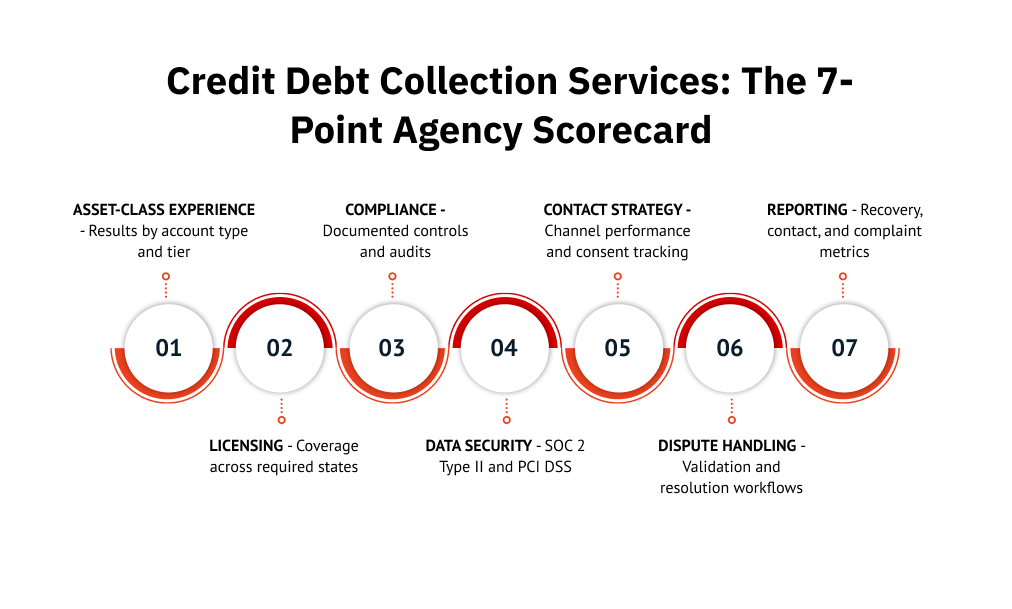
Many lenders choose a credit debt recovery agency on contingency rate alone. A lower rate means little if the agency recovers less, mishandles disputes, or creates compliance exposure. The seven criteria below help you separate a productive partner from a liability.
1. Experience with your asset class and placement tier
Credit cards, installment loans, and BNPL accounts carry different borrower profiles, roll patterns, and legal considerations. For example, an agency strong in card recovery may underperform on installment accounts. Hence, ask for results by asset class and placement tier, because blended averages hide weak spots.
2. State licensing and a documented compliance management system
An agency needs a license in each state that requires one, plus surety bonds where required. Licensing gaps leave accounts in those states unworked. Because of this, a written compliance management system should include the four items below:
- Documented collection policies and procedures
- Call monitoring and recording protocols
- Complaint tracking and resolution workflows
- A recent external audit history
3. Data security certifications
Consumer credit data is a high-value target. Require a SOC 2 Type II report and Payment Card Industry Data Security Standard (PCI DSS) compliance. Gramm-Leach-Bliley Act (GLBA) safeguards apply to banking clients as well. Similarly, ask how account files move between systems and who can access them.
At FCS, we hold ourselves to the same standard. That means national licensing, PCI DSS Level 1 compliance, and SOC 2 Type II compliance. Our agents also pass lender compliance and regulatory audits.
4. Contact strategy and channel mix
Evaluate right-party contact rates, digital channels, consent tracking, and Regulation F frequency limits. Staying within the seven-calls-in-seven-days presumption does not guarantee compliant conduct. Therefore, look for channel selection driven by borrower behavior data, since dial volume alone says little about results.
5. Dispute and validation handling
According to the CFPB FDCPA Annual Report 2025, “debt not owed” has been the most common collection complaint since 2013. Given this trend, ask about validation notice timing, dispute turnaround, and how the agency stops activity on disputed accounts. A mishandled dispute can become a complaint that traces back to you.
6. Payment flexibility and borrower experience
Borrowers tend to resolve balances sooner when they have options beyond a lump-sum demand. Look for the three features below:
- A self-service payment portal available around the clock
- Installment plans across multiple payment methods
- A hardship process for borrowers in financial difficulty
A respectful process also protects your brand and the chance of a future relationship.
7. Reporting transparency
Requires account-level reporting that covers the three measures below:
- Liquidation rates by placement tier
- Right-party contact rates
- Complaint rates per 1,000 accounts
Finally, set a monthly reporting cadence in the agreement, because quarterly reports delay any correction.
The checklist below turns these criteria into questions for your shortlist.
| Checklist callout: 8 questions to ask before you sign a placement agreement. Which states are you licensed and bonded in, and can you share current licenses for every state where our borrowers live? What liquidation rates do you achieve on credit card and installment accounts at our placement tier? When was your last SOC 2 Type II audit, and are you PCI DSS compliant? How do you track consent, contact frequency, and channel preferences under Regulation F and the TCPA? What is your complaint rate per 1,000 accounts, and how quickly do you resolve disputes? How do you screen for bankruptcy, deceased, and active-duty service member accounts before and during placement? Which reports will we receive, how often, and at what level of detail? How is your fee calculated on settlements, payment plans, and payments made directly to us? |
Pricing models and the metrics that show real performance
An agency’s fee structure shapes how it prioritizes your accounts. Each model also changes what you keep after fees, which matters more than the headline rate.
Agencies price credit account recovery through the three models below:
- Contingency: The agency earns a percentage of what it collects, and you pay nothing on unrecovered balances. Rates typically rise with account age and placement tier, because older accounts take more effort.
- Flat fee: You pay a fixed charge per account, regardless of outcome. This model suits high-volume, low-balance placements.
- Hybrid: You pay a smaller flat fee per account plus a reduced contingency rate. This model shares risk between you and the agency.
Many lenders compare agencies by contingency rate alone. However, netback is a better measure because it shows total collections minus total fees. An agency with a higher rate can still return more dollars if it recovers more of each balance.
According to the Federal Reserve Board, U.S. commercial banks charged off card loans at an annualized 3.82% in Q2 2026. That figure is net of recoveries, so every recovered dollar lowers your loss. As such, ask each agency for net-back data on comparable portfolios, split by placement tier.
The table below lists five metrics to track.
| Metric | How it is calculated | What it tells you |
| Liquidation rate | Collected ÷ placed balance | Core recovery performance |
| Net-back | Collected minus agency fees | What reaches your books |
| Right-party contact rate | Right-party contacts ÷ accounts worked | Data and channel quality |
| Promise-kept rate | Kept ÷ promised payments | Whether arrangements are realistic |
| Complaint rate | Complaints per 1,000 accounts | Compliance risk |
Read these metrics together. A high liquidation rate with a high complaint rate points to aggressive tactics and regulatory exposure. Likewise, a strong promise-kept rate shows that the agency sets payment arrangements borrowers can keep.
| Pro tip: Run a champion-challenger split for at least two full placement cycles before judging a new agency. One cycle rarely produces enough resolved accounts to compare fairly. Match the split on balance range, account age, and geography. |
Strong numbers hold up only when the agency’s conduct does, so compliance comes next.
Compliance and vendor oversight you can’t hand off
Placing accounts with an agency moves the work, while the regulatory responsibility stays with you. Federal banking regulators expect a bank to meet the same compliance standards when it uses a third party. In other words, the bank answers for the work as if its own staff had performed it.
That principle governs every placement for consumer debt collection services. Your oversight program should cover the four frameworks below.
- FDCPA and Regulation F: These cover validation notices, the call-frequency presumption, and the ban on credit reporting before borrower contact.
- Telephone Consumer Protection Act (TCPA): This law sets consent rules for autodialed calls and texts, including tracking of revoked consent.
- Fair Credit Reporting Act (FCRA): This law requires accurate reporting on furnished accounts and timely dispute investigations.
- State collection laws: These add licensing, fee caps, and statute of limitations rules that can be stricter than federal law.
Oversight also depends on active monitoring after the contract is signed. Review call recordings, audit complaint logs, and require prompt reports of regulatory actions or lawsuits.
What a strong data handoff includes
The data you send at placement determines how accurately the agency can work your accounts. Every placement file should include the six items below.
- Charge-off date and last payment date
- State statute of limitations for the account
- Full itemization of the balance, including principal, interest, and fees
- Prior dispute history and outcomes
- Bankruptcy and deceased borrower flags
- Servicemembers Civil Relief Act (SCRA) status
A missing field forces the agency to guess, and a wrong guess on a bankruptcy flag creates exposure for you.
With oversight in place, you have every piece needed to choose the right partner.
Choose credit debt collection services that recover more and protect your brand
Three decisions shape how well your charged-off portfolios recover.
First, your placement structure should cover every stage, from early-out through quinary tiers. Second, the seven evaluation criteria help you separate a strong credit debt recovery agency from a risky one. Third, the metrics you track show what reaches your books and whether that performance will last.
Net charge-offs fall when recoveries rise. In short, the right credit debt collection services recover more and protect your brand.
Planning to place your charged-off credit accounts with a new recovery partner? Explore your options with us, and we will map a placement plan to your accounts.
FAQs
1. Can we recall accounts after placing them with an agency?
Yes. A well-drafted placement agreement gives you the right to recall accounts at any time. The agreement should define the notice period and return timeline. It should also state how fees apply to payments already in progress on recalled accounts.
2. Should we sell charged-off credit card debt or place it with an agency?
Selling transfers ownership and brings immediate cash, usually at a steep discount to face value. Placing keeps ownership with you, and contingency fees apply only to recovered amounts. Many lenders place accounts first and sell only the oldest balances.
3. How do agencies handle accounts where the borrower has filed for bankruptcy?
Collection must stop once a bankruptcy case is filed. The automatic stay under federal bankruptcy law bars most collection activity. Reputable agencies check placements against bankruptcy data before and during each cycle, then return or close any flagged accounts.
4. What happens to a credit account when the borrower has died?
A deceased borrower’s debt is generally handled through their estate, with collection agencies communicating with the authorized representative. Family members aren’t automatically liable; responsibility depends on factors such as joint ownership, co-signing, and state law. Regulation F sets specific rules for communications about deceased consumers.
5. How long does an agency keep an account before it moves to the next tier?
The placement agreement sets that window in advance. Unpaid credit accounts with no activity at the end of it return to you for the next placement. Accounts on active payment plans usually stay with the agency until the plan ends.
6. Can an agency collect on debt that is past the statute of limitations?
In most states, an agency can still request payment on time-barred debt. Regulation F bars it from suing or threatening to sue on that debt. Accurate statute of limitations data at placement helps keep the agency within that rule.