


Unpaid customer balances cost your business revenue every month they stay open.
Your team follows up, yet some accounts slip past 90 days and others past 180. Every extra month makes those customers harder to reach and less likely to pay. At that stage, a consumer debt recovery agency can recover what your team cannot.
The process starts with a planned handoff from accounts receivable into collections. A specialist partner then contacts your customers within the law and offers flexible payment plans. As a result, you recover more revenue and keep the relationship intact.
This guide explains how consumer debt recovery services work, which compliance rules apply, and how to choose the right partner.
What is a consumer debt recovery agency?
A consumer debt recovery agency is a licensed third-party firm that collects overdue personal debts for the original creditor. It recovers balances such as credit card debt, medical bills, and personal loans. The creditor keeps ownership of the debt and pays a contingency fee on what the agency recovers.
Here, “consumer” describes the type of receivable your business holds. Specifically, it covers money your customers owe for personal, family, or household purposes. These agencies typically handle:
- Credit card balances
- Personal loans
- Medical bills and hospital balances
- Utility arrears (electric, gas, water, telecom)
- Subscription and membership fees
- Rent and lease obligations
Consumer debt recovery operates under the Fair Debt Collection Practices Act (FDCPA) and state consumer protection laws. Together, these rules govern how, when, and how often an agency can contact your customers.
Many creditors also weigh placing accounts with an agency against selling them to a debt buyer. With an agency, you keep ownership of the account and control the customer experience. By comparison, a debt buyer purchases the debt outright for a fraction of face value and takes over every customer interaction.
Beyond ownership, consumer recovery runs in two stages:
- First-party recovery is generally conducted under the original creditor’s name, either by its internal team or by a service provider acting on its behalf.
- Third-party collections involve an outside collection agency pursuing the debt. The applicable disclosure and collection requirements depend on the agency’s role, the type of debt, and the law.
Ultimately, the right choice depends on account age, balance size, and how much brand control matters to your organization. To make that choice well, it’s important to know how the recovery process works from placement to resolution.
How consumer debt recovery works: The process from placement to resolution
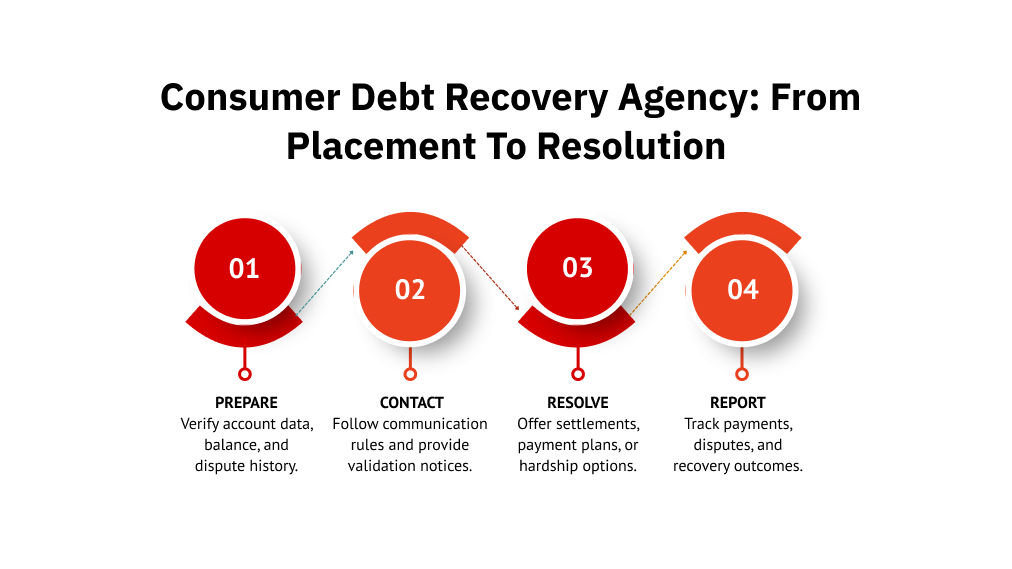
Consumer debt recovery services follow a structured sequence, from data handoff to final payment. Each stage carries its own legal rules, so knowing them helps you spot an agency that cuts corners. The process starts with the file you send.
Account placement and data handoff
First, you give the agency a signed authorization and a placement file. A complete file covers key details for every account, such as:
- Customer name, address, and phone numbers
- Account number and original creditor name
- Balance breakdown by principal, interest, and fees
- Last payment date and prior dispute history
Alongside the file, you share supporting documents, such as the signed credit agreement. Next, the agency runs the following standard checks before any outreach begins:
- Bankruptcy and deceased screening
- Address verification and skip tracing
- Statute of limitations review by state and debt type
Clean data speeds up outreach, while incomplete files delay the validation notice and raise dispute risk. Once the file is clean, outreach can begin.
Customer contact and communication
The agency must send a validation notice in its first message or within five days after. Under Regulation F, this notice lists the debt, the creditor, the amount owed, and dispute rights. After that, outreach moves across the following channels, each with its own rules:
- Phone calls: Regulation F presumes compliance at seven calls per debt within seven days.
- Email and text: Every message must include a clear way to opt out.
- Letters and portals: Letters create the formal record, while portals let customers pay without speaking to an agent.
Above all, tone shapes results. Personalized debt collection uses empathetic scripts and self-service options to help customers resolve balances on their own schedule.
| Pro tip: Ask how the agency handles disputes. A written dispute within the validation period pauses collection of the disputed amount until the agency mails verification. Its speed and documentation during that pause reveal its true compliance discipline. |
When customers respond, the conversation shifts to resolution.
Negotiation, payment plans, and resolution
Most resolutions fall into one of the following three categories:
- Lump-sum settlement: The customer pays a discounted amount for immediate closure.
- Installment plan: The customer makes fixed monthly payments toward the balance.
- Hardship accommodation: The agency offers reduced payments or temporary holds during documented financial difficulty.
Before placement, you set the settlement ranges the agency may offer, so every concession protects your recovery economics. If negotiation fails, the agency may recommend legal action after a pre-litigation review and cost-benefit check.
Credit bureau reporting is another recovery lever. However, the Fair Credit Reporting Act (FCRA) requires accurate, complete reporting. In addition, Regulation F prohibits reporting a debt before first communicating with the customer.
With the recovery process outlined, the next step is identifying when an account is ready for agency placement.
When should a creditor use a consumer debt recovery agency?
The timing of placement shapes how much revenue you recover. Many creditors hold accounts in-house too long, and each extra month lowers the odds of resolution. The following signals show when that point has arrived.
Timing triggers that signal it’s time to outsource
Consumer delinquency remains a steady pressure on receivables. The New York Fed Household Debt and Credit Report Q2 2026 tracks this pressure each quarter. That quarter, 4.7% of household debt sat in some stage of delinquency. Meanwhile, credit card balances moved into serious delinquency at an annualized rate of 6.97%.
Under that pressure, internal teams see diminishing returns once accounts pass 90 days. Watch for the following three signals that it is time to bring in a partner:
- Account age: A growing share of your balances sits beyond 90 days. Past that mark, internal follow-up costs rise while response rates fall.
- Volume over capacity: Past-due accounts grow faster than your team can work them. Consequently, some accounts get no follow-up at all and keep aging.
- Skill gaps: Your team lacks skip tracing, multi-state licensing, or legal escalation expertise. Without these skills, compliance risk grows alongside revenue loss.
Most agencies work on contingency, so you pay only on what they recover. Once you decide to place, it helps to understand what makes consumer accounts different.
Consumer debt vs. commercial debt: Why the approach differs
Consumer accounts follow a stricter rulebook and respond to a different style of outreach. The table below shows where the two diverge across three key factors:
| Factor | Consumer debt | Commercial debt |
| Governing rules | FDCPA, Regulation F, TCPA, and state collection laws | Contract terms and limited state rules |
| What drives resolution | Empathy, flexible payment plans, and digital self-service | Direct negotiation over contract terms |
| Typical balance size | Smaller, which favors contingency pricing | Larger, which supports varied fee models |
Among these rules, the Telephone Consumer Protection Act (TCPA) governs every call and text to your customers. On the outreach side, pressure-driven tactics tend to raise complaints and stall resolution. In turn, smaller balances make contingency pricing the standard model for consumer account recovery.
For any agency you consider, this scrutiny makes compliance the first thing to verify.
The compliance rules every consumer debt recovery agency must follow
Compliance separates consumer collection services that protect your brand from those that create liability. Moreover, your exposure continues after you hand accounts to a third party. That exposure starts with two federal rules every agency must follow.
FDCPA and Regulation F: The federal floor
The Fair Debt Collection Practices Act (FDCPA) sets the baseline for how third-party collectors treat your customers. Its core prohibitions fall into the following three categories:
- Harassment or abuse: Collectors cannot threaten violence, use obscene language, or call repeatedly to annoy.
- False or misleading statements: Collectors cannot misstate the amount owed or falsely imply legal action.
- Unfair practices: Collectors cannot add unauthorized fees or threaten to seize property without legal authority.
Regulation F took effect in November 2021 and added specific operating rules. Apart from call frequency and opt-out rules, it also sets the following two standards:
- Limited-content messages: Voicemails may include only a neutral business name, contact name, callback number, and reply request.
- Model validation notice: Agencies that use the CFPB’s model form gain a safe harbor for the notice’s content.
At the state level, many jurisdictions set their own licensing rules, statutes of limitation, and fee limits. For this reason, an agency working across states must track each one separately.
Although these rules bind the agency, regulators and courts can still trace violations back to you.
What creditors are liable for, even when using an agency
Placing accounts with an agency leaves your own legal exposure in place. Under the TCPA and many state laws, courts have held creditors responsible for vendor calls and texts.
If you offer consumer financial products, the Consumer Financial Protection Bureau (CFPB) expects you to oversee your service providers. Its UDAAP standards cover unfair, deceptive, or abusive acts or practices. These standards can reach you when an agency misleads or mistreats your customers.
This exposure creates the following three practical duties for your team:
- Vendor oversight: Document due diligence before signing, then monitor the agency throughout the relationship.
- Complaint tracking: Review your agency’s complaints in the CFPB’s public database, and watch for rising trends.
- Customer experience review: Audit calls, texts, and letters, because every message carries your brand.
| Pro tip: Before signing, ask the agency for a SOC 2 report, call monitoring protocols, Regulation F training records, and complaint rates per 10,000 accounts. Missing records signal weak oversight. |
Therefore, an agency’s debt collection compliance program becomes the first criterion to examine when you compare partners.
Choosing a consumer debt recovery agency: 6 criteria that matter most
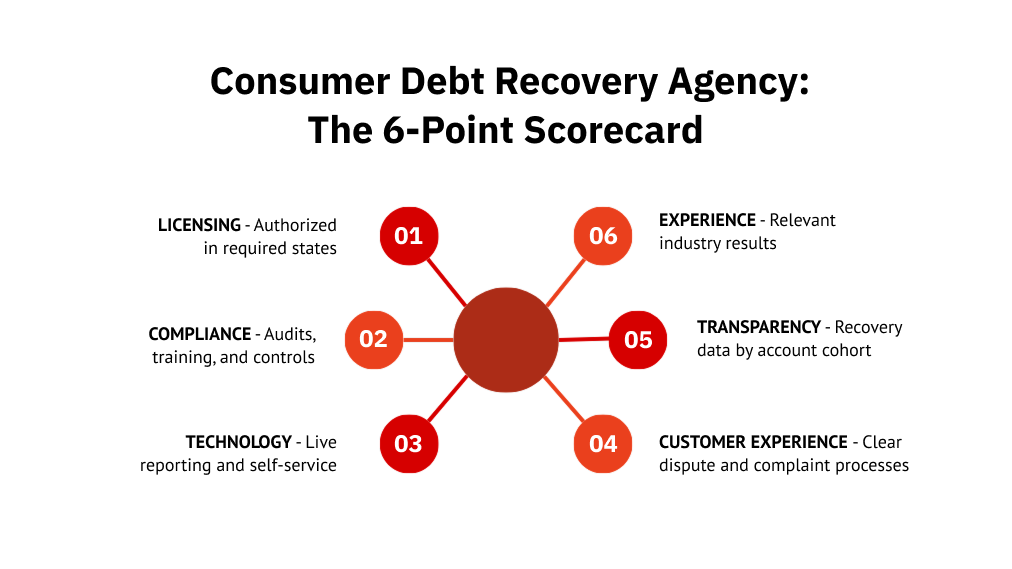
A strong personal debt recovery agency proves its value on six measurable criteria. Score each candidate against the table below before you build a shortlist.
| Criterion | What to evaluate | Red flag |
| Licensing | Licensed and bonded in every state where your customers live | Vague answers about state-specific licenses |
| Compliance program | SOC 2 report, PCI DSS compliance, and documented FDCPA and Regulation F training | No audit trail or independent assessment |
| Technology | Real-time client portal, digital outreach, and customer self-service payments | Monthly PDF reports with no live visibility |
| Industry experience | Proven results with your receivable type, such as medical, utility, lending, or subscription | Claims to serve every industry with no proof of depth |
| Performance transparency | Recovery metrics by account age, balance tier, and placement cohort | “Guaranteed” recovery percentages |
| Customer experience | Written agent standards, a dispute workflow, and complaint monitoring | No call monitoring or complaint tracking |
Licensing and compliance work as pass-or-fail gates. Score the remaining four only for agencies that clear both.
Once two or three agencies remain, direct questions reveal how each one operates.
Questions to ask before signing a contract
Ask each finalist the following questions, and note how specific each answer is:
- What is your contingency rate for my account profile, including age, balance range, and industry?
- How do you handle disputes and validation requests under Regulation F?
- Can you share references from creditors in my industry with similar account volume?
- What is your CFPB complaint rate per 10,000 accounts placed?
- How do you train agents on tone, empathy, and brand-aligned communication?
What First Credit Services brings to consumer debt recovery
At First Credit Services, we provide consumer debt collection services for credit card, lending, healthcare, auto, and fitness creditors.
- Full-lifecycle coverage: We handle both first-party collections and third-party collections. Your accounts stay with one partner from early delinquency through post-write-off.
- Scale: Our model is supported by over 125 million customer interactions each year across four global call centers.
- UCEP: Behind that outreach sits UCEP, our Unified Consumer Engagement Platform. It uses AI and machine learning to pick the best channel and timing for each account. Our team runs the platform on your behalf, so your staff does not have to manage campaigns.
- Compliance: Our credentials include HIPAA, PCI DSS Level 1, and SOC 2 Type II compliance.
This combination lets you recover more revenue through one accountable partner.
Common mistakes creditors make when hiring a recovery agency
Even a well-chosen agency underperforms when the engagement starts on the wrong footing.
The following five mistakes reduce the value of consumer debt recovery services:
- Waiting too long to place: Customers change numbers, move, and shift priorities as accounts age. Each month of delay makes them harder to reach.
- Choosing on price alone: A 20% fee on $100 recovered nets you $80, while a 35% fee on $200 nets $130. Compare net recovery per dollar placed, by account age and balance tier.
- Ignoring compliance evidence: A single lawsuit tied to an agency error can erase the savings from a cheaper vendor. Request audit reports and complaint data before signing.
- Skipping the customer experience audit: Adversarial outreach costs you brand equity along with the balance. Review sample scripts and the dispute process first.
- Placing the full portfolio on day one: Start with a pilot of 100 to 200 accounts. Over 90 days, measure recovery rate, complaint rate, and customer feedback. Because fees apply only to recovered balances, the pilot carries little cost.
Each of these mistakes is avoidable with a clear placement plan and a disciplined partner.
Recover more consumer debt with the right agency partner
Consumer debt recovery is a specialized discipline that demands compliance fluency, customer empathy, and a proven process. The right agency works as a performance extension of your receivables team. It recovers revenue on your behalf while protecting the customer relationships you have built.
To find that partner, vet licensing and compliance first, then compare technology, industry experience, transparency, and customer experience. Every quarter without a dedicated recovery strategy leaves more revenue aging out of reach.
Want to know what your aging consumer accounts are still worth? Explore your options to see how we recover more revenue and protect customer relationships.
FAQs
1. Can a consumer debt recovery agency collect across multiple states?
Yes, if it holds each state’s required licenses. States differ on licensing rules, bonding requirements, statutes of limitation, and permitted fees. Request a license list matched to your customers’ states, and recheck expiration dates during annual vendor reviews.
2. How much does a consumer debt recovery agency charge?
Most agencies charge a contingency fee, a percentage of what they recover. Older and smaller balances carry higher rates, while larger volumes lower them. Compare agencies on net recovery after fees, since the lowest rate rarely produces the highest return.
3. How long does the consumer debt recovery process take?
Timelines depend on account age, balance size, and how quickly customers respond. Recently delinquent accounts resolve faster than charged-off balances. Track progress through monthly reports by placement cohort, which show recovery rates and payment plan activity over time.
4. What happens to accounts the agency cannot recover?
The agency returns them when the placement period or contract ends. You can then close them, assign them to a secondary agency, or sell them to a debt buyer. Set the return timeline in your contract to avoid open-ended placements.
5. Can a recovery agency integrate with my billing or CRM system?
Most can. Some agencies accept secure file transfers, while others work directly inside your system of record. Direct integration logs payments and account notes in real time, so your team sees every update without reconciling separate reports.
6. Can a creditor switch consumer debt recovery agencies mid-placement?
Yes, through a formal recall. Notify the current agency in writing, then confirm it has stopped collection activity and credit bureau reporting. Review your contract’s recall terms first, since payments already in progress may still owe the original agency’s fee.