

What does it cost your hospital when a patient first hears about an overdue balance from a collection agency?
Most patients never ask, “Can hospital bills go to collections?” until that notice arrives. However, an unpaid hospital bill usually makes that move within a few months. The resulting gap drives compliance risk, strained patient relationships, and weaker recovery.
Fortunately, you can address it early. Clear communication after the first statement, a documented escalation timeline, and compliant handoffs keep more accounts out of collections.
This guide covers how and when hospital bills reach collections, the rules behind each step, and what patients and providers can do.
Can hospital bills go to collections?
Yes, hospital bills can go to collections. Hospitals follow the same basic creditor playbook as any other billing entity. When a patient balance remains unpaid after internal billing efforts, your hospital has the following two options:
- Agency placement: You can place the account with a third-party collection agency.
- Debt sale: You can sell the debt to a buyer who then owns it outright.
This choice, in turn, shapes who controls the patient relationship afterward. A placed account means your hospital still owns the debt, and the agency collects on your behalf. A sold account means ownership transfers entirely, and the patient now owes a different company.
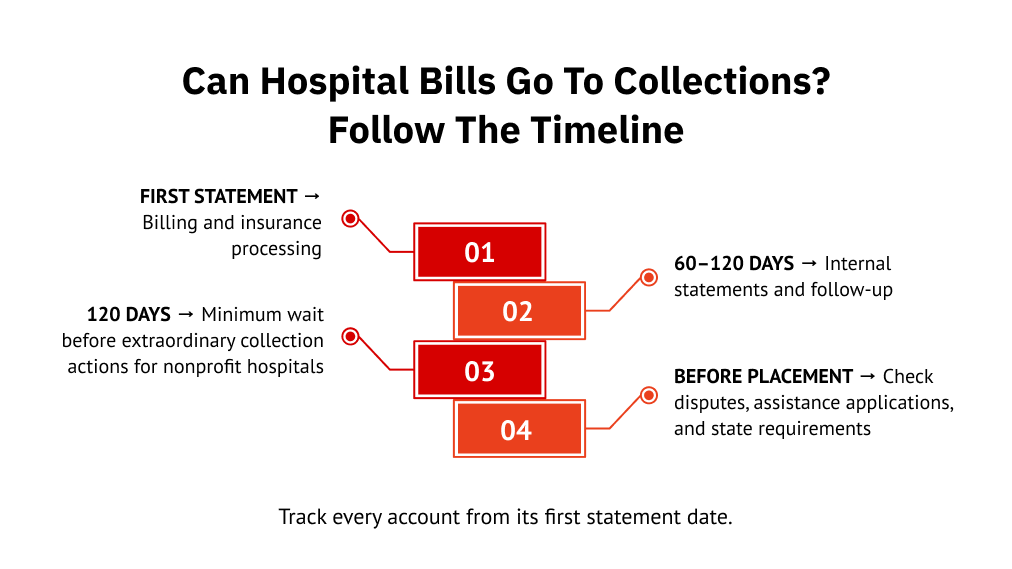
Most hospitals begin the escalation process 90 to 180 days after the first billing statement.
However, the hospital debt collections timeline depends on three variables:
- Hospital type: Nonprofit hospitals face federal requirements that delay collection action. For-profit hospitals set their own policies and can move faster.
- State law: Several states impose mandatory waiting periods, financial screening requirements, or notice obligations before a hospital can escalate.
- Internal policy: Large health systems often build longer grace periods into their revenue cycle. These periods protect patient satisfaction scores and reduce compliance exposure.
In addition, most general guidance misses when the clock starts. The timeline begins at the first statement date, which can fall well after the date of service. Insurance processing, appeals, and coordination of benefits can push that first statement weeks or months past the visit. Therefore, your escalation records should track the statement date for every account.
With that starting point clear, the next section follows an account through each stage of the timeline.
How the hospital billing-to-collections timeline works
The hospital bill collections process moves through defined stages before any account leaves your billing office. Each stage carries its own deadlines, and those deadlines change with your tax status. To begin with, look at what happens while the balance is still in accounts receivable.
What happens before collections: the internal billing phase
After a visit, your billing department processes the insurance claim. Once the insurer pays its share, you send the patient a statement for the remaining balance. That balance may include a copay, deductible, coinsurance, or the full self-pay amount.
Most hospitals send two to four statements over 60 to 120 days before escalating.
During this window, your team can still resolve the account in three ways:
- Payment plans: Your billing office can arrange these directly before any escalation.
- Financial assistance: Applications run on their own deadlines, separate from billing disputes.
- Billing disputes: Unresolved disputes follow the account, so log and close each one before placement.
| Pro tip: Contact patients right after the first missed statement. Payment plans and assistance applications are far easier to process before an account is flagged for escalation. |
Next, the rules tighten for hospitals that hold tax-exempt status.
Nonprofit hospital protections under IRS Section 501(r)
Nonprofit hospitals must follow IRS Section 501(r) before taking any “extraordinary collection action” (ECA). Under the rule, ECAs include selling the debt, reporting it to credit bureaus, and filing a lawsuit.
As a result, nonprofit hospitals work through a mandatory checklist:
- 120-day waiting period: You cannot start an ECA until 120 days after the first post-discharge statement.
- 30-day written notice: Before any ECA, you must tell the patient about financial assistance and name the planned action.
- 240-day application period: You must accept and process assistance applications for 240 days from that first statement.
Skipping a step puts your tax-exempt status at risk. Likewise, an application filed within the 240 days requires you to suspend the ECA. If the patient qualifies, you must also reverse it.
For this reason, any partner handling your hospital collections should check each account against these dates before outreach.
By contrast, investor-owned hospitals face far fewer federal steps.
For-profit hospitals: shorter timelines, fewer mandates
For-profit hospitals fall outside Section 501(r). They have no federal waiting period, no required FAP notice, and no minimum application window.
In effect, these hospitals set their own billing policies. Some escalate in as few as 60 to 90 days after the first statement.
Still, state law adds obligations for every hospital type. Several states now restrict how medical debt reaches credit reports:
| State | Key medical debt protection |
| California | Bars medical debt from consumer credit reports (SB 1061) |
| Colorado | Bars medical debt information from consumer reports (HB 23-1126) |
| New York | Bars medical debt from consumer reports (Fair Medical Debt Reporting Act) |
| Maryland | Bars providers from disclosing medical debt to consumer reporting agencies (HB 1020) |
| Oregon | Bars providers from reporting medical debt to consumer reporting agencies (SB 605) |
Notably, some of these laws face federal preemption challenges. Multi-state health systems need to track current rules by jurisdiction.
Meanwhile, patients will ask for your collections timeline and assistance policy in writing. Your billing team should share both documents early, since patient options narrow after third-party placement.
Once an account does move, the next question is how it affects the patient’s credit.
What happens to patient credit when hospital bills go to collections
Credit reporting for medical debt has shifted significantly since 2022. Equifax, Experian, and TransUnion made a series of voluntary policy changes during that period. Together, those changes reduced how medical collections affect a patient’s credit report.
Three policies now apply to any hospital bill sent to collections:
- Paid collections are removed: Since July 2022, paid medical collection debt no longer appears on credit reports.
- Small balances are excluded: Since April 2023, medical collections with an initial balance under $500 do not appear.
- A one-year waiting period applies: Larger unpaid medical collections stay off credit reports for one year.
All three are voluntary bureau policies with no federal law behind them.
The legal landscape continues to vary by state, and some state restrictions on medical-debt collection and reporting remain in effect. Health systems operating across multiple states should monitor the rules applicable to each jurisdiction.
Beyond credit reporting, a separate set of laws governs how those conversations must happen.
The legal framework when hospital bills go to collections
Several federal laws apply once an unpaid hospital bill leaves your billing office. Each one creates duties for your hospital and your collection partner. Violations bring statutory damages, regulatory scrutiny, and reputational harm that can outweigh the balance itself.
The first of these laws governs how outside collectors communicate with patients.
FDCPA protections once a third-party collector is involved
The Fair Debt Collection Practices Act (FDCPA) applies once you place an account with an outside agency. Your internal billing team generally falls outside its scope.
Under this law, your partner must meet three requirements:
- Validation notice: Within five days of first contact, the collector must send the amount owed, the creditor’s name, and dispute rights.
- 30-day dispute window: A patient can dispute the debt in writing within 30 days. Collection then pauses until the collector verifies the debt.
- Contact limits: Collectors cannot call before 8 a.m. or after 9 p.m., use abusive language, or threaten arrest. They must also avoid workplace contact when told to stop.
A patient who sues can recover up to $1,000 in statutory damages, plus actual damages and attorney’s fees. Moreover, a collector’s violation reflects on the hospital that placed the account. Choosing a partner with a documented compliance program reduces that risk.
A second law controls what patient data travels with each account.
HIPAA and patient medical information in the collections handoff
You can share limited patient information with an agency under a HIPAA Business Associate Agreement. That information must stay at the minimum necessary for payment. Typically, this means name, contact details, service dates, and the amount owed.
Diagnoses and treatment notes have no place in collections outreach. For example, a collector who mentions a patient’s condition creates a potential HIPAA violation. Patients can report such incidents to the HHS Office for Civil Rights.
Both parties share this exposure, because the agreement makes the agency a business associate. For that reason, review an agency’s HIPAA training as closely as its recovery rates.
Finally, some balances should never reach an agency at all.
No Surprises Act: when a hospital bill shouldn’t have gone to collections
The No Surprises Act took effect in January 2022. It protects patients from surprise out-of-network bills in specific situations. Two protections matter most for collections:
- Emergency services: Patients cannot be balance-billed above in-network rates for emergency care.
- Good Faith Estimates: Uninsured patients must receive a Good Faith Estimate before treatment. A bill that exceeds it by $400 or more can be disputed.
Placing a protected balance invites patient complaints and regulatory scrutiny for you and your partner. Add a screening step for emergency and out-of-network accounts before escalation. Catching these accounts early costs far less than defending a disputed placement later.
With these rules in view, the right collection partner becomes easier to recognize.
How professional collection agencies help resolve hospital debt
Collection agencies differ widely in how they run the hospital bill collections process. Many patients expect a call-heavy, aggressive model. Instead, a patient-first agency works as an extension of your billing office.
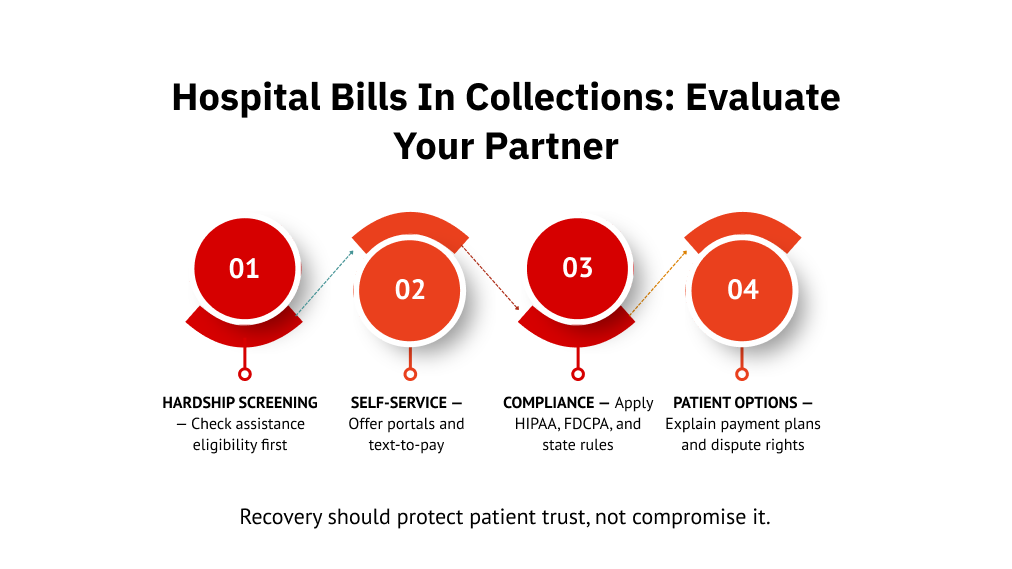
Three practices set a professional partner apart:
- Hardship screening first: The agency checks for charity care, financial assistance, or payment plan eligibility before requesting payment. This step supports your 501(r) obligations and reduces later disputes.
- Self-service resolution tools: Online portals, text-to-pay, and IVR let patients resolve balances without a phone call. Patients can act at a time that suits them, which removes a common cause of delay.
- Layered compliance: HIPAA agreements, FDCPA and Regulation F requirements, and state medical debt rules must all run together. An agency that handles them as part of its daily workflow protects your hospital from liability.
Similarly, patients keep their options after placement. A compliant agency explains payment plans, hardship programs, and dispute rights to every patient who asks.
At First Credit Services, we apply this model to hospital collections through omnichannel outreach and a self-service payment portal. We hold PCI DSS Level 1 and SOC 2 Type II certifications and run a HIPAA compliance program. For balances still in accounts receivable, our first-party collections team works under your brand.
Overall, these practices show how your hospital can recover revenue and keep patient trust.
Recover hospital bills in collections without losing patient trust
The answer to “can hospital bills go to collections” is yes, and most accounts arrive there through an upstream gap. Too often, that gap is a missed notice or a financial assistance screening that never happened.
The cost of an unpaid hospital bill goes well beyond the balance itself. It shows up as compliance exposure, damaged patient relationships, and recovery dollars that never come back.
Ultimately, the hospitals that recover the most build the process correctly from the start. They communicate early, follow every regulatory step, and offer resolution paths that patients actually use.
Need a partner that recovers hospital revenue while keeping patients engaged and your organization compliant? Explore your options with FCS.
FAQs
1. How long does a hospital have before sending a bill to collections?
The hospital debt collections timeline has no single federal deadline. Nonprofit hospitals must wait at least 120 days before extraordinary collection actions under Section 501(r). For-profit hospitals set their own policies, and state laws may add waiting periods.
2. What compliance requirements apply when hospital bills go to collections?
Several layers of rules apply at the same time. Nonprofit hospitals follow Section 501(r), and outside collectors follow the FDCPA and Regulation F. HIPAA limits the patient data you can share, and state medical debt laws add further duties.
3. How do the 2022 to 2023 credit reporting changes affect hospital debt recovery?
The bureaus removed paid medical collections and balances under $500 from credit reports. Larger unpaid collections now wait one year before appearing. Credit reporting now motivates fewer patients, so recovery depends more on early engagement and self-service payments.
4. Can a patient dispute a hospital bill that is already in collections?
Yes, the FDCPA gives patients 30 days after the validation notice to dispute the debt in writing. Patients can also raise billing errors with your hospital at any time.
5. What happens when patients ignore a hospital bill in collections?
The collector may keep attempting contact. A balance of $500 or more may reach the credit report after one year. Some accounts also end in a lawsuit. Self-service portals and early hardship screening reduce unresponsive accounts.
6. Does the No Surprises Act affect which hospital bills can go to collections?
Yes, the Act protects patients from surprise out-of-network bills for emergency care and certain services at in-network facilities. Screen those accounts before escalation, because a protected balance gives the patient grounds to dispute.