

Your collection queue grows overnight, but your team still has the same hours in the day.
AI debt collection can help address that pressure by using artificial intelligence to coordinate outreach across voice, text, email, and chat. Routine follow-ups can run automatically, while human agents focus on disputes and negotiations requiring judgment.
The shift is already visible in customer service. According to Gartner’s 2025 report, 55% of leaders reported stable staffing while handling higher customer volumes. Only 20% reported staffing reductions because of AI.
For lenders, healthcare providers, utilities, and subscription businesses, the aim is similar: reach more past-due customers while keeping human support available.
This guide explains how AI debt collection works and provides a five-step deployment framework. It also covers the key metrics to track, common mistakes, and how to evaluate a provider.
What is AI debt collection?
AI debt collection spans a range of capabilities. At one end, automated tools choose when and how to contact each customer. At the other, managed programs run the full conversation, from first contact through payment, with human collectors handling exceptions.
How AI debt collection works
An AI debt collection system handles four core jobs for your business:
- Outreach: It chooses the channel and time to contact each customer about an overdue balance.
- Conversation: It identifies itself, confirms the right customer, delivers required disclosures, and determines intent: pay, dispute, request hardship, or stop contact.
- Resolution: It offers your approved payment plans or settlements and sends customers to a secure payment portal.
- Handoff and records: It routes complex cases to a human collector with full context and writes outcomes back to your system of record.
Capabilities vary by product. Some tools only automate channel selection and timing. Others run the full conversation end to end.
AI debt collection vs. other collection tools
To see where AI debt collection fits, compare it with the tools and teams your business may already use.
| Option | What it does | What it decides on its own | Best used for |
| Auto-dialer | Starts calls or automates dialing | Nothing | High-volume call connection |
| Rule-based chatbot | Follows predefined conversation paths | Choices within those paths; falls back to a menu or transfers | Simple FAQs and payments |
| Conversational AI agent | Interprets what the customer says and responds within configured limits | The next step, within your policy | Routine conversations at scale |
| Managed AI-enabled collections | Technology plus operations, compliance oversight, and human collectors | The provider runs the contracted workflows | Businesses that don’t want to build or staff a program |
| Human collector | Applies judgment, negotiation, and empathy | Anything within their authority | Complex or sensitive accounts |
Most businesses combine more than one option. A common setup pairs a conversational AI agent for routine outreach with human collectors for disputes, hardship cases, and high-balance accounts.
Why businesses are evaluating AI debt collection in 2026
Rising complaint volumes are pushing businesses toward AI debt collection. At the same time, recent research clarifies where AI adds value and where it still falls short.
Contact practices drive most collection complaints
The Consumer Financial Protection Bureau (CFPB) 2025 report mentions around 207,800 debt collection complaints in 2024. That figure represents roughly 7% of all complaints the bureau received.
Among complaints about communication tactics, 51% cited frequent or repeated calls. Another 34% involved contact that continued after a request to stop. For electronic messages, 58% of complaints centered on frequency.
For your business, these complaints carry regulatory and reputational risk. AI debt collection reduces that risk when contact limits and stop requests are enforced as hard rules. Without those controls, automation can multiply the problem at scale.
AI handles volume well but lags in persuasion
Volume is where AI debt collection delivers clear gains. But persuasion is where the research shows a gap.
A Yale School of Management 2025 study analyzed 22 million collection cases. AI callers collected 9% less than human collectors in the first 30 days past due. They were still about 5% behind a year later.
Customers also broke promises made to the AI more often. When human collectors took over on day six, they could not fully close the gap.
Important note: The study used 2021-2022 data from one consumer lender in China, before generative AI was widely available. It shows that design choices matter, though it does not predict how every product will perform today.
| Did you know? In the same Yale study, the lender assigned nearly all newly delinquent balances under about $42 to AI callers and larger balances to humans. Deciding which accounts an AI debt collector handles is a strategic call that deserves careful planning. |
A 5-step framework for deploying AI debt collection
Deploying AI debt collection safely requires a structured rollout, from choosing which conversations the AI handles through monthly performance review. Here is a 5-step framework to follow:
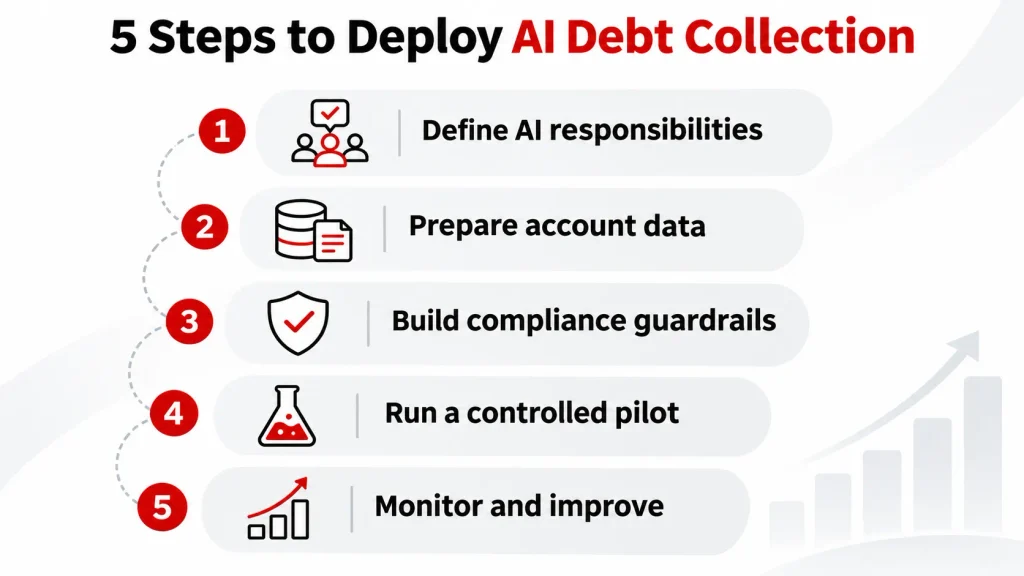
Step 1: Decide which conversations AI owns
Map every conversation type to a tier before launch. Here is how you can do that:
| Tier | Conversation types | Handled by |
| Tier 1: Full AI | Routine reminders, balance questions, standard payment plans, receipts | AI debt collector |
| Tier 2: AI with limits | Arrangements within approved limits, promise-to-pay follow-ups | AI with supervisor review |
| Tier 3: Human only | Disputes, bankruptcy, deceased accounts, hardship, attorney representation | Human collector |
Assign accounts using risk, legal status, customer vulnerability, and balance thresholds together. Balance size alone is unreliable.
Step 2: Prepare account data and consent records
Clean data and clear consent records keep AI debt collection compliant from the first contact.
- The AI should read balances, itemization, and eligibility only from your system of record.
- Confirm consent requirements by call type, number, and channel under TCPA (47 CFR 64.1200). In addition, Regulation F presumes harassment at more than seven calls in seven days. Thus, count AI and human attempts together.
- Load do-not-contact, cease-communication, and dispute flags before any outreach begins.
Step 3: Build guardrails into every conversation
Guardrails turn compliance requirements into rules the AI cannot override, such as:
| Stage | What the AI does | Control |
| Opening | Identifies itself as automated | Fixed, approved wording |
| Verification | Confirms the right customer | No account details until identity confirmed |
| Disclosure | Delivers required notices | Scripted, never generated |
| Offer | Presents payment options | Only approved amounts, terms, and eligibility |
| Payment | Sends customer to secure portal | Card details never in transcripts or model inputs |
| Close | Logs the outcome | Transcript stored for audit |
Set hard-stop phrases that end automation immediately. Examples include:
- “I dispute this”
- “Stop contacting me”
- “Talk to my lawyer”
- “I filed bankruptcy”
- “Let me speak to a person”
These controls turn the compliance requirements behind AI in debt collection into rules the agent cannot override.
| Pro tip: Before launch, test hard stops against how your customers actually talk, including slang, partial sentences, and frustrated wording. A hard stop that only triggers on exact phrases will miss real disputes and cease requests. |
Step 4: Pilot against a comparable control group
A pilot proves whether AI debt collection works for your specific accounts and customers.
- Randomly split accounts that are comparable on balance, account age, delinquency stage, channel, and customer segment.
- Keep offers and contact limits identical so the AI is the only variable.
- Run the pilot for at least a full account cycle, typically 60 to 90 days. Kept promises and later missed payments only show up after that window closes.
| Pro tip: Keep a small control group on your current process even after rollout. Without one, you cannot tell whether a gain came from the AI or from changes in the economy. |
Step 5: Review results monthly and adjust carefully
Ongoing review is what separates a working AI debt collection program from one that slowly drifts.
- Review transcripts from escalations, missed escalations, and failed resolutions.
- Move conversation types between tiers based on results.
- Validate any script, rule, or model change before deployment. Monitor it afterward, and record what changed and why.
At First Credit Services, we expand your team’s capacity to recover consumer balances. AI-driven outreach keeps routine follow-ups moving, while experienced collectors handle conversations that need empathy and negotiation.
Our Unified Consumer Engagement Platform (UCEP) builds a contact strategy for each customer. It predicts the most effective channels and times to connect. We operate it on your behalf, helping your team focus on recovery strategy and results.
Metrics that show whether AI debt collection is working
Track metrics that show recovered revenue and customer outcomes, not just activity. The table below covers what to measure and why.
| Metric | How to calculate | What it shows |
| Right-party contact rate | Verified right-party conversations ÷ contact attempts | Whether outreach reaches the right customer |
| Self-service resolution rate | Accounts resolved without human involvement ÷ accounts handled by AI, within a set resolution window | How much routine work the AI absorbs |
| Promise-to-pay rate | Promises recorded ÷ eligible right-party conversations, counting one promise per conversation | Whether conversations produce commitments |
| Kept-promise rate | Promises paid by the agreed date ÷ promises that came due in the period | Whether commitments turn into cash |
| Net recovery per account placed | (Amount recovered − defined costs) ÷ accounts placed | The real return after costs |
| Cost to collect | Defined collection costs ÷ dollars recovered, with the same cost definitions for AI and human workflows | Efficiency compared with your current process |
| Complaint rate | Complaints per 10,000 contacts | Customer experience and regulatory risk |
| Opt-out rate | Opt-outs per 10,000 contacts | Contact fatigue and channel fit |
| Missed escalations | Cases that needed a human but stayed with the AI, found in audits | Whether hard stops work |
| Unnecessary escalations | Cases sent to a human that the AI could have resolved | Whether tiers are set correctly |
Report every metric by account cohort and delinquency stage, so the AI isn’t flattered by easier accounts.
| Pro tip: Report kept-promise rates separately for promises made to the AI and promises made to human collectors. Research suggests this is where gaps between the two show up first. |
Technology behind AI debt collection
Understanding the technology behind AI debt collection helps you evaluate providers and spot gaps in what they offer.
Understanding, responding, and acting
An AI debt collector does the following three jobs in every conversation.
- Understanding. It interprets what the customer says, whether by voice or text.
- Responding. It generates a reply within your configured rules and tone.
- Acting. It takes an action: setting up a payment plan, routing to a human, or logging the outcome.
However, balances, terms, disclosures, and eligibility must come from your verified systems, never from the model’s own wording.
Gartner’s 2025 report predicts that agentic AI will resolve 80% of common customer service issues without human help by 2029. Still, that forecast covers customer service broadly. In collections, regulatory requirements may lead to a more cautious rollout.
Decisioning and channel choice
Behind each conversation, a decision engine selects the next action for each account. To do this, predictive models choose the channel, timing, and offer using the same debt collection predictive analytics that guides account prioritization. Before wider deployment, model updates undergo validation and a controlled rollout.
Integration, payments, data, and audit
The integration layer moves data between the AI and your existing systems.
- Results write back to your CRM, billing, and collection systems so AI and human collectors see the same history.
- Payment processing stays separate from conversational AI, with clear PCI DSS scope definitions.
- Transcripts are searchable and protected by access controls and retention rules.
- When a customer’s own AI handles the other end of the call, defined authentication rules apply.
Common mistakes when deploying AI debt collection
These mistakes quietly reduce recovery or add regulatory risk. Most surface only after the program is live.
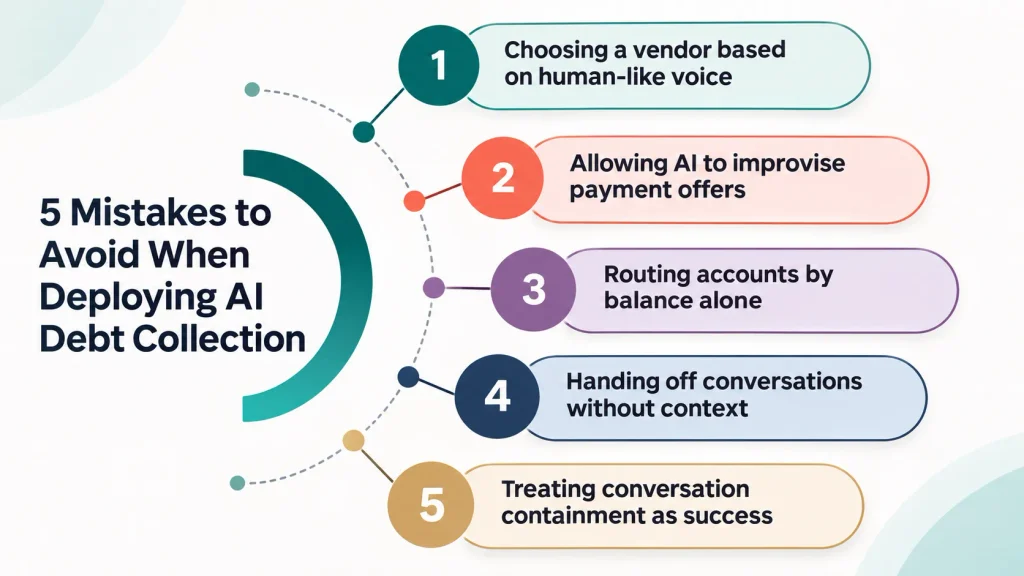
- Choosing a vendor by how human the voice sounds: Realism says nothing about compliance, handoffs, or kept promises.
- Letting the AI improvise offers: Amounts, dates, or terms the AI generates on its own create disputes and regulatory exposure.
- Routing accounts by balance alone: Risk, legal status, and vulnerability matter as much as balance size.
- Handing off without context: Customers who have to repeat themselves complain more and pay less.
- Treating containment as success: A resolved conversation that ends in a broken promise is not a recovery.
How to evaluate an AI debt collection provider
The right provider depends on how much of the program your business wants to own.
Build, license, or outsource
First, match the operating model to your team’s capacity and desired control. Compare what each option provides and what your business must manage.
| Option | What you get | Your responsibility | Watch for |
| Build on an AI platform | Maximum control over design | Full implementation and compliance | Build time and testing burden |
| License collections AI software | Prebuilt workflows | Operations and compliance oversight | Integration effort and escalation staffing |
| Managed AI-enabled collection service | AI plus human collectors and operations | Vendor management and data feeds | Audit rights, incident reporting, and data return |
Capabilities to verify
Once you choose a model, verify these capabilities before signing.
| Criterion | What to verify |
| AI disclosure and verification | Identifies as automated; confirms the right customer before sharing details |
| Stop-and-route design | Hard stops that pause activity, log the event, and pass context to a human |
| Locked offer rules | No amounts, terms, or eligibility outside your policy |
| Consent and contact controls | Consent tracked by channel; frequency limits, time zones, and state rules enforced |
| Channel coordination | Voice, SMS, email, chat, and portal in one workflow |
| Payment and data security | Defined PCI DSS scope; card data never in transcripts or model inputs |
| Audit trail | Every decision logged and explainable to an auditor |
| Outcome reporting | Kept promises, net recovery, and complaints reported by cohort |
| Accountability | Contract terms for errors, complaints, incidents, and regulatory inquiries |
Questions to ask before signing
These questions test whether a provider’s claims hold up in practice.
- Which conversations does your AI handle end to end, and which go straight to a person?
- Can you show anonymized transcripts of a dispute handoff and a hardship handoff?
- How do you report promises kept, not just promises made?
- Will you run a pilot against our current process on comparable, randomly split accounts?
At First Credit Services, we welcome that scrutiny. Our credentials include RMAI Certified Business status, PCI DSS compliance, an AICPA SOC report, and ACA International membership.
Putting AI debt collection to work with human oversight
AI debt collection should give your team more capacity and your customers a clearer path to resolution. That requires defined limits on automation and experienced collectors ready to handle sensitive conversations.
Start by deciding what AI can handle and when a collector takes over. Then prepare reliable data, test your guardrails, and pilot on comparable accounts. After launch, review kept promises and net recovery alongside complaints each month, using the findings to guide expansion.
Talk to our experts about a managed AI-enabled recovery program that combines scalable outreach with experienced collectors.
FAQs
1. Can AI debt collection work under our company’s brand?
In first-party programs, yes. When your business collects its own accounts, outreach can run fully under your brand. In third-party collections, messages must identify the collection agency. Regulation F prohibits misrepresenting who is collecting.
2. Does AI debt collection report accounts to the credit bureaus?
No. AI debt collection communicates with customers and records outcomes. Credit bureau reporting is a separate decision made by the creditor or agency. Regulation F also bars collectors from reporting a debt before communicating with the customer about it.
3. Can AI debt collection handle late-stage or charged-off accounts?
Yes, with a different playbook. Older balances need fewer, better-timed contacts and settlement offers within approved authority. Build statute-of-limitations checks into the workflow, because Regulation F prohibits suing or threatening to sue on time-barred debt.
4. What languages can AI debt collection systems support?
AI debt collection platforms can support multiple languages, including Spanish and other widely spoken languages. Ensure required disclosures are accurately translated, capture each consumer’s language preference, and keep fluent human agents available to handle escalations.
5. Can healthcare providers use AI debt collection for patient balances?
Yes, with extra safeguards. Patient data falls under HIPAA, so access controls and minimum-necessary data sharing matter. Pause outreach while insurance claims are pending, screen patients for financial assistance, and route billing disputes to a person.
Only through private messages, and only within Regulation F’s rules. Collectors may not communicate about a debt in a way the public can see. Each private electronic message must include a clear way to opt out.