

What happens to a past-due account when statements bounce back, and calls hit disconnected lines?
Without a collection agency skip tracing, that account often stalls, even when your customer can pay. Millions of Americans move each year, according to the U.S. Census Bureau’s American Community Survey 2025. Many never update the lenders, healthcare providers, and utilities that serve them. As records go stale, accounts drift toward charge-off and wrong-party risk grows.
Skip tracing helps reach them again. An agency searches credit header records, public filings, and phone data, then verifies results. Afterward, outreach follows the FDCPA and Regulation F.
This guide covers the workflow, data sources, compliance, metrics, and the outsourcing decision.
What is skip tracing in debt collection?
Skip tracing in debt collection is the process of locating a customer whose address, phone number, or employer on file no longer works. Agencies search credit header data, public records, and phone databases to find current details. Most skips are customers who moved or changed numbers.
When billing outreach hits returned mail or disconnected numbers, skip tracing takes over. Typically, an agency runs debt collection skip tracing in layers. First, batch searches scan credit, public, and phone records. Next, the agency verifies results before contact.
Two related processes often get grouped with it:
- Data maintenance keeps records current through periodic updates.
- Account screening flags bankruptcy, deceased, military, or attorney-represented accounts before outreach.
Because all three share data, they often overlap. However, maintenance runs on a schedule and screening happens at placement. In contrast, skip tracing starts only when a customer can’t be reached.
Throughout, the agency must maintain FDCPA compliance and follow Regulation F. Every skip starts with contact data that drifts out of date.
Why customer accounts become unreachable and what it costs
Contact data starts aging the moment an account is opened. Over time, your customers move, switch carriers, and change jobs without updating your records.
For your business, an unreachable account drifts toward charge-off and costs more to work with each failed attempt. In addition, outreach to outdated details can reach the wrong person in your company’s name.
To act early, your team needs to spot the signs of a stale record.
Common reasons contact information becomes outdated
Each of the following signals means your routine billing outreach has stopped reaching the customer. Together, they are also the earliest triggers for skip tracing collections work.
- Returned statements: The customer has likely moved without leaving a forwarding address.
- Disconnected or reassigned phone numbers: Your calls either fail or reach someone else entirely.
- Job changes: Employer details go stale, and workplace contact rules limit how outdated data can be used.
- Name changes: Marriage or divorce can break the link between an account and its holder.
- Death of the account holder: Recovery shifts to locating the estate’s authorized representative.
Some of these signals show up in automated checks. Others appear only after several failed contact attempts. Meanwhile, every week the account sits unresolved adds to its cost.
The cost of unreachable accounts and wrong-party contact
Unreachable accounts age toward charge-off, and older accounts are usually harder to resolve. As a result, your outreach budget goes to letters and calls that reach no one.
Wrong-party contact adds a second layer of risk. For example, a call to a reassigned number may reach someone with no link to the account. That call still carries your company’s name, so it creates both compliance exposure and brand damage.
The CFPB’s 2025 FDCPA Annual Report notes that the agency received about 207,800 debt collection complaints in 2024. Attempts to collect debt not owed remained the most common issue. The report doesn’t tie these complaints to any single cause. Still, they show how costly a mismatched record can be for your brand.
| Pro tip: Flag accounts for review as soon as statements return or numbers disconnect. Fresher data gives the agency a stronger starting point. |
Once those accounts reach an agency, a defined workflow decides how quickly they move toward resolution.
How a collection agency runs skip tracing: a six-step workflow
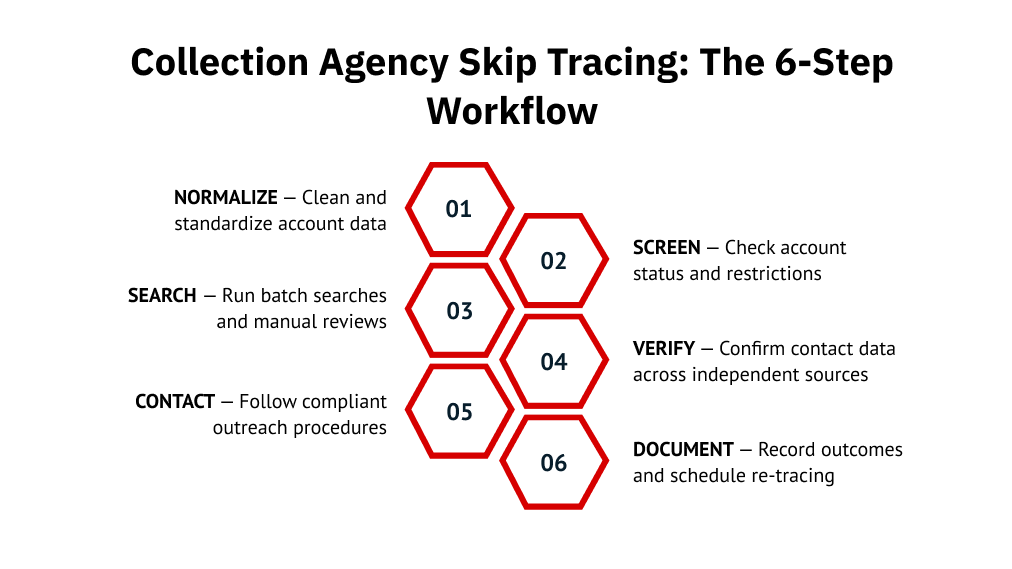
A structured skip tracing debt collection workflow moves through six stages, from account intake to re-tracing.
- Intake and data normalization
- Account screening
- Batch search and manual investigation
- Verify contact data
- Compliant outreach
- Documentation and re-tracing
Each step builds on the one before it. When a step is rushed, the cost often shows up later as wrong-party contact or wasted outreach. The workflow begins with the data your team sends at placement.
Step 1: Intake and data normalization
The agency first standardizes your placement data, including names, identifiers, addresses, phone numbers, and employers. Before any search runs, it fixes errors that could block a clean match. Share complete, recent data, within what your agreements and applicable law allow.
| Expert insight: Include historical addresses, past phone numbers, and employer details where permitted. Every verified data point you share narrows the search. |
With clean data in place, the agency then checks each account’s status.
Step 2: Account screening
Certain statuses need different handling before any tracing or outreach begins:
- Bankruptcy: An active filing triggers an automatic stay, which generally pauses collection activity.
- Deceased: Recovery shifts to locating the estate’s authorized representative.
- Active-duty military: The Servicemembers Civil Relief Act adds protections that affect how the account is worked.
- Attorney-represented: Communications generally go to your customer’s attorney.
- Cease-communication: A written request from your customer limits further outreach.
Each status follows its own path. Depending on the case, an account may be suppressed, routed for review, or worked under special procedures. After screening, the remaining accounts move into the search itself.
Step 3: Batch search and manual investigation
Automated batch searches run across your full placement first, which keeps costs low on large portfolios. Accounts with no hits or conflicting hits then move to manual review, where a skip tracer cross-checks records. The role of skip tracing in auto loan collections shows this step clearly.
Escalation should weigh likely recovery, result quality, and cost, since balance alone ignores lead quality. Even a strong search result still needs checking before outreach begins.
Step 4: Verify contact data
A database match only shows that data exists. In practice, the agency confirms each result across independent sources, weighing recency and confidence. Matches that draw on the same underlying record count as one source.
These three working terms describe different levels of certainty:
- Possible match: A database links an address or number to your customer.
- Verified contact: Verification supports treating that data as current.
- Right-party contact: The agency confirms it is speaking with your customer before discussing the account.
Reassignment and line-type checks flag number risks without proving identity or consent. Only verified data moves into outreach.
Step 5: Compliant outreach
Outreach falls into two categories, and each follows its own rules. Third-party location communications reach someone other than your customer to confirm where they live or work. Direct communications reach your customer and carry their own disclosure duties.
For direct outreach, the agency should cover four basics:
- Confirm identity before discussing the account.
- Provide the required disclosures and validation information.
- Check channel-specific permissions for calls, texts, and emails.
- Honor opt-out requests promptly.
Every one of these contacts, successful or not, leaves a record.
Step 6: Documentation and re-tracing
The agency should log the sources used, contacts attempted, and outcomes for each account. This record gives your compliance team a clear audit trail.
Unlocated accounts also need a re-trace plan. Ideally, re-trace timing should follow account status, prior results, and cost-effectiveness. Tracking changes between passes shows whether each re-trace is worth the cost.
At First Credit Services, our skip tracing enhances business debt collection through an omnichannel approach. We pair traced contact data with AI-driven contact optimization, so located accounts move straight into outreach.
Behind each of these steps sits a set of data sources, and each one has its own limits.
Which data sources and skip tracing tools do agencies use?
Agencies combine several data sources, since no single source finds every customer. Each one reveals different details and carries its own limits.
| Data source | What it may reveal | Main limitation or watch-out |
| Credit header data | Address history and identity associations | Access and use restrictions, including permissible purpose where it applies |
| USPS NCOALink | Change-of-address records filed with USPS, through authorized products | Covers only customers who filed a change of address; freshness varies |
| Public records | Property, court, and other recorded information | May be outdated or match someone with a similar name |
| Utility and telecom data | Possible new address or contact links, where lawfully available | Availability, authorization, and matching accuracy vary |
| Phone intelligence | Line type, carrier, and reassignment indicators | Does not establish identity or consent to call |
| Workplace information | Possible current employer | May be outdated; workplace-contact restrictions apply |
| Email and digital sources | Possible contact channels and identity clues | Ownership and current use may be uncertain |
| Third-party location contacts | Confirmation of a customer’s whereabouts | Strict Regulation F limits on what can be said and how often |
Source access varies by agency. For that reason, ask which sources your agency uses before placing accounts.
Legal rules also differ by source. Consumer-report information requires an FCRA permissible purpose, while public records and vendor data carry separate requirements. Placement size and data quality then shape how an agency searches.
Batch vs. manual skip tracing
Many debt collection skip tracing programs run both methods in sequence. Batch searches run your full placement through automated queries at once. They suit large placements, where cost per account matters most.
Manual review then handles accounts with no hits, conflicting hits, or weak matches. Since it costs more per account, manual tracing works best where extra effort can change the outcome. Technology also helps decide which leads deserve attention first.
Where AI and predictive models fit
Predictive models rank possible matches by confidence and help agencies decide which accounts to work first. Consequently, skip tracers spend less time on low-probability leads. Even so, a high-confidence score still needs corroboration before it counts as a verified contact.
Human review, validation, and compliance controls decide what data reaches outreach. Those controls rest on a clear set of federal rules.
Compliance rules for collection agency skip tracing
Regulation F calls the account holder the “consumer.” In this guide, that’s your customer. Skip tracing debt collection work runs under federal and state rules, with the strictest limits on third-party contacts.
Third-party location communications under the FDCPA and Regulation F
Under Regulation F §1006.10, location information means your customer’s home address and phone number there, or place of employment. When an agency asks a third party for it, the rule sets clear limits:
- The collector gives its name and says it is confirming or correcting location information.
- It names its employer only if asked.
- It never reveals that your customer owes a debt.
- It sends no postcards and puts no debt-collection language or symbols on mail.
- It generally contacts each third party once, unless that person asks or the earlier answer appears wrong.
- If the collector knows your customer’s attorney and can find their contact details, requests usually go to the attorney.
| Action step: Ask to review the agency’s third-party location script before placing accounts. Any line that hints at a debt is a Regulation F red flag. |
From that point, a different set of contact rules applies once your customer is found.
Contact rules after locating your customer
Regulation F’s call-frequency rule presumes a violation in either of two cases, subject to exceptions:
- More than seven calls within seven days about a particular debt
- A call within seven days after a phone conversation about that debt
Beyond calls, the agency must provide validation information in its initial communication or within five days after it. Likewise, each covered email or text must offer a way to opt out of that channel. Phone outreach also raises separate questions under the Telephone Consumer Protection Act (TCPA).
TCPA, consent, and reassigned numbers
Checking the FCC Reassigned Numbers Database is a useful safeguard before calling a traced number. Its safe harbor protects callers who query the database properly and receive an incorrect “not reassigned” result.
That said, the database doesn’t replace consent. The agency must also assess consent, calling technology, and applicable federal and state rules. Equally important is how the agency handles the data behind each call.
Data access, privacy, and security
Strong data controls protect both your customers and your brand. The key areas include:
- Permissible purpose: Access to consumer-report information should be limited and logged.
- Vendor authorization: Each data provider’s terms should allow the agency’s intended use.
- Data security: Sensitive records need safeguards that match the data type.
- State requirements: Collection licensing and privacy laws vary by state.
Moreover, your business keeps oversight responsibilities when it outsources collections. Regular reviews of the agency’s controls and audits help you meet them. Sound controls matter, but their results also need close tracking.
How to measure skip tracing performance
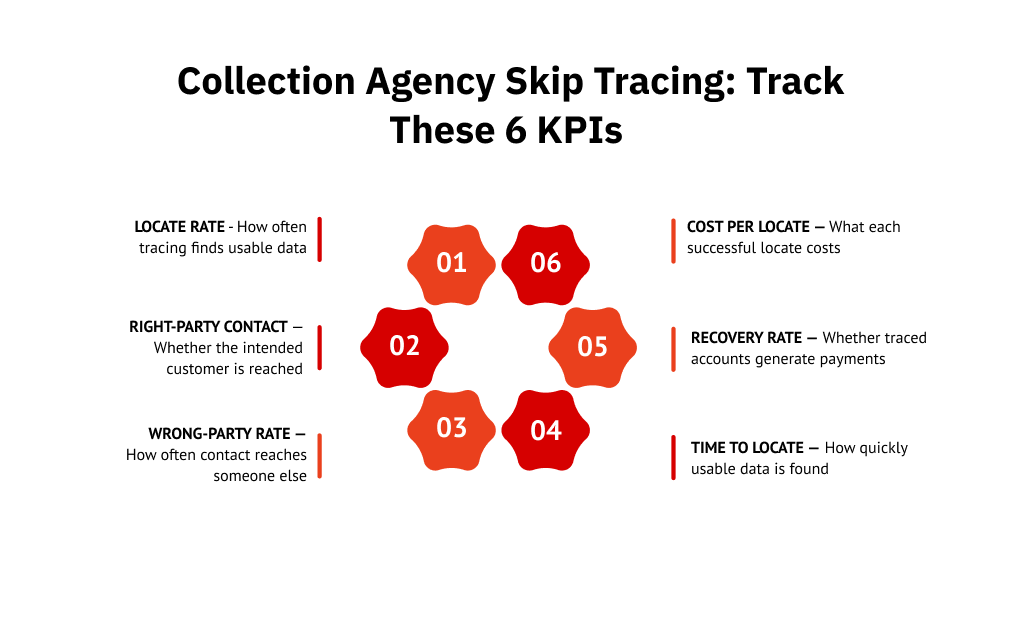
Clear metrics show whether an agency’s tracing leads to contact and recovery. The definitions below are suggested starting points, since no single industry standard exists.
| KPI | Suggested calculation | What it helps assess |
| Locate rate | Accounts with a qualifying location result ÷ accounts traced | How often tracing produces a usable result |
| Verified right-party contact rate | Accounts with verified right-party contact ÷ accounts traced | Whether results lead to reaching your intended customer |
| Wrong-party contact rate | Contacts confirmed as wrong party ÷ relevant contact attempts | Data quality and compliance risk |
| Time to locate | Median time from trace start to qualifying result | How quickly tracing produces usable data |
| Recovery rate on traced accounts | Dollars recovered from a defined traced cohort ÷ dollars placed in that cohort | Whether traced accounts produce recoveries |
| Cost per successful locate | Trace-related costs ÷ accounts successfully located | Cost-efficiency of the tracing process |
Locate rate shows how often tracing finds usable data, while right-party contact rate shows whether it reaches your customer. A wide gap often signals weak verification.
Benchmarks for skip tracing collections vary, so compare agencies across similar periods, account ages, and portfolio mixes.
At First Credit Services, we pair skip tracing with our omnichannel debt collection services. Through our secure client portal, you can view performance reports and recovery data at every stage.
Even strong metrics slip when common mistakes creep in.
Common skip tracing mistakes to avoid
Most debt collection skip tracing problems start before or just after placement. Watch for these six mistakes in your own process and your agency’s:
- Delaying placement: Contact data ages further with every week accounts wait.
- Sending incomplete placement files: Missing identifiers and past addresses weaken the agency’s starting point.
- Treating a possible match as verified: Unverified data can lead to wrong-party contact in your company’s name.
- Repeating third-party location contacts: Contacts beyond Regulation F’s limits create avoidable debt collection compliance risk.
- Calling outdated or reassigned numbers: Dialing without a contact-risk review increases TCPA exposure.
- Skipping re-traces: Without a re-trace procedure, unlocated accounts sit idle instead of moving toward resolution.
Avoiding these mistakes is easier when you know who owns each step of the process.
Turn unreachable accounts into recoverable revenue
Collection agency skip tracing turns stalled accounts into live conversations about resolution. The right agency finds your customers, verifies each match, and contacts them in a way that protects your brand.
To choose that partner, ask how it finds the right customer and verifies each match. Then ask how it stays compliant and how you will measure skip tracing collection results. Each month an account sits unreached, its contact data grows harder to trace.
Have accounts your team can no longer reach? See how we raise collection rates with up-to-the-minute skip tracing. Your customers’ data stays protected under PCI DSS Level 1 and SOC 2 Type II-compliant security.
FAQs
1. Does skip tracing cost extra when you place accounts with a collection agency?
It depends on the contract. Some agencies include skip tracing in a contingency fee, so you pay only on recovered dollars. Others bill data searches separately, so confirm the pricing model in writing before placing accounts.
2. Can a collection agency skip trace accounts placed by a healthcare provider?
Generally, yes. HIPAA permits covered entities to use or disclose protected health information for payment activities, which include collections. Your organization should still confirm the agency’s role, its data safeguards, and whether a business associate agreement applies.
3. Will skip tracing affect how our customers see our brand?
It can, so the agency’s approach matters. A compliant agency keeps the debt private from third parties and confirms identity before discussing the account. Respectful, consistent scripts also protect your long-term relationship with each customer you serve.
4. Can an agency credit-report an account it hasn’t been able to locate?
Under Regulation F, an agency generally can’t furnish credit information until it has spoken with your customer. Alternatively, it can send a communication and wait a reasonable period for an undeliverable notice. The rule treats 14 days as reasonable.
5. Can a collection agency locate the estate of a deceased account holder?
Yes, it can. Under Regulation F, location information for a deceased customer includes that of the estate’s authorized representative. Locating that person differs from treating relatives as personally liable, which agencies must not imply.
6. Can an agency email your customer at an address found through skip tracing?
It can, with care. An address found through tracing generally falls outside Regulation F’s email safe harbor. That leaves the agency with more risk of reaching a third party. Covered emails must also include an opt-out.