

Telecom providers face a difficult recovery equation. Unpaid balances can remain after customers switch carriers, often without collateral supporting recovery.
As these accounts age, timing becomes increasingly important in telecom debt collection. Once subscribers port their numbers, providers also lose a service relationship that previously supported engagement.
Meanwhile, recovery teams manage high account volumes, relatively small balances, and recurring subscriber churn. These accounts can combine service charges, device financing, equipment costs, and disputed fees, making recovery paths more complex.
Effective recovery therefore requires coordinated outreach, accessible payment options, clear escalation points, and attention to consumer protection requirements. Early action can preserve resolution options before delinquent accounts progress into late recovery stages.
This guide explains how telecom providers can structure compliant recovery while managing these challenges. It also examines when providers should supplement internal recovery or escalate accounts to third-party collections.
What is telecom debt collection?
Telecom debt collection is the process of recovering past-due balances owed for telecommunications services. This can include unpaid wireless, internet, cable, and other telecom service charges.
Unlike many secured receivables, telecom debt usually has no collateral supporting recovery. Providers also manage recurring charges across large account volumes, often with relatively small individual balances.
Common sources of telecom debt include:
- Unpaid monthly mobile, internet, or cable service bills.
- Early termination fees when applicable to the service agreement.
- Charges for unreturned or damaged routers, modems, or set-top boxes.
- Outstanding device installment balances, including financed mobile phones.
- Disputed overage or roaming charges.
Taken together, these balance types can combine service, equipment, and financing charges within the same subscriber relationship. As a result, recovery teams must identify what created the balance before determining the appropriate recovery path.
Beyond these account-level considerations, the regulatory framework also depends on the collection model. Covered debt collectors are subject to the Fair Debt Collection Practices Act (FDCPA) and Regulation F. Certain calling and messaging practices may also trigger Telephone Consumer Protection Act (TCPA) requirements.
Why unpaid telecom bills are a growing revenue problem
Unpaid telecom bills create a dual revenue problem because providers can lose both outstanding balances and future subscriber revenue.
Number portability adds another challenge. The Federal Communications Commission (FCC) requires certain simple number ports to be completed within one business day. Recovery may then continue after the subscriber has left the network.
Telecom receivables can also affect account information used across the industry. The Consumer Financial Protection Bureau identifies the National Consumer Telecom & Utilities Exchange as a telecom and utility reporting consortium.
Its database includes past-due payment histories, delinquencies, and charge-offs associated with telecommunications services. As a result, providers may need to consider this reporting environment when managing unresolved telecom balances.
As delinquency increases, providers must balance recovery effort against account value and the remaining subscriber relationship. Delayed action can also move more accounts into late recovery stages.
For telecom providers, the challenge therefore extends beyond collecting unpaid phone bills. As accounts progress, recovery timing can directly affect workload, escalation needs, and portfolio value.
| Pro Tip: Assess telecom delinquency using both the outstanding balance and the value of the subscriber relationship. A departing subscriber can leave an unpaid receivable while also ending future recurring revenue. Early intervention creates more opportunities to resolve the balance while the subscriber relationship remains active. |
5 strategies for effective telecom debt recovery
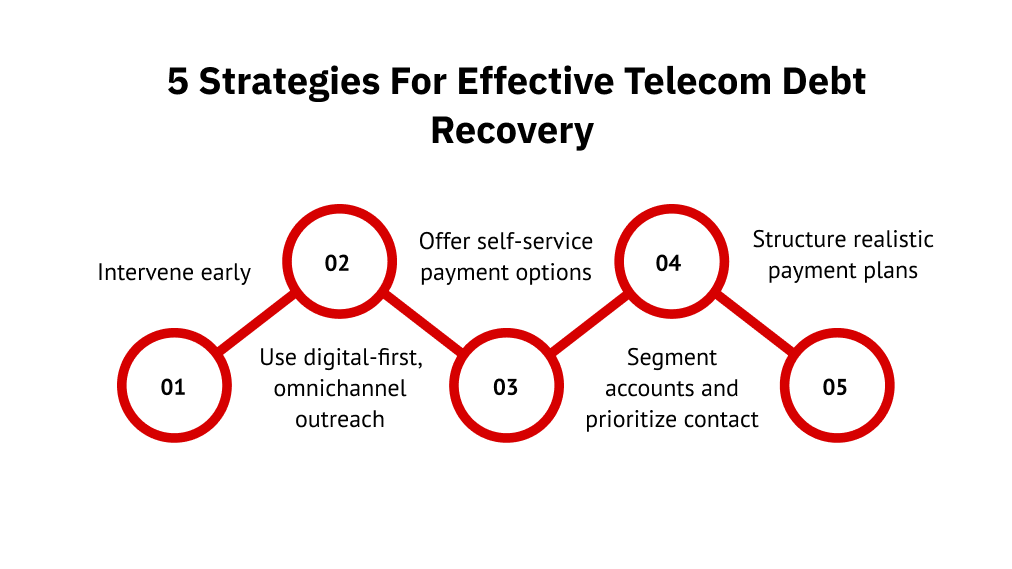
Effective telecom debt recovery matches the response to account age, balance characteristics, and subscriber behavior. A staged approach helps teams focus resources where they can influence resolution most effectively.
1. Early intervention before accounts age past 30 days
Telecom providers should address early delinquency with structured reminders, targeted follow-up, and appropriate hardship screening. Acting promptly can help teams resolve accounts before balances progress into deeper delinquency.
For example, teams can schedule reminders around 7, 14, and 21 days past due. Accounts that remain unresolved can then be flagged for outbound contact.
Before escalating those accounts, teams should also consider whether subscribers with a strong previous payment record need hardship screening. In these cases, a temporary payment problem may require a different response from repeated non-payment.
Accordingly, an early intervention strategy for delinquent accounts can help reduce unnecessary escalation.
2. Use digital-first, omnichannel outreach
Telecom providers should coordinate SMS, email, digital payment access, and phone outreach across one recovery journey. This approach expands contact options while directing complex accounts toward appropriate human support.
An omnichannel debt collection workflow keeps those channels connected throughout the recovery journey.
For example, an SMS can provide a payment path after a missed bill. When more account information is needed, email can provide additional details. If the account requires discussion or clarification, phone outreach can then support a more complex resolution.
This sequencing also helps agents focus on accounts where human involvement adds value.
3. Give customers self-service payment options
Self-service payment options let subscribers resolve straightforward balances without waiting for an agent. Depending on the program, they can provide payment methods, installment options, and account information.
A useful portal should make the next action clear. Around-the-clock access also removes a common operational constraint. As a result, subscribers can act without waiting for an agent or contacting a call center during business hours.
In turn, well-designed self-service portals for digital debt collections can handle routine resolutions. Agents can then focus on accounts requiring discussion or judgment.
4. Segment accounts and prioritize contact
Telecom providers should segment delinquent accounts by recovery needs and prioritize outreach accordingly. Segmentation helps allocate digital and agent capacity across large portfolios.
A practical aging framework might include:
- 0 – 30 days: Automated reminders and accessible payment options.
- 31 – 60 days: Targeted agent outreach and appropriate payment arrangements.
- 61 – 90 days: Stronger escalation, account review, and available resolution options.
- 90+ days: Review third-party placement and other permitted recovery actions.
These ranges are planning examples rather than universal placement rules. Provider policies, account circumstances, and prior outreach should determine actual escalation timing.
Treatment decisions should consider account age alongside balance size, payment history, dispute status, and previous channel responses. From there, analytics can help teams identify response patterns and adjust outreach accordingly. When disputes, hardship, or unusual account circumstances arise, however, human review remains important for informed decisions.
| Pro Tip: Include balance composition when segmenting delinquent telecom accounts. A service charge from a historically reliable subscriber may require a simple reminder. By contrast, a device installment default after departure may require more targeted outreach and escalation. |
5. Structure payment plans around realistic resolution
Structured payment arrangements give providers another recovery path when immediate full payment is unrealistic. Available options can include installment plans and authorized settlements.
Installment plans can spread payments across an agreed period. When settlements are appropriate, they should follow established policies, program permissions, and authorization limits.
Regardless of the arrangement, the economics still require discipline. Before approval, teams should consider account age, balance composition, subscriber circumstances, and expected recovery.
Clear terms matter as much as flexibility. Providers should ensure arrangement terms clearly communicate payment amounts, timing, and completion requirements. Together, these strategies create a graduated recovery process for routine, complex, and aging accounts.
Telecom collection compliance: TCPA, FDCPA, and Regulation F essentials
Telecom providers should align collection workflows with applicable TCPA, FDCPA, Regulation F, and state requirements. Compliance controls should cover communication methods, consent records, collection models, and agency oversight.
TCPA requirements for collection outreach
The Telephone Consumer Protection Act (TCPA) restricts certain calls using an automatic telephone dialing system. It also restricts certain calls using artificial or prerecorded voices. Telecom providers must account for applicable consent requirements when using covered communication methods.
For certain non-telemarketing collection calls, prior express consent can arise when consumers provide wireless numbers during the underlying transaction. However, providers should maintain records supporting that consent.
Teams should also account for consent revocation, reassigned numbers, and the technologies used for each outreach campaign.
FDCPA and Regulation F requirements
The Fair Debt Collection Practices Act (FDCPA) generally excludes creditors collecting their own debts under their own names. Its requirements apply to covered third-party debt collectors handling consumer telecom debt.
Regulation F requires covered debt collectors to provide validation information at the outset of collection communications. They can provide it orally during the initial communication. Alternatively, they can send a validation notice initially or within five days, subject to exceptions.
Regulation F also establishes presumptions concerning telephone frequency. A collector is presumed to violate the rule after more than seven calls within seven consecutive days. A similar presumption applies to calls within seven days after a telephone conversation about that debt.
Regulation F also permits covered debt collectors to use electronic communications within defined safeguards. Covered electronic communications must include a reasonable and simple method to opt out.
Limited-content messages have separate requirements and apply specifically to voicemail.
State requirements also shape collection workflows
State laws can add licensing, disclosure, communication, and other obligations beyond federal collection requirements. Accordingly, telecom providers should account for applicable state rules when designing workflows and overseeing collection partners.
Geographic coverage can affect scripts, notices, channel rules, and escalation procedures. A consumer protection compliance guide for digital-first collections can support that review. Consent records, communication controls, validation processes, and state-specific rules should align before each recovery stage.
When to keep telecom recovery internal or escalate to a recovery partner
Telecom providers should change recovery models when account needs exceed the current workflow’s capabilities. Early accounts can remain internal or use first-party support, while appropriate late-stage accounts can move to third-party collections.
The appropriate model also depends on whether the provider wants to retain its identity during customer outreach.
| Factor | Internal recovery | Outsourced first-party recovery | Third-party collections |
| Subscriber relationship | Provider controls the interaction directly | Partner works under the provider’s brand | Agency contacts subscribers under its own brand |
| Typical account stage | Early-stage delinquency | Typically early-stage recovery | Late-stage or written-off accounts |
| Internal resources | Requires internal staffing and systems | Extends capacity through an outside partner | Adds specialized external recovery capacity |
| Compliance operations | Provider manages collection workflows | Partner operates within the agreed first-party program | Agency manages its operations; provider maintains partner oversight |
| Communication | Provider-approved messaging | Provider identity, scripts, and program standards | Agency processes and branding |
| Reporting | Depends on internal systems | Depends on partner and program reporting | Depends on agency reporting capabilities |
Using these factors, providers should set review points based on account age, prior outreach, disputes, subscriber status, and capacity.
Appropriate early-stage accounts can remain internal or move into outsourced first-party recovery. Late-stage accounts may move to third-party collections when specialized support becomes appropriate.
What to evaluate in a telecom collection partner
Telecom providers should evaluate a collection partner’s industry experience, communication capabilities, reporting, data security, compliance controls, and service standards.
- Relevant telecom and recurring-billing experience.
- Omnichannel communication capabilities.
- Clear performance reporting.
- Data security and compliance controls.
- Subscriber communication standards.
- Relevant independent certifications and audits.
For additional due diligence, Receivables Management Association International maintains a Receivables Management Certification Program for qualifying businesses and professionals.
How First Credit Services supports first-party and third-party recovery
At First Credit Services, we support first-party recovery under the client’s brand and third-party recovery under our branding. Together, these programs address different stages of the recovery lifecycle.
Specifically, our first-party collection services typically address early delinquency stages. Our third-party collection services address late-stage, seriously delinquent, and written-off accounts.
To strengthen engagement across these programs, we operate our Unified Consumer Engagement Platform (UCEP) on behalf of clients. It coordinates SMS, email, chat, and phone engagement across recovery workflows.
In turn, the platform uses analytics, consumer behavior, and response patterns to adapt messaging, timing, and outreach strategy. This managed approach helps telecom providers extend recovery capacity across collection stages.
5 KPIs to measure telecom debt collection performance
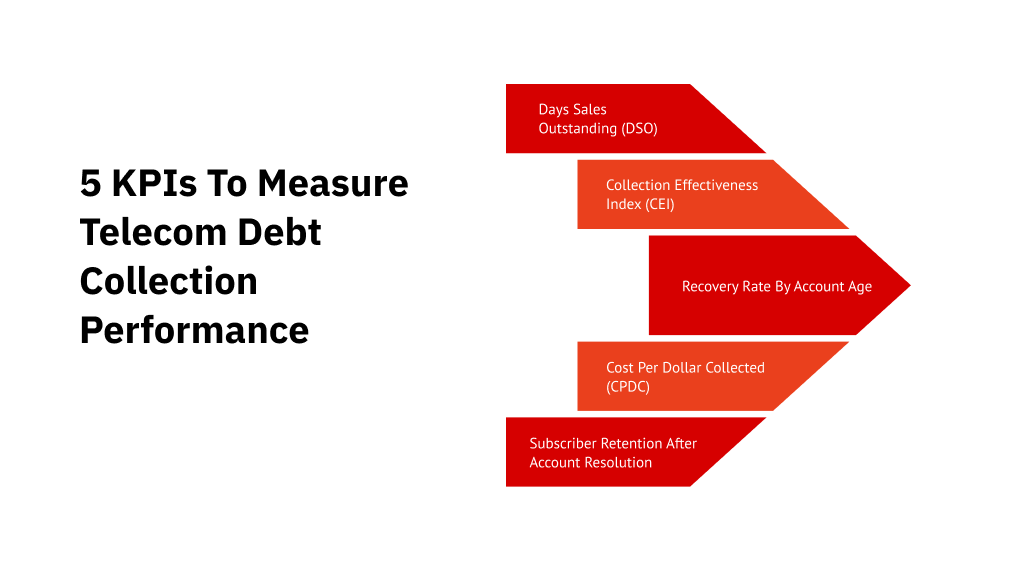
Five useful telecom debt collection KPIs are DSO, CEI, recovery rate by account age, CPDC, and subscriber retention. Together, they measure recovery performance, operating efficiency, and subscriber outcomes.
- Days Sales Outstanding (DSO): DSO measures how long receivables remain outstanding before collection. Track DSO across wireless, broadband, and bundled services. This separation can reveal differences in payment behavior across product lines.
- Collection Effectiveness Index (CEI): CEI measures how effectively a business collects available receivables during a defined period. Changes over time can show whether collection performance is improving or weakening.
- Recovery rate by account age: This metric measures the share of placed balances ultimately recovered. Compare recovery across 30, 60, 90, and 120-plus-day segments. Results can show when accounts become harder to recover and inform escalation timing.
- Cost per dollar collected (CPDC): CPDC compares collection costs with dollars recovered. Compare internal operations with external placements to evaluate staffing, technology, and agency resource decisions.
- Subscriber retention after account resolution: Track how many resolved subscribers remain active after early-stage recovery activity. This metric connects recovery outcomes with the continuing value of the subscriber relationship.
| Pro Tip: Track the 30-to-60-day roll rate each month. This measures the percentage of accounts moving from one delinquency stage into the next. A sudden increase can signal weakening early-stage recovery before the effect appears in late-stage performance. Monitoring the trend gives teams more time to investigate outreach, payment behavior, and other potential causes. |
Strengthen telecom debt collection across the recovery lifecycle
Telecom debt collection works best when providers align recovery intensity with account age and subscriber circumstances. Early action can preserve resolution options before delinquency becomes harder to manage.
A staged model gives providers several options as account needs change. Early recovery can remain internal or use outsourced first-party support under the provider’s brand. Late-stage accounts can move to third-party collections when specialized recovery becomes appropriate.
For telecom leaders, the goal is recovery without creating unnecessary friction across subscriber relationships. Performance data should show where workflows need adjustment and when external support can add value.
Ready to strengthen telecom debt collection while protecting subscriber relationships? Talk to a telecom collections specialist at First Credit Services about your portfolio.
FAQs
1. How much does a telecom collection agency charge?
Telecom collection agency pricing depends on the recovery stage and service model. Third-party collections use contingency pricing, while first-party programs may use contingency or per-seat pricing depending on how the program operates.
2. How long does it take to onboard a telecom collection agency?
First-party programs typically take 30 to 60 days to onboard, while third-party programs can launch in one to two weeks. Timelines depend on program requirements, data transfer, workflows, and implementation needs.
3. What should telecom providers consider before outsourcing collections?
Telecom providers should consider account stage, internal capacity, branding requirements, compliance oversight, and reporting needs before outsourcing. These factors help determine whether first-party or third-party support fits the portfolio.
4. Who owns telecom debt after it is placed with a collection agency?
The telecom provider retains ownership when accounts are placed with a first-party or third-party collection agency. Agency placement assigns recovery activity to a partner without transferring ownership of the underlying debt.
5. Can telecom providers use the same collection strategy for service charges and device balances?
Telecom providers should account for balance type when determining treatment. Service charges, financed devices, equipment costs, and disputed fees can involve different account circumstances, documentation, and resolution considerations.
6. What reporting should telecom providers expect from a collection partner?
Collection reporting should reflect available client data and the program’s requirements. Useful reporting helps telecom providers monitor recovery activity, performance, and workflow outcomes across the agreed program.