


Involuntary churn recovery is the process of reclaiming subscribers lost to failed payments. These are not cancellations. The subscriber still wants the product. Their billing broke.
Most subscription businesses treat payment failure recovery as a billing platform setting. Turn on retries, send a dunning email, move on. That works at low volume. At scale, though, it leaves a measurable share of recurring revenue unrecovered every billing cycle.
A complete recovery operation runs four stages: prevention, intelligent retry, active dunning, and managed outreach. Most teams run the first stage well and invest lightly in the second. The third gets treated as a set of email templates. The fourth rarely gets built at all.
This guide covers what each stage does and where it breaks. It also walks through how to tell when your internal setup has hit its ceiling.
What is involuntary churn?
Involuntary churn happens when a failed payment ends a subscription. The subscriber did not cancel. Their card expired, their bank blocked the charge, or their billing details went out of date. They still want the product. But the revenue is already gone.
Voluntary churn is a product decision. The subscriber looked at what you offer and walked away. Involuntary churn is operational. The subscriber got pushed out by a payment failure they never saw coming. Some teams call it passive churn. Different label, same problem.
And this is where most teams bleed money without seeing it. They lump everything into one churn number. So when a product team sees 5% monthly churn, they start questioning the product. In practice, though, a chunk of that is just expired cards and gateway timeouts. The product had nothing to do with it.
That misread burns real budget. We have seen teams run discount-heavy win-back campaigns for subscribers who just needed a card update. Not a reason to stay. Just a working payment method. A one-click update would have brought them back in hours, without cutting into margin.
What involuntary churn costs a subscription business
Involuntary churn accounts for a significant share of total churn in subscription businesses, often a quarter or more. And once a payment failure pushes a subscriber out, very few ever come back. That makes nearly all of it permanent revenue loss.
The real cost goes well beyond the missed payment. A $79 monthly subscriber who would have stayed six more months represents $474 in lost lifetime value. Most default billing retries recover only a fraction of failed payments. That leaves a large share of failed payment subscribers walking out with their full remaining LTV still attached.
The damage compounds from there. Every one of those subscribers is someone you already paid to acquire. That acquisition spend returns nothing. Your LTV:CAC ratio erodes, and nothing on the product side explains why.
To size this in your own business, divide subscribers lost to failed payments by total active subscribers at the start of the billing period. That gives you your involuntary churn rate. Track it separately from voluntary churn. Mixing the two hides the real driver and sends teams chasing the wrong fix.
How to build an involuntary churn recovery program
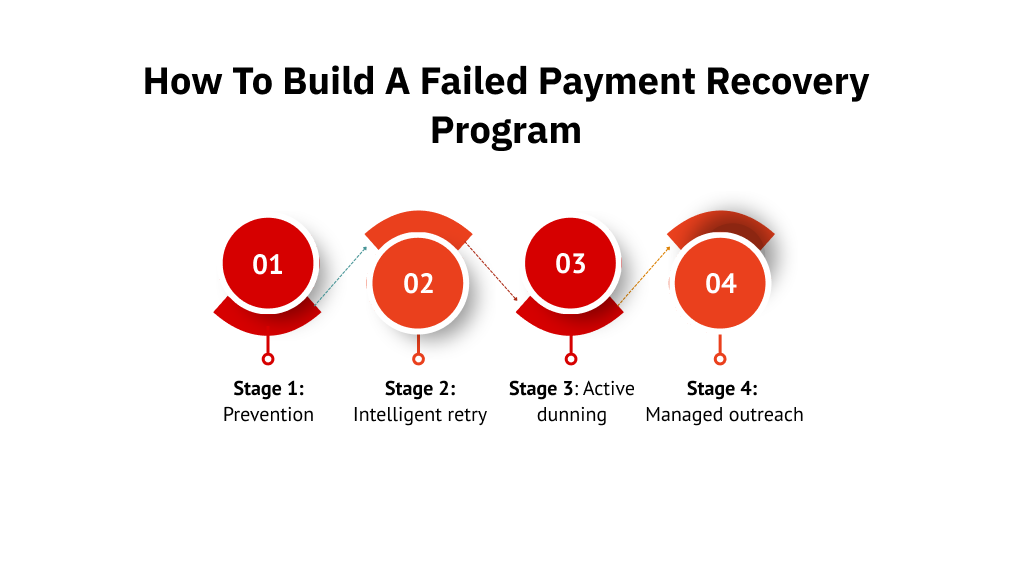
An involuntary churn recovery program runs four stages: prevention, intelligent retry, active dunning, and managed outreach. Each stage catches a different failure type and hands off what it cannot resolve to the next.
Before building the stages, know what you are recovering from. Failed payments fall into distinct categories. Each one responds to a different fix.
| Decline Type | Common Cause | Recovery Action | Retry Value |
| Insufficient funds | Low balance at charge time | Reattempt on payday timing (1st, 15th, Friday) | High |
| Do not honor | Bank-side flag, often temporary | Reattempt on a different cadence | Medium |
| Expired card | Card lifecycle | Card updater or subscriber contact | High if updater works |
| Stolen or lost card | Fraud or replacement | Stop retrying, contact subscriber | Low |
| Gateway timeout | Processor-side error | Reattempt within hours | High |
| Closed account | Account no longer active | Stop retrying entirely | None |
Soft declines like insufficient funds and temporary bank holds carry the highest recovery potential. Hard declines like stolen cards and closed accounts require subscriber action. Retrying hard declines wastes attempts and can damage your authorization rates with the processor.
Stage 1: Prevention
Prevention stops payment failures from ever entering your recovery pipeline. Three tools do the work: pre-dunning notifications, card account updater services, and network tokenization.
Pre-dunning notifications catch card expiration before the renewal fails. A message 30 days before the expiration date, carrying a one-click update link, moves the update into your subscriber’s hands ahead of the charge. This is the lowest-effort, highest-return lever in stage one.
Card account updater services from Visa, Mastercard, American Express, and Discover push refreshed card credentials directly to your billing platform when issuers reissue a card. Deployed across all four networks, they eliminate most expiration-driven failures without any subscriber action.
Network tokenization replaces the stored card number with a token issued by the card network. Tokens survive card reissues, and issuers treat tokenized credentials as lower risk on every charge. Approval rates lift across your entire recurring base.
Your target for stage one: card lifecycle failures sit under 10 percent of your total failure volume. Higher than that, your prevention layer is not fully deployed.
Stage 2: Intelligent retry
Stage two catches soft declines. A soft decline is a payment that failed for a temporary reason: insufficient funds, an issuer hold, or a network timeout. The card still works, and a well-timed second attempt usually succeeds.
Default retry logic runs on the same schedule for every decline. That approach wastes attempts on hard declines that will never recover and misses the timing window on soft declines that would have. Intelligent retry logic matches the retry schedule to the decline code.
Insufficient funds retries land on paydays (typically the 1st, the 15th, and Fridays). The issuer holds the retry for 24 to 48 hours. Hard declines skip retry entirely and route to stage three.
| Quick diagnostic: Pull your retry attempts by decline code and success rate. If your recovery rate is flat across every code, you are running a default schedule, and stage two is the fastest place to lift your number. Your target for stage two: soft decline recovery rate above 40 percent. Below that, your retry logic is not decline-code-matched. |
Stage 3: Active dunning
Stage three reaches your subscribers directly when stages one and two have not resolved the payment. This is where most subscription businesses under-invest, because dunning gets treated as an email exercise instead of an operational discipline.
An effective dunning sequence runs three to five touchpoints across email, SMS, and in-app messaging. The first message goes out within the hour of failure. Follow-ups escalate in clarity, not in tone, and every message carries the amount due and a one-click payment update link.
Channel mix matters more than message frequency. Subscribers who ignore email may respond to SMS. Subscribers who ignore both may act on an in-app banner. Each channel captures a segment that the previous one missed.
The message itself needs to match the decline reason. An expired card needs a “please update your card” message. An insufficient funds decline needs a “we will retry on X date” message. Generic dunning gets ignored.
Your target for stage three: combined recovery rate above 50 percent across stages one, two, and three. Below that, either your channel mix is too narrow, or your messaging is not matched to the decline reason.
Stage 4: Managed outreach
Stage four handles the accounts that automated stages did not recover. These are subscribers who did not open your emails, did not click your SMS, and did not respond to in-app prompts. Left alone, they become permanent involuntary churn.
Managed outreach adds direct human contact through voice, personalized outreach, and negotiated payment arrangements to resolve accounts that automation cannot reach. It also carries compliance requirements that automated dunning does not.
Once you contact a subscriber about an unpaid balance, three regulations apply: the Fair Debt Collection Practices Act (FDCPA), the Telephone Consumer Protection Act (TCPA), and the Payment Card Industry Data Security Standard (PCI DSS). Live call auditing, agent training, and consent management become operational requirements, not optional add-ons.
Most subscription businesses do not staff for this stage. That is exactly where the largest untouched recovery opportunity sits, and it is the reason specialized recovery programs run as a managed service rather than a plug-in tool.
When internal recovery hits its ceiling
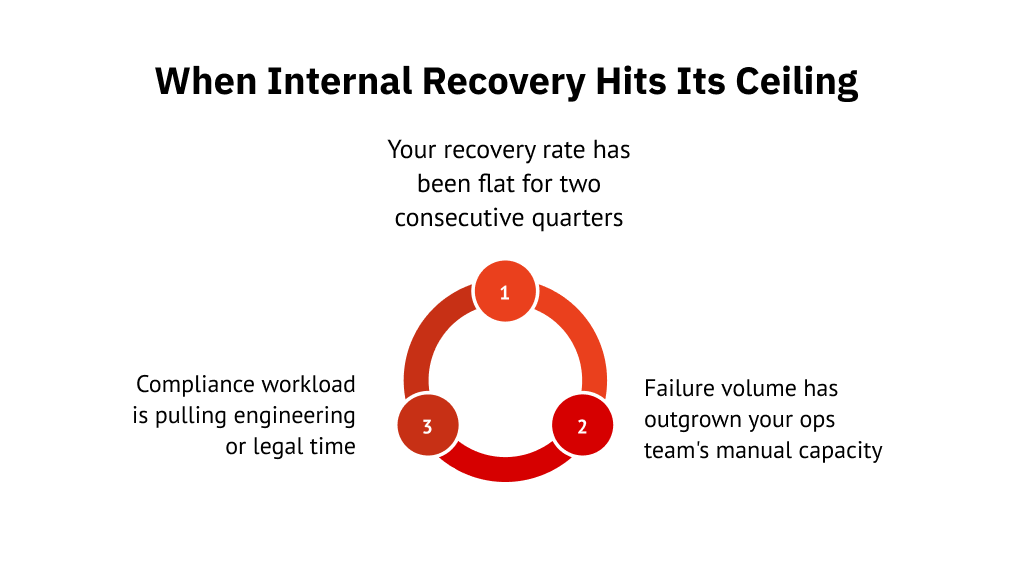
Internal recovery hits its ceiling at stage four. Your team can run stages one through three on automation, templates, and internal ops. Stage four runs on direct subscriber contact under regulated conditions, and most internal ops functions are not built for that layer.
If you are the person accountable for the recovery rate number, three measurable signals tell you the ceiling has arrived.
1. Your recovery rate has been flat for two consecutive quarters
You have deployed prevention tools, tuned retry logic, and expanded your dunning channels. The number moved once. It has not moved since. That flatline signals that the stages you can run internally are already producing their maximum output. Additional lift now sits behind stage four.
2. Failure volume has outgrown your ops team’s manual capacity
Automated recovery works on the pool it can reach. Everything else lands in a queue that a billing analyst is supposed to work on manually.
When that queue is larger than one full-time person can meaningfully touch each month, your recovery rate on the tail is effectively zero. In your data, this shows up as a widening gap between “attempted recovery” and “resolved recovery” volumes.
3. Compliance workload is pulling engineering or legal time
Direct subscriber outreach about an unpaid balance triggers FDCPA, TCPA, and PCI DSS requirements. Your engineering team ends up building consent management flows. Legal spends cycles reviewing call scripts. Ops manually audits outreach for compliance. That is infrastructure work that a specialized recovery function carries as a standard operating cost.
If two of these three are true for you today, stage four is a distinct operational function. It has its own infrastructure, compliance controls, and staffing model. Your internal team cannot build it in a quarter.
The decision from here is straightforward. Run the math on the gap between your current recovery rate and what a stage-four capability can add. If that gap exceeds the cost of running the stage as a managed service, escalation is the right operational move.
If your internal tools are already capturing most of what is recoverable through stages one through three, a stage-four investment adds overhead without proportional return.
How First Credit Services recovers the subscribers automation cannot reach
First Credit Services runs stage four as a managed service. The company handles subscriber recovery on your behalf: outreach strategy, contact sequencing, compliance, and performance reporting. Your billing team keeps running stages one through three. The tail of your recovery funnel becomes a measurable line in revenue reporting instead of a write-off.
Coverage spans first-party and third-party recovery under one program. First-party outreach runs under your brand while accounts are still pre-write-off. Third-party recovery takes over once accounts age past that window. There is no vendor handoff between the two.
UCEP (Unified Consumer Engagement Platform) powers the operation. It scores each subscriber account and selects the right message, channel, and timing. Here is what the subscriber experience looks like:
- Omnichannel outreach across SMS, email, chat, and phone
- A self-service portal to view balances, set up payment plans, and pay through a mobile-first interface
- Schedule-a-callback so subscribers choose when to talk to a human agent
- Brand-consistent experience throughout, since first-party engagements run under your name
Compliance is built into every engagement: PCI DSS Level 1, SOC 2 Type II, FDCPA, and TCPA. Live call auditing, agent training, and consent management run as standard operations.
Best fit: mid-market to enterprise subscription businesses in SaaS, media, financial services, and healthcare with meaningful billing volume where internal recovery has plateaued.
Turn your stage-four gap into recovered MRR
Your involuntary churn number is the sum of what your four recovery stages do and do not catch. Prevention, intelligent retry, and active dunning cover the pool you can reach with automation. Managed outreach covers the tail.
Before you decide what to do next, run the diagnostic on where you actually sit today.
- Are your card lifecycle failures under 10 percent of total failure volume?
- Is your soft decline recovery rate above 40 percent?
- Is your combined recovery rate across stages one through three above 50 percent?
- Do you have a stage four at all, or does your tail write itself off?
If the answer to any of the first three is no, your fix sits inside stages one, two, or three, and internal tuning is the right move. If the answer to the fourth is no, your recovery rate has a ceiling you cannot lift from inside.
Talk to First Credit Services about how a managed stage-four function would run across your recurring billing base.
FAQs
1. What is a good recovery rate for failed subscription payments?
Default billing platform retries recover 30 to 40% of failed payments. Optimized programs that combine smart retries, multi-channel dunning, and managed outreach achieve 50 to 70%. The gap between those two numbers represents significant recoverable recurring revenue.
2. How long is the recovery window after a subscription payment fails?
Most card networks allow retries within a 30-day window. Recovery rates drop sharply after 14 days, and the steepest decline happens in the first 72 hours. Faster response after the initial failure yields meaningfully higher recovery rates.
3. What is the difference between first-party and third-party payment recovery?
First-party recovery contacts subscribers under your brand, preserving the customer relationship. Third-party recovery operates under the recovery partner’s identity. First-party works best for early-stage failures. Third-party recovery handles aged accounts where branded outreach has been exhausted.
4. Can a managed recovery partner work alongside an existing billing platform?
Yes. A managed recovery partner operates after automated retries and dunning sequences are exhausted. The partner recovers subscribers that self-serve tools could not reach through direct, compliance-driven, multi-channel outreach without replacing your billing infrastructure.
5. How does your merchant descriptor affect subscription recovery rates?
The merchant descriptor is the short string that appears on a subscriber’s card statement. If it does not match the brand they signed up for, issuers flag the charge and subscribers file chargebacks. A clean, brand-matched descriptor lifts approval rates on every recurring charge.
6. Does recovering a failed payment actually retain the subscriber long-term?
Yes. Recovered subscribers typically continue their subscriptions for months after the payment issue is resolved. The value of a successful recovery extends far beyond the single missed payment to include the full remaining customer lifetime value.