


Your underwriting team approved the loan. Your servicing team managed the account for months. Then one day, the borrower stopped paying.
That moment is one every lender eventually faces. Delinquent accounts stack up faster than your team can work them. Internal capacity maxes out, and recovery rates start to slide. Each week without meaningful outreach, the balance becomes harder to recover, and the borrower relationship harder to save.
A debt collection agency for lenders is a specialized recovery partner built for this challenge. These agencies recover delinquent balances from banks, credit unions, fintech companies, and auto finance portfolios.
They do so while meeting Fair Debt Collection Practices Act (FDCPA), Telephone Consumer Protection Act (TCPA), and Consumer Financial Protection Bureau (CFPB) requirements.
However, choosing the wrong partner can cause more harm than the delinquency itself. This guide covers what to evaluate, which compliance standards are non-negotiable, how pricing works, and which mistakes to avoid when placing a lending portfolio.
What is a debt collection agency for lenders?
A debt collection agency for lenders recovers overdue balances from regulated consumer lending portfolios. It works accounts from banks, credit unions, fintech platforms, and auto finance providers while operating within federal and state collection laws.
Unlike generalist agencies that handle retail invoices or medical receivables, lending-focused partners operate in a different regulatory environment. Compliance frameworks are stricter, and recovery timelines are shorter.
The borrower is often still your customer. Recovery that ignores this reality damages the broader relationship across every product that the borrower holds.
Why lender collections are different from standard debt collection
The difference starts with what is at stake. A borrower who misses a payment on a credit card or auto loan may still hold a checking account or mortgage with you. Recovery that alienates that borrower damages all of those connections at once.
Regulatory expectations are also higher for lenders. The CFPB oversees lenders directly. Credit unions face additional scrutiny from the National Credit Union Administration (NCUA).
As a result, any collection activity tied to your institution is subject to regulatory review. That applies whether you manage it internally or place it with a partner.
Timing makes the stakes even sharper. According to the Federal Reserve Board Q1 2026 report, U.S. banks charged off credit card debt at a 4.01% annualized rate. Once accounts cross the charge-off threshold, recovery rates fall sharply.
Most recoverable value is captured in the first 90 to 180 days of delinquency. Early engagement and the right channel strategy drive better outcomes than pressure-based tactics ever will.
| Did you know? Credit card balances reached $1.252 trillion in Q1 2026. The transition rate into serious delinquency (90+ days) stood at 7.10%, according to the New York Fed Household Debt and Credit Report Q1 2026. |
What to look for in a debt collection agency for lenders
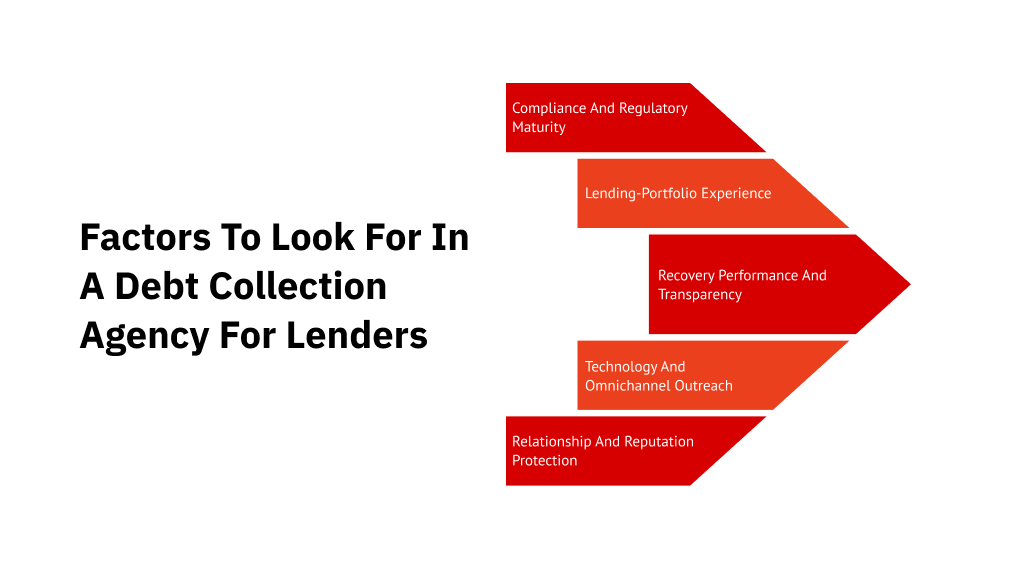
Several factors separate a lending-focused recovery partner from a generalist agency. The following criteria will help you evaluate each vendor on your shortlist.
1. Compliance and regulatory maturity
Start with compliance because every other part of the recovery program depends on it. A qualified partner should maintain documented procedures covering the FDCPA, Regulation F, and TCPA. In addition, verify that the agency holds current licenses in every state where you lend and has established processes for audit trails, call monitoring, and script reviews.
2. Lending-portfolio experience
Regulatory knowledge is essential, but it must be supported by lending-specific experience. Look for a proven track record across bank, credit union, fintech, consumer lending, and auto finance portfolios. Experience with retail or medical receivables alone may not prepare an agency for the regulatory requirements and account complexities involved in consumer lending.
3. Recovery performance and transparency
Once you have confirmed the agency’s experience, examine the results it has delivered. Ask for recovery-rate benchmarks segmented by account age, debt type, and delinquency stage. A credible partner should also provide real-time reporting and clearly defined performance metrics. It gives you the visibility needed to track results and hold the agency accountable.
4. Technology and omnichannel outreach
Strong recovery performance depends on the technology driving the outreach. Your partner should offer coordinated engagement across SMS, email, voice, and self-service portals.
Integration with your systems through API, SFTP, or direct CRM sync eliminates manual handoffs. Hence, look for digital debt collection capabilities that go beyond phone-only recovery.
5. Relationship and reputation protection
Technology enables scale, but reputation protection determines whether that scale helps or hurts your brand. The agency will speak to your borrowers on your behalf, especially during first-party recovery. Therefore, ask how agents are trained on your brand voice. Then, review sample scripts and escalation protocols before signing.
Compliance is non-negotiable for lender collections
For lenders, compliance is where the highest financial risk lives. A single violation can trigger regulatory action, class-action liability, and reputational damage that far exceeds the overdue balance. The areas below represent baseline requirements for any partner you evaluate.
1. FDCPA and Regulation F
The Fair Debt Collection Practices Act (FDCPA) governs debt collector conduct, including required disclosures, prohibited harassment, and communication restrictions. Regulation F adds specific guardrails from the Consumer Financial Protection Bureau (CFPB).
Under its telephone-call frequency provisions, a collector is presumed to violate the rule if they place more than seven calls within seven consecutive days about a particular debt. The same presumption applies if they call within seven days after speaking with the consumer about that debt.
Regulation F also requires clear opt-out instructions in electronic communications. Thus, your partner should have documented procedures for both requirements.
2. TCPA and consent-based outreach
The Telephone Consumer Protection Act (TCPA) governs calls and texts to mobile phones. Before any automated or prerecorded outreach begins, you must obtain consent. Poor consent management can create direct liability for the lender because regulators may hold the creditor responsible alongside the agency. Therefore, verify that your partner tracks consent at the account level.
3. CFPB and NCUA oversight
The CFPB supervises lenders and larger debt collectors through its examination authority. Credit unions must also comply with member-protection requirements established by the National Credit Union Administration (NCUA). Therefore, your collections partner should understand both frameworks and remain prepared for regulatory examinations. A documented debt collection compliance program designed for regulated lenders is essential for maintaining that readiness.
4. Data security and audit readiness
Regulatory compliance is only one part of protecting your institution. Your collections partner must also have strong controls for securing borrower and payment data. Look for System and Organization Controls (SOC 2) Type II and Payment Card Industry Data Security Standard (PCI DSS) Level 1 certifications, along with complete audit trails. In addition, monitor calls and, where legally permitted, record them and make them available for review when needed.
| Pro tip:Ask prospective partners for their most recent SOC 2 Type II report and a sample compliance audit. Agencies that hesitate to share these documents often lack a formalized program. |
First-party vs third-party collections and the pre-charge-off window
Understanding the difference between first-party and third-party collections helps you match the right approach to each stage of delinquency. Each model serves a distinct purpose in the recovery lifecycle.
First-party collections operate under your institution’s brand. The borrower sees your name on every communication, and the agency stays invisible. This approach works best during early delinquency, when the relationship is still active and preservable.
Third-party collections operate under the agency’s own identity. This model applies to later-stage or written-off accounts, where the borrower relationship has already shifted, and different regulatory requirements apply.
The pre-charge-off window holds the most recoverable value. The table below shows when each approach typically applies.
| Delinquency Stage | Collection Approach | Primary Goal |
| 1 to 30 days | Internal team or first-party partner | Preserve the relationship and recover the balance early |
| 31 to 90 days | First-party partner, white-labeled | Increase outreach frequency and offer payment plans |
| 91 to 180 days | Transition to third-party | Escalate recovery efforts before charge-off |
| Post-charge-off | Third-party or portfolio sale | Recover remaining value on aged accounts |
| Pro tip: Place accounts with an omnichannel recovery partner within the first 30 to 60 days of delinquency. Early placement consistently outperforms late-stage recovery by a significant margin. |
How debt collection agencies charge lenders
Pricing structures vary, and each model fits a different portfolio profile and risk appetite. The table below compares the three most common approaches lenders will encounter.
| Pricing Model | How It Works | Best For | Tradeoff |
| Contingency | Agency takes a percentage of recovered funds, typically 25% to 50% | Most lending portfolios | Higher per-dollar cost, but no payment unless recovery succeeds |
| Flat fee | Fixed cost per account placed | High-volume, uniform account types | Predictable cost, but the agency has less financial incentive to maximize each recovery |
| Debt purchase | Agency buys the debt outright at a discount | Aged, post-charge-off portfolios | Immediate cash for the lender, but recovery control is lost entirely |
Contingency is the most common model for lenders because it aligns incentives directly. The agency earns only when it recovers. For early-stage accounts with first-party outreach, some agencies combine contingency with staffing fees when dedicated agents handle branded communications.
Common mistakes lenders make when choosing a collections partner
Even experienced lending teams make avoidable errors during vendor selection. The following patterns show up repeatedly and are worth guarding against.
1. Choosing on price instead of compliance risk
A low contingency rate looks appealing on a spreadsheet. However, a generalist agency with weak compliance infrastructure can expose you to FDCPA or TCPA lawsuits. The legal and regulatory cost of a single violation typically exceeds years of fee savings from a lower rate.
2. Hiring a generalist with no lending experience
Retail or medical receivables recovery operates under different rules and different customer dynamics. An agency unfamiliar with lending-specific compliance, credit bureau reporting protocols, or loan servicing handoffs will struggle with your portfolio from day one.
3. Ignoring relationship and reputation impact
Aggressive tactics erode the borrower trust your institution spent years building. Retention, referrals, and member loyalty suffer when recovery feels adversarial. Ask specifically how the agency handles disputes, complaints, and borrower hardship cases before you sign.
4. No visibility into reporting or recovery data
Some agencies operate as a black box, taking accounts and returning results weeks later with no transparency in between. Demand real-time dashboards, account-level status tracking, and regular performance reporting. Without this visibility, you have no way to manage the partnership effectively.
| Did you know? The CFPB received 387,400 debt collection complaints in 2025, an 86% increase over 2024, according to the CFPB 2025 Consumer Response Annual Report. Poor vendor selection is one of the fastest ways for a lender to appear in that count. |
How First Credit Services handles lending-portfolio recovery
The evaluation criteria covered throughout this guide, including compliance depth, omnichannel outreach, and early-stage placement, reflect how First Credit Services approaches lending portfolios:
- Proven recovery performance: Our portfolio recovery work for a Top 10 U.S. credit card issuer increased the recovery rate from a 1% baseline to 3%, delivering a 3x lift across a $750 million portfolio. The client named FCS its Collections Agency of the Year in both 2024 and 2025.
- Data-driven engagement: We use our proprietary Unified Consumer Engagement Platform (UCEP) to score accounts using behavioral data and determine the most appropriate channel and timing for outreach.
- Convenient self-service resolution: Borrowers can resolve their accounts through a self-service payment portal, reducing the need for agent involvement.
- Designed for larger portfolios: Our model is best suited to mid-market and enterprise lenders placing multimillion-dollar portfolios annually. Smaller portfolios may be better served by in-house recovery teams or regional specialists.
A decision framework for choosing your agency
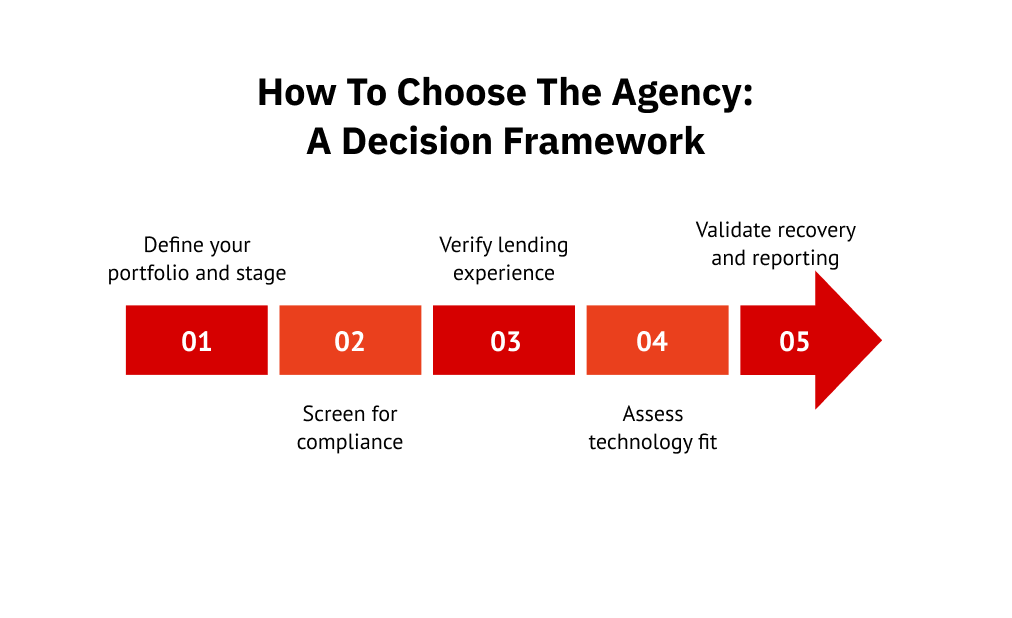
A structured evaluation process keeps the selection objective. The following five steps give you a repeatable framework for comparing candidates.
- Define your portfolio and stage: Identify the debt types, delinquency stages, and volumes you plan to place.
- Screen for compliance: Eliminate any partner that cannot document compliance with the FDCPA, Regulation F, TCPA, and state licensing requirements.
- Verify lending experience: Confirm the agency has active credit collection services clients in your specific lending vertical.
- Assess technology fit: Evaluate integration options, outreach channels, and reporting capabilities.
- Validate recovery and reporting: Request performance benchmarks, client references, and a sample reporting cadence.
Use the scoring table below to rank shortlisted agencies side by side.
| Evaluation Criterion | Suggested Weight | Agency A | Agency B | Agency C |
| Compliance and licensing | 25% | |||
| Lending-portfolio experience | 20% | |||
| Recovery performance (benchmarks) | 20% | |||
| Technology and omnichannel capability | 20% | |||
| Reputation protection | 15% |
Score each agency on a 1 to 5 scale per criterion, multiply by the weight, and total. The highest weighted score identifies your strongest candidate on paper. Then validate with references and a pilot placement.
Turn lending delinquencies into stronger recovery outcomes
Choosing a debt collection agency for lenders comes down to compliance depth, lending-portfolio experience, and borrower relationship protection.
Price matters, of course. However, it should never outweigh regulatory readiness or a proven track record in your specific lending vertical. The evaluation framework in this guide gives you a structured way to compare candidates on the criteria that actually predict performance.
Ready to place a lending portfolio with a partner built for it? Discuss with FCS what recovery looks like across your delinquent accounts.
FAQs
1. When should a lender outsource collections instead of keeping it in-house?
Consider outsourcing when delinquency volumes exceed internal capacity, compliance requirements grow complex, or your team lacks omnichannel outreach capabilities. A specialized partner can manage early-stage recovery alongside in-house efforts and handle aged accounts that require dedicated expertise.
2. What recovery rate can lenders expect from a collection agency?
Recovery rates depend heavily on account age and debt type. Early-stage placement within the first 30 to 90 days typically yields significantly higher recovery than late-stage or post-charge-off placement. Ask prospective agencies for benchmarks specific to your portfolio profile.
3. How fast can a collection agency onboard a lending portfolio?
Third-party placement can go live within one to two weeks with standard integration. First-party programs require branded scripts, compliance alignment, and agent training, which typically takes 30 to 60 days. Speed depends on the integration method and the complexity of your compliance requirements.
4. How does credit bureau reporting work with an outsourced collections partner?
The agency typically reports account status to credit bureaus on the lender’s behalf. Verify that your partner follows Metro 2 reporting standards and updates status accurately when payments post or disputes are resolved. Inaccurate bureau reporting creates regulatory exposure for the lender.
5. Can a lender place accounts with multiple collection agencies at the same time?
Yes. Many lenders split placements across two or three agencies and compare performance over time. This approach creates competitive benchmarks and reduces concentration risk. Ensure each agency reports consistently to avoid conflicting bureau records on the same account.
6. What data does a lender need to provide when placing accounts with a collection agency?
At minimum, provide borrower contact information, account balances, payment history, and the date of last activity. Additional fields such as product type, original loan terms, and prior internal collection attempts help the agency prioritize outreach and tailor its approach.