


Accounts receivable collections is the process of resolving overdue consumer receivables through structured follow-up, payment options, and appropriate escalation. For creditors, it covers the gap between an amount becoming past due and the point where later-stage recovery may require a different model.
When overdue balances accumulate, the impact extends beyond the individual account. Finance and recovery teams spend more time on follow-up, while working capital remains tied up in unresolved receivables. According to QuickBooks Midsize Payments Research, mid-sized businesses reported an average of $304,066 in late customer payments.
A defined recovery process helps teams prioritize accounts, coordinate outreach, document responses, and establish clear escalation points. It also helps to determine when internal capacity is sufficient and when first-party outsourcing can provide additional support.
For organizations managing large consumer portfolios, that decision becomes increasingly operational. This guide explains how the recovery process works, which metrics reveal pressure, and when outsourcing makes sense.
Accounts receivable management vs. first-party recovery vs. third-party collections
Accounts receivable management, first-party recovery, and third-party collections differ in scope, timing, ownership, and customer-facing treatment.
| Dimension | Accounts Receivable Management | First-Party Recovery | Third-Party Collections |
| Focus | Billing, payment tracking, and active receivables | Resolving overdue consumer balances before later-stage placement | Recovering seriously delinquent or written-off consumer accounts |
| Typical timing | Ongoing through the active receivables lifecycle | Earlier-stage delinquency and failed payments | Later-stage, seriously delinquent, or written-off accounts |
| Who handles it | Finance, billing, or AR team | Internal team or outsourced first-party provider | External third-party collections provider |
| Customer-facing brand | Creditor’s brand | Creditor’s brand where white-labeling is configured | Recovery provider’s brand |
| Compliance considerations | Billing policies and applicable requirements | Requirements vary by account, program, communication method, and jurisdiction | Covered consumer debt collection may involve the FDCPA and Regulation F |
The distinction matters because recovery requirements change as an account progresses. Early-stage work often emphasizes brand continuity, resolution, and customer engagement.
Later-stage recovery uses a different operating model. Defining the handoff clearly helps prevent active receivables and post-write-off collections from being treated as one process.
Why structured receivables recovery matters
Structured receivables recovery matters because overdue balances restrict cash flow and increase internal workload. Aging accounts can also create additional operational complexity.
The impact appears in metrics such as Days Sales Outstanding (DSO). When DSO rises, cash takes longer to come in from outstanding receivables, leaving more money tied up in unpaid invoices. That can reduce working capital available for operations and investment.
A defined process helps counter these pressures through consistent account prioritization, outreach, documentation, and escalation.
Effective accounts receivable management strategies provide the broader foundation. Recovery becomes critical when overdue consumer balances require active resolution rather than routine tracking.
The accounts receivable collections process, step by step
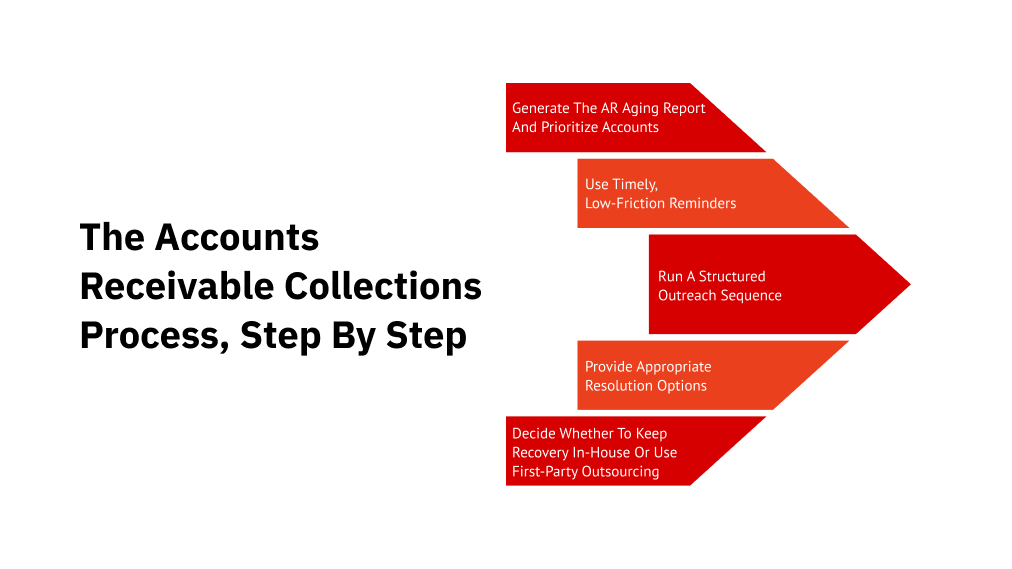
A consistent recovery process gives every overdue consumer account a defined next action and escalation point. The process starts with identifying accounts that need attention. It then progresses through appropriate outreach, resolution options, and stage-specific handoffs.
Step 1: Generate the AR aging report and prioritize accounts
Start with an aging report that groups open balances by their age. Common reporting buckets include current, 1-30, 31-60, 61-90, and 90-plus days past due.
This replaces memory and individual judgment with a consistent operational view.
Prioritize accounts using age, balance, risk, prior responses, and other relevant account information. Age alone should not determine where your team spends its time.
Your policies should also define when an overdue account enters active recovery and what conditions trigger additional attention.
Step 2: Use timely, low-friction reminders
Early outreach should give customers a clear way to understand and resolve an outstanding balance. Depending on the account and communication permissions, reminders may use appropriate digital or voice channels. Payment information should be accurate, accessible, and easy to act on.
If payment remains unresolved, the account can move into a more structured first-party recovery workflow.
Step 3: Run a structured outreach sequence
Repeated non-response requires a coordinated process rather than disconnected contact attempts. Email, SMS, and phone can form part of an omnichannel workflow when appropriate. The sequence should reflect account status, response patterns, communication permissions, and applicable requirements.
Log contact attempts, responses, disputes, and promises to pay. Accurate records reduce gaps when an account changes owners or moves to another recovery stage.
Escalation criteria can include continued non-response, a broken payment commitment, or another defined account-status trigger.
Step 4: Provide appropriate resolution options
When immediate payment is not feasible, an appropriate resolution path may help the customer address the balance.
Depending on the program, options can include a payment arrangement, promise to pay, or another authorized resolution structure.
The terms should reflect the creditor’s policies and the account’s circumstances. Document the arrangement and establish what happens if the customer does not meet it.
A failed arrangement or continued non-response may indicate that the account requires a different recovery approach.
Step 5: Decide whether to keep recovery in-house or use first-party outsourcing
As consumer receivables move through the recovery process, businesses can consider whether to manage collections internally or partner with a specialized collections provider.
First-party collections can extend recovery capacity while keeping customer-facing communication under the creditor’s brand where configured.
This model can fit organizations that need more structured outreach, additional staffing capacity, or broader channel coverage without moving accounts directly to later-stage collections.
Third-party placement becomes a separate decision when an account reaches a later recovery stage or meets the creditor’s placement criteria.
The past-due recovery timeline
A past-due recovery timeline assigns specific actions and escalation triggers to each aging stage. It helps your team decide when to intensify outreach, change recovery ownership, or evaluate later-stage placement.
| Aging Bucket | Potential Action | Decision Trigger |
| 1-30 days | Timely reminders and account review | Continued non-payment or non-response |
| 31-60 days | More structured first-party outreach | Repeated non-response or failed payment commitment |
| 61-90 days | Evaluate resolution options and recovery ownership | Continued disengagement or failed arrangement |
| 90+ days | Review for later-stage handling based on policy and account status | Account meets established placement or escalation criteria |
The key is consistency. Your team should know what information or account event triggers a new action.
| Pro tip: Define escalation rules before accounts become seriously delinquent. Use account age, balance, response history, and other relevant factors to guide decisions. |
Key metrics to track recovery performance
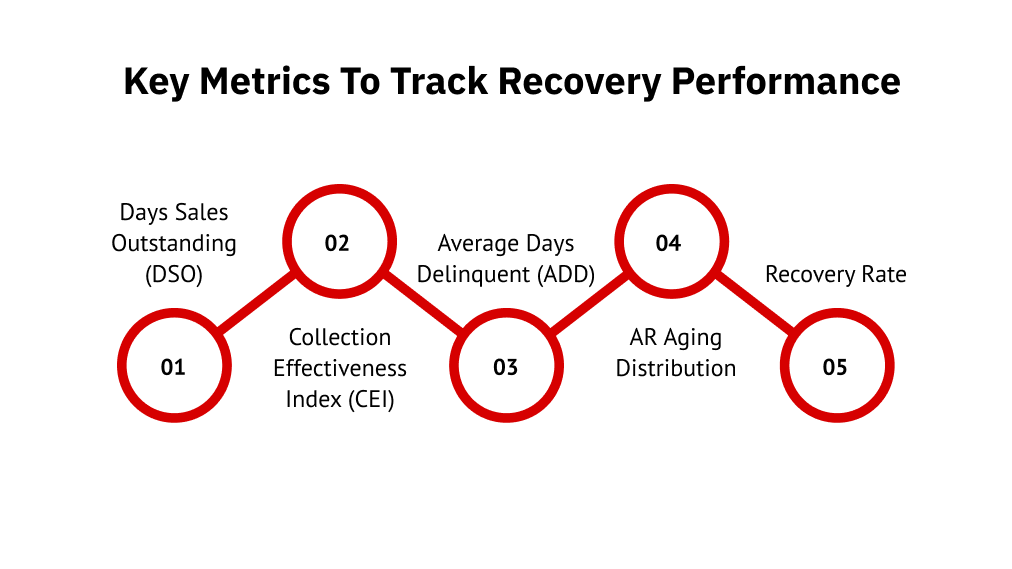
These five key metrics show whether your receivables recovery process is moving overdue balances toward resolution. They also help identify capacity or workflow problems.
- Days Sales Outstanding (DSO): Measures how long receivables take to convert into cash. Track changes against payment terms and historical performance.
- Collection Effectiveness Index (CEI): Measures how effectively collectible receivables convert into cash during a defined period. Compare trends rather than using a universal threshold.
- Average Days Delinquent (ADD): Shows how long balances remain overdue beyond their expected payment date.
- AR Aging Distribution: Shows the percentage of receivables within each aging bucket. Movement toward older buckets can reveal growing recovery pressure.
- Recovery Rate: Measures the share of delinquent dollars recovered during a defined period. Track it by account stage and portfolio where possible.
No single metric proves that outsourcing is necessary. However, several deteriorating indicators can justify a deeper review of capacity, workflows, and recovery ownership.
That review should focus first on whether earlier-stage recovery needs additional support before accounts progress further.
When first-party recovery hands off to third-party collections
First-party recovery should hand off to third-party collections when an account reaches later-stage delinquency or meets your established placement criteria. The transition changes both recovery ownership and the customer-facing brand.
| Dimension | First-Party Collections | Third-Party Collections |
| Who does it | Internal staff or an outsourced partner working under the creditor’s brand | External recovery partner operating under its own brand |
| Typical stage | Earlier-stage delinquency, failed payments, or similar recovery needs | Later-stage, seriously delinquent, or written-off accounts |
| Outsourced pricing | Digital-only programs can be contingency-based; live-agent programs can use per-seat pricing | Contingency-based |
| Brand experience | Client-brand continuity where white-labeling is configured | Recovery provider communicates under its own brand |
The handoff should reflect account status and creditor policy rather than a universal aging threshold.
For covered consumer debt collection, third-party activity may fall under the Fair Debt Collection Practices Act (FDCPA) and Regulation F.
These frameworks establish requirements for covered debt collectors, including communication and dispute-related obligations. Applicability depends on the actor, account, and circumstances.
The practical goal is to preserve clear ownership. Earlier-stage accounts remain within first-party recovery until program rules or account status justify a later-stage handoff.
In-house vs. outsourced first-party recovery: how to decide
Choosing between in-house and outsourced first-party recovery depends on capacity, operating requirements, portfolio needs, and customer-experience priorities.
The comparison below highlights the practical differences.
| Dimension | In-House Recovery | Outsourced First-Party Recovery |
| Control | Internal team manages strategy and execution | Governance is established with a partner that manages agreed recovery activities |
| Staffing | Requires internal staff, training, supervision, and capacity planning | Partner provides recovery resources within the agreed program |
| Scalability | Additional volume can require more internal capacity | External resources can expand recovery capacity without equivalent internal hiring |
| Compliance | Organization maintains its own applicable controls and oversight | Buyer should verify the partner’s licensing, audits, training, controls, and certifications |
| Cost structure | Includes staffing, management, and technology costs | Varies by service model and staffing design |
An in-house model can work when your team has enough capacity, documented workflows, suitable technology, and appropriate oversight.
Several signals should prompt a closer evaluation:
- DSO or delinquency trends continue to deteriorate.
- Account volume grows faster than available recovery capacity.
- Escalation depends on individual judgment rather than documented rules.
- AR or finance staff spend increasing time on specialized recovery work.
- Your team lacks the channel coverage or staffing needed for consistent outreach.
These signals do not automatically mean outsourcing is the answer. They indicate that the current operating model deserves review.
When to outsource first-party receivables recovery
Outsourcing becomes worth evaluating when your organization needs recovery capabilities or capacity that are difficult to maintain internally.
Once that need is clear, the decision should shift from identifying symptoms to evaluating implementation.
Look for a partner that can clearly explain:
- how first-party recovery operates under your brand;
- how responsibilities are divided;
- how account data moves between organizations;
- which communication channels the program uses;
- how reporting and performance reviews work;
- what compliance controls support the program;
- how staffing and routing are established; and
- which industries and portfolio types fit its operating model.
Data transfer is particularly important. Depending on the provider and implementation, programs may use an application programming interface (API), secure file transfer protocol (SFTP), or another agreed connection method.
Reporting expectations should also be established before launch. Define which performance indicators matter, how often they are reviewed, and who owns follow-up actions.
A well-defined outsourcing arrangement makes these responsibilities explicit before recovery activity begins.
Best practices to improve receivables recovery
Strong receivables recovery depends on consistent prioritization, coordinated outreach, documented account activity, clear escalation rules, and regular performance tracking. These practices help your team resolve overdue balances before they require later-stage intervention.
Use these practices to strengthen the process:
- Set clear account and payment expectations. Customers should understand their obligations and available payment paths.
- Prioritize accounts consistently. Use aging, balance, response history, and risk instead of relying on memory.
- Coordinate appropriate channels. Use available communication methods as part of a documented workflow rather than isolated attempts.
- Document responses and commitments. Maintain a usable record of contact, disputes, arrangements, and next actions.
- Define escalation rules. Establish when accounts move to another workflow, team, or recovery stage.
- Track performance. Monitor DSO, aging distribution, recovery rate, and other relevant indicators over time.
Common mistakes include waiting too long to review deteriorating accounts, relying on one communication method, and operating without clear performance metrics.
Another risk is applying debt-collection requirements too broadly or too narrowly. Covered third-party consumer debt collection can involve FDCPA and Regulation F requirements.
Other programs may involve different federal, state, contractual, or industry-specific obligations.
| This week’s action: Review your aging report, escalation rules, account ownership, and unresolved payment commitments. Identify accounts that lack a documented next action. |
How First Credit Services supports first-party consumer receivables recovery
At First Credit Services, we support early-stage consumer receivables through managed first-party programs. Our approach combines customer engagement, proprietary technology, and compliance expertise.
We support more than 125 million consumer interactions, providing a proof point for enterprise-scale engagement.
We operate our proprietary UCEP (Unified Consumer Engagement Platform) on the client’s behalf. It supports coordinated SMS, email, chat, and phone engagement while adapting workflows to consumer behavior and response patterns.
Our managed model fits mid-market and enterprise organizations with high-volume consumer receivables. It provides coordinated engagement, additional recovery capacity, and compliance-aware execution.
Build a clearer receivables recovery strategy
Receivables recovery works best when every overdue consumer account has a defined owner, next action, and escalation rule.
The decision to keep early-stage recovery in-house or use a partner depends on more than account age. Capacity, portfolio needs, customer experience, and performance trends all matter.
When those factors reveal an execution gap, first-party outsourcing can add recovery capacity. It can also preserve the creditor’s customer-facing brand where configured.
Later-stage accounts can move to third-party collections when account status and placement rules justify that handoff.
Ready to evaluate your recovery model? Discuss your first-party recovery needs with our team for your consumer portfolio.
FAQs
1. How long does it take to onboard a first-party collections partner?
First-party programs typically onboard within one to two weeks. Timing can vary with integration, staffing, training, routing, and program design. More complex implementations may require additional coordination before launch.
2. What is a good accounts receivable collection period?
There is no universal collection period for every organization. Compare actual payment timing with contractual terms, historical Days Sales Outstanding, account type, and portfolio expectations. Sustained deterioration can indicate a capacity, workflow, or payment-resolution problem.
3. What does outsourced first-party recovery typically cost?
Pricing depends on the service model. Digital-only first-party programs can use contingency-based pricing, while live-agent first-party programs may use per-seat pricing. Portfolio requirements, staffing needs, and implementation design affect the final structure.
4. Does first-party outsourcing require replacing existing systems?
Not necessarily. Data exchange can use an application programming interface, secure file transfer protocol, or direct customer relationship management system synchronization. The appropriate method depends on your infrastructure and the onboarding design rather than a universal plug-and-play integration.
5. Can first-party receivables recovery be digital-only?
Yes. First-party recovery can operate as a digital-only managed program or combine digital outreach with voice. The right model depends on account volume, customer engagement needs, staffing requirements, and the recovery strategy established for the program.
6. Can internal agents remain involved after first-party recovery is outsourced?
Yes, where the program supports that operating model. Chat and phone interactions can be routed to either internal agents or the recovery partner’s agents. Staffing and routing should be established during onboarding because later changes require coordination, training, and implementation work.