

When unpaid consumer balances keep piling up, making more calls and sending more reminders may not be enough. Businesses need accurate account information, compliant communication, and clear ways for consumers to resolve what they owe. A consumer debt collection agency can provide that structure while helping creditors improve recovery without losing visibility into the process.
The scale of the challenge reinforces why partner selection matters. The Urban Institute’s 2025 Debt in America data found that 23% of people with a credit bureau record had debt in collections, with a median balance of $2,528. For creditors, that level of delinquency can increase workload, complicate account treatment, and raise compliance and customer-experience considerations.
Choosing an agency therefore requires more than comparing fees or headline recovery claims. The right provider should fit your portfolio, delinquency stages, service model, and oversight requirements. This guide will help you understand how consumer collection agencies operate and evaluate which partner best fits your recovery strategy.
What is a consumer debt collection agency?
A consumer debt collection agency helps creditors recover overdue balances owed by individuals. Its work can include account outreach, payment arrangements, dispute handling, resolution options, account updates, and reporting.
Agencies may manage portfolios involving credit cards, consumer loans, auto finance, healthcare balances, utilities, telecommunications, and subscriptions. However, execution can differ significantly by account type, since documentation requirements, communication practices, payment options, account age, and regulatory exposure can all affect treatment.
For buyers, those differences make portfolio-specific experience an important screening criterion. Consumer collections involve individual account holders and consumer-protection requirements, while commercial collections address business obligations.
Buyers should therefore shortlist providers with demonstrated consumer-account experience before assessing methodology, technology, compliance controls, and evidence of performance. That initial fit check helps prevent a mismatch between the agency’s operating model and the portfolio you need it to manage effectively.
How does a consumer debt collection agency work?
A consumer debt collection agency typically works through a staged recovery workflow that starts with account placement and ends with resolution, reporting, or escalation. Each stage depends on accurate data and the treatment appropriate for the account.
After data transfer, the agency reviews account details, balances, documentation, and dispute status before outreach begins. Contact strategy can then vary by account age, balance, prior response patterns, portfolio characteristics, and the collection model. Those factors influence channel choice, follow-up cadence, payment options, and the timing of human intervention.
If the consumer responds, the agency may support payment in full, an approved arrangement, a dispute process, or another authorized resolution path. Account status is then reported back to the creditor, helping the business track progress and determine whether unresolved accounts need different treatment.
What types of accounts can agencies handle?
Agencies may handle credit cards, personal loans, auto finance, healthcare, utilities, telecommunications, and subscriptions. However, portfolio-specific expertise affects how those accounts move through recovery.
Buyers should verify that a provider understands the documentation, treatment requirements, payment patterns, and customer expectations associated with comparable portfolios.
Consumer vs. commercial collections and first- vs. third-party recovery
Consumer and commercial collections differ according to who owes the balance. First- and third-party recovery differ by who manages the account and under whose brand. These distinctions shape provider fit, compliance obligations, and customer treatment.
Consumer collection agency vs. commercial collection agency
Consumer collections involve debts owed by individuals and operate within consumer-protection requirements. Those requirements can affect communication, validation, disputes, and reporting. Commercial collections involve obligations owed by businesses, so the legal environment, account documentation, negotiation process, and provider expertise differ.
For buyers, commercial-collections credentials are not interchangeable with consumer-account experience. Shortlist providers that can demonstrate relevant consumer-portfolio expertise and the controls required for that environment.
First-party vs. third-party collections
First-party vs. third-party collections serve different stages and relationship goals. First-party programs typically support early-stage delinquency under the creditor’s brand, helping preserve continuity while resolving balances. Third-party recovery usually begins later, with an outside agency contacting consumers under its own brand.
The right model depends on account age, internal capacity, customer sensitivity, and recovery strategy. Some organizations use both, creating a staged handoff as accounts become more delinquent.
| Buyer checkpoint: Determine whether you need first-party support, third-party recovery, or both before comparing providers. This decision narrows the field before deeper vendor evaluation begins. |
What capabilities should a modern consumer collection agency provide?
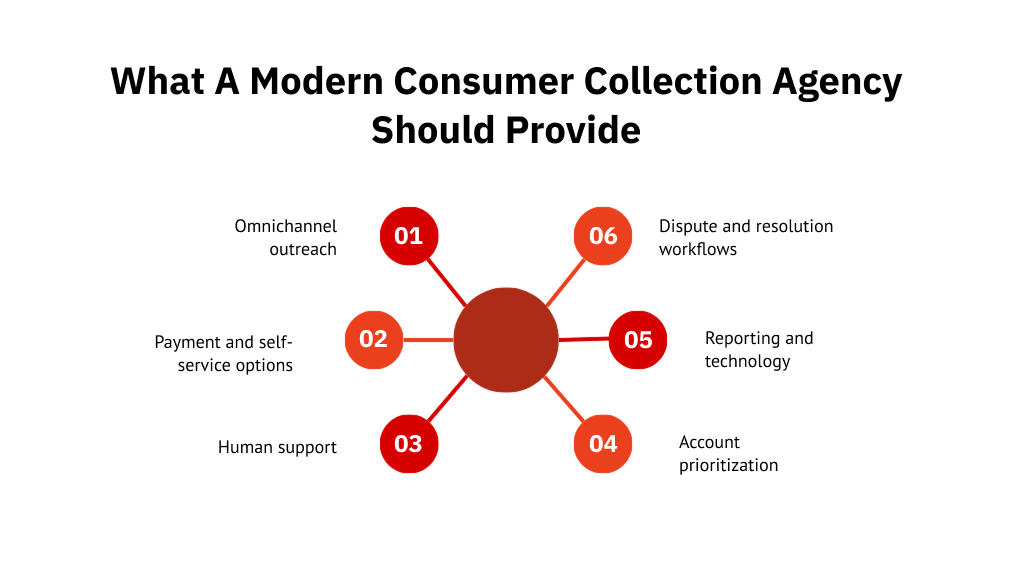
A modern consumer collection agency should connect outreach, payment resolution, self-service, reporting, and technology within one coordinated recovery model. The goal is to move accounts toward resolution while giving creditors clear visibility into treatment, responses, and portfolio performance.
That requires more than adding digital channels to a calling strategy. Each channel, payment path, and human intervention should support the same account strategy.
Omnichannel outreach and account recovery
Effective omnichannel collections coordinate phone, SMS, email, and chat rather than operating each channel independently. Outreach should reflect account status, prior responses, available contact information, and the permitted treatment for that account.
A strong recovery process may also include:
- prioritizing accounts based on portfolio and account characteristics;
- adjusting follow-up when consumers respond or remain unreachable;
- using appropriate skip tracing when contact information needs updating;
- moving engaged consumers into negotiation or resolution workflows; and
- escalating accounts when the current treatment no longer fits the recovery stage.
At the same time, human support remains important within an omnichannel recovery model. Digital outreach can improve contactability, while trained agents can handle disputes, questions, negotiations, and situations requiring judgment.
Payment and self-service options
Once contact is established, the agency should make resolution straightforward. Secure payment access can reduce friction between outreach and action, especially when consumers can respond outside traditional service hours.
Buyers should evaluate whether the recovery model supports payment in full, flexible plans, and authorized settlement or promotional offers where appropriate. Personalized payment links can provide another path to resolution. Callback scheduling, chat, and human assistance also matter when self-service alone cannot resolve the account.
The operational question is whether those options connect back to account status and approved treatment rules.
Reporting and technology
Reporting should give creditors visibility into portfolio treatment and outcomes. Meanwhile, analytics and automation can help determine which accounts need attention and when.
Technology can support prioritization, outreach timing, channel selection, workflow changes, and follow-up based on response patterns. However, automation should operate within defined recovery and compliance controls rather than replace operational oversight.
For buyers, the value lies in understanding how treatment decisions affect portfolio performance. That visibility helps teams identify exceptions, detect treatment gaps, and determine when recovery strategy needs adjustment.
How to choose a consumer debt collection agency
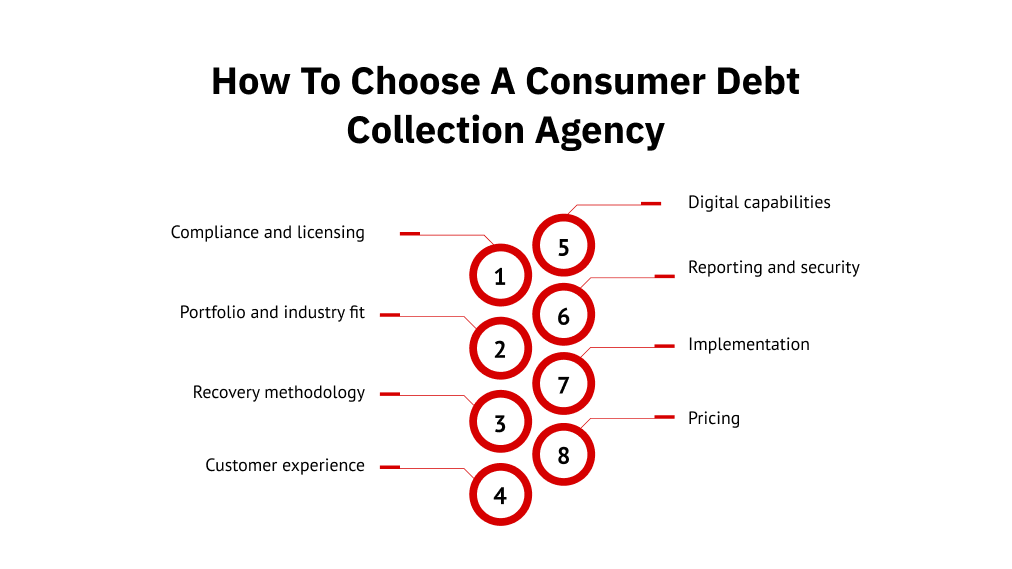
Choosing a consumer debt collection agency requires more than comparing recovery rates or fees. Assess portfolio fit, compliance, customer treatment, execution, and supporting evidence.
Verify compliance and licensing
The Consumer Financial Protection Bureau (CFPB) Regulation F addresses communications, validation, disputes, prohibited practices, and record retention. It implements the Fair Debt Collection Practices Act (FDCPA) for covered debt collectors.
Verify applicable state licensing, training, complaint handling, dispute procedures, and recordkeeping. Ask how the agency documents and monitors controls. A provider should support its debt collection compliance claims with policies, audits, licenses, or relevant evidence.
Match the agency to your debt and industry
Portfolio fit varies by account type, delinquency stage, volume, and regulatory environment. Ask for comparable portfolio experience.
Healthcare portfolios may require different documentation and customer-service approaches than auto finance or subscriptions. Confirm that staffing, workflows, and escalation paths match the portfolio being placed.
Evaluate the recovery methodology
Ask how accounts are prioritized and how treatment changes when consumers respond, dispute balances, or remain unreachable. The methodology should explain when digital outreach, human collectors, payment arrangements, or escalation enter the workflow.
Also ask for performance evidence tied to a comparable portfolio, service model, and account stage. That context helps distinguish repeatable methods from unsupported claims.
Evaluate customer experience and digital capabilities
Assess how SMS, email, voice, chat, mobile access, and self-service work together. Determine whether consumers can move from outreach to secure payment, payment plans, callbacks, or human assistance without unnecessary friction.
Ask how channel use changes with account status and response patterns. A coordinated journey should adapt treatment rather than apply one pattern to every account. For the business, that supports clearer resolution paths and customer treatment.
Review reporting, security, implementation, and pricing
Ask what reporting your team will receive and which portfolio questions it can answer. Review data-transfer methods, security controls, onboarding requirements, and implementation responsibilities.
Pricing should be evaluated against the proposed service model and scope. Verify how the provider prices first-party and third-party programs, including differences between digital-only and agent-supported services.
Red flags across your evaluation
Warning signs can reveal governance or execution gaps. Unverifiable licensing or unclear compliance controls may create oversight concerns.
Guaranteed recovery claims should prompt scrutiny because outcomes vary by portfolio, account age, and service model. Phone-only strategies may indicate limited channel flexibility. Weak dispute processes, unclear security practices, limited reporting, or unsupported technology claims can also make performance harder to verify.
| Use these checklists to complete your evaluation: 1. Does the agency have relevant portfolio and industry experience? 2. Can it document compliance controls and applicable licensing? 3. Does its first-party or third-party model fit your account stage? 4. Are outreach channels coordinated across the recovery journey? 5. Which payment and self-service options are available? 6. What reporting, security, and implementation controls are provided? 7. Can the agency support performance and technology claims with relevant evidence? |
How First Credit Services supports consumer collections
At First Credit Services, we support consumer collections as a revenue recovery and customer engagement partner for high-volume organizations. Our managed programs can cover both first-party and third-party recovery, aligning treatment with delinquency stage, customer-relationship goals, and portfolio needs.
In first-party programs, we can operate under the client’s brand for early-stage recovery. Our third-party programs address late-stage or seriously delinquent accounts under the First Credit Services brand. This distinction helps organizations align account maturity with the customer experience they want to preserve.
We bring more than 30 years of receivables management experience and manage more than 125 million consumer interactions annually. Our managed approach can also support credit card and consumer loan collections where financial-services expertise is relevant.
We operate UCEP (Unified Consumer Engagement Platform) on the client’s behalf. It supports coordinated digital engagement, payment access, and workflow adaptation. We manage integration, outreach strategy, sequencing, reporting, and program optimization.
Our model is designed for high-volume organizations, particularly mid-market and enterprise businesses managing substantial consumer portfolios and complex recovery requirements.
Choose a consumer debt collection agency that fits your recovery model
Choosing the right consumer debt collection partner requires balancing recovery capability, compliance controls, customer treatment, and operational visibility. The strongest fit should align with your account types, delinquency stages, internal capacity, and preferred recovery model.
Look beyond headline recovery claims or pricing alone. Consider whether the provider can demonstrate an operating model that your team can oversee and evaluate. Relevant portfolio experience should support that model, while clear payment paths and reporting should help maintain visibility throughout recovery.
Your final decision should reflect how well the provider fits your current portfolio and how accounts progress through recovery. The right operating model should also give your team clear oversight as account treatment changes.
That alignment helps you evaluate performance without losing sight of customer treatment, compliance expectations, or internal control.
Ready to choose a recovery partner that fits your portfolio? Discuss your portfolio type, delinquency stage, and recovery model with our team to evaluate the right managed recovery approach for your organization.
FAQs
1. When should a business outsource consumer debt collection?
A business should consider outsourcing when internal capacity, account volume, or recovery performance no longer supports effective follow-up. The decision should also reflect delinquency stage, portfolio complexity, customer strategy, and the level of specialized recovery support required.
2. Can a consumer debt collection agency work with an in-house collections team?
Yes. A consumer debt collection agency can complement an internal team when responsibilities and account stages are clearly defined. Businesses may outsource selected portfolio segments or recovery stages while retaining other activities internally.
3. How should businesses measure a consumer collection agency’s performance?
Businesses should measure performance against agreed metrics that reflect the portfolio and service model. Evaluation may include recovery results, account resolution, consumer engagement, payment activity, dispute handling, and reporting quality rather than relying on one headline recovery rate.
4. What data security controls should businesses look for in a collection agency?
Businesses should look for documented access controls, secure data-transfer practices, monitoring, audits, and relevant independent assurance. Depending on the portfolio, certifications or frameworks such as SOC 2 Type II, PCI DSS Level 1, and HIPAA compliance may also be relevant.
5. What information should a business provide to a consumer collection agency?
Businesses should provide accurate account-holder details, balances, payment history, creditor information, dispute status, and available supporting documentation. They should also establish clear processes for account updates, data transfer, reporting, and authorized resolution options before placement.
6. Can a consumer collection agency handle accounts across multiple states?
Yes, when applicable licensing, registration, bonding, and jurisdiction-specific requirements are satisfied. Businesses with multi-state portfolios should verify geographic coverage and applicable licensing before placing accounts with a consumer collection agency.