

A failed payment does not have to become lost revenue or involuntary churn. The right failed payment recovery solution can turn recoverable declines into resolved payments through coordinated retries, customer outreach, and follow-up.
Stripe reports that its Smart Retries have helped businesses recover an average of 57% of recurring payments that originally failed. That result is specific to Stripe, yet it shows why failed-payment workflows deserve closer scrutiny.
For finance, billing, subscription operations, revenue, accounts receivable, and recovery leaders, the buying decision extends beyond automated retries. You need to understand how dunning, customer communication, managed follow-up, implementation ownership, and measurement work together.
Gaps between these functions can leave recoverable revenue unresolved or create unnecessary customer friction. Those gaps also complicate attribution, staffing decisions, and the handoff after automation ends.
This guide will help you compare recovery models and evaluate the capabilities and operating responsibilities that matter. You will also see how to close persistent gaps in your recurring-payment workflow.
How does failed payment recovery work from first decline to resolution?
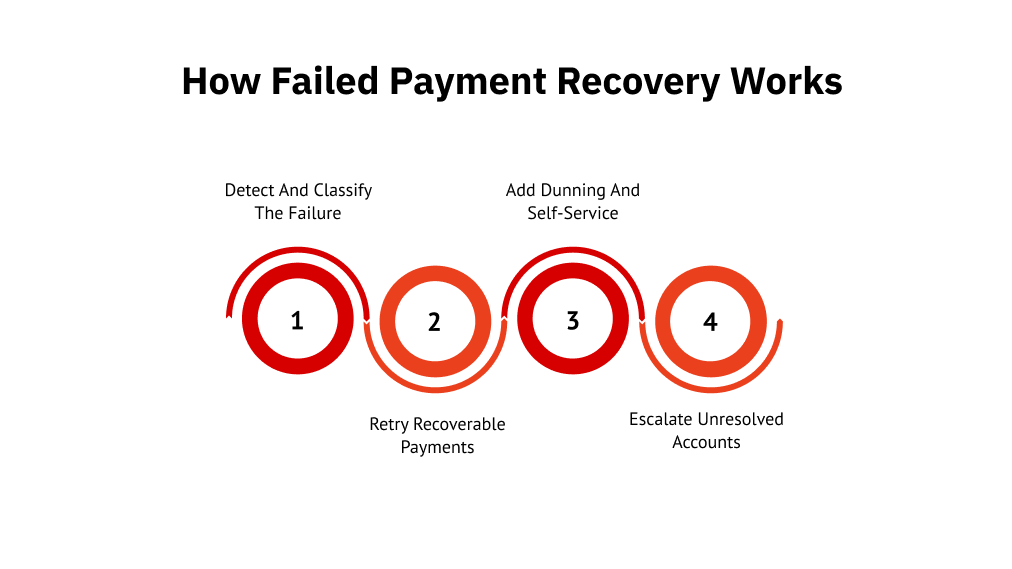
Failed payment recovery works best as one coordinated workflow from decline detection through final resolution or handoff. Payment technology may handle retries, while customer engagement teams manage communication, payment support, and unresolved accounts.
1. Detect and classify the failure
The first step is identifying why the transaction failed and what action is appropriate. Payment-status information can distinguish temporary failures from cases requiring updated credentials, authentication, or customer action.
Chargebee, for example, distinguishes hard declines from soft declines in its Smart Dunning documentation. Soft declines may become recoverable later, while hard declines can require intervention. That distinction prevents unnecessary retries and directs attention toward cases that need customer action.
2. Retry recoverable payments
Retry logic should reflect both the failure type and the rules governing the payment method. While fixed retries follow predetermined intervals, smart retries use available payment signals or transaction-error patterns to determine when another attempt may be appropriate.
Adyen’s Auto Rescue documentation describes automated retry logic for eligible refused transactions that may succeed later. However, retry design still needs to respect payment-system and card-network constraints. Repeated attempts without sufficient logic can increase declines, create processing issues, and waste recovery opportunities.
3. Add dunning and self-service
When retries alone cannot resolve the failure, dunning management adds customer communication when the account holder must update payment details or take another action.
A coordinated process may include:
- Send payment-failure notices.
- Prompt customers to update a payment method.
- Time reminders around retry activity.
- Provide direct paths to complete payment or resolve issues.
Channel support varies by provider, so buyers should verify what is available. The goal is to improve contactability and payment access without increasing customer effort, complaint risk, or avoidable churn.
4. Escalate unresolved accounts
When automated retries and dunning stop producing resolution, ownership should shift clearly. Human support or managed first-party recovery can address cases needing conversation, clarification, or additional follow-up.
Define the handoff before launch by specifying who receives unresolved accounts, what information follows them, and which outcomes close the workflow.
During vendor selection, evaluate the entire chain rather than isolated features. Strong recovery depends on clear responsibility across payment technology, customer engagement, and the final recovery outcome.
With clear ownership across those steps, finance and recovery leaders can see which stage recovered revenue. They can also identify where unresolved balances require attention next within the recovery workflow.
Which failed-payment recovery model best fits your business?
The best recovery model depends on which parts of the failed-payment workflow your existing systems and teams already handle well. For many enterprise businesses, a layered approach works better because payment processing, outreach, exceptions, human conversations, and escalation often require different capabilities and owners.
| Recovery approach | Automated retries | Customer outreach | Human follow-up | Internal workload | Best fit |
| Native billing/payment recovery | Usually core capability | Standard notifications | Usually limited | Lower if already configured | Businesses with straightforward retry needs |
| Dedicated recovery software | Often specialized | Dunning and messaging workflows | Varies by provider | Moderate | Businesses seeking deeper automation |
| Managed first-party recovery | Complements payment-stack retries | Managed, branded engagement | Core capability is configured | Lower operational burden | Businesses needing managed resolution |
Native billing or payment-platform recovery
Native recovery keeps failed-payment handling close to the existing billing or payment environment. It is generally best suited to businesses that mainly need automated retries, payment-method updates, billing-state changes, and standard notifications.
Because the capability already operates within the payment stack, implementation can involve fewer new systems. However, internal teams still need to determine retry settings, monitor outcomes, manage exceptions, and decide what happens when automated recovery ends.
They also remain responsible for adjusting retry rules and monitoring performance over time. That ownership matters as failure patterns and payment behavior change.
Dedicated failed-payment recovery software
Dedicated software can add specialized retry logic, dunning workflows, messaging, analytics, or retention capabilities beyond native billing tools. This approach can suit businesses that want more control over automated recovery without outsourcing the customer-engagement process.
However, buyers should examine gateway dependencies, configuration requirements, pricing, and optimization ownership. A feature set can increase implementation work if internal teams must connect systems, maintain workflows, interpret results, and coordinate exceptions across multiple platforms.
Managed first-party failed-payment recovery
Managed first-party recovery fits businesses that need external operational support after payment technology has completed its role. Through first-party collections, an external partner can manage branded customer engagement and payment resolution while complementing existing billing and payment systems.
This model adds human follow-up and managed outreach without requiring internal teams to operate recovery steps themselves. Its implementation still requires clear data flows, account-status updates, escalation rules, and defined responsibilities between the business and recovery partner. Ongoing optimization also depends on the provider’s operating scope and agreed program design.
For enterprise buyers, the decision is about choosing the right combination of capabilities and owners for recovery performance. A layered model can combine automated payment recovery, specialized software, and managed engagement where each approach provides the strongest fit.
What should you look for in a failed payment recovery solution?
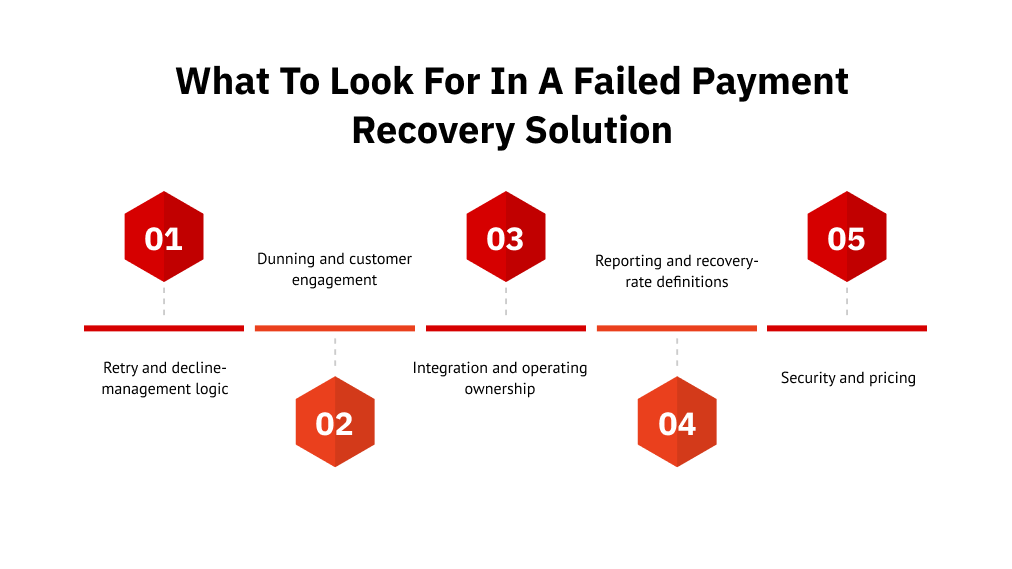
Evaluate a failed payment recovery solution by the workflow it can execute, its recovery logic, ownership model, and measurement approach. Buyers should confirm where each provider’s responsibility starts, where it stops, and how recovery performance is calculated.
Retry and decline-management logic
Start by checking how the provider handles different failure types.
- Ask how retryable declines are identified and when another payment attempt is appropriate.
- Confirm how non-retryable failures move into customer action, authentication, or another recovery path.
- Determine whether retry logic is native, supplied by another payment platform, or outside the provider’s scope.
This distinction matters because overlapping systems can create duplicate or poorly timed attempts. Clear ownership reduces confusion over who controls retry timing and what triggers the next step.
Dunning and customer engagement
Next, evaluate whether communication supports resolution rather than simply adding more messages.
- Confirm which channels the provider supports and how they coordinate with retry activity.
- Review how payment-update prompts and self-service paths reduce customer effort.
- Assess whether messaging supports contactability, brand continuity, churn reduction, and complaint-risk management.
For businesses evaluating omnichannel debt collection, the key question is whether each channel serves a defined recovery purpose.
Integration and operating ownership
Integration should be reviewed by examining both the technical connection and the operational responsibilities required to keep the recovery workflow functioning.
- Confirm required data sources, status updates, and systems of record.
- Ask who owns implementation, testing, exception handling, and ongoing optimization.
- Verify how failed updates, data mismatches, or workflow breaks are resolved.
An available application programming interface (API) does not guarantee plug-and-play deployment. Data mapping, workflow design, and operational ownership can still create significant internal work.
Reporting and recovery-rate definitions
Before comparing provider performance, make sure every recovery metric uses the same rules.
- Define which failed payments are eligible for recovery-rate calculations.
- Confirm the recovery window, exclusions, and attribution rules.
- Ask how recovered revenue and customer-initiated payments are counted.
Without shared definitions, similar account outcomes can produce very different reported recovery rates. It also makes vendor comparisons more defensible across finance, operations, and procurement teams with different operating models and pricing structures.
Security and pricing
Finally, evaluate security responsibilities and commercial structure together.
The PCI Security Standards Council explains that the Payment Card Industry Data Security Standard (PCI DSS) sets requirements for protecting payment account data.
- Confirm which parties store, process, transmit, or can affect the security of payment data.
- Compare software fees, implementation costs, and managed-service pricing separately.
- Identify any internal configuration, exception management, or optimization work that remains after launch.
A strong buying decision comes from matching payment-stack fit, recovery ownership, security responsibilities, measurement rules, and pricing to the workflow your organization actually needs.
How should you implement and measure a failed payment recovery program?
A failed payment recovery program should translate the selected recovery model into clear ownership, shared measurement rules, and defined handoffs. Before launch, map how data, communications, exceptions, reporting, and escalation move between systems and teams.
Map data, ownership, and handoffs
Start by identifying the system of record and the event that triggers recovery activity. Then document how payment-status data moves, which team acts on each status, and how updates return to the billing or customer record.
The operating map should answer five questions:
- What event triggers the next recovery action?
- Who owns that action?
- Which system provides the required data?
- How is success recorded?
- Where does the account move if the step fails?
This mapping prevents accounts from becoming trapped between billing, recovery software, customer service, and managed outreach. It also makes exception handling easier because each failure state already has an assigned owner.
Measure more than the headline recovery rate
Recovery rate is useful only when everyone calculates it from the same population and recovery window. Establish shared definitions before reporting begins so billing retries, recovery software, managed outreach, and customer-initiated payments do not claim the same result.
Where data is available, track eligible failures, recovered revenue, recovery rate, time to recovery, recovery method, customer-action rate, and unresolved balances. These measures show both what was recovered and how the recovery occurred.
A practical measurement framework can look like this:
| Trigger | Owner | Action | Success metric | Next handoff |
| Initial payment failure | Billing or payment system | Classify and retry where appropriate | Successful retry | Dunning or customer action |
| Customer action required | Dunning or engagement workflow | Send notice and payment path | Update or completed payment | Managed follow-up |
| Automated recovery ends | Assigned recovery team | Review and contact unresolved accounts | Resolution or defined outcome | Approved next treatment |
Set the recovery window and next treatment
The recovery window should define when automated retries and dunning stop, along with the treatment that follows. That decision should reflect failure patterns, customer value, staffing capacity, and internal recovery policy.
When automation ends, unresolved accounts should move immediately to a named owner. Depending on the program, that may be managed first-party follow-up or another internally approved treatment.
With those ownership rules in place, finance and recovery leaders can measure each stage more accurately across reporting periods. They can see where recovery occurred, how long it took, and which balances remain unresolved.
How First Credit Services supports failed payment recovery
At First Credit Services, we support failed payment recovery through managed first-party programs for early-stage, brand-sensitive accounts. Our model complements existing billing and payment systems by managing customer outreach after automated recovery reaches its limits.
For recurring-revenue businesses, we can coordinate Short Message Service (SMS), email, chat, phone engagement, and self-service payment access. We manage messaging strategy, reporting, and program optimization so clients do not need to operate the recovery platform themselves.
We operate UCEP (Unified Consumer Engagement Platform) on the client’s behalf to coordinate these recovery activities.
Depending on implementation design, data can move through an application programming interface (API), Secure File Transfer Protocol (SFTP), or direct customer relationship management (CRM) sync. Integration responsibilities are established during onboarding rather than assumed to be plug-and-play.
A coffee subscription company testimonial on our first-party collections page reports recovery of more than 70% of failed payments each month. That result reflects one client’s experience and is not a universal recovery benchmark.
Our managed model can reduce internal follow-up demands while preserving branded engagement. It best fits medium-to-large and enterprise recurring-revenue organizations that need managed follow-up alongside existing billing infrastructure.
Close the gaps in your failed payment recovery strategy
The right recovery approach depends on where your current payment stack stops resolving failed transactions effectively. Smart retries, dunning software, and managed recovery address different parts of the workflow. Buyers should assess how those capabilities fit together and where ownership gaps remain.
Before choosing a provider, map your failure volume, existing billing capabilities, staffing capacity, customer-experience requirements, implementation resources, and unresolved-account workflows. That exercise exposes ownership gaps, duplicated effort, and stages where recoverable revenue may still require follow-up.
Ready to close recovery gaps with managed first-party follow-up? Discuss your failed-payment recovery needs with our team to evaluate a managed first-party program for your recurring-revenue operations.
FAQs
1. How much does a failed payment recovery solution cost?
Pricing depends on the operating model and scope. Buyers should distinguish software subscription costs, implementation expenses, managed staffing, and recovery-based pricing because each model assigns cost and operational responsibility differently.
2. Does a failed payment recovery solution replace a billing platform?
Usually, no. Most recovery solutions complement existing billing or payment systems by handling retries, dunning, customer engagement, or follow-up after a payment fails.
3. Can failed payment recovery work across multiple payment gateways?
It depends on the provider’s technical model and supported data flows. Businesses should verify gateway compatibility, required payment-status data, and how updates move between systems before assuming one recovery workflow can span multiple gateways.
4. Can vendors guarantee a specific failed payment recovery rate?
A guaranteed recovery rate should be treated cautiously unless the provider clearly defines the eligible failure population, exclusions, and measurement window. Buyers should compare methodology before relying on headline performance claims.
5. How long should a business retry a failed recurring payment?
There is no universal retry period. The appropriate window depends on decline type, billing cadence, payment-system rules, customer communication, and the business’s policy for moving unresolved accounts into another recovery treatment.
6. What should happen to service access while a recurring payment is being recovered?
Service access should follow a defined business policy that aligns with the recovery window. Grace periods, suspension, or cancellation rules should coordinate with retry activity and customer outreach to avoid conflicting account actions.