


A customer service outsourcing company is a third-party provider that manages support across phone, email, chat, or social media on a business’s behalf. It helps you reduce costs, extend coverage, and tap into specialized compliance-certified support teams.
If you’re reading this, you have likely already decided to outsource. The real question now is which partner to trust with your customers’ data. According to Deloitte’s “The Power of a Multidimensional Workforce” 2026 report, 67% of organizations have adopted outcome-based outsourcing models that prioritize measurable results over headcount. That shift changes how you should evaluate a partner. It is no longer just about seat count or hourly rates.
For regulated businesses, the stakes run higher. A support ticket that touches a payment, an account balance, or personal health information carries real compliance risk with the wrong vendor.
This guide covers what the term means, how to choose a partner, and what a compliance-first provider should offer. It also breaks down outsourcing costs and the mistakes that tend to surface six months into a contract.
How to choose a customer service outsourcing company
Picking the right partner for customer service outsourcing comes down to five factors. These are volume and channel fit, compliance and data security, industry experience, pricing model, and technology readiness. Weigh each one against your own ticket volume and risk profile before you shortlist outsourced customer service providers.
Start with the most concrete factor: how much support your team handles today, and how varied it already is.
1. Volume and channel fit
Evaluate whether your ticket volume, channel mix, and coverage requirements justify the overhead of managing an external partner. A business fielding a few hundred tickets a month on one channel usually does not need outside help. The coordination cost outweighs the benefit.
Once volume climbs into the thousands, or spans phone, email, chat, and social at once, internal teams start missing coverage windows. A few signals it may be time to look outside:
- Ticket volume spikes during peaks, such as renewal cycles or holiday seasons, that overwhelm your team
- Coverage gaps outside business hours or across time zones
- Channel expansion outpacing hiring, such as adding chat or social without adding staff
Once volume and channel fit make the case for outsourcing, compliance decides which vendors even belong on your list.
2. Compliance and data security
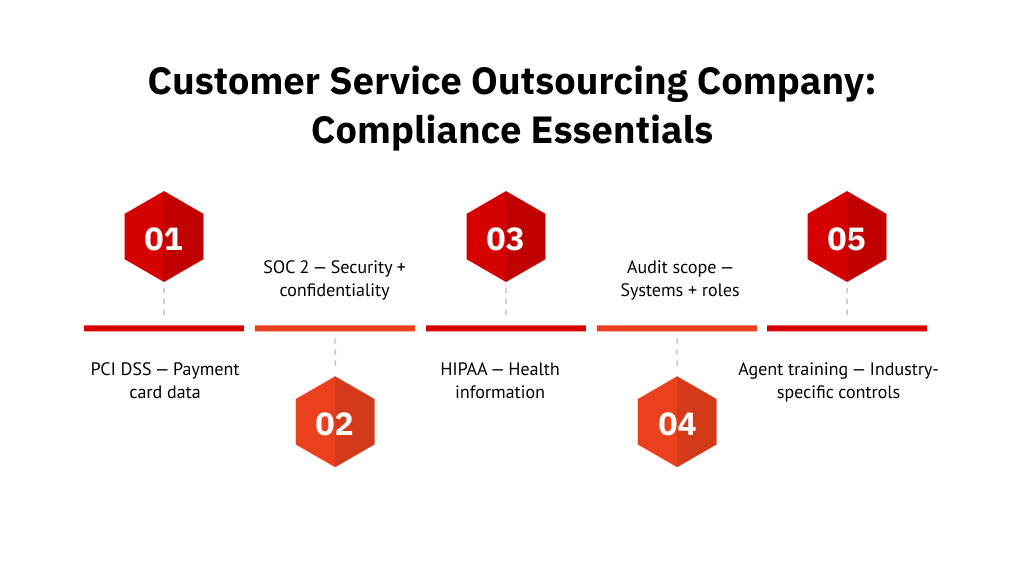
Require documentation from every vendor instead of taking their compliance claims at face value. If any of your ticket volume touches payment card data, the PCI Data Security Standard sets the baseline security controls a provider must meet.
If tickets involve account balances, billing disputes, or other sensitive financial data, look for a current SOC 2 report covering security and confidentiality.
Healthcare or health-adjacent support adds another layer. Any ticket that touches a medical bill or a diagnosis falls under HIPAA, so agents need training and access controls built around it.
Ask for the actual audit report or bridge letter, never just a website badge. Then confirm the scope too: who conducts the audit, how often, and which systems it covers.
| Pro tip: Ask a vendor to name the specific systems and agent roles inside their audit scope. A company-wide compliance badge can still leave the team handling your account outside that boundary. |
Certifications set a floor. Industry experience decides how well a team actually applies them.
3. Industry and regulatory experience
General e-commerce or SaaS support experience does not transfer cleanly to regulated categories. A team that has spent years resolving retail order disputes needs real ramp-up time before it understands loan servicing complaints or health plan appeals.
Ask for specifics before you sign anything:
- Which regulated verticals does the vendor currently serve?
- How are agents trained on vertical-specific escalation rules?
- What happens when a routine ticket turns into a formal complaint?
With compliance and experience confirmed, pricing decides who actually carries the operational risk.
4. Pricing model alignment
Each model shifts risk differently between you and the vendor:
- Hourly pricing suits unpredictable volume, since you pay for time worked rather than output.
- Per-ticket pricing suits high-volume, low-complexity work, where cost tracks cleanly with output.
- Dedicated teams suit steady, predictable volume that justifies a fixed monthly cost.
- Outcome-based pricing shifts more risk onto the vendor, tying payment to resolution rates or service levels.
The right model depends on how predictable your volume is and how much risk you want to hand off.
5. Technology and AI readiness
Technology decides how efficiently a vendor manages that risk day to day. The Deloitte Global Outsourcing Survey 2024 found that 83% of surveyed executives already run AI inside their outsourced services. Most use it for ticket triage, routing, and summarization.
Ask a vendor how their AI actually gets used. Confirm whether it only handles first-line deflection, or whether it also supports quality monitoring and agent coaching. Then ask how human escalation works when it falls short.
Why compliance and certification matter in CX outsourcing
Most support tickets are straightforward. Shipping questions, login problems, and general complaints all resolve the same way, regardless of who answers the phone. A ticket becomes something else the moment it touches money or protected information.
Take a request like “why was I charged twice?” or “can you confirm my balance?” That ticket stops being routine support once it touches payment or account data. It now needs the same escalation discipline and audit trail as a regulated call. A vendor without the right compliance program can turn a routine question into real liability for your business.
Data breaches make that risk concrete. According to the IBM Cost of a Data Breach Report 2025, financial services breaches averaged $5.56 million, the second-costliest sector measured after healthcare.
| Did you know? The IBM Cost of a Data Breach Report 2025 found that breaches identified and contained within 200 days cost organizations an average of $3.87 million, compared to $5.01 million when detection drags past the 200-day mark. |
That gap between sectors is not random. It tracks how much sensitive data flows through a given industry’s support tickets, and how attractive that data is to attackers.
Use these criteria to evaluate any provider handling regulated support volume:
| Criteria | What It Looks Like in Practice |
| Scale and operating track record | Multiple delivery sites and enough agent capacity to absorb a volume spike without a service dip |
| Certified compliance program | Current compliance documentation, backed by regular internal audits and ongoing agent training |
| Onshore or offshore delivery flexibility | The ability to route sensitive tickets to onshore teams while offshore teams handle lower-risk volume |
| Volume across regulated sectors | Real experience with the compliance patterns of healthcare, financial services, or other regulated categories |
| Multi-decade operating history | A track record long enough to have been tested and refined across multiple regulatory cycles |
| Pro tip: Certifications and scale narrow your shortlist, but they do not replace due diligence on your own ticket volume and use case. Confirm the fit before you sign. |
Scale and documented compliance are two practical criteria to consider when evaluating CX outsourcing services for regulated, high-volume operations.
For example, First Credit Services is one provider that combines experience across regulated industries with established compliance credentials. Its capabilities include support for sectors such as healthcare, fintech, consumer lending, automotive finance, government, and health and fitness. The company also maintains HIPAA, PCI DSS Level 1, and SOC 2 Type II credentials.
What does customer service outsourcing cost?
Pricing among customer service outsourcing companies depends heavily on delivery model, and each option trades cost against control.
Here is how the major models typically compare:
| Delivery Model | Hourly Range | Best Fit |
| Onshore | $25 to $38/hr | Regulated or complex support where compliance and native-language nuance matter most |
| Nearshore | $10 to $25/hr | Time-zone-aligned coverage with strong English or bilingual support at a lower cost than onshore |
| Offshore | $7 to $15/hr | High-volume, lower-complexity tickets where cost efficiency outweighs time-zone overlap |
| Per-ticket | $0.50 to $2.50 per ticket | High-volume, low-complexity work where cost should track directly with output |
| Per agent, per month | $1,200 to $3,500+ | Steady, predictable volume that justifies a dedicated offshore or nearshore team |
Hourly rates only tell part of the story. Most pricing lists bury a few costs that show up later:
- Setup and onboarding fees, often charged before a single ticket is handled
- Integration costs for connecting the vendor to your CRM, helpdesk, or other systems
- Minimum team-size or seat requirements that raise the floor regardless of your actual volume
Treat the ranges above as directional estimates rather than a quote. Actual rates vary by geography, language requirements, support complexity, service levels, technology, and contract structure.
Maximizing efficiency in a customer service outsourcing budget starts with confirming current pricing directly with any vendor before you build a budget around it.
Common mistakes to avoid when choosing a partner
Common mistakes can still undermine an outsourced customer service partnership. These five mistakes account for most of the regret buyers report six months into a contract:
- Choosing on price alone. The cheapest hourly rate often comes with the least experienced agents and the thinnest compliance program.
- Skipping compliance-scope questions. An unverified certification offers no real protection against your actual ticket types.
- No pilot period before a full contract. A demo script looks nothing like your real ticket volume under real conditions.
- SLAs that define response time without covering resolution quality. A fast reply that does not solve the problem just moves the complaint downstream.
- No defined escalation path for sensitive tickets. Payment disputes or account issues can sit in a general queue until they turn into bigger problems.
Fixing these upfront, before you sign, costs far less than fixing them after a bad rollout.
How to evaluate and onboard a partner
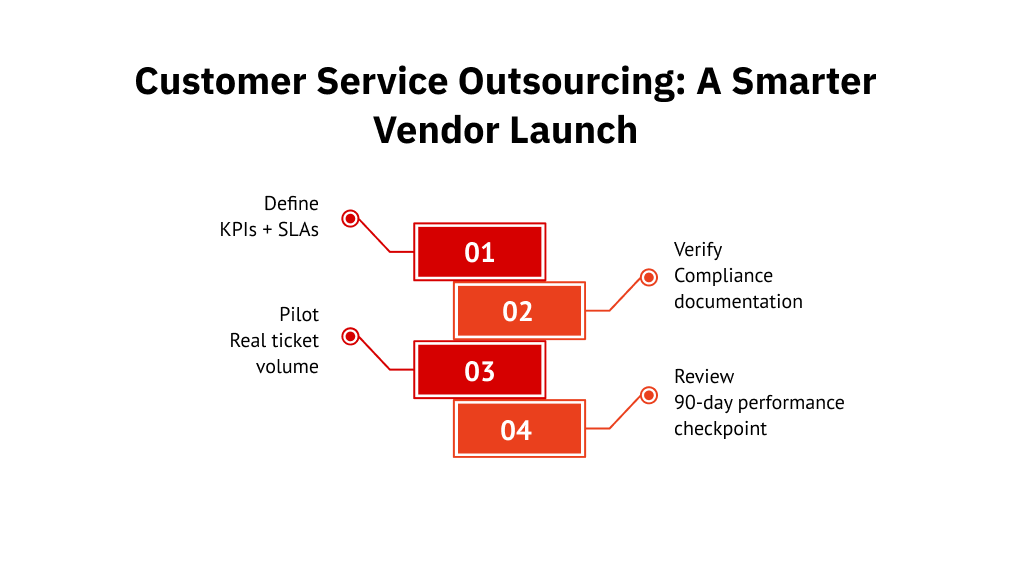
A structured process for business process outsourcing catches most of the mistakes above before they cost you anything. Here is a straightforward sequence to follow:
- Define your KPIs and SLAs before the RFP goes out, so every vendor responds to the same standard instead of setting their own.
- Shortlist three to five vendors and request their compliance documentation upfront, before you have already picked a favorite.
- Run a paid pilot against real ticket volume instead of a polished demo script, so you see how the team handles your actual edge cases.
- Set a 90-day review checkpoint before scaling, so problems surface while the contract is still easy to adjust.
None of this adds much time to a normal procurement cycle. It just moves the hard questions earlier, when they are still cheap to answer.
FCS operates global call centers with onshore and offshore support capacity, including teams in the U.S. and India. This gives you flexibility to evaluate coverage and delivery models across outsourced customer service providers during a pilot.
What to prioritize
Choosing a customer service outsourcing company comes down to a few decisions rather than a long checklist. You now know what volume and channel mix actually justifies handing support off. You also know which certifications are non-negotiable for your industry, and how each pricing model shifts risk between you and the vendor.
The best way to test a partner before committing is to request their compliance documentation and run a 90-day pilot against your actual ticket volume and industry.
Weighing compliance risk against cost on your shortlist? Reach out to FCS about how customer service outsourcing is handled for regulated industries.
FAQs
1. What is the difference between a customer service outsourcing company and a call center?
A call center typically handles phone-based support only, usually just inbound or outbound calls. A customer service outsourcing company manages support across every channel, including phone, email, chat, and social, functioning as a broader, fully managed extension of your team rather than a single-channel vendor.
2. How much does it cost to outsource customer service?
Costs vary by delivery model, geography, ticket complexity, coverage requirements, and contract structure. Outsourcing may be priced hourly, per ticket, per agent, or through an outcome-based model. Ask providers for current rate cards and a full breakdown of setup, technology, and minimum-volume costs before you build a budget.
3. What certifications should a customer service outsourcing company have?
Look for SOC 2 and PCI DSS at minimum, since both confirm independently audited controls over sensitive data. HIPAA alignment matters the moment support touches a medical bill or account balance. Always request the actual audit report or bridge letter, not just a website compliance badge.
4. Can a customer service outsourcing company handle regulated industries like fintech or healthcare billing?
Yes. Most established providers can, but not every one is built for it, since general e-commerce or SaaS experience does not transfer cleanly to regulated categories. Confirm certification scope, agent training on vertical-specific rules, and escalation protocols before signing, not after onboarding starts.
5. How long does it take to launch an outsourced customer service program?
Launch timelines vary based on team size, system integrations, training requirements, data-access reviews, and compliance requirements. Regulated-industry programs typically need additional time for access controls, documentation, and agent certification. Ask shortlisted vendors for a detailed implementation timeline before you sign anything.
6. Is outsourcing customer service cheaper than hiring in-house?
Yes. Usually, once recruiting, training, benefits, and infrastructure costs are counted against an in-house build, outsourcing tends to come out ahead. Savings are less certain for highly specialized or low-volume needs, where coordination overhead can outweigh what you’d save on headcount alone.