


A missed membership payment can look minor on one account. Across hundreds or thousands of members, it can quickly become a recurring revenue problem. Effective gym debt collection starts with recognizing that tension early, before recoverable payment failures become harder-to-resolve balances.
The Health & Fitness Association reported roughly 77 million U.S. fitness facility members in 2024. For gyms using recurring payments, every failed transaction can interrupt expected membership revenue. When cards expire, payments decline, or members disengage, unpaid dues can accumulate across locations and billing cycles.
For gym owners, franchise operators, receivables managers, and finance teams, the challenge is balancing recovery with retention. Aggressive outreach can damage member relationships, while slow escalation can weaken cash flow and increase internal workload. The right approach separates routine payment failures from true delinquency, then applies the appropriate recovery path.
This guide explains when to escalate unpaid dues, how compliance shapes recovery, and what matters when choosing a specialist collection partner.
What is a gym debt collection?
Gym debt collection is the process of recovering unpaid membership dues after a gym’s routine billing and internal recovery efforts have been unsuccessful. It typically begins when the account requires dedicated outreach, payment resolution, and follow-up beyond the gym’s standard billing process.
That distinction matters operationally. A declined card or expired payment method can cause involuntary churn even when a member still intends to pay. An unresolved balance after a member disengages may require formal collection activity. Treating both situations alike can create unnecessary escalation.
Why members fall behind on gym dues
Members fall behind on gym dues for reasons ranging from routine billing failures to genuine financial hardship. Recognizing the cause helps you choose a response that matches the account.
Expired cards and declined transactions can interrupt recurring billing even when a member intends to continue paying. Insufficient funds create similar failures, although repeated declines may require a different response. Billing confusion can arise when members misunderstand renewal dates, cancellation terms, charges, or membership changes.
Financial hardship creates another challenge. A member may recognize the balance yet lack the ability to resolve it immediately. In these cases, repeated payment attempts alone may do little to address the underlying issue.
The operational risk comes from treating every missed payment as deliberate non-payment. Early identification helps your team separate routine billing recovery from accounts that require structured collection activity.
| Pro Tip: Segment failed payments from persistent non-payment before choosing a recovery path. The timing, tone, and outreach type should reflect why the balance became unpaid. |
The true cost of unpaid dues to your gym
Unpaid dues affect more than the balance attached to one membership. They reduce recurring revenue, increase recovery workload, and can turn otherwise retainable members into avoidable churn.
For gyms, the financial effect can spread beyond the original missed dues:
- Lost future membership revenue: An unresolved payment failure can stop recurring revenue from a member who never intended to leave.
- Replacement pressure: Every avoidable loss creates another membership your sales and marketing teams may need to replace.
- Accounts receivable drag: Accumulating balances require staff time for account review, member contact, payment reconciliation, and exception handling.
These costs compound across locations because billing failures create both revenue leakage and administrative work. Faster identification helps keep recoverable payment problems from becoming larger receivables-management issues.
When should a gym send an account to collections?
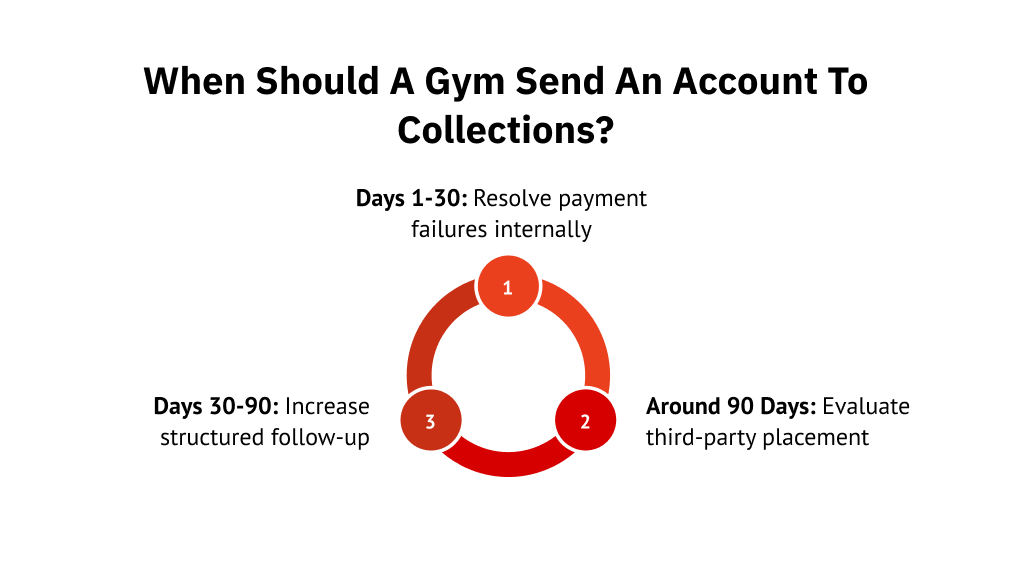
A gym should consider collections after reasonable internal recovery efforts fail and the balance shows signs of genuine delinquency. Timing should reflect the account, membership agreement, prior contact, and reason for non-payment.
Waiting for every account to reach a fixed age can be counterproductive. A recent card failure may need a payment update, while an older unresolved balance may justify structured escalation.
A practical escalation ladder can help your team make that distinction consistently:
- Days (1 to 30): Resolve payment failures internally: Retry eligible failed transactions and notify members promptly about declined or expired payment methods. Confirm billing information and the amount due before escalating.
- Days (30 to 90): Increase structured follow-up: If the balance remains unresolved, use consistent outreach and document contact attempts, responses, disputes, and payment commitments.
- Around 90 days: Evaluate third-party placement: Valid, unresolved, and unresponsive accounts may warrant referral to a collection partner. Verify balances, membership agreements, contact details, and previous recovery activity before placement.
The 90-day point should function as an evaluation marker rather than an automatic trigger. Some accounts may justify earlier or later action based on your policies and circumstances.
For soft payment failures, earlier intervention serves a different purpose. Resolving a declined transaction quickly can restore recurring billing before the account develops into a larger gym collections problem.
Staying compliant: FDCPA, Regulation F, and credit reporting
Compliance becomes especially important when unpaid gym dues move to a third-party debt collector. Applicable rules affect contact frequency, required disclosures, voicemail practices, and credit-reporting decisions.
What the FDCPA and Regulation F require
The FDCPA and Regulation F govern covered third-party debt collection activity. Their requirements depend on the debt, collector, and circumstances involved.
For gym membership collections, several rules directly affect outreach:
- Call frequency: Regulation F creates a presumption of violation after more than seven calls within seven consecutive days about a particular debt. It also generally restricts calls for seven days after a telephone conversation about that debt.
- Validation information: A collector generally must provide required debt validation information in the initial communication or within five days afterward. The Consumer Financial Protection Bureau provides Model Form B-1 for compliant disclosures.
- Voicemail: Regulation F defines a limited-content message with specific permitted content. This structure can support contact attempts while reducing unintended debt-disclosure risks.
For operators, partner oversight should include communication controls, documentation, and clear handling of disputes or contact preferences. A strong debt collection compliance framework should be evaluated at the workflow level.
| Trust consideration: Poor collection practices can create regulatory exposure and member complaints. Those issues can also undermine customer relationships your recovery process should preserve. |
Reporting to credit bureaus
Credit reporting requires its own controls. Under Regulation F, a debt collector generally cannot furnish debt information before taking specified steps to communicate with the consumer.
Reporting also creates obligations under the Fair Credit Reporting Act when an organization furnishes consumer information. Accuracy and dispute handling therefore require careful controls.
Because inaccurate or premature reporting can create disputes and relationship risk, gyms should avoid treating credit reporting as a routine collection step. Appropriate outreach should remain the operational priority for a member-focused recovery program.
In-house vs. outsourced vs. automated recovery
The right recovery model depends on account stage, portfolio volume, internal capacity, and compliance resources. In-house teams provide control, outsourcing adds specialized capacity, and automation supports repeatable outreach at scale.
Automation is therefore less a separate collection model than an execution approach. It can support internal teams or operate within an outsourced program.
| Factor | In-house team | Collection agency | Automation / omnichannel layer |
| Cost structure | Internal staffing and systems | Outsourced service cost | Technology and implementation costs vary by model |
| Recovery capability | Depends on staff capacity and expertise | Specialized recovery resources | Strong for repeatable, high-volume workflows |
| Compliance exposure | Managed internally | Specialist controls, with creditor oversight still required | Requires compliant workflows and oversight |
| Member experience | Direct brand control | Depends on partner approach and account stage | Consistent digital outreach and self-service |
| Scalability | Limited by staffing capacity | Can absorb larger placement volumes | Strong for high-volume outreach |
A single studio with manageable volume may keep early membership dues collection in-house. This preserves control when staff has enough capacity for consistent follow-up. However, recovery work can compete with billing, service, and other operational responsibilities.
Franchises and multi-location operators face a different challenge. Higher volumes make consistent follow-up, documentation, and compliance oversight harder to maintain across locations. Outsourcing can add dedicated recovery capacity without requiring each facility to build its own collection operation.
Omnichannel debt collection can support repeatable tasks through coordinated digital and voice outreach. Human escalation still matters when disputes, hardship, or complex accounts require judgment.
The strongest model may combine approaches rather than force one method across every account. Your operating design should match resources to account stage, volume, and required judgment.
How to choose a gym collection agency
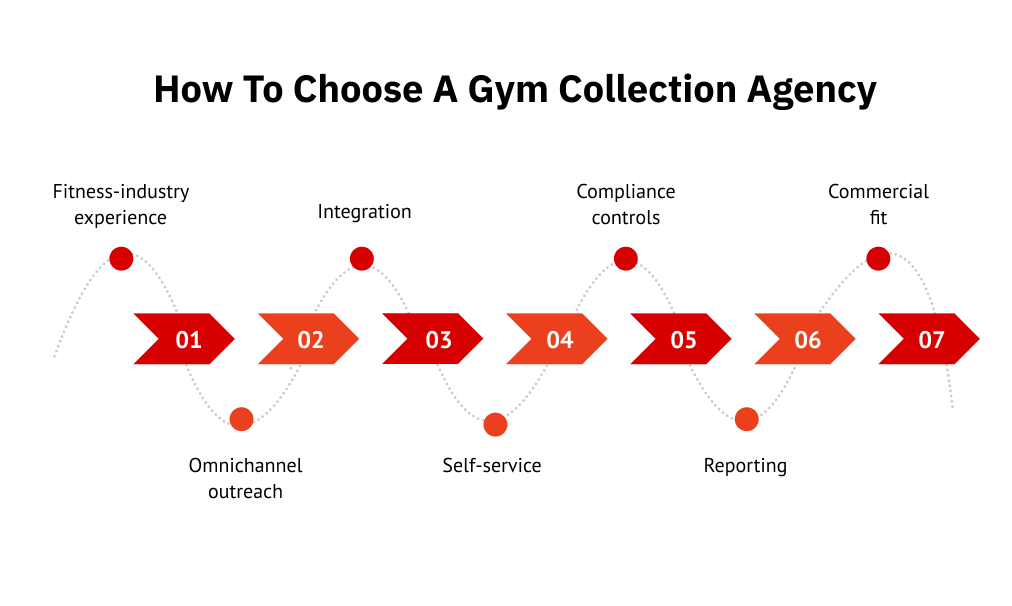
Choose a gym collection agency based on fitness-sector experience, recovery model, compliance controls, technology, reporting, and member treatment. The strongest fit should also match your account stages, portfolio volume, and billing operations.
Evaluation criteria
Fitness collections involve recurring memberships, failed payments, cancellations, and balances requiring different treatment. Ask whether the partner can distinguish these account types instead of applying one workflow to every placement.
Evaluate these capabilities closely:
- Fitness-industry experience: Look for experience handling recurring membership balances and multi-location portfolios.
- Omnichannel outreach: Assess how phone, text messaging, email, and other appropriate channels work together, rather than operating as disconnected campaigns.
- Integration: Determine how account and payment data will move between club software, your customer relationship management (CRM) system, and the provider.
- Self-service: Members should have practical ways to review balances and resolve eligible accounts without unnecessary friction.
- Compliance controls: Ask how the provider governs communications, trains staff, handles disputes, audits activity, and documents compliance.
- Reporting: Confirm which portfolio, contact, payment, and recovery information you will receive and how often.
Questions to ask any partner
Vendor discussions should reveal how the proposed operating model works with your portfolio. Ask:
- What recovery benchmarks can you substantiate for comparable fitness accounts?
- How do you distinguish failed payments from late-stage delinquency?
- How do you protect member relationships during outreach?
- Which security and compliance controls govern consumer data?
- How will data integrate with our existing systems?
- What reporting will our team receive?
- How does pricing change by service model or account stage?
| Gym Collection Partner Scorecard: Score candidates on fitness experience, channel strategy, integration, self-service, compliance, reporting transparency, and commercial fit. |
A partner should explain each capability at the workflow level. Clear answers about handoffs, data movement, oversight, and pricing provide more decision value than a feature list.
Preventing gym debt before it starts
Prevention remains important even when an external recovery program is available. Gyms can reduce avoidable membership debt by identifying payment problems early and making routine failures easier to resolve.
Several controls can strengthen recurring billing recovery:
- Card-updater tools can refresh eligible payment credentials before outdated card information causes a failure.
- Automatic retries give temporary declines another opportunity to clear without immediate manual intervention.
- Backup payment methods provide another authorized payment path when the primary method fails.
- Clear membership agreements reduce confusion about billing dates, renewals, cancellations, and payment obligations.
- Upfront or annual billing options can reduce recurring transactions for members who choose those arrangements.
- Early payment monitoring helps teams identify declines and repeated billing failures before balances continue accumulating.
The operational advantage is timing. Resolving a problem close to the failed transaction can keep routine billing recovery separate from late-stage collection activity.
| Pro Tip: Build a failed-payment save flow around an appropriate retry, prompt branded outreach, and an easy payment-update path. |
How First Credit Services supports gym debt collection
At First Credit Services, we support gym debt collection through managed recovery programs designed for health and fitness organizations. Our approach combines collection operations, technology, customer engagement, and compliance expertise.
More than 4,000 health and fitness clubs use our collection services. We focus on member-centric recovery that helps fitness organizations address delinquent accounts while protecting customer relationships.
We operate our UCEP (Unified Consumer Engagement Platform) to support coordinated digital outreach, response-based workflows, and self-service payment options within our managed programs.
Our health and fitness recovery model can support multi-location operators as well as smaller gyms with collection needs.
Protect revenue and member relationships with better gym debt collection
Effective gym debt collection should protect recurring revenue while preserving viable member relationships. Resolve soft payment failures quickly, escalate genuine delinquency appropriately, and apply compliant practices throughout recovery.
For multi-location gyms and fitness businesses, partner selection affects current receivables and future membership value. Prioritize recurring-billing experience, compliance controls, member-sensitive communication, and a recovery model suited to your portfolio.
Ready to strengthen recovery across overdue gym accounts? Connect with First Credit Services to discuss your recovery needs.
FAQs
1. How should gyms compare collection pricing?
Compare collection pricing by reviewing service scope, account stage, staffing, technology, reporting, and portfolio characteristics together. Ask what each fee covers and whether pricing changes with the recovery model.
2. What should be decided before a gym collection program goes live?
Define account eligibility, data-transfer responsibilities, reporting expectations, dispute routing, escalation ownership, and internal contacts before launch. Clear responsibilities reduce handoff gaps and support smoother ongoing program management.
3. Which metrics should gyms track after outsourcing collections?
Track agreed measures such as placements, resolved balances, recovery performance, disputes, contact outcomes, and account aging where available. Define each metric and reporting cadence before launch so you can review performance consistently.
4. How should franchises manage collections across multiple locations?
Standardize placement criteria, documentation, escalation rules, and reporting definitions across locations. Central governance helps reduce inconsistent account treatment while preserving location-level visibility into recovery activity.
5. What data-security questions should gyms ask a collection partner?
Ask how the provider protects consumer and payment data, controls access, manages data transfers, audits activity, and responds to security incidents. Request evidence for material security and compliance claims during vendor evaluation.
6. How should gyms divide responsibility between internal teams and a collection agency?
Define which accounts remain with internal teams, when third-party placement occurs, who handles disputes, and who owns reporting and escalations. Clear handoff rules help prevent duplicate outreach and inconsistent account treatment.