


One unpaid medical bill can tell two very different stories. For a healthcare organization, it is revenue trapped in accounts receivable. For a patient, it may be the financial aftershock of a diagnosis, a confusing insurance adjustment, or a cost they cannot manage all at once. How the provider handles that balance can determine whether it recovers payment, preserves trust, or loses both.
Those balances are becoming harder to absorb. According to HFMA’s May 2025 analysis, hospital bad debt and charity care costs rose 32% between 2022 and 2025. Healthcare finance teams now face a difficult mandate: recover more without worsening the patient experience.
A medical collections company addresses this challenge through structured outreach, payment resolution, dispute routing, and compliant account management. This blog explains what these companies do, how first-party and third-party models differ, how pricing works, what to evaluate, and how to build a reliable vendor shortlist.
What a medical collections company actually does
A medical collections company manages more than phone calls to patients with overdue balances. Its work can span the patient receivables lifecycle, from early engagement through late-stage recovery. To define that scope clearly, review the core services first, then compare the two primary engagement models.
Core services covered by a medical collections company
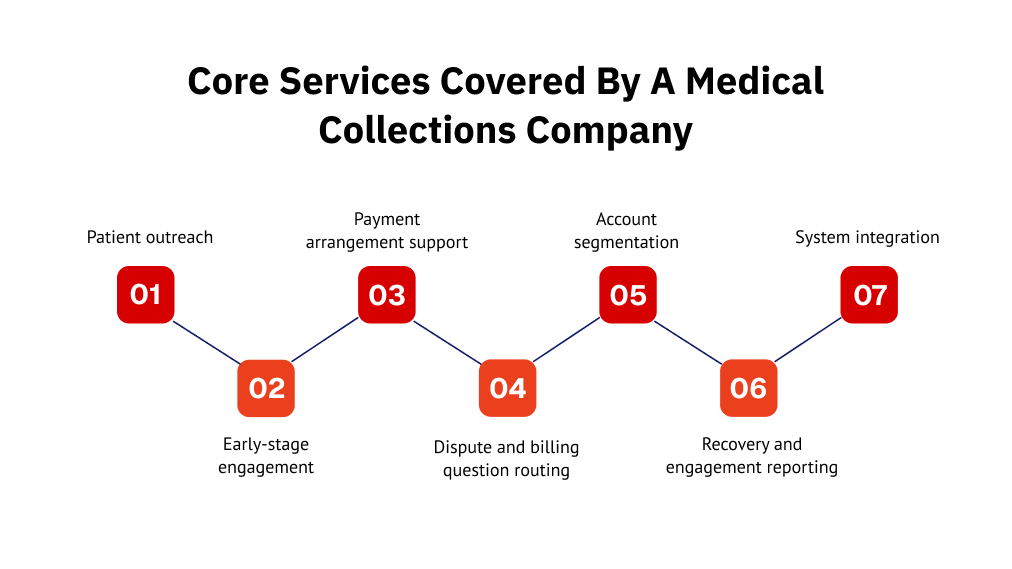
Most healthcare collections partners deliver the following core services across the recovery process:
- Patient outreach across approved channels: phone, email, SMS, mail, and digital self-service portals
- Early-stage engagement with recently delinquent accounts, typically within the first 30 to 90 days
- Payment arrangement support, including installment plans, hardship options, and balance resolution
- Dispute and billing question routing back to the provider’s billing team
- Account segmentation based on balance size, delinquency age, and patient payment history
- Recovery and engagement reporting with visibility into contact rates, payment conversion, and account movement
- System integration with your billing platform, CRM, or payment system through API, SFTP, or direct sync
Together, these services support two connected priorities: payment resolution and patient engagement. Recovery remains the goal, while respectful and patient-sensitive communication provides the path to it.
First-party vs. third-party medical collections
Healthcare organizations typically engage a medical collections company through one of two models. Each serves a different stage of the receivables lifecycle. The table below shows how brand identity, account timing, regulatory requirements, and patient perception change between them.
| Factor | First-party collections | Third-party collections |
| Brand identity | Patient sees the provider’s brand | Patient sees the agency’s brand |
| Typical stage | Early-stage delinquency | Late-stage or written-off accounts |
| Regulatory framework | Provider’s own policies apply | Fair Debt Collection Practices Act (FDCPA) and Regulation F govern outreach |
| Patient perception | Extension of the provider | Outside collection agency |
In a first-party model, the partner operates as an extension of your organization. Patients see your brand name on every communication. This approach works best in the early stages of delinquency, when preserving the patient relationship matters most.
In a third-party model, the collection agency operates under its own identity. Hence, accounts move to this stage after they have been placed for formal recovery. Regulatory requirements shift here, and the FDCPA governs how and when the agency contacts patients.
Many healthcare organizations use both models at different stages. A first-party program handles early outreach under the provider’s brand, while unresolved accounts may move to third-party recovery. Therefore, an accurate proposal comparison must show which stages each vendor covers and how the handoff between them works.
Medical collections pricing and contract considerations
Once you understand the service scope, the next step is evaluating how vendors price their work. Medical collections pricing varies widely, and a headline rate rarely reveals the full program cost. Begin by identifying the operational factors behind the quote, then compare the commercial structure and contract terms.
The following factors commonly influence pricing:
- First-party vs. third-party scope
- Age of accounts at placement
- Portfolio volume and average balance
- Required staffing and operational support
- Technology and integration requirements
- Communication channels used
- Reporting and analytics requirements
Based on those factors, vendors generally use one or more of these commercial structures:
- Contingency-based pricing, where the partner earns a percentage of recovered balances
- Account or placement-based pricing, where fees are tied to the number of accounts placed
- Managed-service or Extended Business Office arrangements, where the partner handles broader revenue cycle functions
- Customized structures for larger, more complex engagements
| Pro tip: Ask every prospective medical collections company for the complete fee structure in writing. Compare total program economics and service scope rather than selecting a vendor based on one headline rate. |
However, the fee model is only one part of the decision. Before signing, clarify the following contract details:
- What services are included in the quoted price
- Volume or placement commitments
- Technology, integration, or setup fees
- Communication, statement, or mailing costs
- Additional service charges
- Account-return procedures and exit terms
A thorough comparison protects you from hidden costs and mismatched expectations. More importantly, it shows which vendor offers the strongest value across the entire engagement.
How to evaluate a medical collections company
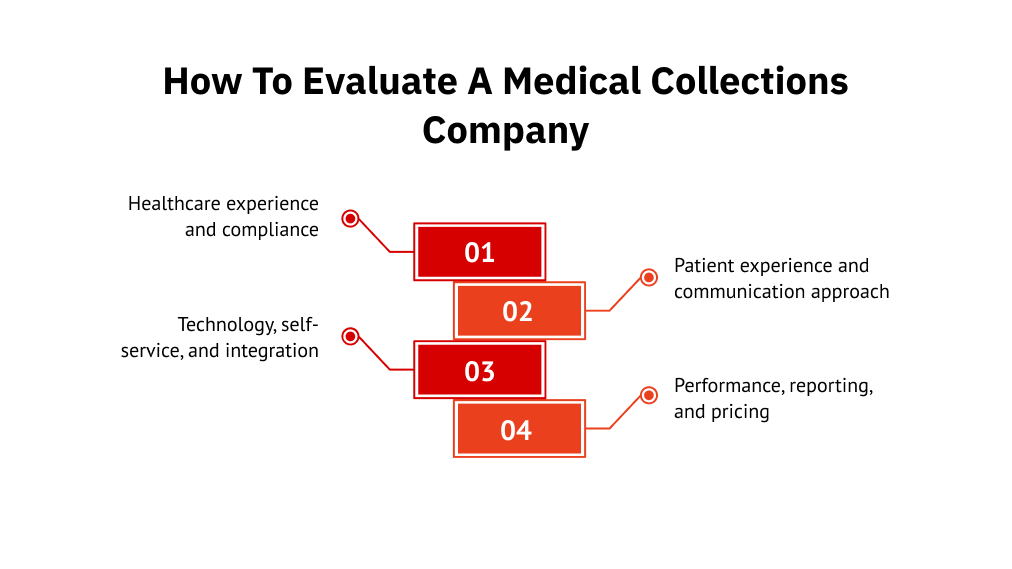
Choosing a medical collections company directly affects revenue, compliance exposure, and the patient billing experience. To evaluate those outcomes together, assess every vendor across four areas: healthcare and compliance expertise, patient communication, technology and integration, and measurable performance. Then use the shortlist scorecard to compare the evidence behind each proposal.
Healthcare experience and compliance
Start with portfolio fit. The right partner should have direct experience with healthcare accounts similar to yours in size, volume, and complexity. The following questions help establish whether that experience matches your needs:
- How much experience does the company have with healthcare patient accounts?
- Which account types and delinquency stages does it handle?
- Does it offer both first-party and third-party programs?
- Can it support your required account volume?
- Can it provide healthcare-specific references or case studies?
Once you establish portfolio fit, evaluate the vendor’s compliance capabilities. Healthcare collections carry regulatory requirements that a general collection agency may lack the infrastructure to meet.
Focus the compliance review on these areas:
- Health Insurance Portability and Accountability Act (HIPAA) and protected health information (PHI) handling
- FDCPA and Regulation F requirements for third-party programs
- State-specific licensing and collection requirements
- Digital communication compliance controls
- Patient dispute and complaint management processes
- Call monitoring, quality assurance, and script approval
- Payment Card Industry Data Security Standard (PCI DSS) and System and Organization Controls 2 (SOC 2) certifications
- Data security, access controls, and audit trails
Avoid vendors that claim blanket compliance without providing specifics. Instead, ask how each control will apply to your engagement and how the vendor will document it.
| Did you know? According to the MGMA’s 2025 analysis, time-of-service copay collection rates dropped from roughly 90% before the pandemic to 56% in 2022. More patient balances are reaching the collections stage than ever before. |
As more balances move beyond the point of service, the quality of every subsequent patient interaction becomes even more important.
Patient experience and communication approach
Healthcare collections directly affect the provider-patient relationship. Therefore, a partner that handles conversations poorly can cost your organization more than the unpaid balance itself. Use the following questions to evaluate how each vendor communicates with patients:
- What training do agents receive for healthcare-specific conversations?
- How is communication tone managed and monitored?
- What process documents and resolves patient complaints?
- Where do billing questions and disputes get routed?
- Can your organization review and approve outreach scripts?
- Does the partner accommodate patient channel preferences?
The answers reveal whether the vendor treats payment resolution as a patient experience function. The strongest outcomes occur when patients feel respected, informed, and in control of how they resolve a balance.
Technology, self-service, and integration
Evaluate the technology behind the service instead of stopping at whether the vendor offers digital collections. The depth of its capabilities determines how effectively the partner reaches patients and how easily they can act. Start with the channels and resolution tools available to the patient:
- SMS, email, chat, and phone outreach
- Digital payment links and self-service payment portals
- Flexible payment plan options
- Behavioral segmentation and personalized outreach
- Channel and timing optimization
Patient-facing tools cannot operate effectively in isolation; evaluate these integration capabilities with equal care:
- Billing-system and electronic health record (EHR) integration
- CRM and payment-system connectivity
- Account-status synchronization
- Real-time reporting visibility
- Implementation timeline and resource requirements
For enterprise healthcare organizations, also clarify which implementation tasks belong to the vendor and which require internal resources. Because integration complexity varies significantly, that division of responsibility can affect both the timeline and the total cost.
Performance, reporting, and pricing
Performance claims are meaningful only when the comparison is relevant. Ask vendors to provide data from healthcare portfolios similar to yours, because results from retail or auto finance do not predict performance with patient accounts.
Use the following metrics to compare results consistently:
- Recovery performance by delinquency stage
- Patient contact and engagement rates
- Payment conversion rates
- Promise-to-pay performance
- Roll-rate movement between aging categories
- Complaint rates and resolution time
- Cost per dollar recovered
Avoid comparing providers through a single blended recovery percentage. That number can hide more than it reveals. For example, a vendor with strong early-stage results and weak late-stage performance may look identical to one with the opposite profile.
Next, determine whether the reporting makes those performance differences visible. Request the following:
- Sample dashboards with account-level and portfolio-level views
- Aging and delinquency breakdowns
- Engagement and communication metrics
- Complaint and dispute reporting
- Reporting frequency and business review cadence
Finally, confirm the complete pricing structure and contract terms before deciding which vendors belong on your shortlist.
Medical collections partner shortlist scorecard
After reviewing each capability in depth, bring the findings into one consistent comparison. Before signing, every vendor on your shortlist should answer these seven questions clearly and support each answer with evidence:
- What results have you achieved for healthcare portfolios similar to ours?
- Can you show recovery performance by delinquency stage?
- How do you manage compliance, patient disputes, and complaints?
- Which digital and self-service capabilities are included?
- How will you integrate with our billing, CRM, and payment systems?
- What reporting and performance visibility will our team receive?
- What is included in the complete pricing and contract structure?
| Pro tip: Bring this scorecard into your vendor conversations. A partner that answers all seven with specifics and evidence is worth a closer look. One that answers in generalities will likely perform that way too. |
How First Credit Services approaches medical collections
FCS operates both first-party and third-party programs. During first-party engagement, the team works as an extension of the healthcare provider, with communication aligned to the provider’s brand, tone, and workflows.
Accounts placed for third-party recovery are handled under the FCS identity and applicable collection requirements. This gives providers the flexibility to match account treatment with the appropriate recovery stage.
Digital resolution backed by human support
The FCS digital engagement model runs through its proprietary Unified Consumer Engagement Platform (UCEP), which FCS operates on the client’s behalf. Behavioral data guides the channel, message, and timing used for each account, creating coordinated outreach across SMS, email, chat, and phone.
Patients can follow personalized links directly to their balances without entering a login or account number. From there, they can review balances, arrange payment plans, and resolve accounts independently. Agent support remains available when a patient needs clarification or assistance.
Compliance infrastructure built for high-volume recovery
Scale requires strong controls as well as operational capacity. FCS supports HIPAA-compliant workflows and maintains PCI DSS Level 1 and SOC 2 Type II certifications. With more than 30 years in compliant collections and 125 million patient interactions annually, FCS supports high-volume healthcare revenue recovery.
This operating model is best suited to hospitals, health systems, and medical groups with significant patient account volume. Smaller practices with limited placements may find that in-house recovery or a regional agency is a better operational fit.
Recover revenue without losing patient trust
Every unresolved patient balance creates a choice: allow it to age or give the patient a clearer path to resolution. The right medical collections company makes that path easier while protecting the revenue and relationships your organization has worked to build.
Before signing, verify results from comparable healthcare portfolios, examine how the partner will communicate with patients, and use the shortlist scorecard to expose meaningful differences between proposals. The strongest partner will not simply promise recovery. It will show how recovery, compliance, visibility, and patient experience work together.
Ready to turn more overdue balances into respectful resolutions? Discuss with FCS about your patient account portfolio, recovery process, and engagement goals.
FAQs
1. How long does onboarding with a medical collections company typically take?
Timelines vary by program type and complexity. First-party programs with branded outreach and system integration typically require 30 to 60 days. Third-party placements with standard reporting can often go live within one to two weeks.
2. Can a medical collections company report patient accounts to credit bureaus?
In most cases, third-party agencies can report delinquent accounts to credit bureaus. However, credit reporting rules for medical debt have changed significantly in recent years. Verify each vendor’s reporting practices and current policies during evaluation.
3. What happens to accounts a medical collections company cannot recover?
Unrecovered accounts are typically returned to the healthcare provider after a defined period. Return timelines and procedures depend on the contract terms. Clarify account-return policies, including whether returned accounts can be placed with a different agency.
4. Is HIPAA compliance required for all medical collections companies?
Any entity handling protected health information on behalf of a healthcare provider must follow HIPAA requirements. A medical collections company that contacts patients about medical balances qualifies as a business associate and must maintain appropriate safeguards.
5. What account volume is typically needed to engage a medical collections company?
Volume requirements differ by partner and service model. Some agencies serve smaller medical practices with pooled portfolios, while others focus on large health systems with significant annual placement volume. Ask about minimum requirements early in the conversation.
6. How do medical collections companies protect patient data beyond HIPAA?
Many healthcare collections partners maintain additional certifications such as PCI DSS Level 1 and SOC 2 Type II. These address payment data security and operational controls, respectively. Ask each vendor for its current security certifications and audit history.