

Every overdue account forces a choice: either keep spending internal time on follow-ups or move it to a partner who only gets paid when the money comes back.
That is why the contingency collection agency model appeals to AR leaders, CFOs, and recovery teams. According to the PYMNTS 2024 report, 43% of organizations face too many late or delinquent payments, while 46% struggle to reduce days sales outstanding. The pressure is not just financial. It also pulls your team away from current receivables, disputes, and customer support.
This guide breaks down how contingency collections work, what they cost, when to use them, and how to choose a partner that improves recovery without adding upfront risk.
What Is a Contingency Collection Agency?
A contingency collection agency is a third-party firm that recovers unpaid debts for a creditor and earns a percentage of what it collects. If it does not collect, it does not get paid. That is why the model is also called contingency debt collection, no-recovery, no-fee debt collection, or performance-based collections.
The key point is simple: contingency is a pricing model, not a brand model. Both first-party and third-party recovery can be on a contingency basis.
In first-party collections, the agency works as an extension of your brand. In third-party collections, the agency contacts consumers under its own name. Either structure can be billed as contingency fee collections.
You usually retain ownership of the accounts. The agency works on the placement. It does not buy the debt. Still, confirm recall rights, account ownership, settlement authority, and remittance terms before signing.
Here is how the model moves from placement to payment.
How the no-recovery, no-fee model works step by step
The model sounds simple, but outcomes depend heavily on the handoff.
A strong placement file includes:
- Original invoices or account statements.
- Signed agreements or service records.
- Payment history and prior promises to pay.
- Previous contact attempts and dispute notes.
- Current contact information.
- Any restrictions, hardship flags, or compliance notes.
Incomplete files slow recovery and increase dispute risk. A no-collection, no-fee collection agency can only work with the documentation it receives.
Once accounts are placed, the agency usually follows this sequence:
- Account intake: The creditor transfers account data and supporting documents.
- Segmentation: The agency groups accounts by age, balance, risk, and collectibility.
- Outreach sequencing: Digital channels, phone, letters, or chat are used based on account type and consent rules.
- Resolution path: The consumer can pay, set up a plan, accept a settlement, dispute the balance, or request help.
- Payment capture: Funds are collected through approved payment channels.
- Remittance: The creditor receives the recovered amount minus the agreed commission.
The fee is deducted from recovered funds before remittance. If an agency recovers $10,000 at a 25% contingency rate, the agency fee is $2,500, and the net remittance is $7,500.
That is why net recovery matters more than the lowest headline rate.
What Does a Contingency Collection Agency Charge?
Contingency pricing is tied to effort, risk, and recovery probability. Newer accounts with clean documentation are easier to resolve. On the other hand, older, disputed, or highly regulated accounts take more work.
For many placements, a practical starting range is 15% to 30% of the recovered amount. Older or more complex accounts can move higher. The creditor pays that fee by deducting it from recovered funds. The consumer does not usually pay the agency’s fee unless the original contract allows collection costs to be passed through.
The mistake is comparing rates in isolation. A 15% rate is not better if the agency recovers too little. In contrast, a 30% rate can produce stronger economics if the agency resolves more accounts, does it faster, and avoids compliance problems.
| Use this formula: Gross recovered amount × contingency rate = agency fee Gross recovered amount minus agency fee = net recovery That net number is the real comparison point. |
How debt age, account size, and industry affect the fee
The fee changes because the recovery challenge changes.
Debt age is usually the biggest driver. As accounts age, consumers become harder to reach, documentation gets stale, and disputes become harder to resolve.
A practical planning view looks like this:
| Account profile | Typical fee direction | Why it changes |
| Newer delinquency | Lower | Contact data is fresher and intent to resolve is often higher. |
| 90 to 180 days past due | Moderate | Internal follow-up has usually stalled, but resolution is still possible. |
| 180 days to 2 years | Higher | More outreach, skip tracing, and negotiation may be needed. |
| 2+ years or disputed | Highest | Recovery is harder and documentation quality matters more. |
| Larger placements | Often negotiable | Scale can justify better pricing and dedicated workflows. |
Industry also matters. Healthcare, financial services, fintech, auto finance, and consumer lending require tighter controls around disclosures, consent, privacy, disputes, and audit trails. That compliance work can affect pricing.
Earlier placement helps on both sides. It can reduce the percentage of the fee and improve the chances of recovery.
Contingency Fee vs. Flat Fee: Which Pricing Model Fits Your Situation?
Pricing should match the accounts you are placing. A flat-fee model can work when account value is low, volume is high, and the recovery path is predictable. A contingency model works better when collectability is uncertain, and you want the agency’s incentive tied directly to results.
The core tradeoff is risk. With a flat fee, you pay whether or not anything is recovered. With contingency, the agency earns only when it collects.
Here is the side-by-side view.
| Basis of difference | Contingency fee | Flat fee |
| Cost structure | Percentage of recovered amount | Fixed per-account fee |
| When you pay | Only after recovery | Upfront or regardless of outcome |
| Who bears the risk | Agency | Creditor |
| Agency incentive | Directly tried to recover | Not fully tied to recovery |
| Best for | Uncertain, complex, or higher-balance accounts | High-volume, low-balance, predictable accounts |
| Cost visibility | Variable, based on results | Predictable, but not outcome-based |
Hybrid pricing also exists. Some agencies charge a smaller flat fee plus a reduced contingency rate. That can make sense for large portfolios with mixed account quality.
If your team is unsure which accounts will pay, contingency usually gives you a cleaner risk profile.
When Should You Use a Contingency Collection Agency?
The placement decision is also a timing decision. Every month an account remains unresolved, your internal costs rise, and the probability of recovery usually falls. However, that does not mean every overdue account should be placed immediately. It means you need clear triggers.
The broader credit environment matters too. The New York Fed’s 2026 press release states that total U.S. household debt rose to $18.8 trillion in Q1 2026, and 4.8% of outstanding debt was already in some stage of delinquency.
When consumers carry more debt, recovery teams need smarter timing, clearer communication, and easier paths to resolution. These are the signals that placement may be the better move.
Signs your accounts are ready for placement
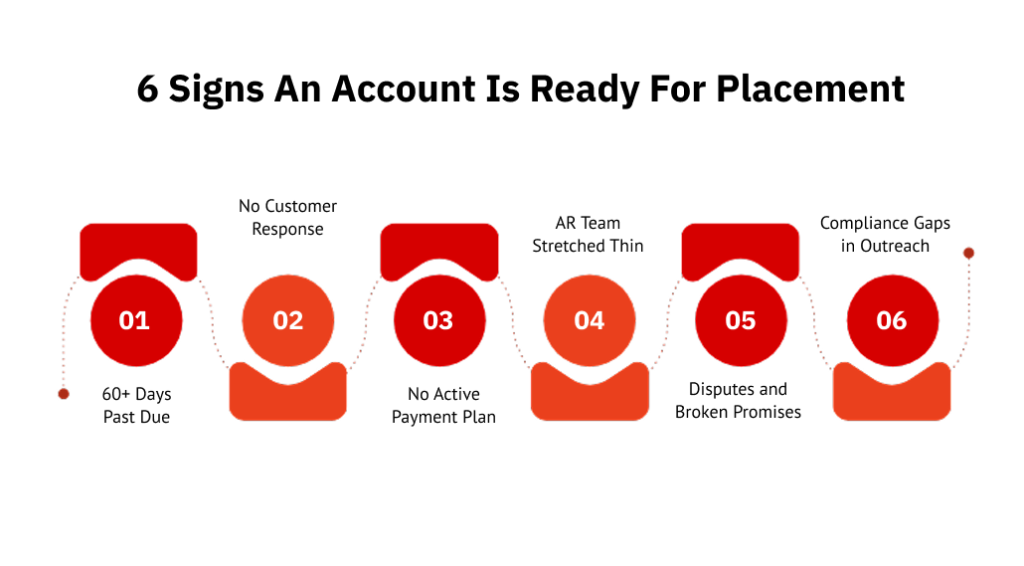
Most placements happen after internal follow-up stops producing movement.
Look for these signs:
- The account is 60 to 90+ days past due.
- The customer has not responded across available channels.
- No payment plan is active.
- Internal AR staff are spending too much time on hard accounts.
- Disputes, address issues, or broken promises are delaying resolution.
- Your team lacks the licensing, documentation, or controls needed for compliant outreach.
Regulated industries should move even more carefully. Healthcare, financial services, fintech, and consumer lending cannot treat collections as basic follow-up. The CFPB’s 2025 FDCPA report found that the bureau received around 207,800 debt collection complaints in 2024.
Recovery activity needs documentation, channel controls, dispute handling, and audit readiness. Hence, a good agency should not just chase the balance. It should help resolve the account in a way that protects your business.
When the contingency model may not be the right fit
Contingency is powerful, but it is not always the best structure.
It may not be ideal when:
- Balances are too small to justify a meaningful effort.
- The customer relationship is active, and internal resolution is still likely.
- Your portfolio has predictable recovery patterns.
- You only need light-touch reminders, not full recovery support.
- The expected net recovery is lower than the operational disruption.
Very small balances can be difficult. If the agency earns only a percentage of a $100 or $200 recovery, the account may not receive meaningful effort. A flat-fee, pooled, automated, or internal process may work better.
The same applies to active customers. If the relationship value exceeds the balance, escalation should be handled carefully. The better move may be first-party outreach, payment flexibility, or customer service support before third-party placement.
What Should You Look for in a Contingency Collection Agency?
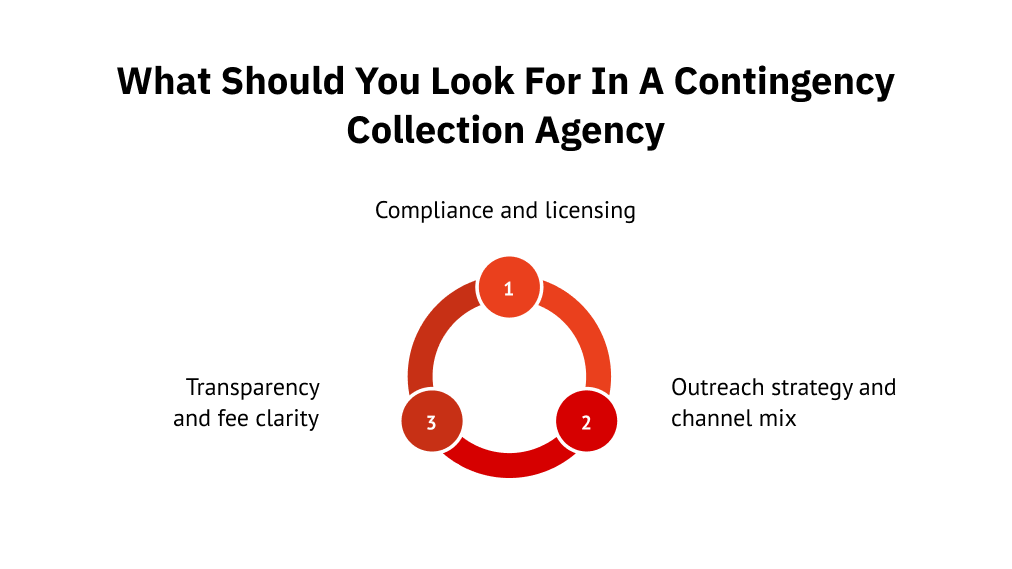
A contingency collection agency should be evaluated on more than rate. The wrong partner can recover too little, create consumer friction, or expose your team to compliance risk. The right partner gives you a clear operating model, clean reporting, and a recovery process built around resolution.
Start with the questions that reveal how the agency actually works.
1. Compliance and licensing
Compliance is the floor, not a differentiator by itself.
Ask whether the agency is licensed in every state where your consumers live. Then go deeper:
- How do they document consent and communication preferences?
- How do they handle disputes and validation requests?
- What controls exist for SMS, email, phone, and letters?
- Are calls monitored and documented?
- Can they provide audit trails at the account level?
- How are agents trained on FDCPA, TCPA, privacy, and state rules?
For regulated sectors, also ask about HIPAA, PCI DSS, SOC 2, and data security controls. You are not only outsourcing recovery but also extending your compliance environment.
A strong partner should explain its process clearly. If the answer is vague, the risk is yours.
2. Outreach strategy and channel mix
A phone-only model is no longer enough for many portfolios.
Consumers may ignore calls but respond to SMS, email, chat, or self-service options. That does not mean the phone has no value. It means the phone should be part of a coordinated strategy, not the default starting point for every account.
Look for a partner that can support omnichannel collections with:
- SMS and email outreach.
- Self-service payment portals.
- Chat or callback scheduling.
- Payment plans and settlement options.
- Human escalation when needed.
- Reporting by channel, stage, and outcome.
Effective outreach is not about volume. It is about timing, relevance, documentation, and giving consumers a simpler path to resolve the balance.
3. Transparency and fee clarity
A low rate can hide expensive terms. That is why, before signing, you should ask for a complete written fee schedule. At minimum, confirm:
- Contingency percentage by account type or age.
- Whether skip tracing is included.
- Whether legal escalation costs extra.
- Whether credit reporting is included or optional.
- How the settlement authority works.
- How quickly recovered funds are remitted.
- Whether accounts can be recalled.
- How disputes and complaints are reported.
You should also ask what the agency will not do. That answer shows where your internal team may still need to support documentation, approvals, legal review, or customer service.
How First Credit Services Approaches Contingency-Based Recovery
FCS approaches recovery as a full lifecycle service, not a single late-stage collection event. That matters when your portfolio includes accounts at different stages, from early delinquency to post-write-off recovery.
FCS supports both first-party recovery and third-party collections. Here is how the model works in practice.
1. One contingency model across the receivables lifecycle
Many agencies focus on one stage. FCS supports a broader path across early-stage recovery, post-write-off collections, and ongoing BPO and customer engagement.
In first-party recovery, FCS can operate as an extension of your brand. In third-party recovery, FCS works under its own name. Third-party work is contingency-based. First-party digital-only recovery can also be contingency-based, while programs that require call center seats may use a seat-based model.
This gives enterprise teams more flexibility. You can match the recovery model to the account stage instead of forcing every account into the same workflow.
2. AI-driven outreach sequencing across digital channels
FCS uses the Unified Consumer Engagement Platform (UCEP) to integrate digital outreach, self-service payments, and your existing systems into a single managed recovery workflow.
It is not a CRM, and it does not replace your billing system. Instead, it connects to your systems, then FCS runs the recovery workflow for you.
UCEP powers digital-first engagement across SMS, email, chat, phone, and self-service payment portals. Instead of sending every account through the same sequence, it helps match the message, timing, and channel to consumer behavior.
Your team does not have to operate the platform. FCS manages integration, outreach strategy, reporting, and day-to-day workflows.
3. A white-labeled self-service payment portal
For first-party programs, the consumer experience can remain under your brand.
Consumers receive a personalized link by text or email. They can access a white-labeled payment portal without needing an account number. From there, they can:
- View balances.
- Pay now.
- Set up weekly or monthly payment plans.
- Accept offers or discounts.
- Schedule callbacks.
- Start a chat when support is needed.
Resolution should not depend on whether someone answers a call during business hours. A self-service path lets consumers act when they are ready, while giving your team clearer reporting and fewer manual follow-ups.
For third-party programs, FCS operates under its own brand with the controls, documentation, and compliance processes required for that stage.
Recover More Without Paying Before Results
A contingency collection agency is not just a cheaper way to outsource follow-up. It is a way to align recovery cost with recovery outcome.
The model works best when you place accounts before they age too far and send complete documentation. It also depends on choosing a partner that combines compliance, digital engagement, self-service payments, and transparent reporting. The lowest rate rarely produces the best result on its own. Net recovery, customer experience, and risk control matter more.
If you are evaluating contingency collection partners, discuss with the FCS team about how a digital-first, no-recovery, no-fee model can help recover more on the accounts your team is ready to place.
FAQs
1. What happens when a consumer disputes a placed account?
The agency should pause the disputed workflow, review documentation, validate the balance, and follow required dispute procedures. Your placement file should include enough evidence to confirm the account, amount, service history, and prior payments.
2. Should every overdue account go to the same agency?
Not always. Segment accounts by age, balance, customer status, industry rules, and recovery difficulty. Some accounts need first-party outreach. Others are better suited for third-party placement or specialized recovery workflows.
3. How often should you review agency performance?
Review performance monthly at a minimum. Track gross recovery, net recovery, account-level progress, dispute volume, complaint trends, channel performance, average time to payment, and remittance timing. Quarterly reviews should cover strategy changes.
4. How is a collection agency different from a debt buyer?
A collection agency recovers accounts on your behalf. A debt buyer purchases the debt and owns the recovery process. With contingency placement, you usually retain ownership while the agency earns from successful collections.
5. Can legal escalation be included in contingency collections?
Sometimes. Legal escalation may be included, optional, or billed separately. Confirm thresholds, approval rights, court costs, attorney involvement, and settlement authority before signing the placement agreement.
6. What reporting should you expect from a recovery partner?
Expect clear reporting on placements, contacts, payments, disputes, settlements, payment plans, recalls, remittances, and unresolved accounts. Strong reporting should show what is recoverable, what is stalled, and why.