

The phone-first collections is losing its grip. Consumers are harder to reach, portfolios are growing, and every manual gap can lead to recovery losses or compliance risks.
The issue is not just missed calls. It is a recovery model built around a channel consumers increasingly avoid. According to Hiya’s 2026 State of the Call report, 86% of unknown calls go unanswered.
That is where debt collection technology changes the operating model. It helps teams prioritize accounts, choose the right channel, guide consumers toward self-service, and document each step.
This guide breaks down the core layers of modern collections technology and how they improve recovery outcomes. It also explains how to decide whether to build, buy, or work with a managed service partner.
Why Manual Collections Falls Short of What the Market Demands
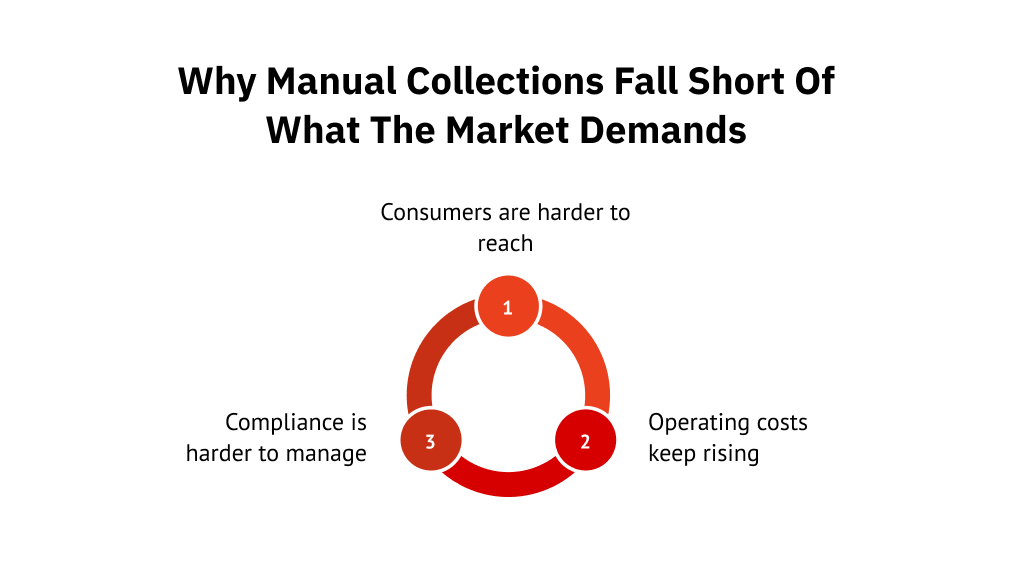
Manual collections can still work for small portfolios with low delinquency and simple workflows. But most finance and collections teams now face a different reality:
- Consumers are harder to reach: People do not always respond to outbound calls. If phone outreach is the primary channel, agents may spend time chasing down accounts that could respond more quickly via SMS, email, chat, or a self-service portal.
- Compliance is harder to manage: Manual workflows depend on agents taking the right step every time. That increases the risk of missed logs, inconsistent disclosures, delayed opt-outs, and incomplete notes.
- Operating costs keep rising: More overdue accounts often mean more callers, more supervision, more manual reviews, and slower follow-up. Over time, this can reduce recovery per agent hour and increase DSO.
Manual collections does not fail because teams lack effort. It fails because the model depends too heavily on human capacity in a market that now demands speed, documentation, and channel flexibility.
| Pro tip: If rising delinquency always leads to more hiring, your collections model may be treating volume as a staffing problem instead of a workflow problem. |
What Modern Collections Technology Actually Does
Modern collections technology integrates data, decisioning, outreach, payments, and compliance into a single recovery workflow. Besides automating reminders, it also helps teams decide what should happen next for each account.
That is the difference between a useful collections tech stack and a group of disconnected tools. A dialer, an email tool, a spreadsheet, and a payment page may all support collections. But they do not become a modern collections system unless data moves between them and shapes the next action.
In practice, modern collections technology helps teams answer five questions:
| Questions | Why it matters |
| Which accounts should receive attention first? | Prioritization improves recovery focus. |
| Which channel is most likely to work? | Channel fit increases response. |
| What action should happen next? | Decisioning reduces generic follow-up. |
| Can the consumer resolve without an agent? | Self-service reduces friction and cost. |
| Is every step documented? | Audit trails reduce compliance exposure. |
The best debt recovery technology does not replace strategy. Instead, it gives teams the data and workflow control needed to execute strategy at scale.
The Core Technology Capabilities in Modern Collections
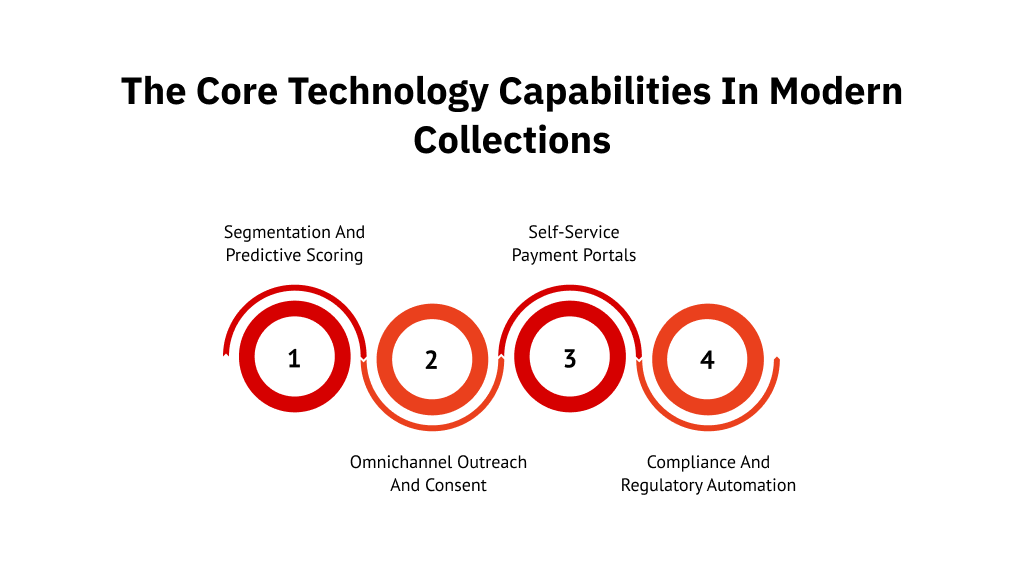
A strong collections platform is not one feature. It is a connected set of capabilities. Each layer does a different job, and the value grows when they work together in the following ways:
1. Predictive scoring and account segmentation
The first layer is predictive scoring. Before teams send outreach or assign an agent, they need to understand which accounts are most likely to be resolved and which need a different path.
Traditional workflows often prioritize accounts by days past due or balance size. Those signals matter, but they do not tell the whole story. AI in debt collection can analyze more signals, including payment history, account age, past response behavior, channel engagement, promise-to-pay activity, and dispute indicators.
This is where machine learning and behavioral analytics become useful. The system can identify patterns that help predict collectability, response likelihood, and the best next step.
For example:
- A first-time late account may need a simple reminder and payment link.
- A repeat delinquent account may require a payment plan option.
- An account with dispute signals may need review before further outreach.
- A low-response account may need lower-cost digital engagement before escalating to an agent.
Predictive scoring is the logic layer. It helps teams stop treating every overdue account the same way.
2. Omnichannel engagement infrastructure
Once accounts are segmented, outreach needs to adapt. Omnichannel engagement is not blasting the same message across SMS, email, chat, phone, and portal links. It is using each consumer’s behavior to decide the next best step.
The industry is already moving in that direction. According to TransUnion’s 2024 debt collection survey, 88% of debt collection companies used self-service online portals in 2024, up from 79% the year before. The same report notes that SMS and email often guide consumers to online payment portals, creating a lower-friction path to resolution.
So, a consumer who opens an SMS link but does not pay should not receive the same follow-up as someone who never responds. The execution layer should adjust the channel, timing, and message based on what the consumer actually does.
A strong omnichannel collections workflow should include:
- SMS and email sequences.
- Chat or agent escalation.
- Contact timing based on response behavior.
- Channel preference tracking.
- Opt-out suppression across channels.
- A single contact history.
The objective here is better-timed outreach that feels easier for the consumer to act on.
3. Self-service payment portals
Outreach only matters if it leads to resolution. That is why self-service portals are central to modern collections technology.
A consumer can receive a secure link by text or email, open a personalized self-service portal, view the balance, choose an option, and make a payment without calling an agent. For routine balances, that path is often faster and less stressful.
An effective self-service portal should allow consumers to:
- View balances.
- Pay in full.
- Set up payment plans.
- Accept approved offers.
- Schedule callbacks.
- Start a chat when support is needed.
This is the resolution layer. It turns engagement into action without making every account dependent on agent availability.
Self-service also reflects how people prefer to manage sensitive financial tasks. Many consumers want privacy, speed, and control. McKinsey’s 2026 customer care research found that 42% of customer care leaders reversed rising inbound volumes through smarter self-service and digital deflection.
Collections teams can apply the same principle. When routine accounts resolve through digital self-service, agents can spend more time on disputes, hardship cases, and complex conversations.
4. Compliance and regulatory automation
Compliance is not a separate layer in collections. It has to be built into the workflow.
The FDCPA and Regulation F set federal rules for debt collectors, including communication practices and consumer protections. The CFPB also states that Regulation F implements the FDCPA and governs debt collector activity.
Modern collections technology turns these requirements into system-level controls. Instead of relying on agent memory, the workflow can enforce rules before outreach happens.
Compliance automation can support:
- Contact frequency controls.
- Consent documentation.
- Opt-out management.
- Required disclosures.
- State-law overlays.
- Audit trails.
- Record retention.
Recordkeeping is just as important. CFPB Regulation F requires debt collectors to maintain records that show evidence of compliance or noncompliance with the FDCPA and Regulation F.
That means every contact attempt, disclosure, opt-out, payment action, and dispute response needs a clear trail. When records are captured automatically, teams can build audit-ready workflows across accounts, agents, and channels.
What Collections Technology Changes About Recovery Outcomes
Modern collections technology improves recovery by changing how work moves through the system. Instead of pushing every account through the same process, this approach helps teams act with greater precision.
- Better prioritization: Predictive scoring helps teams focus on accounts with stronger resolution potential, reducing wasted outreach.
- Faster resolution: Digital channels and self-service portals shorten the path from first contact to first payment.
- Higher efficiency: More consumers can resolve without agent involvement, lowering costs and freeing agents for complex accounts.
- Stronger visibility: Leaders can track which segments are converting, which channels are working, and where accounts are leaking.
Here is what that shift looks like in practice:
| Recovery challenge | Manual collections | Modern collections technology |
| Low contact rates | Agents keep dialing | Omnichannel workflows create more response paths. |
| Generic treatment | Accounts follow the same queue. | Decisioning matches action to account behavior. |
| Agent overload | Routine payments consume live support. | Self-service portals resolve simple balances. |
| Compliance gaps | Documentation depends on manual steps. | Controls and audit trails sit inside the workflow. |
| Weak visibility | Leaders review results after the fact. | Dashboards show performance by segment and channel. |
The strongest results come when these layers work together. Predictive scoring only improves a list without outreach. Outreach can create interest, but self-service turns it into action. And without compliance controls, even strong digital workflows can create risk.
That is why modern collections technology works best as one connected recovery system.
How To Evaluate Collections Technology: Build, Buy, Or Managed Service
The right model depends on your team’s capacity, technology maturity, compliance needs, and account volume. Before comparing features, ask one question first: who will operate the workflow every day?
Most organizations fall into one of three models.
| Model | What it means | Best fit | Watch-out |
| Build in-house | Your team develops and maintains the technology. | Large institutions with data, engineering, compliance, and collections teams. | High cost, long timeline, and ongoing maintenance. |
| Buy software | Your team licenses tools and runs them internally. | Teams with strong operations that need better tools. | Internal teams still own strategy, execution, and compliance. |
| Managed service | A partner operates the technology and workflow. | Teams that need recovery outcomes without running another platform. | Partner selection and integration quality matter. |
Building in-house gives control, but it requires serious infrastructure. Teams need data engineering, model governance, integrations, compliance expertise, reporting, and product support.
Buying software can work when the internal collections function is already mature. The tool adds capability, but the team still has to manage segmentation, outreach, testing, reporting, and compliance.
A managed service is different. The partner operates the workflow on behalf of the client. That includes scoring, outreach sequencing, self-service portal management, reporting, and compliance controls. The technology connects to existing billing or account systems, but it does not require the client to replace those systems.
This model often fits organizations with high account volume, stretched internal teams, or limited appetite for building a collections technology operation.
Questions to ask before choosing a model
A good evaluation should focus on operating reality, not demo polish. Consider asking these questions:
- Will the model integrate with your billing, loan servicing, EHR, CRM, or AR system?
- Who owns day-to-day segmentation, outreach, testing, and reporting?
- How are consent, opt-outs, disclosures, and contact limits enforced?
- What reporting will you see by account, segment, bucket, and channel?
- Does the pricing model align with recovery outcomes or activity volume?
- What happens when an account does not resolve in the early stage?
| Pro tip: Do not judge collections technology only by its feature list. Judge it by who operates it, how it connects to your systems, and what proof you get in reporting |
How First Credit Services Approaches Collections Technology
First Credit Services uses collections technology as part of a managed recovery model, not as a software handoff. It operates a Unified Consumer Engagement Platform.
UCEP is an AI-driven platform that supports predictive scoring, omnichannel outreach, self-service payment flows, reporting, and compliance controls.
The key difference is execution. Clients connect their billing or account system to UCEP. FCS then operates the scoring, outreach sequencing, portal workflows, and reporting on their behalf. That gives clients a managed recovery layer without adding another system for internal teams to run.
The model is designed for mid-to-large organizations that place high account volumes, including healthcare networks, auto finance lenders, financial services firms, subscription businesses, and other AR-heavy environments.
FCS provides:
- AI-driven segmentation based on account behavior, stage, risk, and response patterns.
- Omnichannel debt collection for businesses that need digital engagement with human escalation when it matters.
- Digital-first outreach across SMS, email, chat, phone, and self-service workflows.
- White-labeled first-party programs where consumers see the client’s brand.
- Self-service resolution through payment links, plans, approved offers, callbacks, and chat.
- Full-lifecycle recovery through first-party collections and third-party collections.
For clients, the value is the combination of debt recovery technology, operations, compliance, and customer engagement.
Debt Collection Technology Works When It Is Operated Well
Modern collections technology works best when every layer supports the next. Predictive scoring shows where to focus first. From there, omnichannel engagement helps teams reach consumers in the right place, while self-service portals give them a simpler path to resolve. Compliance automation and reporting keep the entire program controlled and measurable.
Still, technology alone does not create better recovery. The real value comes from how well the workflow is operated, tested, and adjusted over time.
That is where a managed model can make a difference. Instead of adding another platform for your team to run, FCS helps integrate digital engagement, compliance, and recovery execution into a single operating model.
Talk to FCS about bringing the right technology and recovery model into your collections program.
FAQs
1. What is the difference between debt collection software and a managed collections service?
Debt collection software gives teams tools to operate internally. A managed collections service operates the workflow for the client, including segmentation, outreach, payment support, reporting, and compliance controls.
2. How does AI improve debt recovery rates in practice?
AI helps teams prioritize accounts, predict response behavior, choose better timing for outreach, and route consumers to the right resolution path. This reduces wasted effort and helps collectors focus on accounts with stronger recovery potential.
3. What regulations govern debt collection technology in the US?
Common requirements include the FDCPA, Regulation F, TCPA, state collection laws, licensing rules, UDAAP standards, and industry-specific rules such as HIPAA for healthcare collections or FCRA-related requirements for credit reporting.
4. What channels does an omnichannel collections approach include?
An omnichannel approach can include SMS, email, chat, phone, self-service portals, and sometimes mail. The key is coordination. Each channel should inform the next step rather than operate in isolation.
5. How does a self-service payment portal reduce friction for consumers?
A self-service payment portal gives consumers a private and convenient way to view balances, choose payment options, set up plans, accept offers, or ask for help without waiting for an agent.
6. How long does it typically take to implement new collections technology?
Implementation depends on system complexity, data readiness, compliance review, and workflow design. A managed service may move faster than an internal build because the platform and operating model already exist.