


A customer misses a payment. Your internal team is already managing thousands of overdue accounts, so follow-up is delayed.
By the time someone reaches out, the balance has aged, and a relatively simple payment issue has become harder to resolve. That pressure is increasing.
According to the Federal Reserve Bank of New York, the annualized share of U.S. consumer debt flowing into serious delinquency rose from 1.68% in Q3 2024 to 3.03% in Q3 2025.
White-label collections outsourcing helps businesses intervene earlier. An external partner manages first-party recovery under your brand. Your team gains additional capacity, technology, and collections expertise while keeping the customer experience consistent.
This guide explains how white-label collections outsourcing works, who it is for, and what to consider when choosing the right partner.
What is white-label collections outsourcing?
White-label collections outsourcing is when a business hires an outside recovery partner to contact and resolve overdue accounts, but all communication appears under the creditor’s own brand. Consumers receive calls, texts, emails, and payment links that look like they came from you. They never know an external team is involved.
This model is typically used in the pre-charge-off window, which is roughly 0 to 120 days past due, depending on your industry and write-off policy. At this stage, recovery probability is still high, and the customer relationship is still salvageable.
You will see this model referred to as white-label, brand-name collections outsourcing, or creditor-branded collections. They all describe the same arrangement.
Is white-label the same as first-party collections?
They overlap but describe different things. First-party refers to the lifecycle stage: recovery that happens early, while the account still belongs to the original creditor. White-label is the brand mechanism: outreach runs under the creditor’s identity rather than the agency’s. In practice, the two travel together.
Most first-party collections programs are white-labeled because the point of working an account early is to recover it without signaling to the customer that they have been turned over to a collector.
White-label vs in-house vs third-party collections
Not every recovery situation calls for the same model. Here is how the three approaches compare across the criteria that matter most to AR and finance leaders.
| Basis of difference | White-label outsourcing | In-house collections | Third-party collections |
| Branding | Your brand throughout | Your brand | Agency’s name |
| FDCPA exposure | Generally exempt (first-party) | Generally exempt | Fully applies |
| Customer experience | Seamless, brand-consistent | Seamless, brand-consistent | Formal, escalated feel |
| Scalability | High, without headcount | Limited by internal capacity | High |
| Cost | Contingency-based, low upfront | Fixed staff costs | Contingency-based |
| Best-fit stage | 0 to 120 days past due | 0 to 60 days, low volume | 90+ days, post-charge-off |
The short read-out:
- If your account volume exceeds what your internal team can handle at the 0-to 90-day mark, white-label outsourcing fills that gap without disrupting the customer experience.
- If accounts are already seriously aged or unresponsive after multiple first-party attempts, third-party collections are the right escalation path.
- In-house works well for low-volume portfolios or businesses with strong existing AR infrastructure, but it does not scale without proportional hiring.
How a white-label collections partner operates under your brand
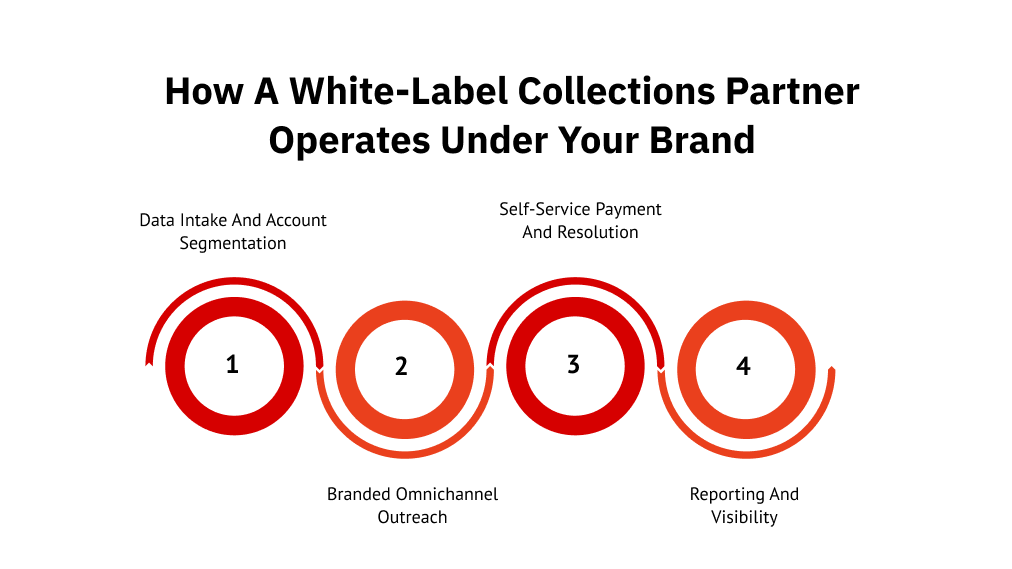
The value of this model is not just branding. It is that a good partner runs a coordinated recovery workflow from account intake to payment resolution, entirely under your name. Here is what that looks like in practice.
1. Data intake and account segmentation
Accounts typically flow from your system to the partner via API, CRM sync, or secure SFTP transfer. Most programs run on a daily or weekly batch cycle, though real-time API integration is increasingly common for high-volume portfolios.
Once accounts arrive, they are not worked in the order they came in. A strong partner segments them by delinquency stage, payment history, channel responsiveness, and recovery likelihood. An account that is 15 days past due with a history of on-time payments gets treated very differently from one at 90 days with no response to prior outreach. That segmentation is what keeps early-stage recovery from feeling like a blunt instrument.
2. Branded omnichannel outreach
Outreach runs across voice, SMS, email, and a self-service portal, all under your brand. The channel and timing for each account are determined by behavior data, not a fixed schedule applied to everyone.
This matters because phone-only outreach has a reach problem. Google’s 2025 report found that 60% of Americans typically reject or ignore calls from unknown numbers, while 83% expect unknown callers to be scammers or telemarketers. A partner who still relies primarily on calling will miss a significant portion of your portfolio in the first contact attempt.
3. Self-service payment and resolution
A 24/7 portal, branded as yours, lets the customer pay in full, set up a plan, or accept a settlement without ever speaking to an agent. This converts better and costs less for a practical reason: many past-due balances are not disputes; they are friction.
The person meant to pay and needs a way to do it at 11 pm, not a callback during business hours. Routing routine resolutions through self-service also frees your partner’s people for the accounts that genuinely need a conversation.
4. Reporting and visibility
You get customizable dashboards covering recovery rates, engagement by channel, and conversion, while the partner runs the underlying software. Outsourcing the work should not mean losing sight of it: you see what is being recovered and how, close to real time, without staffing the operation yourself.
What “true” white-label actually means (and how to spot a thin label)
Many vendors say white-label. Fewer actually deliver it across every consumer touchpoint. The distinction matters because a single branded gap, a caller ID that reads “Unknown,” a payment link pointing to the agency’s domain can undermine the entire brand-safe model you are paying for.
A genuinely white-labeled program keeps your brand consistent across all of the following:
- Caller ID — Displays your business name or a number registered to your brand, not the agency’s.
- Outbound email domain — Sent from your domain or a subdomain tied to your brand, not the partner’s.
- Payment portal subdomain — The URL the consumer lands on should reflect your brand, not the vendor’s platform name.
- Agent scripts — Written in your brand voice, trained to your policies, and free of third-party disclosures that signal an outside collector.
- Letters and written notices — Printed on your letterhead, with your contact information.
- SMS sender name or short code — Recognizable as your brand before the consumer even opens the message.
If a partner cannot confirm each of these, the label is thin. The consumer experience will have cracks in it, and those cracks erode the trust the model is built to protect.
| Pro Tip: Before signing with any white-label recovery partner, ask them to walk you through a complete consumer journey from first SMS to payment confirmation. Have them show you every touchpoint the consumer sees. If they hesitate or cannot demonstrate it live, that is your answer. |
The compliance layer that creditors actually need to understand
The FDCPA first-party exemption is real, but it is narrower than most people assume.
The FDCPA generally defines a “debt collector” as someone collecting debts owed to another party. When a partner collects in your name, they may fall outside that definition, which means the FDCPA’s specific requirements do not automatically apply to them. That is the exemption.
What does not go away:
- TCPA — Governs all outbound SMS and calling. Consent requirements, opt-out handling, and frequency rules apply regardless of whose name is on the outreach.
- FCRA — If the partner is furnishing data to credit bureaus, accuracy and dispute obligations apply.
- CFPB UDAAP authority — The CFPB can pursue unfair, deceptive, or abusive practices across the collections chain, whether or not the FDCPA technically applies.
- State laws — California’s Rosenthal Act and Massachusetts debt collection regulations explicitly cover original creditors and their agents. If you operate in multiple states, your partner’s compliance program needs to map to each one.
- Regulation F — Even in first-party programs, the seven-in-seven call cap and electronic communication rules represent the operational standard a responsible partner should meet.
| Compliance is the floor, not the upsell. FCS holds FDCPA-level standards across federal and state requirements on every account, branded or not. |
Audit trails, validation notice workflows, and documented opt-out handling are not optional extras. They are the minimum evidence you need if a consumer dispute or regulatory inquiry lands on your desk.
What white-label recovery protects beyond the balance
The obvious goal is to recover the outstanding amount. But there are three things this model protects that do not show up directly on the recovery report.
Customer lifetime value. Early-stage delinquency is often unintentional. An expired card, a missed email, a billing dispute that was never resolved. A consumer who gets a branded, respectful reminder and a straightforward way to pay is far more likely to remain a customer than one who receives a call from an agency they do not recognize.
Internal team capacity. Your AR staff has a finite bandwidth. When volume spikes, either accounts go unworked, or your team gets stretched across follow-ups, disputes, and payment processing simultaneously. White-label outsourcing absorbs the volume without requiring you to hire ahead of it.
Cash flow and charge-off rate. Accounts resolved at 30 to 60 days past due cost significantly less to recover than accounts worked at 90 to 120 days. Every balance closed in the early window does not age into a write-off, a portfolio sale, or a third-party placement with a lower recovery yield.
White-label collections by industry
The model applies broadly, but each industry has a different reason to care about brand-safe recovery.
| Industry | Why white-label matters here |
| Healthcare | Patients associate billing with care quality. A third-party name on a balance notice damages that trust before the conversation starts. |
| Auto finance | Lenders need early-stage cure rates to protect portfolio performance. Brand-consistent outreach keeps borrowers engaged before repossession becomes the only option. |
| Fintech and BNPL | High transaction volumes with thin customer relationships. Early digital engagement through a familiar brand keeps resolution rates up without agent overhead. |
| Banking and consumer lending | Regulatory scrutiny is high. White-label programs need airtight UDAAP and state law compliance built in, not layered on afterward. |
| Subscriptions | Failed payments are usually involuntary. A branded recovery touchpoint resolves the issue while preserving the membership. |
| Utilities | Customers often have no alternative provider. Recovery tone matters for long-term payment behavior, not just the current balance. |
FCS serves all six of these verticals, with compliance workflows and outreach strategies calibrated to each industry’s specific regulatory and customer experience requirements.
How to choose a white-label recovery partner
Most vendor decisions in this space come down to a sales call and a reference check. That is not enough. Here is a more structured way to evaluate.
The evaluation criteria that matter
- True white-label depth — Can they demonstrate every branded touchpoint, caller ID, email domain, portal URL, agent scripts, end-to-end?
- AI-driven segmentation — Does the platform determine contact timing and channel per account based on behavioral data, or does it run a fixed outreach cadence for everyone?
- Omnichannel coordination — Are voice, SMS, email, and portal connected as one journey, or are they parallel tracks that create duplicate outreach?
- Self-service portal — Can consumers pay, set a plan, or accept an offer at 2 am without an agent?
- CRM and billing integration — API, SFTP, or direct sync? How frequently does data flow, and how are reconciliation gaps handled?
- Compliance program — State licensing, TCPA consent documentation, Regulation F adherence, audit trail depth.
- Escalation under one roof — One partner that carries an account from early-stage to third-party recovery without a vendor switch.
- Pricing model — Contingency-based is standard for first-party programs. Understand what triggers the fee and how performance is reported.
Questions to ask before you sign
- Walk me through one complete consumer journey, from first outreach to payment confirmation.
- How is TCPA consent documented and stored at scale?
- What does the escalation path look like if an account does not resolve in the first-party?
- What reporting do we receive, and how frequently is it updated?
- What does onboarding require from our side, and what is the typical go-live timeline?
A simple partner scorecard
Use this to rate two or three vendors side by side on a 1 to 5 scale.
| Criteria | Weight | Vendor A | Vendor B |
| White-label depth across all touchpoints | 20% | ||
| AI-driven segmentation capability | 15% | ||
| Omnichannel coordination | 15% | ||
| Self-service portal quality | 10% | ||
| CRM and billing integration | 10% | ||
| Compliance infrastructure | 20% | ||
| First-to-third-party escalation | 10% | ||
| Weighted total | 100% |
Common mistakes creditors make when outsourcing early-stage recovery
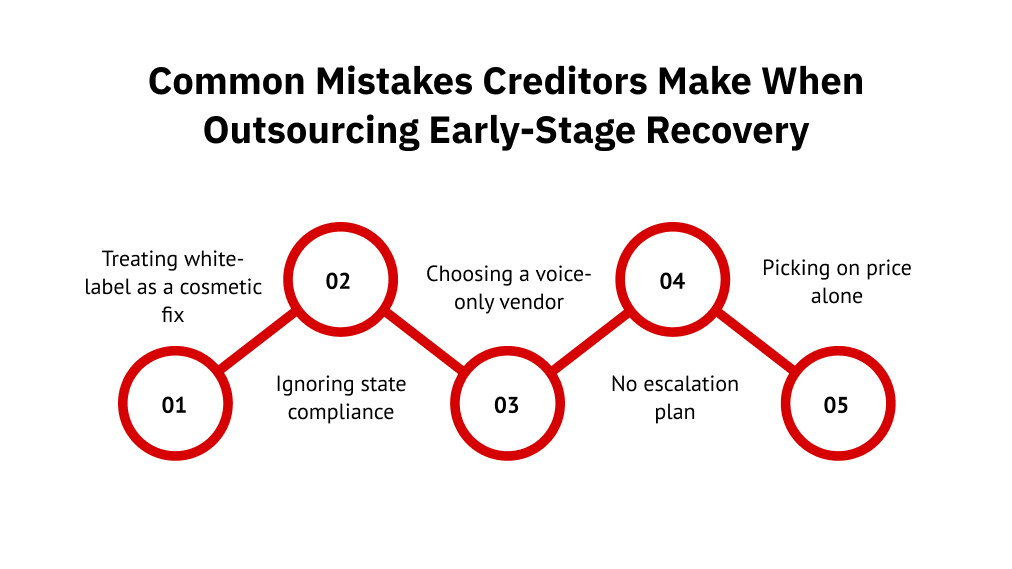
Most of these mistakes do not show up during vendor selection. They surface three months into the program, when recovery is underperforming, or a compliance issue lands in your inbox. Here are the five most common ones and what to do instead.
- Treating white-label as a cosmetic fix. Slapping a logo on a generic portal is not white-label. If the consumer experience has any gap, a caller ID, a URL, or a script that sounds like a collection agency, the model breaks.
Fix: Audit every touchpoint before go-live, not after.
- Ignoring state compliance. Federal exemptions do not override California’s Rosenthal Act, Massachusetts debt collection rules, or state-level UDAAP interpretations. Multi-state portfolios need a partner with matching state licenses.
Fix: Ask for a state licensing map before signing.
- Choosing a voice-only vendor. Phone-first outreach misses a growing share of consumers who will not answer unknown numbers. Recovery suffers from the first contact attempt.
Fix: Require omnichannel capability as a baseline, not a premium add-on.
- No escalation plan. First-party recovery stalls on some accounts. Without a pre-agreed path to third-party collections, those accounts sit unworked or require a disruptive vendor switch.
Fix: Choose a partner who handles both stages under the same relationship.
- Picking on price alone. Contingency rates look similar across vendors. The real cost difference is in recovery yield, compliance exposure, and customer retention.
Fix: Weight the scorecard on outcomes, not just fee structure.
When white-label first-party makes sense, and when to escalate
Use white-label outsourcing when:
- Accounts are 0 to 120 days past due, and the customer relationship still has value
- Your internal team cannot work the volume at the pace the portfolio needs
- Brand sensitivity is high, and a third-party name on outreach would create more damage than it resolves
Escalate to third-party collections when:
- First-party outreach has run its full course with no response or repeated broken arrangements
- Accounts are approaching or past charge-off
- The balance and delinquency stage justifies a more formal recovery process
The cleanest escalation is when one partner handles both stages. No vendor switch, no data handoff, no re-segmentation from scratch. Account history carries forward, and recovery continues without a gap.
| Working accounts across the full delinquency lifecycle? FCS manages both first-party collections and third-party collections under one relationship, so escalation is a handoff, not a vendor switch. Talk to us now! |
How First Credit Services approaches white-label collections
First Credit Services (FCS) runs white-label collections as a fully managed service. You get the recovery operation. Your brand stays on everything the consumer sees.
The technology behind it is UCEP (Unified Consumer Engagement Platform), FCS’s proprietary AI-driven platform that manages outreach sequencing, channel selection, self-service payment flows, and real-time reporting. FCS operates UCEP entirely on your behalf. Consumers interact with a branded portal and branded communications without ever seeing the FCS name.
Operationally, FCS handles first-party collections and third-party collections under the same relationship, which means escalation is handled without a vendor switch or data gap. Pricing is contingency-based for most programs, so you pay on recovery, not on activity.
Compliance is built into the workflow across federal and applicable state requirements, with documented audit trails, consent management, and opt-out handling at scale.
FCS has been operating in this space for over 30 years across healthcare, auto finance, fintech, banking, subscriptions, and utilities.
Conclusion
White-label collections outsourcing comes down to three things: protecting your brand during early-stage recovery, staying on the right side of a compliance landscape that extends well beyond the FDCPA, and choosing a partner with the operational depth to deliver on both.
The model works when the execution is genuine. That means every consumer touchpoint matches your brand, every outreach channel is coordinated, and escalation to a third party is a planned handoff rather than a scramble.
Ready to evaluate a white-label recovery program for your portfolio? Talk to FCS about your delinquency stage, industry, and what a pilot on one account segment could look like.
FAQs
1. What is white-label debt collection?
White-label debt collection is when an outside recovery partner contacts consumers entirely under your brand. Consumers see your name on every touchpoint. It is typically used for accounts 0 to 120 days past due.
2. Does the FDCPA apply to white-label or first-party collections?
Generally, no, because the partner collects in the creditor’s name. However, TCPA, CFPB UDAAP authority, FCRA, and state laws like California’s Rosenthal Act still apply. A responsible partner follows FDCPA-level standards regardless.
3. Will the customer know they are talking to an outside agency?
No, not in a true white-label arrangement. All calls, texts, emails, and payment portal pages appear under your brand. The consumer has no indication that an external team is involved.
4. How does white-label collections pricing work?
Most programs are contingency-based, meaning you pay a percentage of what is recovered. There is typically no upfront fee. Some partners also offer per-seat pricing for dedicated live-agent support.
5. Can a business start with a small pilot before committing to full volume?
Yes. Most established partners can run a pilot on a single delinquency segment or account type before scaling. This lets you evaluate recovery performance and brand execution before a full rollout.
6. What is the difference between first-party and third-party collections?
First-party runs under your brand in the early delinquency window, typically 0 to 120 days. Third-party involves the agency operating under its own name for late-stage or post-charge-off accounts where formal escalation is needed.